Thursday, August 12, 2010

When The Wheel Went Round


Life goes on. The car is taken, the car is gone, the car is recovered, the car is in pieces and, of course, it’s still gone. During times like this it’s tough to maintain enthusiasms…enthusiasms. Enthusiasms. I’m walking a lot these days. Look on the streets between Los Feliz and the Silverlake Trader Joe’s sometime, you may find me there. To close the book on the whole matter I got driven down to the tow yard in Watts to deal with the final paperwork on my completely stripped car and take one last look at it. I was told what the state of it was but actually seeing this for myself was something else altogether. So it wasn’t very much fun. Because of this I’ve spent way too many nights at home lately, probably being depressed about it all. Partly because of this mood, the night before I went to see the car I knew that I had to get out of the house and decided to somehow get over to the New Beverly on that Saturday night. Since it was still daylight hours, I took the train from Los Feliz to the Hollywood & Highland stop, walked down Orange to get a quick dinner at the In-N-Out Burger, my first time there in several weeks. Damn good burgers. I then walked over to La Brea and proceeded straight down, past Fountain, past the Target-Best Buy at Santa Monica, past the ridiculously long line at Pink’s and down the long, creepily empty stretch between Melrose and Beverly. After getting the food the hike didn’t take much longer than a half hour. And the New Beverly was at the end of that trail, greeting me with a De Palma-De Niro double bill of THE UNTOUCHABLES and HI MOM! Probably not a pairing that happens all the time and a bill that was of course preceded by a number of nasty comments about Brian De Palma on the theater’s Facebook page, no doubt left by people with nothing but hate in their hearts.


I’ve seen THE UNTOUCHABLES more times than I can probably guess, starting from its opening weekend in June 1987 right through working as an usher during that summer for weeks afterwards getting to know every line and inflection by heart, eagerly going back in at certain points to hear the audience response that I knew would be there every time. Maybe to fully maintain the love for this movie you have to be of a certain age, or just to have first seen the movie at the age I was at the time. People older may associate the title with the TV show and Robert Stack. People younger, raised on other things, maybe don’t respond to its earnestness, the plotting might seems a little sparse to them and they’re of a different mindset to respond to things like the more sentimental passages of the Ennio Morricone score. But please just understand where I’m coming from is the insistent thought that You don’t fuck with the all holy THE UNTOUCHABLES. You just don’t do it and when I’m around, you shouldn’t even try. I don’t want to hear it and I’m not going to listen. Looking at it now, a little more aware of how these things work, to me the film has a feeling that De Palma read David Mamet’s script and thought, “I know how to make this, I know how to make this good, I know how to make this a big fucking hit.” (Considering his previous film was WISE GUYS, he no doubt felt he needed to make it a big fucking hit as well) And he did exactly that, with the film playing for weeks over that summer, making the cover of Newsweek (“MOB HIT”) at a time when that was still kind of a big deal and the very concept of hit movies was maybe a little more exciting. Sometimes a director’s biggest box office successes aren’t necessarily the ones that remain the most interesting years later, as good as they may be, and THE UNTOUCHABLES may very well fall into that category. Much as I will defend it to my dying day, I know that it’s not as overwhelmingly powerful as it was way back in ‘87. And in admitting that about the film I’m not even sure how much I want to try to analyze it. That doesn’t mean I think any less of it, which would probably be impossible anyway.


Chicago, 1930. At the height of prohibition, Al Capone (Robert De Niro) essentially rules the city. Feberal officer Eliot Ness (Kevin Costner) arrives in town intent on bringing down Capone. After one raid turns out embarrassingly for Ness, he encounters beat fop Jimmy Malone (Sean Connery) who he suddenly becomes convinced is the man to help him. They recruit police trainee George Stone (Andy Garcia) to be on their team and the foursome is rounded out by bureau accountant Oscar Wallace (Charles Martin Smith) who has the odd notion of charging Capone for income tax evasion. Together the four are known as The Untouchables, men who no one can bribe and as they begin to cause damage to Capone’s empire the crime boss gets ready to hit back.


It is a somewhat slim plot looking at it now in its archetypal way, almost surprisingly so. Ness gets on the job, he recruits Malone to help him and so on. But it really doesn’t need to be any more complex than it is. In the aftermath of the release back in ’87 I happened to read the original 1957 memoir Eliot Ness wrote with Oscar Fraley after which, struck by how different the events recounted in there were, I happened to think, ‘Hey, this would’ve made a good movie too!’ Of course, who knows how much of what was in that book was really happened. In 1987 I had barely heard of David Mamet who with this script was pretty much cashing in after winning the Pulitzer Prize (Producer Art Linson writes in his memoir “A Pound of Flesh” that he basically said to Mamet, “Don’t you think that the best career move for somebody who just won the Pulitzer Prize would be to adapt an old television series like THE UNTOUCHABLES for a shitload of money?” to which Mamet understandably replied, “Yes, I think so.”) though with the writer’s directorial debut HOUSE OF GAMES released several months later and the thrill of seeing SPEED-THE-PLOW on Broadway with Joe Mantegna, Ron Silver and Madonna the following year I would find out who he was soon enough. I’ve become familiar enough with his style by now—everyone probably has—that it’s hard to imagine Mamet ever having much interest in the actual facts beyond using the setting and names, instead approaching it as what it’s now become at least in part due to this film: myth. The film of THE UNTOUCHABLES doesn’t print the legend, to steal a line from John Ford. It creates its own legend. When I take such satisfaction from Kevin Costner screaming “DID HE SOUND ANYTHING LIKE THAT??” at a certain someone who didn’t perish that way in real life simple facts have ceased to matter.


So much in the film works, from the heightened Morricone music to the countless extravagantly high ceilings in the locations used shot from low angles in some kind of Orson Welles way to those speeches that each of the actors willingly attack ferociously, as if reveling in the chance to say dialogue like this of the sort that they never saw put down in a script before. THE UNTOUCHABLES is correctly larger than life and De Palma keys into the mythic tone with every piece of confidence and skill he knows how to put into his anamorphic frame. The tracking of Sean Connery’s Jimmy Malone through his apartment stands out and those massive close-ups of Costner & Connery discussing “the Chicago Way” in that church is appropriately larger than life but one of the most unsung (and, in context, not at all showy) pieces of film in De Palma’s career has to be that expertly choreographed steadicam shot through the police station hallway after Brad Sullivan’s informant has been apprehended. When I worked in that theater way back when I used to love timing things so I could go in and watch this shot to examine how it was laid out, listening for the shocked audience reaction at that cutaway to the elevator. The response was always the same. Even the climactic courtroom sequence strikes me now as the best chaos-erupts-in-courtroom ever shot.


And the forever celebrated train station/Odessa Steps/Eisenstein homage has been parodied and referenced so many times by now that it’s probably lost some of its impact but even if David Mamet, who had nothing to do with this sequence, hated it (during a Q & A at the Aero earlier this year he apparently referred to De Palma being the one to add “that cockamamie baby carriage”) everything about it works as an immaculately assembled work of suspense, stretching out every second as effectively as possible, fully aware of what he’s doing every step of the way. The way it spends so much time on the mother forced to drag her baby with the giant carriage up all those steps is almost agonizing and there’s such great satisfaction in hearing Andy Garcia cockily say “TWO” at the end of the whole thing. It’s an amazing sequence, one that arose out of desperation when what had been written required a period train that was beyond the production’s budget (Linson writes about this in his book but also says the scene contains no dialogue, which is of course incorrect). It makes me realize that if CGI had existed then this celebrated scene would never have happened, so what does this tell us about how directors deal with challenges these days? It feels like a gift that this film was made at the exact time it was.


The rich, juicy feel permeates every frame with the opulence soaking into my pores and the staccato rhythms of all that immensely quotable dialogue stay with me as much as Ennio Morricone’s phenomenally addictive score. I honestly feel that I still haven’t heard the main title “The Strength of the Righteous” enough times in my life and paying attention to how the film is spotted this time it stands out to me how it uses the Morricone style of playing through the scenes, not necessarily always matching every action and cut-- the raid on the post office and assault on the bridge not scoring the specific action so much as the triumph and glory of what the four men are achieving. The more lyrical passages meant to represent the close friendship of these four men are very much of a piece with other scores by the composer from around this time, maybe CINEMA PARADISO in particular. I’m very aware that this nature of scoring, to say nothing of the specifics of the actual music, is somewhat passé by now—in this digital era it’s genuinely surprising to hear a film with this type of music given such prominence, unencumbered by a massive swarm of sound effects which overwhelm a composer’s work. While watching how a particularly dramatic moment between Costner and Connery late in the film was scored in a particularly lyrical way I thought of how this type of film was now in the past, this type of music was now in the past and I found myself genuinely moved by everything about it. This sort of film that I love doesn’t really happen anymore, it’s as gone as my car and realizing this as I sat there in the New Beverly struck me as sad as anything actually happening onscreen.


Watching it now, it may be impossible to fully realize what an effect the power of Robert De Niro as Al Capone had on this film when it was released. It’s no longer quite the revelation it once was—again, due to parody, due to imitation—but he makes every single one of his moments onscreen count enormously using every inch of his body to command the screen and the way he delivers each of those speeches is absolutely thrilling. Kevin Costner didn’t get much respect for his work as the stoic, noble Eliot Ness even then but he really delivers exactly what he’s supposed to—the level-headed hero (and, I suppose, audience surrogate) who gets the audience to believe in him, willing to follow him into battle, the human being we can depend on between the larger than life personas of De Niro and Connery. I’ve said this sort of thing about Costner before but seeing his stardom begin to crystallize in a performance like this, completely and totally delivering what the material requires, makes me wonder how the hell things went so wrong a number of years later. Sean Connery in his Oscar-winning performance attacks his role with huge energy, spitting out Mamet’s dialogue as if he is an actor reborn, remembering for the first time in years why he ever started doing this to begin with. This was really the beginning of Sean Connery-as-mentor and no other version of the conceit ever came close to matching it. Charles Martin Smith and Andy Garcia each nail their surrogate roles making them totally heroic and endearing in their own ways while Billy Drago as Frank Nitti oozes every bit of nastiness he can from that white suit he always wears. Patricia Clarkson’s now-familiar acerbic nature shows through in her role as Ness’ wife (listed in the credits as ‘Ness’ Wife’ even though she does have a name) and prevents these scenes from being too sickly sweet. Clifton James is uncredited as the District Attorney, Del Close kills in his one scene as the Alderman who tries to bribe Ness and Chelcie Ross, seen last year on MAD MEN as Conrad Hilton, can be spotted among the reporters always interviewing Capone.
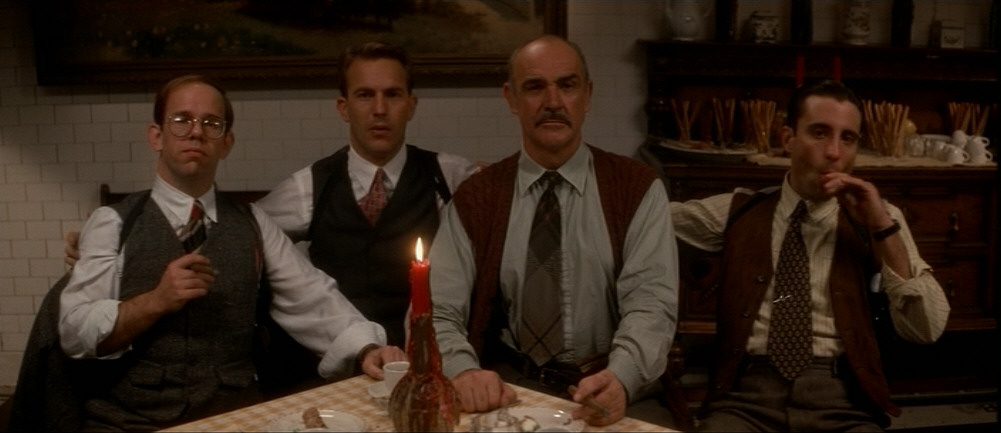

Never stop fighting ‘til the fight is done, so says Eliot Ness. I even put that under my photo in my high school yearbook picture senior year and after recent events I’m doing what I can to keep that phrase alive in my head these days. THE UNTOUCHABLES is a film that I passionately love and always will, even if it isn’t quite the filmic experience it was in 1987 but I wouldn’t want to go back and live through that time again anyway. And this film about real life figures made larger than life, about heroes who prove themselves by remaining righteous and in doing so becoming legends, retains that feel of pure cinema that Brian De Palma expertly put into it. It still resonates with me, it still sings to me. It made it worth making that long walk down La Brea to get to the New Beverly and see it once again. Now if you’ll excuse me, I think I’ll have a drink.

Tuesday, August 10, 2010

The Future Is Right Now


John Carpenter’s ESCAPE FROM L.A. played as a huge disappointment when it came out back in August 1996 with a plot that was seemingly lacking, uninspired action, lousy special effects, a waste of some good actors and maybe way too much of a feeling of been there, done that. Kurt Russell was still cool as Snake Plissken in this belated sequel to 1981’s ESCAPE FROM NEW YORK, no doubt about it, but they hadn’t come up with something appropriately cool to go around him. And yet all these years later after numerous repeat viewings on VHS and DVD I feel kind of attached to the thing. There was one night a several years ago when I had a lengthy phone conversation with a friend about who knows what. ESCAPE FROM L.A. was on one of the networks and I had it going with the sound off. Well into our conversation it came out that my friend also had been watching it with the sound off and he commented on how strange it was that we hadn’t said anything. I guess it’s the sort of movie that you keep in the background, liking that it’s there, but not really admitting to it. At least, maybe that’s the case for me. The effects are still pretty terrible and a few things that don’t work throughout still bug me but as it turns out it’s aged extremely well, maybe because of its own unique tone that sets it apart from the first film, maybe also because of a certain prescience it contains, it’s proven to be rewarding for me to return to for some time now. I gladly went to see it a few years ago during a “Los Angeles Destroys Itself” series at the Billy Wilder Theater in Westwood and there have been a number of Friday nights where it’s become the ideal movie to put on once again, while trying to put all the events of the past week out of the brain, escaping from the city in its most apocalyptic version (appropriately, it’s even set on a Friday night). The lesson here might also be that no matter how lousy certain effects are it eventually becomes undeniable how much a certain amount of meat on the bone can help how a movie ages over time while you begin to pay attention to what’s really there.


In 2013, thirteen ears after a massive earthquake has essentially destroyed L.A., resulting in the election of a God-fearing theocrat (Cliff Robertson) as “President for life”, the U.S. is a different place, a new “moral America” which allows no smoking, drinking, sex, freedom of religion or other freedoms and in which those not willing to conform are sent directly to what is now the island of Los Angeles, sentenced there for life. When the president’s rebellious daughter Utopia (A.J. Langer, later of the unfortunately short-lived sitcom IT’S LIKE, YOU KNOW) who has been brainwashed by revolutionary Cuervo Jones (George Corraface) escapes to the island with a potentially dangerous black box, the only choice the President and Commander Malloy (Stacy Keach) of the United States Police Force have is to recruit the recently captured Snake Plissken (Kurt Russell), eyepatch and all, to recover the black box and deal with Utopia. Plissken of course has no interest in doing them any favors but when he’s informed that he’s just been infected with the man made Plutoxin 7 virus that only they have the antidote for, he realizes that he has no choice to go in there, do the job however he can and escape from the island of L.A. before the clock on his life runs out.


The icy cool, sparse feel of the original ESCAPE FROM NEW YORK is done away with in favor of an approach that is bigger, broader and noisier as it clearly tries to use every piece of the bigger budget they have this time around. Carpenter raised the bar pretty high for himself with the original (and a few of his other films, for that matter) so the seeming halfhearted vibe it gave off made it difficult not to play like a letdown when it first opened. Those digital effects are almost embarrassingly bad at times, a fact that becomes very amplified on a big screen, and after Isaac Hayes’s Duke of New York (A-Number-One) in the first film George Corraface’s Che-lookalike adversary Cuervo Jones just feels like a satirical element that never quite becomes anything. Peter Fonda’s lackluster underplaying of his aging surfer dude seems to say something about the film as a whole—what should play as total madness in this environment just kind of cruises along, never becoming anywhere near as crazy as it should be, content to just go at random from one set piece to the next. Even the way the story packs itself into such a tight timeframe of around ten hours for Plissken to complete his mission has always bugged me—spanning a complete day, the original film managed to flow somewhat better but I imagine Carpenter never liked having to incapacitate his lead character for a section to avoid shooting in daylight and this was his solution. It does make perfect sense to paint this nasty future as one long seemingly endless night but forced into covering so few hours causes things to move in too much of a rush.


Though this story is almost as much of a remake as it is a sequel, in some ways that could be seen as yet another John Carpenter emulation of Howard Hawks, who also blatantly redid the same story several times because he felt that if it worked once it would work just as well again. But though a few plot points are maybe more convoluted than they need to be in the script written by Carpenter, Russell and producer Debra Hill (of course, to simplify those pieces would probably make them too much like the first film), it all goes much further with the politics than even the nihilistic, ‘fuck everyone’ feel of the original. With this film it somehow becomes a melding of Carpenter’s liberalism and star Russell’s own libertarianism, maybe the two friends finding common ground to make a statement about the madness they saw beginning to happen to the world. As a result, fourteen years after it came out to a pretty negative response the film seems not only amusingly prescient in terms of what the country went through during the 2000s but the metaphor of a Los Angeles literally separated from the rest of the country works pretty damn great when looked at now.


There’s also the feeling I get that Carpenter is actually interested in Los Angeles, as opposed to his use of New York which he really just presented for the most part as a big, mean city with very little regard for the landmarks we all know with the obvious exception of the prevalent Twin Towers. The targets here are broad—plastic surgery-obsessed ghouls in Beverly Hills, Steve Buscemi’s fast talking agent, surfing down ‘Wilshire Canyon’ with spaced out Peter Fonda—but the satire keeps things coming and the wide variety of characterizations that are tossed into the mix—sometimes without even fully explaining who they are at first—prevents it from ever becoming dull. And, at times, it gets the balance of the humor right—Snake Plissken forced to walk on a treadmill in the background as Cuervo makes his demands known is actually pretty funny. It seems to embrace how broad it can be from the way each character is costumed and made up as if ready for a cartoon series based on the film to the chatter of the dialogue which replaces the infamous “Heard you were dead,” from the first film with alternating “I thought you’d be taller,” or various condolences for whatever happened to Snake in Cleveland. His encounter with Valeria Golino’s ‘Muslim from South Dakota’ also seems to capture the feel of odd late night encounters you sometimes have with people around here. The extra level of intimacy between the two that develops out of nowhere fast never violates Plissken’s characterization and brings a great deal of weight to things that it wouldn’t have otherwise. His simple phrase to her, “The future is right now,” could be used as a mantra—no point in living for when things are going to happen, just keep moving ahead in the moment which is all we ever really need to know about him. I always kind of wish that her character could have tagged along with him for more of the movie or maybe I just like watching Valeria Golino here. The swipe at Disneyland with the climax set at ‘The Happy Kingdom’ feels kind of dated now and I should point out that the Chinese Twin Theaters seen when Snake walks by Grauman’s (where I saw this film on opening night, incidentally) were long gone when this film’s Big One hit on 8/23/00 but many of the elements that bugged me way back then don’t bother me so much anymore. By this point, the plot feels secondary to the characters and satire so the film has become its own thing and the final choice that Plissken makes in the end (“You’d better hope I don’t make it back,” he warns early on—the ending was by all accounts provided by Kurt Russell, so make of that what you will) feels about as appropriate as I could possibly imagine in this L.A. we’re living in these days. Yes, it’s hard not to wish that the effects were even slightly better than they are—I’m not even sure how certain things like the surfing scene could really be made to work anyway—but I’ve long since stopped dwelling on them and in some ways I don’t even really care all that much anymore. I wonder if they ever really bothered Carpenter either.


Even with its various good points there is something about the overly hectic feel of the film that feels almost too big for Carpenter’s sparse aesthetic with too many of the action scenes (involving digital effects or not) ultimately feeling like they never quite have the proper oomph as if maybe the director either didn’t have the time or the inclination to achieve all that was necessary. The motorcycle chase along Sunset in particular feels like the very definition of listless. As it is, it sometimes feels like the director is having the most fun when he doesn’t have to deal with those elements, whether it’s pausing to have Stacy Keach’s Malloy spray some mist on the plants at his desk or Snake Plissken deciding to just have a seat at a moment where he doesn’t know what to do next. Even at one point during the huge climax the hero and villain launch into a good old-fashioned fist fight and it’s hard not to wonder if the director is enjoying working out this man to man struggle in the middle of all this massive stuntwork, happy to get back to basics. I guess it’s these moments of flavor, combined with the feel that the movie seems to understand the nature of living in an island named L.A. that’s separated from the rest of the world (“Dark Paradise” as Plissken calls it) that stay with me, something that will no doubt lead to further Friday night viewings that I imagine will continue all the way to the year 2013 and beyond.


Kurt Russell is, no surprise, completely and totally Snake Plissken, keeping his ultra-cool no matter how crazy things get and it’s a pleasure to follow him with his spare bits of dialogue through this Los Angeles. Stacy Keach brings a great amount of quiet strength to his role as Cmdr. Malloy, teetering on the divide between being likable and snide nastiness as this film’s Lee Van Cleef equivalent (that said, I always kind of wished this role had been played by Tom Atkins reprising his role from the first film which could have added some depth to things). Steve Buscemi is maybe a touch too goofy as Map-to-the-Stars Eddie but still likable, while Michelle Forbes is always interesting to watch in her quiet authority as Keach’s second in command. Valeria Golino is quirkily affecting as Taslima and A.J. Langer works well as the too-naïve Utopia but Pam Grier’s late appearance as Hershe Las Palmas never gets the chance to have any real effect even if she does have a cool introduction. I may be admitting to how much I’ve come to like this film but I’ll also put out there the possibility that no film which wastes Pam Grier’s presence can be considered a total success. George Corraface was actually cast in the lead role of David Lean’s never-made NOSTROMO back in the 80s but here he never comes off quite as charismatic or villainous as it feels he should be as Cuervo Jones, despite a pretty good voice. Bruce Campbell is slyly amusing in his (too) brief appearance as the Surgeon General of Beverly Hills, Cliff Robertson nails the right kind of arrogance and pathetic cluelessness as the power mad Christian President, Robert Carradine is unrecognizable as a skinhead, Leland Orser enjoyably spits out a huge amount of exposition about the MacGuffin and if Paul Bartel had any dialogue playing “Congressman” it was left on the cutting room floor. In the pan and scan version he’s totally cut out. Like the film itself, Shirley Walker’s score movies away from Carpenter’s steady keyboard sound of the past towards a feel that is big and symphonic, mixing Carpenter’s original theme with her own material. It all adds immeasurably to the film mixing horns, electronics, surf rock (her music even almost sells the surfing sequence) and a spaghetti western flavor in a way that works extremely well and at its very best is a total blast.


Making a belated sequel is always a difficult task whether the director is John Carpenter or Francis Ford Coppola, not to mention George Lucas, with the end result always difficult to live up to those years of expectations. ESCAPE FROM L.A. satisfied few people when it was released but the film has survived as something that fits right in with its director’s filmography, playing today as individualistic as his very best work even if the scale of it possibly got away from him at a certain point. It satisfies as another look at the character of Snake Plissken as well as the mad future he occupies but its darker satirical elements have also aged along with the world in a way that makes the film more effective than it once was. The digital effects may have gotten better in summer movies all these years later but the personality of a film like this has mostly been drained out, the fun replaced by an assault of sound and fury, no ideas of any kind to be found at all, nothing to connect those films to “the human race” as Snake Plissken himself says. If its director wasn’t so concerned about the quality of the film’s effects maybe that’s because he was focused on what were to him, in his own style of filmmaking, more important matters. Hopefully some form of that approach to creating movies with genuine personality and humanity will survive in the future. Just like Snake Plissken.

Sunday, August 8, 2010

Trying To Look Hip


I’m beginning to think that I just don’t have it in me to write a screenplay that contains any sort of examination of a long-term relationship. I’ve tried. I’ve tried recently. It just doesn’t work. I can’t even get a girl to have dinner with me these days, so I’m nowhere close to being able to explore something like that creatively. Maybe just give me a call when the remake of THE LONELY GUY needs some script polishing. So don’t expect an ANNIE HALL or TWO FOR THE ROAD for our times to come from me and I guess I also wouldn’t be the guy to write something as goofy as SO I MARRIED AN AXE MURDERER, a would-be satirical look at the fears of marriage which stands as the one attempt Mike Myers has ever made to play a relatively normal person in a movie. That is, to say, the character actually looks like Mike Myers, even if it isn't the only character he plays in the film. A box office flop when it was released at the end of July 1993 it’s the sort of film that should play as a relaxing summer romantic comedy but even though there are some laughs found in there it never really comes together. Even now there are too many things that bug me while watching it and the movie winds up not being very much of anything.


Charle MacKenzie (Mike Myers) is a coffee house beat poet in San Francisco with a best friend named Tony (Anthony LaPaglia) who works as an undercover cop, a father (also Myers) who angrily spends most of his time watching soccer on TV and an eccentric mother (Brenda Fricker) who refers to the Weekly World News as ‘the paper’. Charlie also has a habit of seemingly looking for reasons to dump women he’s dating (“She smelled like soup”) seemingly ending every relationship he gets into before they can even start. When he meets a beautiful butcher named Harriet (Nancy Travis) the two of them fall for each other almost immediately but Charlie soon begins to fixate on the possibility that she may be the infamous “Mrs. X” his mother learned about from the Weekly World News, a serial killer who murders each of her husbands on their honeymoon. After he breaks it off with Harriet based on this fear Charlie soon realizes how crazy the whole idea is but after they get back together and he finally proposes the evidence that Harriet really might be Mrs. X genuinely begins to mount.


The screenplay is credited to Robbie Fox but from the moment a STARSKY & HUTCH joke is heard near the very beginning much of the humor is very obviously the work of Myers himself (working with one-time partner Neil Mullarkey apparently—the two were denied screen credit in arbitration) and revisiting it seventeen years after its release this coffee house milieu couldn’t come off as more early 90s if we were watching a romantic comedy made today that was set in the early 90s and tried to play up the time frame in a WEDDING SINGER sort of way. If comedy comes from truth then the thematic notion that marriage equals some sort of death is a good place to start for a dark comedy but with very little reality to begin with the movie continually undercuts its own premise. It’s a film with a lead character who doesn’t seen to do much to make a living beyond recite poetry and tool around San Francisco in a snazzy convertible, nothing to worry about, nothing to ever do, no real character beyond a gimmicky ‘fear of commitment’. Shouldn’t he move to Chicago and try to get into Second City or something? With the coffee house scenes giving me a few flashbacks that I actually don’t mind all that much, Myers’ poems bemoaning his broken romances get the right mood going but it’s never a very good idea to focus so much on a movie character who’s actually funny to people in the movie and the actor never seems to realize this. He seems to spend way too much time trying to prove how cute and charming he is to everyone—many other comedians of his ilk (Dana Carvey, Dan Akroyd) have tried to play ‘straight’ leads in their own films but it never really seems to take because personalities like that usually work better in character roles or Austin Powers-type leads. In Myers’ case as this regular guy there are shots when he just seems frozen, trying to make his toothy grin as big as possible and hope that will compensate for how he doesn’t have much of an idea of how to play this normal guy.


The movie skirts the issues of love and commitment on occasion but instead of exploring them in any incisive or satirical way it mostly either gives us another wacky montage to show us how ‘funny’ Myers/Charlie is or just ignores it, lurching from one plot point to the next. Emphasis is continually placed on the wrong thing whether it’s the unnecessary comedy cameos (Charles Grodin and Steven Wright work well in their appearances when they happen but Phil Hartman and Michael Richards just come off as distractions) or its portrayal of San Francisco which is pretty and gives a cheerful feel to things but spends way too much time having its characters walk through tourist attractions as opposed to places people who live there might actually go. Director Thomas Schlamme starts things off with a big shot in the coffee house following the process of how a giant cup of cappuccino is made but since there’s no real point to it touches like that don’t really amount to much and the overall feel is that the director was able to make the film feel more nice than funny (one element that helps is Bruce Broughton’s music which gives a nice beatnik vibe to the coffeehouse milieu, making it that rare comedy score that actually compliments the film). Schlamme, who later joined forces with Aaron Sorkin to direct multiple episodes of THE WEST WING and SPORTS NIGHT among numerous other TV shows, apparently didn’t get along with Myers (I remember reading some of this in an article on the star in GQ a number of years ago) and there’s a vagueness to the overall approach that gives the impression the whole thing just never had the guiding hand it needed, somebody to focus on what the film should be about. Instead, it all just comes off as kind of random. Funny bits do float in there like Anthony LaPaglia’s cop best friend who wants to actually do things that he imagines cops do but never enough of them and once the marriage happens it feels like the entire approach to the third-act is just wrong, even when it finally begins incorporating nods to the whole marriage=death theme. It’s also hard not to notice how the rushed ending feels hesitant to show the two leads truly together and lend a sense of completeness to all this, content to do nothing but show Mike Myers smiling a little too big once again. Maybe most importantly of all, too much of the time the film just isn’t as funny as it should be or seems to think that it is. It’s just kind of empty, maybe best exemplified in how a few years ago it was reissued on DVD as a ‘Special Edition’ which contained absolutely zero special features.


The awkwardness Myers projects in the lead role gives the impression that he seems more into playing his character’s father under heavy old age makeup. It’s the first example of this Peter Sellers sort of approach in his films (interestingly, Myers also dotes on the word ‘evil’ at one point, as if preparing for the AUSTIN POWERS trilogy) but the father always seems slightly separated from the rest of the story, singing along to the Bay City Rollers or muttering conspiracy theories as if playing in an SNL sketch while everyone else is in an actual movie. With Myers seeming uncomfortable playing a normal guy, the film needed a female lead to really bring some juice to all this, to somehow add something to the script’s subtext. Nancy Travis is very attractive (I love her in that dress she wears on their honeymoon) and seems friendly enough but she has no edge to her at all, so the romance just all comes off as vanilla. She’s one of those actresses who always worked better on sitcoms, like ALMOST PERFECT in the mid-90s and the two leads combined just turn the center of the movie into a giant black hole.


Amanda Plummer as Harriet’s sister Rose actually does provide some edge in her first scene but she doesn’t get to do very much after that. Anthony LaPaglia does proves how consistently funny he can really be in the stock best friend role, Brenda Fricker feels slightly underused as Charlie’s mother, Debi Mazar has one cute moment as Tony’s girlfriend who got electrocuted once, Al Nalbandian (instantly recognizable from other Bay Area shoots like THE CONVERSATION and AMERICAN GRAFFITTI) is a customer in the butcher shop while Sheila Kelley of L.A. LAW and recently LOST can be seen in photos as Charlie’s ex-girlfriend—evidence of deleted scenes or was she just doing someone a favor? By a long shot, the best thing in the whole movie is the uncredited Alan Arkin, brilliant as Tony’s captain in three brief scenes (it feels like there should be another to make the running gag completely work, but never mind) who has no idea how to be the kind of cop who screams at people. When Tony moans how he wishes he could commandeer a vehicle and Arkin, smiling, says, “Now that sounds like a fun of fun,” in a spacey kind of way it gets me to laugh out loud like nothing else in the entire movie. A few brief minutes in this middling movie should be all anyone needs to realize what a treasure Alan Arkin really is.


Sharon Stone was apparently once a possibility for the female lead which may have been too much of a skewering of her BASIC INSTICT performance too soon but I can’t help but wonder if a version of this film with Stone, a stronger male lead, a more solid level of commitment within its humor and a firmer directing hand might have actually had potential as a good, dark comedy. Debi Mazar’s one scene toys with the notion of the perception of humor and how something darkly funny to an outside observer doesn’t need any extra embellishments to those going through the suffering. It’s a notion that a film willing to be a more biting look at romance could have done something with but SO I MARRIED AN AXE MURDERER is more content with giving us another montage of Mike Myers trying to be cute in various ways. I’ve liked him during other points in his career (still, like most everyone else, I could probably go at least another ten years without dealing with the AUSTIN POWERS films again) but one thing this film reminds me of is that jokes about Huggy Bear and the large size of coffee cups just aren’t as innovative as they used to be. And whether I’m qualified to write about the nihilistic subject of relationships between men and women or not, a film exploring that needs to commit to itself. Otherwise, it’s just another goofy romantic comedy—not that there’s necessarily anything wrong with that, you just sometimes need to decide which way you’re going to go with these things and until you do the end result is never going to be ideal.

Friday, August 6, 2010

A Debt We Can Never Repay


I was doing some cleaning around here the other day when I stumbled across a copy of a script I wrote a few years back, one that I spent a pretty long time on. Based on the date it was probably about as final a draft as there ever was so I sat down to read it for a little while. It actually wasn’t as awful an experience as I feared—I didn’t think what I’d written was all that bad. It wasn’t all that great either, a sobering realization in itself for something I put so much time into and I could see a number of reasons why what I’d been going for with it never quite clicked together. I mention all this partly because a friend of mine went to The Palm in West Hollywood for dinner the other night and reported back to me that there was an empty table made up for dinner with a lone candle burning in the center. Also on that table was the LA Times obituary for screenwriter Tom Mankiewicz, who died on July 31 from pancreatic cancer at the too-young age of 68. As a small, elegant tribute to him the table was set in memoriam for the man who was apparently a regular customer at the restaurant for years, eating lunch there almost every day. Mankiewicz was one of those scribes who brought a definite style and wit to his work, quotable dialogue almost dripping out of the frame, the sort of thing that I guess I can’t help but aspire to at times.

Son of Joseph, nephew of Herman, that’s a big piece of Hollywood legend to live up to and with his success he proved his family name proud. He was hired to rewrite DIAMONDS ARE FOREVER at what looking at it now was a ridiculously early age and stayed in the Bond fold for much of the 70s but these days he might be better known for his credit as “creative consultant” on SUPERMAN and SUPERMAN II, essentially serving as the writer of the final draft as long as Richard Donner was there as director. He was a writer on THE CASSANDRA CROSSING and LADYHAWKE, did uncredited rewrite work on a number of other films, was considered the key creative force in the creation of the hit show HART TO HART and was apparently very much involved in the Writers Guild over the years. His brief stint into directing with films like the Aykroyd-Hanks DRAGNET and the John Candy vehicle DELIRIOUS weren’t quite as successful but this is nevertheless a career to be proud of. Anyone who came up with all the sharp characterizations and snappy one-liners he did through his career (“Why does the phone always ring when you’re in the bathtub?” “I didn’t know there was a pool down there.” I could go on.) deserves all the praise we can give him. One other film his name is on that I have a fondness for is 1976’s dark comedy MOTHER, JUGS & SPEED an unusual combo of wacky 70s hijinks and dark turns featuring a cast that would probably have only been brought together during that oddball decade. It has a director as well as stars that are probably better known for other points in their careers these days and it’s maybe a little too laid back to qualify as any sort of classic but its scrappy nature is endearing even if it probably would never have been made a few years later.


Loosely plotted as you could maybe only do during those days, MOTHER, JUGS & SPEED is set among the Los Angeles based F&B Ambulance Company, a ramshackle organization with the decidedly crooked, money-grubbing owner Harry Fishbine (Allen Goorwitz) and employees who can’t be trusted with the Hawkeye Pierce of the group definitely “Mother” Tucker (Bill Cosby) who barely seems to take anything seriously, loves terrorizing a group of nuns and thinks nothing of stopping off for a burger while his boss screams at him on the radio. Handling calls for the company is the very attractive Jennifer (Raquel Welch), nicknamed Jugs for obvious reasons and when an unfortunate accident leaves them short one man in comes Tony Maletesta (Harvey Keitel) a Vietnam Vet and cop nicknamed Speed undergoing an investigation for drugs who gets instantly thrown into the madness. The three soon discover that they’re just about the only ones they can depend on in this company which is in the middle of a major rivalry with the competing Unity Ambulance Company.


Directed by Peter Yates with a light touch that would make it an ideal pairing with his 1972 caper film THE HOT ROCK, MOTHER JUGS & SPEED always plays to me as a sort of Los Angeles equivalent to the New York-set THE TAKING OF PELHAM ONE TWO THREE. Not in terms of plot, of course, but in how it’s a kind of serio-comic look at life in its particular city (mostly shot around Venice and West L.A.) with equal parts nastiness and dark humor, loaded with character actors and presenting a world in which seemingly everyone is corrupt in some small way, but the good guys in the world presented are somehow able to find their own nobility within that corruption. And just as PELHAM is non-stop sarcasm, MOTHER remains flaky in tone, fitting for the city they set it in. The slight, scrappy nature of MOTHER (Screenplay by Tom Mankiewicz, Story by Mankiewicz and Stephen Manes) makes it feel a touch lightweight even considering how dark it gets on occasion but it also features characters who are continually enjoyable to follow along with from Larry Hagman’s slimeball behavior to Allen Garfield’s memorable opening speech about the current state of America (based on what he says, some things never change). Bill Cosby’s loose but steady nature carries the movie throughout, somehow letting us know that we’re in good hands and I love how the movie basically stops for a few minutes for him to eat a cheeseburger which he insists on slathering with mayonnaise. The various combos of these people as they ride around in their ambulances on calls always offers something a little different and the three leads fit together surprisingly well considering how different each of their personas are.


Director Yates and Mankiewicz produced the film together and the credit at the beginning even reads, “A Yates-Mankiewicz Production” suggesting that this is one case where the writer may very well be as much of an auteur on the project as the director was. Tonally the movie veers from one extreme to the other in an almost whiplash fashion going from wackiness, including a dry run for a certain famous gag in THERE’S SOMETHING ABOUT MARY, towards more sober character development, one or two genuinely shocking developments and maybe a shade too much melodrama for its own good during the second hour. This was something that both Roger Ebert and Vincent Canby complained about in their reviews at the time but while it may not be as darkly iconic as MASH or as hysterically offensive as FREEBIE AND THE BEAN, MOTHER JUGS & SPEED has a tone that in its own low-key way is shabby, endearing and funny, focusing on its characters in a 70s way which makes it compulsively rewatchable, with each new viewing turning into another fun chance to hang out with these people during that very loose decade. It feels like the filmmakers were very careful with some of the violence, sleaze and general ‘adult situations’ to get the PG rating they managed to achieve, even with a visit by none other than Bill Cosby to a massage parlor and it does feel slightly like a feature-length TV pilot—no big surprise, there was an attempt to turn it into a series with other actors later on which never made it past the pilot stage, aired once during the summer, with the nickname for the female lead changed slightly to ‘Juggs’ apparently to make it more palatable. Even if that show didn’t happen, the brainy yet gorgeous company secretary named Jennifer played by Welch definitely feels very much like it was an inspiration for the brainy yet gorgeous secretary also named, um, Jennifer played by Loni Anderson on WKRP IN CINCINNATI. All these elements crashing together makes it kind of a hodgepodge overall, but even with the more serious moments it provides a loose vibe that I find infectious and in its own way kind of optimistic. While I don’t want to make any claims for the film being the ultimate lost 70s classic when it hits the final gag as the main theme “Dance” bursts onto the soundtrack for the end credits it gets a big smile out of me, a genuine feeling of satisfaction. Come to think of it, SUPERMAN made some pretty extreme tonal shifts itself and that film holds together pretty well too.


Cosby in particular is fantastic, carrying the lighthearted moments along with the heavier sections with ease and more than anyone here, I wouldn’t mind another movie that focused on just his character. Keitel’s quiet intensity makes him appropriate as an outsider to this group (this is one of his first major non-Scorsese roles which provides an interesting subtext) and Welch brings sharp humor to her star power as Jugs, although unless I’m mishearing things her character is supposed to be 23—the actress looks great here but I’m not sure that she pulls that off. Larry Hagman is particularly good as one of the other drivers, making a very memorable sleaze—he’s a prick, but he’s somehow a believable prick (Is the Mankiewicz connection the reason for his SUPERMAN cameo?). A young Bruce Davison is quietly likable as Cosby’s shotgun rider, Allen Garfield who apparently appeared in every movie made during this period is enjoyable as always, L.Q. Jones has some nice moments with Cosby as a pragmatic cop, Valerie Curtin is fun as Fishbine’s wife, Severn Darden is the company’s shyster lawyer, Allan Warnick, the “not a lending library” clerk in CHINATOWN, is one of the F&B employees and Arnold Williams, the cabbie who keeps turning up in LIVE AND LET DIE (Another Mankiewicz connection!) is a driver for the rival Unity Ambulance Company.


“High concept is the enemy of the writer,” Mankiewicz once said. “The friend of the writer is the human being, the full-blooded character interacting with another character.” Those might be unexpected words from somebody responsible for various films that featured James Bond and Superman but it’s the character moments and genuine wit that can be found in those films which provides much of the reason why they remain so entertaining to this day. And it’s in how each of the film’s characters relate to each other, how they figure out a way to keep going throughout all the madness, that is much of what MOTHER, JUGS & SPEED is about in the end, much more than any fake jeopardy that would be provided by a plot that it doesn’t need. Such allegiance to characterization is hardly in vogue with blockbusters that get made these days but it’s still a thought worth remembering and I’ll try to do that with my own work as well. As a key creative force behind such memorable films he probably knew what he was talking about in these matters and what he left us with is certainly worth paying whatever tribute we can.

Saturday, July 31, 2010

Disappointments Thicken Our Skins


It’s been over a week since I was in San Diego and I feel like I’m still recovering from Comic Con. This is particularly surprising considering how I was only there for about a day and a half. It was fun, but by a certain point I was just worn out from it all and decided to head back up the coast via Amtrak. With some of this still in mind and looking for something superhero-related to watch I pulled out my DVD of SUPERGIRL—not just the DVD but the Anchor Bay double-disc set released back in 2000 which contains both the 124 min International Cut (the version I chose, for the record) and the never-before-seen “Director’s Cut” which goes a full 138 min. If that’s your idea of a good time. (The shorter U.S. release version, listed at 114 min., seems to be pretty much unavailable now) I got the DVD when it was released probably for completist’s sake, probably out of curiosity and probably for some odd form of nostalgia even though, like most people in America, I didn’t even bother seeing the film theatrically when it was released at Thanksgiving 1984 (several months after it already played Europe), tossed into theaters by Tri-Star when Warner Bros. apparently declined. There is a definite level of craft to the film which is apparent even now as I watch it—it’s slick enough that for brief periods I’m too distracted to notice just how terrible it is. It’s enjoyable to a point but it all feels like some sort of big-budget miscalculation of a kind that was really only possible back in the 80s with hazy rules and a tone which by a certain point feels kind of smothering. Helen Slater is cute, that much is certain. But it’s really not very good at all.


In the isolated Argo City, existing somewhere in innerspace, Kara Zor-El (Helen Slater) is one of a large number of Kryptonians who live there. The powerful Zaltar (Peter O’Toole) who dreams of going to Earth allows her to see the powerful Omegahedron, a small device which powers the city. But an unfortunate mishap results in the Omegahedron sucked out of the city towards Earth, jeopardizing all of Argo City. Taking matters into her own hands, Kara heads for Earth herself where she discovers her enormous powers in her identity as Supergirl and soon takes the guise at a nearby girls’ school of Linda Lee, cousin of Clark Kent, where she winds up rooming with Lucy Lane (Maureen Teefy), younger sister of Lois. Meanwhile, the Omegahedron has landed at the feet of would-be sorceress Selena (Faye Dunaway) who with loyal assistant Bianca (Brenda Vaccaro) fully intends to use the device to allow her to possess hunky gardener Ethan (Hart Bochner) and fulfill her greatest dream, to rule the world.


A movie for pre-teen girls of all ages, SUPERGIRL has energy and spirit but very little about it seems to come together as if those in charge (directed by Jeannot Szwarc, screenplay by David Odell) never quite came up with the right ideas to give this thing the life it needed. It’s admirable that they wanted to set the tone apart from SUPERMAN and the style Richard Donner brought to his film but many of the ideas either feel too different for something set in the same universe or don’t make very much sense on their own level (Since Christopher Reeve ultimately declined to appear as Superman in an extended cameo we’re told via radio early on that he’s on a peacekeeping mission in faraway galaxy). Why are these former citizens of the destroyed Krypton living in what is called ‘Innerspace’? HOW are they living in Innerspace? How do they know about Kal-El and his identity as Superman? Why does the Omegahedron fall on Earth from the sky when it gets loose but Supergirl comes up from the water? Where does she get her costume from anyway? Does anybody understand any of this? The style is much more heightened, more fantasy oriented than the intentionally grounded (no pun intended) approach Donner took but it still feels like no coherent rules were established. Elements are just tossed in there, never explained all that much and we’re apparently just supposed to get caught up in the wonder of Supergirl endlessly flying around to the strains of Jerry Goldsmith’s majestic score.


The loss of the Omegahedron and the potential destruction of Argo City imply an urgent ticking clock but this seems to be forgotten about almost immediately. In the context of this story it just feels like a big waste of time for her to disguise herself as Linda Lee (even if it is a part of whatever Supergirl mythos there is) and enroll in this school, suddenly becoming best friends with Lucy Lane. With her spending time figuring out math equations, playing field hockey and discovering the joy of taking a shower (it’s not like how it sounds) during the first half of the film it just makes it seem like she has no interest in getting her job done and saving the lives of everyone she knows—for a story with what should be a tight timeframe it’s impossible to tell how many days the story is actually set over just on a casual viewing. Szwarc directed JAWS 2 which, whatever else you want to say about it, at least moves but here there’s no tension, no decent spine, no tone that feels either correct or consistent (After one more try with the Salkinds helming the following year’s SANTA CLAUS, the director has spent much of his subsequent career in episodic TV). The emphasis always seems to be on the wrong thing, whether spending fifteen minutes in the girls’ school for ultimately no reason, getting lost in Selena’s funhouse, an attack by killer bumper cars or in Supergirl’s big fight with….a runaway tractor. Can’t she beat up some henchmen or something? Don’t we want to see Supergirl actually doing some stuff that’s cool?


There’s at least an earnestness to the film which helps (particularly when compared with SUPERMAN III) as well as a great deal of evident production value (particularly when compared with SUPERMAN IV) and, to give it some credit, there is some nice use of widescreen framing throughout (cinematography by the recently deceased Alan Hume) and the continuous shots of Supergirl flying, both on set and front projection, really do feel like the effects people involved had perfected all this stuff by that point. It’s never even particularly dull at all. But the vaguely defined fantasy rules (what exactly does Supergirl do to defeat Selena in the end?) just become too frustrating in the end so it doesn’t allow us to have any satisfaction when the heroine emerges victorious. It’s all too soft, too girly (all due respect to any girls reading this, of course) with lots of genuinely lousy dialogue and even if there is money onscreen it still feels like there were cutbacks somewhere along the way. The Argo City section with its giant set that doesn’t look like much other than a set in an 80s fantasy film feels truncated in the scripting so the high-billed cameos by Mia Farrow and Simon Ward of FRANKENSTEIN MUST BE DESTROYED as her parents come off as pretty pointless. Argo City apparently has ‘Guardians’ who are in charge but we never see them just as Zaltar casually says he’ll banish himself to the Phantom Zone then we cut away before anything happens (“Your suffering will be short. Mine…forever.” I don’t know, how magnanimous is that, really?). Even when we get to the Phantom Zone ourselves as Supergirl herself is banished there in the third act we’re told about others trapped in the place but never get to see them (“They’re here, over the hill there…”). There’s also that fake Salkind Productions-style Midwestern town with typical distracting product placement everywhere (Hey! Anybody want an A&W root beer? Let’s get something to eat at Popeye’s!). There’s never any reality established, just this small town with an abandoned amusement park that the villains are hanging out in for some reason so it all feels like it’s set nowhere—Supergirl does fly over Chicago several times but it’s all second unit stuff.


Even the comedy bits throughout wind up feeling too light and too leaden at the same time. And, in the case of Faye Dunaway and Brenda Vaccaro, the film offers a pair of villains who come off as bickering drag queens. Whatever else you want to say about Gene Hackman’s Lex Luthor (what can I say, I’m a fan) he was just one part of that movie. Here, Faye Dunaway is let loose and allowed to smother the thing whole. She and Vaccaro seem to enjoy playing off of each other but that doesn’t really have much to do with why we’re watching SUPERGIRL. In many ways the film just winds up feeling like it’s not about much more than a cute young girl battling a mean old woman (playing this role eight years after NETWORK, Dunaway was 43 at this point) for the affections of some lunkheaded shirtless gardener who’s put into a trance by Selena so early that I’m not sure why I should care. For all I know he’s still in that trance when the credits roll, it’s not even clear, so the love story never really means anything. It feels like there are some good intentions among the creative personnel but it just comes off as wrongheaded, like the overall approach wasn’t correctly thought out and the money they had was spent on the wrong things.


After saying all this I can’t help but think that I’m being too hard on it. Maybe SUPERGIRL is kind of like a cute little puppy dog that knocks over a lot of breakables but still tries to lick you all over the face. How long can you stay mad at it? Maybe I just like looking at Helen Slater. In her film debut the actress brings a great amount of spirit to things combining grace, innocence, forcefulness and humor in a performance that is responsible for just about any endearing qualities that the film possesses. She is the role. Hell, there are plenty of actresses who could do a lot worse with trying to say, “The Omegahderon, Selena. I want it,” with any real authority. And, yes, she looks terrific in the costume as well. Isn’t she supposed to? Faye Dunaway, meanwhile, is dressed in ridiculous outfits while lit across her bulging eyes like William Shatner in some old STAR TREK episodes while wind blows her hair every which way. Based on her nonstop shrieking I can’t help but genuinely wonder if her director was too afraid to tell her to tone things down a little. So am I saying that she’s actually effective in the role? I’m not sure but in her attempt to go ‘big’ and ‘camp’ or whatever it’s just too much for things as she tries to do as much with every single tiny line of dialogue she has (“Now I am really upset!”). Not to mention that the brief glimpses of Faye Dunaway attempting to play light comedy reveal that it’s not what she’s best at. Peter O’Toole, on the other hand, is enjoyable to watch in his extended cameo with his drunken style like he still has a little of Alan Swann in him but the main problem feels like the material isn’t quite worthy of him, blatant exposition that’s trying to turn itself into juicy dialogue for him to do something with. Brenda Vaccaro is appropriately annoying but her presence never really adds very much. Marc McClure is the SUPERMAN cast member who turns up in place of Reeve, with Jimmy Olsen serving as a love interest for Lucy Lane but not doing much else besides that (actually, I wonder how Lois would feel about that coupling). Peter Cook, during the brief period where he attempted to replicate Dudley Moore’s Hollywood success, is Selena’s abused flunky Nigel and Matt Frewer makes an early appearance as a truck driver who winds up on Supergirl’s bad side when she arrives on Earth. Valiantly trying to do something with all this, Jerry Goldsmith’s score could best be described as ‘twinkly’. It finds the appropriate amount of majesty but its bigness becomes a bit much by a certain point and winds up another one of the numerous scores by the composer where it becomes obvious how hard he’s trying to get a movie that clearly isn’t coming together to somehow work. In this case, by a certain point hearing the same themes over and over becomes a little like eating way too much butterscotch.


SUPERGIRL is a film that’s hated by a lot of people and I don’t even have much that’s positive to say about it myself. I mean, it’s definitely not a good movie. And at the same time I don’t really mind having it around, if only to look at in small doses every now and then. And I’d still kind of like to see a 35mm print of it someday. It’s at least trying, even if it doesn’t succeed, and the optimistic spirit it insistently trumpets along with Helen Slater’s performance at least counts for something. None of this really makes it any good of course, so maybe it is some sort of 80s nostalgia thing after all. Maybe I just appreciate that it’s trying, even if much of the effort is misguided. Maybe I just like seeing movies. And in the end, there’s nothing too wrong with that.

Friday, July 30, 2010

Just A Bunch Of Moments


I sometimes remember it as just about the worst Friday for new releases that I’ve ever encountered. July 26, 1991. Not the best summer ever and not the worst either but that weekend was particularly bad. All huge flops and three of them about as bad as any group of major studio releases that I’ve ever seen in my lifetime. The first I saw on opening night--MOBSTERS. Christian Slater, Patrick Dempsey and various others doing YOUNG GUNS during the gangster era. You could tell that even the Friday night Yonkers Movieland crowd didn’t think much of it. But on Saturday evening I went early to the nearby Yonkers Central Plaza where I spent the night theater hopping and seeing each of the other three—ANOTHER YOU (Gene Wilder and a visibly unwell Richard Pryor in their final teaming), V.I. WARSHAWSKI (Kathleen Turner in a godawful adaptation of the Sara Paretsky mystery series) and, closing out the evening at midnight, the Mel Brooks comedy LIFE STINKS. A film with a miserable reputation, it has a storyline that is fairly problematic and yet I have to say that even now I have a fond memory of sitting in that giant, nearly empty theater late at night laughing almost in spite of myself. But this is a Mel Brooks film that we’re talking about, after all. Wasn’t laughing almost in spite of myself what I was supposed to do?


Powerful billionaire Goddard Bolt (Mel Brooks), CEO of Bolt Enterprises, has a plan to tear down much of the slums of downtown Los Angeles with a plan to build the massive Bolt Center but his plan runs into trouble when he realizes that the other half has been bought by his main rival Vance Crasswell (Jeffrey Tambor). So to settle their differences the two make a bet: Crasswell will give up his half if Bolt is able to survive living on those very streets of skid row that he wants to tear down with no money and no help for 30 days. Taking the bet, Bolt suffers the indignities of living on the streets and even befriends Molly (Lesley Ann Warren) a homeless woman who helps him out. But as the 30 days draw to a close, Bolt is in for a big surprise.


It’s no SULLIVAN’S TRAVELS, that’s for sure, but that much is probably obvious and I suppose there are far worse things you could say about any movie. One of Brooks’s few directorial efforts which is not an outright parody of some other film genre let alone attempting any sort of fourth-wall breaking, the relatively straightforward LIFE STINKS (screenplay by Brooks & Rudy De Luca & Steve Haberman, story by Brooks & De Luca & Haberman & Ron Clark) is an attempt to be a broad comedy about the plight of the homeless which is a problematic concept to be sure, but also one that never tries to make too much fun of those people. As a result, for a fair amount of the film there’s the feeling that it isn’t quite sure who to make fun of, an odd approach for a Mel Brooks movie to take. The film’s portrayal of the streets and the people forced to live on them, even if it was shot on location, feels like something out of the forties and never really becomes more complex than thinking of them in a ‘hobo’ kind of way. No slapstick comedy with this kind of setting can ever completely overcome such a depressing kind of feel and LIFE STINKS doesn’t totally pull that off. It makes the first half of the film feel pretty grim on occasion as Bolt desperately tries to survive—the point of it all, no doubt, but kind of a bummer for a comedy and by a certain point it feels like just a little too much, even including the death of a supporting character. At the very least Brooks knows to get out of the section by ending it on a very dark joke which isn’t exactly a great joke (one that’s apparently inspired by something that happened to co-star Howard Morris) but at least it’s something and after this point things do begin to pick up, actually becoming funny on a consistent basis. Every now and then LIFE STINKS is able to actually deliver on a number of laughs, from the early scenes of obscenely wealthy Goddard Bolt figuring out how to kick people out of a nursing home without the media finding out (“Do it late at night.”) or much later on when Bolt encounters a crazy person who goes by the name J. Paul Getty ( co-screenwriter Rudy De Luca) and their bickering over which one is richer turns into a full-fledged Three Stooges routine with nonstop slapping which, so help me, gets me laughing out loud no matter how many times I see it. I’m just easy, I guess. Even from the very beginning of Bolt and his lawyer/flunkies entering his headquarters as shown in an opening credits montage from floor level so we see nothing but their shoes proceeding forward (smartly, there’s a callback to this later on), Brooks displays a formality with his framing as if he’s continually trying to figure out in scenes how to pull off a joke in a single shot. The overall effect this approach gives off is genuinely cinematic combining a sleek, old Hollywood deep focus look to the office scenes that effectively contrasts with the gritty nastiness of skid row. There is that specificity but there are also a number of jokes that seem to fizzle away, fading out to the next scene not to mention a genuinely maudlin quality (hell, let's just call it schmaltz) that Brooks never really explored before or since. Actually, much of the approach isn’t entirely unlike a film that I imagine Jerry Lewis would have made circa 1991, which I suppose I mean in both every good and bad possible way.


By a certain point at least Brooks seems willing to throw down the gauntlet of the grim plotting and actually throws the two leads into a full-fledged Astaire-and-Rogers dance routine between him and Warren seemingly out of nowhere. It’s one of the few times that Warren has been able to make use of her dancing background during her film career and the free-spirited nature of it which tosses all pretense towards realism out the window manages to come off as somehow experimental in the way it seems to willingly go against everything the film has been doing up to that point—it feels genuinely European in a way I can’t quite pinpoint and it’s also, I suppose, as close to one of Brooks’s requisite musical numbers that the film can provide. Suddenly past the halfway point the film has begun to become alive and in the final half-hour it begins to have a touch of fearlessness in its dark humor with the aforementioned J. Paul Getty scene and a considerably grimmer section in a hospital as the destitute Bolt is continually over-medicated by a doctor who doesn’t notice he’s examining the same person over and over. It’s as if once Brooks and the film has figured out what exactly to be making fun of there’s something kind of pure about it all. Once the film achieves the freedom of the latter sections, culminating in a Godzilla like battle between two giant wrecking machines being controlled by Brooks and Tambor the silliness of it definitely gets to me. Maybe there’s a purity in Brooks’s stylistic approach throughout even if it does make it kind of like an old man’s film, for lack of a better term (and, I admit, I also like DRACULA DEAD AND LOVING IT), but that purity at least makes it something. In the end, the latter section of the film tries to disprove itself of the sentiment behind its title by stating that Bolt’s money doesn’t really matter and all that matters is how life is ultimately good, expressing this in the most sentimental way possible. I don’t know how much that idea really holds, but I suppose there are worse things than a film which tries to say such a thing. There’s very little to get out of LIFE STINKS about helping the homeless beyond simple platitudes but watching it now I can remember a few of the genuine laughs that I got out of it during that empty late-night screening and those laughs stand out to me now as well. It’s not great but there is a certain freedom to its elegance so maybe it’s just the sort of film that you’re supposed to see in a mostly empty theater late at night and forever have a sneaking admiration for.


Maybe Mel Brooks was never the best leading man in his films when compared with somebody like Gene Wilder but he is absolutely eager in his performance, willing to dive in and embrace the madness when it’s needed particularly during his frantic dance emulating a little kid to try to get a few pennies (yeah, that gets me to laugh out loud as well) or his non-stop fight with Rudy De Luca (who, it really should be said, winds up stealing the whole movie). As a woman who’s been going through an admitted nervous breakdown for the best eight years, Lesley Ann Warren can sometimes come off too broad in her inherent goofiness but it fits her character here and when she does a small mock-performance to illustrate just what happened to her character to end up on the street it’s genuinely disarming and affecting—for the first time the movie seems to be about something other than just Mel Brooks exploring a comically questionable subject and the actress manages to elevate it all with her off-kilter nature. Jeffrey Tambor displays a lot of enjoyably passive-aggressive behavior as the bad guy with his best moment being when he states concern for Bolt’s safety then immediately begins carelessly humming a song aloud as soon as he’s alone. Comedy legend Howard Morris makes one final appearance for Brooks here as Sailor, Theodore Wilson (who died just days before the film’s release in ’91) is Fumes and the always very funny Stuart Pankin is Bolt’s main attorney getting a particularly well-timed extended moment with De Luca near the end. Billy Barty’s in there too.


I don’t want to make any grand case for the movie and I don’t even feel like drawing some parallel between the title and some of the stuff that’s happened to me lately. But as Lesley Ann Warren tearfully tries to say near the end, “That’s all life is. Just a bunch of moments,” I can’t help but think about how this film once capped off a night of seeing terrible movies, during a time long ago when I probably didn’t know how good I really had it, a time when I felt free enough to take a night and not worry about anything but seeing those terrible movies—not that I think this film counts as terrible at all. But my point is that whatever anyone reading this might be thinking about how I’ve spent my time in life, I wouldn’t give up the memory of that night for anything. And with the mood I’m in these days, I kind of wish that I could relive it all right now. And I would do it. As long as I could get the pure enjoyment of all that laughter from the midnight show of LIFE STINKS, a movie that probably few other people have any real fondness for, in that huge, empty theater once again. As Mel Brooks himself says in this movie, there's so many things that you can't do when you're dead.