Monday, January 17, 2011

Now's The Time To Be One


So I’m sitting here, staring straight ahead. Pretty much out of ideas. I’m feeling pretty much done with the whole thing, even as I continue to look for a job. All I know is that when faced with the terrifying prospect of being a p.a. on some crappy reality show I begin to wonder if I should just give up, get the hell out of Dodge, move to a place like Santa Fe where it’s much quieter. Of course, I know for a fact that the movie theaters there are pretty lousy so that might not actually do much good. Maybe I’m stuck here. The other night I went to an art gallery opening where I spent some time chatting with this girl who seemed pretty cool and actually interested in talking to me but at the end of it all when we said good night I wasn’t really sure what I was supposed to do. Ask her out? Get her number? Act like a cool guy who isn’t broke and jobless? Maybe I was misreading the signs. I wasn’t totally sure that she was even single. It doesn’t matter anyway. So I sit here. Occasionally leaving, buying groceries, going to the movies, going on long walks, wondering how long some of these walks might end up being. And then when I’m done walking sometimes I sit here, staring straight ahead.


For a few years in the early aughts following their smash success with 1999’s AMERICAN PIE the brother team of Chris and Paul Weitz moved away from teen comedies towards what appeared to be a latter day Billy Wilder kind of thing, creating mainstream character driven pieces that had a certain amount of depth to them, willing to infuse what appeared to be romantic comedies on the surface with the right kind of darkness, the mixture of sweet and sour. That seems to have ended as each brother has branched out into separate directing careers helming would be franchises (THE GOLDEN COMPASS, THE VAMPIRE’S ASSISTANT) as well as sequels in series that had already been established (ECLIPSE, LITTLE FOCKERS) which seems sort of like a case of little risk, big-ass paychecks for a reward. It’s kind of a shame because while 2004’s IN GOOD COMPANY, which Paul wrote and directed by himself, was never quite as effective as it maybe should have been this approach seemed to really click when the pair traveled across the pond to make the Nick Hornby adaptation ABOUT A BOY. The film did fairly decent business along with receiving strong reviews and even an Oscar nomination for Best Adapted Screenplay but has always felt more than a little underappreciated maybe because Universal decided to make it a sacrificial lamb by opening it directly opposite ATTACK OF THE CLONES in May 2002. That counter-programming approach of Hugh Grant vs. STAR WARS worked pretty well with NOTTING HILL in 1999 but not having Julia Roberts this time around probably made the competition a little too lopsided. It’s really too bad, because ABOUT A BOY is a lovely film with it’s own kind of charm, serving as a terrific showpiece for Hugh Grant in a story that contains a surprising level of seriousness. More than any film they’ve been involved with before or since the Weitzes offer an approach to this film that consistently brings a true visual intelligence to a story that is after all mostly people talking in rooms. I wish there were more movies like it being made now which contained characters genuinely willing to contemplate things in life, even if they were used solely as sacrificial lambs against giant blockbusters. After all, there’s gotta be something else to go see sometimes, right? I only wish.


Well-off Will Freeman (Hugh Grant) lives a leisurely life in London doing very little beyond watching TV, listening to music and going out on dates with women that rarely lead to a second date, by his own choice. After a brief, nearly accidental, relationship with a single mother shows him the benefits of coming off as a good guy, he decides to peer into the world of single mothers by pretending he has a child of his own. Going out on a few dates with one of them leads him to encountering 12 year-old Marcus (Nicholas Hoult), the lonely son of Fiona (Toni Collette) who herself is going through a massive depression. After Will aids in rescuing Fiona after a botched suicide attempt, Marcus gets the bright idea that if this new guy dates his mom that will solve all their problems and she’ll never try this again. When Will tries to brush them off after one lunch date Marcus quickly figures out his charade of not actually having a kid but the two of them soon begin an odd friendship nevertheless. And when Will finds himself attracted to yet another single mother named Rachel (Rachel Weisz), he has to convince Marcus to take part in one more charade in an attempt to not seem like the total blank he really is.


Some of the pleasures of ABOUT A BOY may be minor but as its story goes on the film becomes genuinely satisfying, going to emotional levels that help place it in a considerably different category than the incessantly upbeat scripts Hugh Grant has played in several times for Richard Curtis. I like a few of those movies, don’t get me wrong, this one just seems to go a little deeper beyond a timeworn moral that friendship will solve everything and maybe because of its acknowledgement of what a certain sort of self-imposed isolation into ‘island living’ can do to a person I find myself returning to it more as time goes on. Merging its sly humor with a suicide attempt by one of the leads, depression amidst the holidays and genuine sense of resignation in life through what the characters are going through, Wilder’s THE APARTMENT is definitely an influence but ABOUT A BOY’s striking rhythms, dual narration and anamorphic visual stylization make it also easy to imagine that the Weitz Brothers had a DVD of CASINO right by their side all during making it and this seems to have inspired them in all the right ways. In a time when way too many characters in films turn out to be total ciphers, here’s one where the lead is intentionally a blank, gladly doing “nothing” as he goes by himself in his own kind of island living with no particular goals to doing anything beyond that until he finally comes to the realization that he has to do something, to feel something. Of course, unlike me this guy’s got plenty of money though I have known a few people out there just content to not do much of anything and while I may have a few more goals in life than Will does lately I can identify with this aimlessness, of drifting, of dividing your day into “units”, as if making it a point to avoid thinking about anything else. It’s something I can feel my life becoming more and more just as Will quietly seems to realize what he’s in danger of turning into—the backstory involving his father having made his wealth by writing one cheesy Christmas song is touched upon in just a few brief moments in dialogue, allowing the continued looks on Hugh Grant’s face whenever that song is heard to do the rest of the work with nothing more needed to be said.


Unlike the book which was set in the early 90s—the death of Kurt Cobain occurs during the narrative—the film isn’t as locked into 2002 quite as much but it occurs to me that the nature of the online world by now would give Will even less of a reason to go out into the world than he does here. He’d probably be on Facebook every hour and give that as even more of a reason not to deal with people in person. The character’s isolation seems a bit much at times considering how you’d think he would be close friends with at least somebody—the relationships with the few people we do see are never really explained which is fine—but I can actually understand this feeling of getting into your late thirties and not even wanting to try anymore, not wanting to go out to meet people, not wanting to risk anything as far as that goes, since by this point it feels much more likely that you’ll just wind up getting hurt in the end. I think I understand that last past most of all. One difference between Will and myself is that I’ve never been much for daytime TV even when unemployed but that aside, I get it, I really do. And seriously, just leave me alone, I’ve got Netflix movies to finish. The whole thing kind of cuts deep for me, being forced to acknowledge to yourself how you might really be a blank without anything to say to make you interesting and get any particular girl to like you. What would I really tell that woman from the other night or the ultra-cute waitress at the Dresden who I’ve become smitten by? I don’t think mentioning this blog is ever going to do much good.


There’s also the film’s other lead in Nicholas Hoult’s Marcus, a kid who is genuinely sad and alone but since he hasn’t had everything beaten out of him by the world just yet he’s admirably trying somehow to figure out what to do about it. The hell of dealing with other kids in school is really only briefly touched upon but this is still is the rare movie that seems to acknowledge how shitty a time childhood can really be. Part of the goal of the story from Hornby’s novel seems to specifically be to avoid what it automatically sounds like it will be about so fortunately the prospect of Will and Fiona becoming a couple never seems likely for a second, keeping things all the more unpredictable and the friendship that develops is ultimately extremely satisfying. There’s a spirit that infects the movie all through the song score by Badly Drawn Boy with the recurrence of the song “Something To Talk About” (a GRADUATE influence in how it repeats, I suppose) staying with me in particular. The ambitious visual style doesn’t always feel completely disciplined—like the mirror shot in the hair salon where the camera moves from Will in the frame to a female extra behind a pillar for no reason—but the willingness of the Weitzes to make the film this way makes it different, makes it alive, so you feel every bit of the desperation and loneliness and desire to be alone through every shot. Ultimately, part of what makes ABOUT A BOY so satisfying is that it doesn’t have to destroy the character of Will to provide him with a feel-good ending like some bogus Chris Columbus movie—actually, I’ve never seen NINE MONTHS, which Grant starred in, but maybe that’s what I’m thinking of. What I’m trying to say is that the film never cloyingly becomes about somebody who hates holding a baby, as what happens here early on, but then learns to love holding a baby. Will doesn’t need to change everything about Will but sometimes in life a little connection, a willingness to make the plotline in your life complicated and to mean something, to help you genuinely grow as a person among other people, isn’t really so bad. The rewards of ABOUT A BOY are, in the end, relatively minor and maybe don’t add up to much more than discovering the desire to close ones eyes while singing a certain song, but they are rewards nevertheless. Even if things feel just a little too happy in the end—the directing pair on the DVD audio commentary can talk about the final shot being a 400 BLOWS homage all they want but a freeze frame ending of somebody smiling is still just a little too cut and dried—there is enough messiness along the way, enough of an acknowledgement of all the crap that’s out there, so those rewards mean something. It’s not a great film but it is good enough that it feels like it’s being made by somebody building towards making a great film which makes the more recent output by the brothers that much more of a shame. Granted, I haven’t seen LITTLE FOCKERS yet, but still.


Hugh Grant does some of his best work here, burying that FOUR WEDDINGS AND A FUNERAL charm as much as possible and making palpable how closed off he wants to be while paired up against the very talented Nicholas Hoult (also seen in THE WEATHER MAN—the two might be an interesting double bill) who here maybe gives one of the strongest, least cloying performances by a child actor in the past twenty years. Toni Collette never overplays Fiona’s daffiness while Rachel Weisz totally sells how special her character potentially can be to Will in relatively little screen time. Overall, there’s a sensitivity in how the actors are directed that allows respect for everyone, even the bit players (somehow I suspect that if I knew more BBC shows there would be more actors here I’d recognize), a refreshing change from how one of the Richard Curtis scripts will get a cheap laugh out of somebody having blue hair or whatever--I actually really do like a few of those movies, but those touches can sometimes really bug me. One of the things that makes ABOUT A BOY so special is how it seems to genuinely like everyone and acknowledge that they each have their own stories, their own reasons for being worried about leaving the house at the beginning of the day.


I go for walks. I shop at Trader Joe’s. I watch DVDs. I watch TCM. I drink coffee. I work on this blog. I write other things. I obsess over certain girls who have been a part of my life in the recent past. I go for walks in my neighborhood up to the Albertson’s on Hillhurst and back to my apartment, staying within my own island. And I do look for jobs but nothing I’m willing to mention on that front, at least not right now. Maybe there never will be. On the other hand, as I write this, Paul Weitz is reported to be reuniting with FOCKERS star Robert De Niro for the drama ANOTHER NIGHT, which he’ll be directing from his original script. So maybe there is hope out there, hope for some decent movies to be made, hope that at some point in the future I’ll wake up into a day that I find myself actually looking forward to. Right now, I suppose, all I have is the ability to imagine the joy of closing my eyes while singing a favorite song, lost in some sort of reverie that right now I feel I can only imagine, dreaming of a life I hope that I will someday get to live.

Monday, January 10, 2011

The Only Wealth In This World


From a beginning comes an ending. Whether you like it or not, twenty years later we still have to contend with THE GODFATHER PART III. It exists, it’s what was made at the time and that’s just the way it is. Removed from the furor that surrounded its original release on Christmas Day 1990 the way the film plays now seems quieter and more personal than it may have come across at the time, in many ways almost nakedly so on the part of director Francis Ford Coppola. Arriving sixteen long years after THE GODFATHER PART II it may never live up to the degree of greatness shown in the first two films but it deserves better than easy dismissal or cheap shot jokes in pop culture. Regardless, it’s never been seen that much on the revival circuit so when the New Beverly screened it recently as their last showing of 2010, following a double bill of I and II, I leapt at going--partly because of the rarity of the occasion, certainly, but also out of sentiment for the twentieth anniversary. As admirable as some of it is and as much as I may have a soft spot for it due to my own memories (damn right I was on line at Loews Astor Plaza early Christmas morning) looking at it now some of its flaws don’t just become more apparent—they deepen, to the point that it becomes plain how in making the film they needed another year. Another year in the writing, the shooting, the casting, the cutting, another year to allow them to find the movie and figure out what it was, what they wanted it to be.


And, really, I think it’s time for the world to move beyond that fantasy of insisting that either the inclusion of Robert Duvall or the substitution of Winona Ryder for Sofia Coppola would have solved everything. Duvall as Tom Hagan is undeniably missed, yes, but the problems that are there go beyond casting, beyond mere plot points. There is a movie inside of it which genuinely reveals something of who Coppola was as a person in 1990 and there are many things in there that I genuinely respond to on an emotional level. But too many of the concepts it wants to explore haven’t been adequately fleshed out either because Paramount insisted on the movie being in theaters that Christmas, because the madman of the 70s that Coppola was didn’t really exist anymore or just some natural combination of the elements. I admire the hell out of some what it achieves and my fondness for what’s there remains but the end result still feels a little like a shadow of what it really should have been, what it needed to be. And yet, I still kind of want to defend it.


New York, 1979: Michael Corleone (Al Pacino), years after ordering the death of brother Fredo and divorcing his wife Kay (Diane Keaton), has left Nevada and moved back to Manhattan, hoping for some sort of reconciliation between him and his two children, Anthony (Franc D’Ambrosio) and Mary (Sofia Coppola). At a party in his Park Avenue penthouse after receiving a special honor by the Roman Catholic Church Michael tries to make peace with his family, allowing Anthony to pursue being an opera singer and hoping he and Kay can still have some sort of relationship. He also comes across the energetic Vincent Mancini (Andy Garcia), his late brother Sonny’s illegitimate child, who is chomping at the bit to become a member of the family. Michael has little interest in such matters anymore, instead making an effort to finally go completely legitimate and purchase a controlling interest in the Vatican bank Immobiliare. As he attempts to make the deal go through, Vincent is making his own moves to gain power as he battles rising mob boss Joey Zasa (Joe Mantegna) but he also takes an interest in first cousin Mary, an interest she returns. Michael forbids this but soon forces beyond his control both cause him to reassess the wave of corruption that exists wherever he goes and how certain attempts to control his and his family’s destiny may truly be out of his hands no matter what he tries to do.


“Just when I thought I was out, they pull me back in,” goes the famous line Pacino rolls out in his gravely voice and surely the one thing people seem to remember about the film but the phrase also maybe inadvertently says something about it as a whole. Just as Michael Corleone is dragged back into this world against his wishes when he thinks he’s finally rid of it Coppola himself seems to be dragged back into telling a story about this world which in turn makes the movie into kind of a sludge, a film being made by someone who doesn’t want to make it and as a result he tries to mold it into a story he actually does want to tell, about a lead character who wants nothing more than to not be in this movie at all. As ambitious as it is at times and as admirable some of what it reaches for is, too much in THE GODFATHER PART III just doesn’t come together. Something in its very blood seems to be missing right from the start, a less adventurous feel to the approach is evident beginning with a rather dull expository letter-writing sequence at the top in place of a more GODFATHER I-like opening with the Archbishop which was instead pushed back to forty minutes in—for me, not one of editor Walter Murch’s better ideas and results in the film slightly faltering in the very first moment when it should be making a firm grab for our attention. One of the thrusts of the basic idea (the script was of course written by Mario Puzo & Coppola) is how Michael Corleone is looking for some sort of redemption for his actions of the past, especially ordering the killing of brother Fredo and the loss of Kay, but considering how insular the character seemed to irretrievably become by the end of PART II it’s a little difficult to reconcile that with the jovial businessman seen here, wisecracking about going into the kitchen to listen to Tony Bennett records. It seems a little more like Al Pacino circa 1990 dressed up as an old man with more wrinkles in his forehead than I can count (with maybe a little of Coppola tossed in) than any logical extension of when Michael Corleone was last seen out at Lake Tahoe.


And too much of the story, with nothing left from the original novel to mine, is just kind of shapeless with not enough momentum to things—the steady GODFATHER pacing is sort of there but not really, as if they were trying to move ever so slightly faster to keep up with the times but there’s the feeling that the rhythms in the editing haven’t been entirely worked out. Even the basic thematic thread of the American Dream that had carried through the series, beginning from the very first line of the original, feels more than a little abandoned in pursuit of the Vatican storyline and setting so much of it in Sicily. Too many elements feel either missing or in there for reasons that are never clarified so it’s a little like a sculpture that hasn’t been properly molded yet—why is John Savage in the movie as Tom Hagan’s son but practically an extra? If he’s a priest was he going to be more involved in the Vatican intrigue at one point? Why is Bridget Fonda (smoking hot here, it can’t be stated enough) prominent during the opening sequence only to suddenly disappear? How is Don Altobello the family’s oldest friend when we’ve never heard of this guy before? Why do side characters like Anthony ‘The Ant” Squigliaro get a big introduction (“He dips his bullets in cyanide.”) but then never do anything? How come George Hamilton is just standing there? Why does somebody recite Michael Corleone’s catchphrase back at him, is it that well known in the GODFATHER universe? Why did Michael get his hair cut like that anyway? Every now and then a fade out occurs to conclude a section—a stylistic carryover from the previous entries—but with so many scenes just kind of dwindling away as we watch them in this case it just seems to cause the audience to shrug its shoulders and wonder what the purpose of any number of things were. All throughout there’s a feel I get that Coppola is happy to be on the set working out stuff with the actors but, with the timeworn assumption that the jungle of APOCALYPSE NOW bled the insanity out of him coming to mind, there’s never the sense that he wants to push some of these scenes to the wall so he can get the best possible versions of them. It’s like he’s happy to just get some takes and move on. Big, violent GODFATHER-like setpieces such as the Atlantic City helicopter massacre of the other mob bosses or the mounted policeman execution of Joey Zasa are…fine, they more or less get what’s needed done. But not really more than that.


On his genuinely revealing DVD audio commentary with the film, Coppola at one point during the Atlantic City negotiations offers, “Michael doesn’t care about any of this stuff anymore,” and it’s hard not to realize that Coppola himself doesn’t care about this stuff anymore, instead interested to focus on personal matters of the family as well as just the desire to be left in peace. If they had the time to solve such inherent conflicts with the material, preferably when the script was being hashed out with Puzo, maybe they could have found a way to reconcile these opposing themes and come up with a movie to go with them. On a basic storytelling level it all winds up crippling the movie in a way that goes beyond the absence of Duvall—although the loss of Tom Hagan does feel like a large hole in things, like Michael is missing an extra person to be talking to—or placing daughter Sofia in such a key role. For those who don’t remember, the response to Sofia playing the part of daughter Mary after Winona Ryder dropped out at the last minute due to exhaustion resulted in a veritable outrage of criticism when it was released—people were lining up to give Hayden Christensen a pat on the back after ATTACK OF THE CLONES came out in comparison—and looking at it now, yes, she isn’t all that good with no particular acting technique at all but there is an awkward earnestness to her that becomes more endearing as the years go on and she hardly deserves to have been made some kind of punchline out of all this. Of course, we all know that she’d moved on from it by now.


Out of any number of personal feelings I get from the film, there are times where I got the feeling that Coppola was as happy as anything while making this when he got to put her in front of the camera but when you think about it, can you blame him? It’s his daughter, after all, and it may not be for the good of the film but is understandable in terms of what he was going for and where the plot was leading. In a similar way, the prolonged opera climax set during son Anthony’s performance of Cavalleria Rusticana (Coppola is credited with the staging) is also a sequence where the director seems genuinely engaged with what he’s doing, relieved to be staging something a little different from what everyone expects and enjoying the excuse he’s come up with to stage an opera. It’s not necessarily enough of a reason to have it there and at times it reflects events seen in the film in a way that’s a little too obvious, but at least some passion is there. The Coppola eccentricities find their way in at various points throughout like the children he’s clearly fond of having run through scenes—I may joke about it and it doesn’t have much to do with anything but my favorite moment of the whole movie is still probably when Michael tells Al Martino’s Johnny Fontane he’s going to the kitchen to hear those Tony Bennett records. Other side characters from old times like Lucy Mancini and Enzo the Baker played by the same actors appear to remind us of the old days but I can’t help but wonder about some of those Corleone family photographs around Michael’s apartment—did someone really snap a shot of his private garden conversation with him and Vito in the first film when it was happening? Vincent Mancini, meanwhile, appears to have two framed photos of James Caan-as-Sonny in his apartment, which also seems a touch cheesy.


The entire cross-cutting of the ‘settling of accounts’ that surrounds the opera during the climax is, again, pretty much fine but nothing all that special compared with what has come before in previous movies and also makes me wonder how somebody broaches the idea of using a pair of glasses a target is wearing as the murder weapon. And, no, there’s absolutely nothing I can say to defend that whole goddamned poison cannoli thing. I also can’t help but wonder just what this entire section is supposed to represent—in the first film intercutting the killings with the baptism of Connie’s baby was supposed to represent Michael’s triumph over everyone once and for all while in the second film a similar sequence of crosscutting was meant to represent the dark version of that, such as with the Jack Ruby-like killing of the no longer threatening Hyman Roth. But, really, what is all this supposed to be? A return to glory? A Passing of the torch? One last triumph? Maybe I’m overthinking it all and it’s just how a GODFATHER movie is supposed to end.


And since the Vatican plotline (inspired by actual events surrounding the brief reign of Pope John Paul I) has never been entirely clarified anyway some of these killings have no real impact. I’m still not aware how anyone has any idea that Donal Donnelly’s Archbishop isn’t on their side unless it just reached them via their ‘man inside the Vatican’ like they get informed of something else. During one montage of the numerous newspaper headlines that are seen the type on one beneath the banner is visibly revealed to be dummy text (check it out at 43:27), a glaring error that seems to say something about the movie as a whole--the broad strokes are there in the characters and photography and plot machinations but the blanks haven’t been filled in to give us the same sort of richness, scenes like Clemenza making that spaghetti sauce that would make it fully satisfying in the way it should be, the way I desperately want it to be. I guess it shows that you can give a movie a beginning, middle and end and it can make sense but sometimes it needs more than that. It’s a film where both Joe Mantegna and Eli Wallach at different points tell someone, “I have a stone in my shoe,” as if nobody was paying enough attention to realize that the script was using the same line twice. If you look at the lengthy trailer or the making of materials there seems to be quite a bit of deleted and alternate material which indicates how much things were maybe being rethought all along the way—one that has always interested me is how in the HBO special when Connie introduces Vincent Mancini to Michael she says, “Michael, this is Vincent Mancini,” but in the film she is dubbed to say, “Michael, you know Vincent Mancini,” as if somebody decided that it made more sense to have Michael already know of him.


THE GODFATHER PART III is a movie at war with itself, at war with anyone who wants to see a GODFATHER film. And yet, in the end the film is THE GODFATHER. It does have that sumptuous feel that it needs with Gordon Willis’ photography (honestly, the film actually looked better this time than I remembered), with the dialogue, with the music, with Pacino forever locked in the role of Michael Corleone, weeping over what he did to his own brother decades ago. The grace notes are there, small touches sprinkled in on occasion which haunt me to this day. And, as sad as it might be, in a way the film is my own GODFATHER, the only one I got to experience when it was first released as well as being set in a world and a New York I was familiar with—in spite of when it’s set, period detail feels limited to not much more than getting the New York license plates right—and the brief glimpses we get of these characters in present day is enough to make me wish there was more. And say what you want about the final coup de grace (just like what happened on opening day, I heard a genuine gasp from someone who clearly had never seen the film before from behind me at the New Beverly) it kind of hits home like a sledge hammer for me every single time and the degree to which that moment actually pays off means that all of the awkwardness and puzzlement that has come through in the proceeding two-and-a-half hours (not to mention the brilliance of the two prior movies) obviously had some sort of proper effect. Michael’s final scream of agony is, for me, absolutely shattering, making it clear once and for all what this film was meant to be for Coppola as well as what he was trying to say about his own life with it (anyone who doesn’t know what I’m referring to, go look up what happened to him on May 26 1986). The thing is, the more I write about THE GODFATHER PART III, the more I criticize it, the more I watch it, the more I nitpick it, the more I kind of love it and even weep a little for it. I want to scream at the film for not living up to its potential while embracing it with every ounce of love that I have in my heart.


Some of that uncertainty extends to Al Pacino’s performance, at times maybe uncertain how old he should be playing things and at other times seeming like he hasn’t fully shed playing Big Boy Caprice in DICK TRACY but more often than not totally revealing how haunted Michael really is down to his very soul that is beyond redemption. Even if the character’s odd tendency towards joking is still a little awkward watching it now it’s just one of those things in the movie I find endearing in spite of itself. Diane Keaton never had the best role in these movies, obviously, but her genuine rapport with Pacino that comes from the other films and probably their own real-life romance as well undeniabely comes through so their big reconciliation scene achieves a genuine rawness to it which is truly effecting. Talia Shire makes for an effectively earthy dragon lady as the older Connie and though his performance as Don Altobello may not be his best work as he goes way over the top with that accent, it’s very hard not to enjoy Eli Wallach each time he appears. Joe Mantegna as Joey Zasa for some reason never seems as effective as he should be while George Hamilton looks very cool and ready to act, but never gets to do anything making it strange just what he’s doing there (his role in things feels somewhat clarified to me in the longer cut). In her small role as photojournalist Grace Hamilton, Bridget Fonda sets off such a spark that it makes me wish that somebody had thought to pair up her and Andy Garcia in another movie that they could have all to themselves. As for daughter Sofia she does have a certain charm to her presence and, hey, the Italian in me finds her pretty damn attractive even if she’s still kind of gawky at this young age. I truly admire the films she’s directed (I just love SOMEWHERE--that said, she still can’t have the seat I was saving for someone she asked me to give up on the opening night of RANSOM at the Cinerama Dome back in ’96) but if in casting her director Coppola was trying to give it all that much more of a personal dimension, like so many other aspects where the film falters he needed to find a way to bring that out. In terms of discussing her performance, I’ll just leave it at that.


Andy Garcia is fantastic as Vincent, no doubt about it, making it puzzling why he didn’t become an even bigger star after this but frankly the effectiveness of his performance feels slightly hurt by the script since the actions that lead to Michael wanting him to take over the family never really seem all that special (not in a take out Sollozzo and McCluskey in Louis’ Restaurant in the Bronx kind of way, at least). There’s also the simple fact that when he’s playing love scenes with Sofia he’s working opposite somebody who really isn’t able to help make these scenes work as well as they need to so it ultimately hurts the character in the end, making him not quite the legend he probably should be. Over the years leading up to the 1999 death of Mario Puzo there were occasional rumors of a fourth film (dividing Vincent with Sonny back in the 30s maybe?) and during the commentary as the credits roll on this film Coppola hints at what might have been in such a scenario. The thing is, through no fault of Garcia’s, I’ve always felt that part of the problem with moving on from this point might have been that I never felt anyone ever really cared about Vincent Mancini, maybe because ultimately the film never becomes about him to the extent it’s already about Michael.

In addition to the main stars, familiar recurring players (Richard Bright is Al Neri! Franc Citti is Calo!) and bits by recognizable faces like Catherine Scorsese are some who are now familiar to me from various other films I’ve now seen over the years, particularly a number made over in Italy--Raf Vallone who plays the Cardinal who hears Michael’s confession and is later named Pope was the head of the Mafia in THE ITALIAN JOB, Helmut Berger whose many credits include MAD DOG KILLER with Marisa Mell (heard in JACKIE BROWN between Samuel L. Jackson and Bridget Fonda: “Is that Rutger Hauer?” “No, it’s Helmut Berger.”) is Vatican banker Keinszig, ONCE UPON A TIME IN THE WEST and THE GOOD, THE BAD AND THE UGLY English dialogue director Mickey Knox is one of the Atlantic City Dons (sharing the scene with Eli Wallach!) and Brett Halsey, star of Mario Bava’s FOUR TIMES THAT NIGHT, appears as Kay’s new husband.


Since the film was rushed into theaters for Christmas what was released on video months later was a slightly extended version, adding back in 9 minutes (the very nice print at the New Beverly was of course the theatrical cut) and that’s what can be found on DVD now. Several new scenes were included and though having Michael give Anthony back his drawing from PART II is kind of silly for the most part they help clarify and enrich a few points so I suppose it’s the best possible version of the film (I once noticed that a single line of Pacino’s was cut from a scene and have a feeling that something else was snipped but I’ve long since forgotten whatever it was). For the most part, this is THE GODFATHER PART III that the world has, that we’ll always have and be forced to deal with. Whenever I see the film again I find myself wishing that the last shot (if you’ve seen it, you know what happens) would simply be Michael sitting in that chair, seen from a distance, followed by the cut to black. Of course, it goes a little further than that, again harkening back to a famous scene from a previous film. As a result, the final image we ever see in a GODFATHER film is an odd one, a little messy and to a great extent honest. Which kind of describes the entire film as well and if that’s what Coppola felt he had to do, that’s the way it should be. THE GODFATHER PART III will remain forever frustrating but because of its connection to the other films and because of some of its own power which it does achieve in the end, I’ll always feel protective of it anyway. The films you love sometimes need your protection, even while you still wish they could live up to their potential and all you can do is sit there, dreaming, hoping, wishing, for the redemption that will never come. Just like Michael Corleone.

“When they come, they’ll come at what you love.”

Friday, December 31, 2010

You Always Know When It's Over


So here it is, the end of the year, and as usual I’m obsessing over my regrets about it all, thinking about the few good things that happened while fixating on the many bad things that did as well. I don’t want to go down the list but I will say that I wish things had gone a little differently, that I’d feel a little further along in where I want to go by now. Sometimes you just can’t know with some people and as a result you wind up lying awake in the dead of night, thinking about them, wondering about the possibility that you’ll suddenly get a text from her. They’re the ones who sometimes make it worth just getting up in the morning but at the same time they still make me want to take a flying leap out the nearest window. What I’m saying is, I guess they just make me grateful to be alive. Just like certain films are able to do, come to think of it. And that’s the sort of thing you find yourself thinking about on the very cusp of the New Year, convinced of everything you haven’t managed to accomplish. Is there any reason why I’m going to remember any of 2010? Well, yes, there are several but those are the very things it would probably be best for me to forget.


See, the thing is, New Year’s Eve ’99 in L.A. it rained all day. It stopped some time around nightfall but it was still pretty wet out. I went to a party, started drinking way too much way too early and things didn’t end well so somewhere in the world there are pictures of me at that party embarrassingly passed out sprayed in silly string. I will not be posting those pictures here, but I digress. It’s a problem sometimes with movies set in the near future when they hit their sell-by date and we’re confronted with a past version of a future that never happened. At least with what’s presented in 2001 it all still looks pretty cool but since we’re now hitting the end of 2010 I suppose it’s safe to say that this won’t be the year we make contact. Kathryn Bigelow's STRANGE DAYS is an interesting case, a film set on the cusp of the then-futuristic turn of the millennium in L.A., a place where it very obviously isn’t raining and the city is in a considerably different state than it was when the date finally rolled around. In real life there also wasn’t some massive celebration on the streets of downtown and considering the city is portrayed as all but in the throes of martial law I’m not sure why such an event would be put on anyway. I know I would have much rather been home watching TCM but then again I’m not the lead character in a Kathryn Bigelow-James Cameron collaboration. An idea clearly born in the aftermath of the Rodney King verdict, it seems notable that the film opened mere days after O.J. Simpson was declared not guilty by a jury of his peers, something which may or may not have had a negative impact on the box office of this racially charged look at the near future and as the city took some sort of other turn in the coming years—at the very least, things kind of calmed down—it soon became clear that this view of a veritable dystopia just didn’t seem quite right anymore. The term “2K” is tossed around to refer to the year 2000, but there are never any mentions of Y2K fears and for that matter there’s nobody bitching about THE PHANTOM MENACE either so those little things get noticed now. I find myself wondering if there are any side details meant to be blatantly futuristic that aren’t anymore but outside of the inherent goofiness in a few of the fashions nothing really jumps out at me and things in the city at least seem to have gotten better than what’s presented here. Then again, have they? I’ve been out of work for a year so the future doesn’t seem too bright to me. At least there’s no rioting in the streets. Is there? Meh, I’m too lazy to go to the window to look. So if these elements are dated then what’s left in the film is primarily a look at what a person is faced with at the point of the New Year, as they realize they are in danger of looking back too much, of getting caught in the reverie of what might have been, as certain women disappear from your life. What once seemed possible no longer is, so a person has to find what else is out there, right? Is such a thing really possible, whether you’re living in the present or the future? Sitting here right now, I’m not really sure.


Late December, 1999, the near future: Los Angeles has practically become a war zone, with cops and tanks on every corner and the smoke regularly rising from the ashes. As New Year’s Eve rapidly approaches, tensions are even higher than usual with the murder of Jeriko One (Glenn Plummer) a rapper who had been garnering increased attention with his anti-LAPD activism. In the middle of all this is Lenny Nero (Ralph Fiennes) an ex-cop who has taken to dealing in black market “SQUID” recordings, events taken directly from the cerebral cortex and placed onto discs, allowing anyone to re-experience what has happened in search of ultimate pleasure or pain. While in secret he pines for a former love, the rising rock star Faith (Juliette Lewis), playing tapes he made of them over and over reliving their love, he spends much of his time with his close friends chauffer/bodyguard Mace (Angela Bassett) and private investigator Max Peltier (Tom Sizemore) who are both aware of what he’s dealing in and try to put up with it. But things soon change when Lenny gets hold of a snuff tape showing the murder of friend Iris (Briggitte Bako) him Lenny to worry that Faith, now tight with manager Philo Gant (Michael Wincott), might somehow be next but he has no idea what the path of the investigation he sets out on along with Mace will lead to, a powder keg that could cause the biggest riot of all time to erupt in Los Angeles on New Year’s Eve before the 21st century is allowed to begin.


STRANGE DAYS went into wide release on Oct. 13, 1995, the same day as William Friedkin’s JADE and Roland Joffe’s THE SCARLET LETTER which has long provided me with the theory that the high profile box office disasters of these three big budget R-rated films (total domestic gross for this one: $7.9 million) all at once at that point in time was some kind of ground zero for the development of major changes in Hollywood in the coming years, resulting in a never ending swarm of lame comic book movies and other pre-packaged concepts that by this point signals the possible death of quality commercial movies. And it’s all the more unfortunate considering how this particular film at time displays genuine cinematic bravery in how everything is put together even within all its dystopian drudgery. Kathryn Bigelow is an amazing filmmaker and STRANGE DAYS, maybe one of the best sustained examples of her talents years before she won the Best Director Oscar, continually provides proof of that. With a screenplay by co-producer James Cameron and Jay Cocks (story by Cameron) everything about it is a hugely ambitious piece of work with undeniable confidence in almost every frame in what feels like an attempt to make the biggest, most important and exciting movie ever made, one that would point the way towards where humanity needs to be going and what it needs to move past. And it does this while giving us the most rocking, extreme entertainment experience imaginable all in an epic running time of nearly two-and-a-half hours which, frankly, seems like it’s that long mainly to remind us of what an epic it is. Make no mistake, it is at times a staggeringly phenomenal piece of work technically speaking, at times overwhelming to watch in its furiously compelling clarity and it makes it endlessly fascinating to watch, no matter what some of its flaws might be. It’s just hard to ignore some of those flaws.


The issues that have dated a few things are there but so are any number of other matters, points which reveal some of Cameron’s own limitations as a storyteller like the runner about Lenny’s taste in ties which has a Screenwriting 101 feel to it along with considerable histrionics in both plot and dialogue (gobs of exposition spat out by characters in a blatantly obvious style, lines like “Memories were meant to fade!” and “This tape is a lightning bolt from God!”) that could very well have come right out of BEYOND THE VALLEY OF THE DOLLS—I may as well mention for the hell of it that Roger Ebert gave STRANGE DAYS four stars, so there you go. As is the case with some of her other films, including BLUE STEEL and POINT BREAK, Bigelow’s undeniable skill behind the camera can sometimes override her ability to adequately address inherent flaws in the material she’s working with. Some of the specifics of Iris’s death in particular are so inherently unpleasant that it just causes things to become kind of a skeevy bummer (that said, points to it for being the rare film to explore such R-Rated sci-fi concepts) and as much as the film tries to make a big thing about the thematics of what can be seen with the naked eye--the very first shot, the nightclub named the Retinal Fetish, even the name Iris--in some ways it feels like a case where so much attention is lavished on the various themes, the production design, the music and just the overall gestalt of the thing that certain little elements like actual human motivation get lost in the process. Mace is a little too much of a superwoman-slash-figure-of-all-that-is-pure-in-the-world (a truly awesome one, granted) and the character of Faith feels particularly like the script never managed to make sense of her which may be partly due to miscasting (I actually think Juliette Lewis is sort of awesome in about 43 different ways as a screen presence and she sometimes drives me a little crazy but I’m still not convinced she’s completely right in this role) but too much of her effect on Lenny has to be taken on, well, faith. Trust me, I’ve gotten massively fixated on certain women myself in the past (shocking, right? And one or two of them may have slightly resembled Juliette Lewis so trust me, I get it) and if you saw the way I behaved you’d think I was a fucking idiot too but it doesn’t necessarily play as drama, at least not how it’s presented here. It feels like the character is missing a crucial beat of calmness between her and Lenny along with all her screaming at him, beyond what we see in the SQUID flashbacks, to provide a kind of understanding to their relationship. As it is, fifteen years after seeing this movie for the first time I’m still not sure what to think about the character at the end (I can’t help but wonder if the final shots of her were tacked on after the fact) and I don’t mean that as a point of interesting ambiguity. It’s just a little frustrating.


The issues with Faith are such a minor point in such an ambitious storyline that it feels strange to be spending so much time on it, but other problems arise throughout resulting in a piece of work so seemingly convinced how it has to be ‘the film of the 90s’ that it kind of drowns in its own self-importance, details like the important activist/singer whose death the plot revolves around but whose music doesn’t sound like anything that would be a hit then or now, not that I know much about rap. All the talk of a CHINATOWN-like conspiracy turns out to be a smokescreen, one provided by both the character making the claims and the film as well, leading to how everything involving Josef Sommer’s Police Commissioner—how much of the story winds up getting resolved—feels like it’s right out of a 70s cop show produced by Universal. Much of the film’s understandable preoccupations with racial politics may very well be rooted in what was going on in Los Angeles throughout the 90s, almost more than the film knows what to do with, but solving it all and quelling the riot still comes down to the decision made by an old white guy which doesn’t seem all that rebellious.


And some of it has to do with the staging as well, like how long Angela Bassett is able to hold certain people at bay during the climax without anyone stopping her and the rioters who all seem to be waiting for their cue for them to begin. And yet, the film is constantly a demo for some of the most amazing camerawork you’ve ever seen—seriously, my total admiration for how Bigelow and her crew shoots some of this knows no bounds—in multiple demonstrations of the first person sensation of being ‘jacked in’, particularly during the astounding almost-opening shot. These sections contain a quality that is truly visceral beyond words and also interestingly sets them apart from how Brian De Palma would have approached such material. If the quality of the script matched Bigelow’s own ambitions as a visual stylist this might very well be a masterwork. On the one hand, it’s continually awesome. On the other hand, it’s kind of a case of substance over, well, substance which displays how Bigelow’s forever compelling vision doesn’t necessarily disguise how she’s not always the best with plausibility and tying everything together (if I wanted to nitpick further I’d wonder about how these professionally made discs—wait, aren’t they black market?—are always referred to as ‘tapes’ which for some reason I find a little distracting). In some ways the entire film now plays as a howl in the night at something that never quite was and even Lenny’s obsession with Faith seems to just fizzle away in the end amidst all the mayhem in favor of Mace. While it may be a truly ambitious attempt to proclaim what the state of the world is like in 1995, transposing things to what it will become by the millennium, it still feels like it’s a statement being made by somebody whose idea of the world doesn’t go beyond the Los Angeles county line. It’s a display of humanity only if by humanity you mean total cinematic awesomeness and lots of nonstop intensity in a future noir urban hellhole, forever obsessed with the people in life you’ll never get back. I’m not saying those things aren’t human but it still feels like it’s missing some key element of genuine feeling, as astounding as every frame is.


It’s another sign of ambition in the movie is how it attempted to feature who was emerging at the time, even if it may have paid the price in how they weren’t really box office names. Ralph Fiennes is a terrific actor and his slippery style makes him ideal when he’s selling his wares but I’m never sure I buy him as a former L.A. cop and his inherently serious nature means he’s not very good at selling those Hollywood movie-style quips he’s supposed to blithely toss off. His weak nature provides an interesting effect, making him sort of the woman in the film when paired up against the much tougher Bassett who, make no bones about it, is pretty fantastic, looking amazing and making me wish that the film had been a hit if only so we could have gotten another ten movies, a few hopefully directed by Bigelow, in which she got to be a similar badass. Sadly we didn’t but she’s still amazing here, lending total conviction to all of her overbaked dialogue and I will simply mention without comment that of all of the tough women James Cameron has created over the years this one, directed by Kathryn Bigelow, is by a long shot, the most feminine and the toughest at the same time as well as being, what the hell, probably the hottest as well. Juliette Lewis is the one with the problematic role but her inherent intensity does shine through and she owns the camera whenever it’s pointed in her direction, it’s just the movie hasn’t figured out what to do with her. Tom Sizemore also has some problematic dialogue (seriously, I think at least half of what he has to say is just him endlessly explaining things) but he does strong work nevertheless and Michael Wincott is as slimy as we ever want a Michael Wincott character to be. Vincent D’Onofrio and William Fichtner are appropriately imposing as the two cops connected to it all (based on D’Onofrio final moments, it’s clear how much Bigelow loves FULL METAL JACKET), Brigitte Bako provides palpable desperation to her few scenes as Iris and Todd Graff from Cameron’s THE ABYSS (and a screenwriter/director in recent years) has one of the film’s most affecting moments as a paraplegic with his own sad addiction to getting jacked in. I should mention that there’s also lots of terrific music always bleeding into scenes including Juliette Lewis singing “I Can Hardly Wait” by PJ Harvey (which is pure dynamite) along with a particularly evocative score by Graeme Revell—I always liked the propulsive force of the car chase after a McGuffin has to be recovered at an impound lot which incidentally is a beautifully sustained section of pure action filmmaking in every possible way.


So? What happens now? I’m feeling like I need to find a way to move forward, to move beyond some of what’s happened in the past year. Hopefully I can at least start to do that. The ending of STRANGE DAYS has what is now an unfortunate byproduct of that kind of feeling, concluding on a point of optimism after the dystopia of the past two-plus-hours with the date of the new century displayed but looking at that date flashed now, eleven years after it was supposed to happen, the hope doesn’t seem to be there anymore. Maybe if I try hard enough deep down, I can somehow find that optimism at midnight when we turn to the very odd sounding year of 2011. I’m glad 2010 is ending. I need it to end. I need to move on. Now I’ll just have to see if I can. After all, memories, certain memories anyway, were meant to fade. It sure sounds cheesy in the context of this film that is considerably flawed while also being somewhat great, but maybe it’s also kind of true. Anyway, Happy New Year. I hope.

Monday, December 27, 2010

That Gift Was Granted


So anyway, Christmas. Not much to say. My annual viewing of ON HER MAJESTY’S SECRET SERVICE. TRUE GRIT twice at the Vista. Seeing BLACK SWAN for a second time. Becoming one of the mere handful of people on the planet who absolutely loves SOMEWHERE. Revisiting a few titles like IT’S A WONDERFUL LIFE and GREMLINS along with popping various other Christmas movies into the DVD player at random. Started to watch LOVE ACTUALLY, then realized that I couldn’t deal with all that incessant romantic holiday cheeriness at this point it time—it’s just too damn depressing. Somehow I never got around to watching DIE HARD again this year, but since I’ve seen it about ten million times already that’s all right, there were a few others to make up for it. Not exactly one of the better Christmas movies of all time on either an ironic or non-ironic level, John Frankenheimer’s REINDEER GAMES followed up his late career triumph of 1998’s RONIN and turned out to be his final theatrical release. But not the final film he directed--the excellent PATH TO WAR, an HBO biopic on LBJ, followed premiering shortly before his death in 2002 and I suppose for such a legendary career it’s a somewhat more esteemed note to go out on. But just having REINDEER GAMES tossed in there, essentially a down and dirty genre piece of the sort that he had done a number of times before, indicates the wide, sometimes bizarre range that his long career spanned from when it began way back in the days of live TV. Pushed from a Christmas ‘99 release, which would have made sense, back to February 2000 seeing it at the time was a pretty big disappointment after RONIN and revisiting it now reminds me just how many Ben Affleck movies released by Miramax/Dimension we had to see back in those days. And when this film’s plot begins in prison the sight of the clean-cut Affleck serves as a reminder that we’re a long way from Burt Lancaster doing time in the director’s BIRDMAN OF ALCATRAZ. It’s still not great—hell, it was probably never going to be great and I kind of wonder if this was the best script he got offered after RONIN or just the best deal—but maybe I’m feeling easy these days amidst the misery of the holidays that I can’t bring myself to mind it all that much. At the very least it has momentum, some decent action and to some extent tries to be a no-nonsense crime thriller without, for the most part, dealing in any postmodern tropes that were becoming all the more common around this time.


Imprisoned car thief Rudy Duncan (Ben Affleck) is just a few days away from the end of his five year stint and looking forward to getting home just in time for Christmas. His friend and cellmate Nick Cassidy (James Frain) is getting out at the same time too and he’s excited to finally meet the girl who he’s been corresponding with for the past few months. But when a prison riot results in Nick getting stabbed and killed, it only takes one look at Ashley Mercer (Charlize Theron) as she waits at the prison gates for Rudy to make the impulsive decision to claim to be Nick. In spite of his charade, the two of them hit it off immediately but things soon take a turn for the worse when Ashley’s brother Gabriel (Gary Sinise) turns up with his gang of toughs intent on using what they believe to be “Nick’s” expertise of a casino security job he once worked to knock off that very casino on Christmas Eve, when they know business will be slow and the place won’t be fully staffed with security. Since nothing Rudy says will convince them that he isn’t really Nick, ultimately he has no choice but to go along with them since it might be the only way he can stay alive.


Actually, writing out that synopsis was harder than I expected and as anyone who’s seen this film knows there are any number of plot revelations I left out. There are the issues of learning who certain people actually are along with just what is really going on in this plot, twists upon twists which become so outlandish that when the final surprises come to light near the end (I guess I’ll avoid spoilers) it’s hard not to ponder just how many things needed to fall into place to make things work as they were supposed to. Frankly, it seems like the most unnecessarily complicated plan in the entire history of heist movies. REINDEER GAMES was written by Ehren Kruger who in the past decade has become one of the most successful screenwriters in the business with his hand in several big franchises and, naturally, he’s become a pretty big whipping boy on the net for a few of these—check out his imdb page to get a look at the hatred. To keep things fair I’ll just say that I’ve liked some of his films, I haven’t liked others and if he’s become a success for whatever reason then good for him (his involvement with writing a remake of VIDEODROME, on the other hand, is pretty indefensible on every possible level so I guess my kindness only goes so far). REINDEER GAMES is so packed with the most wacko plot twists imaginable that if it began life as a spec script by Kruger I could see how it would have read well as a gimmicky attempt to get a reader’s attention, as patently ridiculous as it is with very little happening that ever feels credible on any basic human level. And maybe, since it would be near impossible to make any of this plausible, it’s a spec script that should have stayed a spec script no matter how much skill somebody like Frankenheimer brings to the material.


Compared with the gritty, serious kick-ass action of RONIN this film feels a little more immature, a blatant stab at a movie-movie kind of plot that might not have been worthy of the guy who made THE MANCHURIAN CANDIDATE. It contains his patented forceful style but the whole thing is so goofy that the various elements never really go together. Combine that with the basic believability issues with begin cropping up about five minutes in and it just becomes this oddball thing, a fake movie designed to play late nights on cable from now until the ends of time. Wasn’t there ever a reading of the script with the actors that ended with somebody sitting at the table going, really? Is anybody actually going to buy any of this? Maybe they just liked that they were getting to make an action movie with John Frankenheimer and kept quiet. I’m not sure I would blame them. The Maltin book points out that the actors “all seem to be playing ‘grown-up’ parts from an old movie script” in its one-and-a-half star review, a criticism that isn’t all that unwarranted and also brings to mind that it’s fairly easy to imagine this basic setup serving as part of some fatalistic noir made in the late 40s/early 50s (actually, the more I think about it this non-existent movie it sounds pretty great) with a cast who might have seemed a little more grounded and believable, something most of these actors never fully become. That version probably would have pulled off its story in about eighty minutes as well and maybe wouldn’t have ended in so happy-go-lucky a fashion, just one extra element among many that feels placed in there to make the movie something that it shouldn’t be. After all, who goes to see a hard-boiled John Frankenheimer film hoping that it’ll end with a lead character smiling amidst the warmth of family?


Since the disappointment felt when I saw it on opening weekend isn’t a factor anymore, I won’t exactly say that I’ve grown to like REINDEER GAMES but revisiting it now I found myself getting some enjoyment out of its dopey, over-complicated plot. At least the thing moves, with action that is always well-staged, along with a directing style that continually presents giant close-ups of its tough guys snarling at each other, sometimes with a second tough guy framed behind them snarling as well (Frankenheimer always seemed to love lining up shots like this through the decades), ready to pound the hell out of somebody at a moment’s notice. Even being a little more charitable to it now it’s still awfully long, particularly in the 124 minute director’s cut that can be found on DVD (the theatrical cut is out there too but I watched this one because it’s what he seems to have preferred. It’s also what I happened to have around) and on occasion becomes just a little too unpleasant with its lunkhead bad guys who are more thugs than anything, as if Frankenheimer was ok with making a popcorn movie but wasn’t going to scrimp on how truly viscerally nasty he could make things if at all possible. Considering how freezing it always looks this probably wasn’t the most enjoyable shoot ever (filmed in Vancouver to represent Michigan) and not many movies set in snow have as dirty a feel to them as this one does, with the bitter cold it’s all set in coming off as so palpable that just watching it makes me want to put on a coat. It’s definitely a weird combination of tones and since I’m a dumb guy who never realized until now that this Christmas movie features major characters named Rudy, Nick and Gabriel I suddenly wonder if Frankenheimer, a brilliant filmmaker but never one of the most humorous, ever realized the joke himself (there’s also a Santa’s dwarves/elves runner in the dialogue that never gets its payoff as if he just didn’t didn’t care about that sort of one-liner). I could believe that the script was intended to be a little more arch and fun but he goes for the furious intense action, as pummeling as he can make it. Even if it’s not quite right, it’s still at times an impressive display of craft for the director who turned 70 just before the film was released.


Considering how many double crosses there are, both Frankenheimer and Kruger deserve some credit for it all coming together in more or less a way that can be followed (the whole thing with the Pow Wow safe never seems clarified, however), as blatantly absurd as it all is. Some of the little details manage to have a fair amount of cleverness, like when one of the dumb crooks uses some logical reasoning if a way that feels kind of refreshing and even when it feels a little overstuffed (Dennis Farina’s casino manager seems like a rich characterization who Kruger should have saved for a script where he could have been fully utilized) at least it’s trying to never be dull. So help me, by the time we hit the big heist in the casino with multiple Santas, I’m pretty much with it. And except for one or two unnecessary points, like Danny Trejo discussing an article he’s reading on how Christmas aids the retail economy, not much in the way of Tarantino-era jokiness either. Really, the film isn’t badly done at all--it’s just never believable for a second and the way Frankenheimer directs it he seems to believe that it is. That, combined with how it’s never as much fun as it probably should have been makes me think that maybe it just wasn’t his kind of material. Still, it makes it kind of interesting to pick it apart. REINDEER GAMES isn’t a good movie but it has such a force to all its absurdity making it weirdly enjoyable that I just don’t see much reason to dislike it anymore. Looking up some of the reviews David Edelstein, who more than some critics out there is sometimes willing to give things the benefit of the doubt, seems to be just about the only one not looking to stick it on a worst film’s list, expressing admiration for Frankenheimer’s familiar style and concluding, “The picture is an empty parlor trick, but it’s carried out with a master’s concentration.” The craft to it all displays a professionalism that may not qualify as consciously old school but there’s an undeniable confidence to it which gets the job done, with an eye towards making it all work that doesn’t really seem to be all that present in souped-up CGI-crazed action movies anymore. As a director John Frankenheimer made films that ranged all over the map in terms of quality. This one definitely isn’t in the top half but I wouldn’t put it quite at the bottom either. How’s that for praise?


I’ve got no real beef with Ben Affleck. He seems like a smart guy who genuinely wants to make good movies now. I’d like to think that he took the money he made for this (or maybe it’s just one of several movies he owed the Weinsteins) and got something out of the experience of working with Frankenheimer, lessons he uses as a director now. Not to mention how his performance in THE TOWN feels a little more lived in than his pretty boy just released from prison here, one who barely seems to have spent five hours in lockup let alone five years. He seems totally down with all the physicality the part requires (his director also seems to enjoy working with his angular features within the frame), he’s just too lightweight to ever be really believable and I don’t buy him for a second. I’d still want to ask him about this movie if I ever got the chance. Gary Sinise, almost always a terrific actor, also never really sells that he’s actually this tough guy no matter how many times he snarls and displays how he obviously got pumped up for the role. I kind of half expect there to be another twist where it’s revealed that this long hair biker garb is some sort of disguise (I guess this is a spoiler, but that’s one twist the movie doesn’t have) so ultimately it just feels like a case of miscasting. Charlize Theron has been somewhat unkind about the movie in print (to Esquire – “That was a bad, bad, bad movie. But even though the movie might suck, I got to work with John Frankenheimer. I wasn't lying to myself -- that's why I did it.” So points to her as well) but she really does give the best performance in the film and is kind of awesome, veering between believable vulnerability and total femme fatale, always seeming present and active in scenes. For the record, I should also point out that there are a few nude scenes by Theron as well. Just for the record, you understand. Clarence Williams III, Danny Trejo and Donal Logue play Sinise’s three imposing cohorts and I get the feeling that only Williams knows what to do with all those moments of quiet menace in his close-ups throughout and based on how he shoots him I get the feeling that Frankenheimer really loved working with this guy (both Sinise and Williams, incidentally, also star in the director’s cable movie GEORGE WALLACE and they’re both brilliant in it). Dennis Farina is very enjoyable in what is basically the Dennis Farina role, even if I wish he had more screen time, and for some reason Isaac Hayes turns up for a moment as a prisoner who recites the legendary line, “There’s monsters in the gelatin!” Maybe strangest of all is the early appearance by Ashton Kutcher as “College Kid” who Affleck pulls a bait and switch with at one point in the casino. One quick shot of him talking to an extra when seen at a distant is so strangely phony, like he can’t even pretend to be saying something to another person, almost looks now like it was added after the fact on an episode of “Punk’d” or some late night comedy show.


Just think about this for a second. John Frankenheimer had a directing career which spanned from the likes of Burt Lancaster and Frank Sinatra all the way to Ben Affleck and Ashton Kutcher. Some might see that as a comedown but it’s still impressive nevertheless and of course he made one more film after this starring the likes of Michael Gambon, Alec Baldwin and Donald Sutherland (as well as Gary Sinise, reprising his role as George Wallace in a cameo). PATH TO WAR is of course as different from REINDEER GAMES as possible and yet the fact that he was a director who was attracted to both kinds of material, approaching each with a similar kind of passion evident in the approach, only underlines his wide range of talents as well as what a loss it was when he died. I have a feeling that my sneaking admiration for REINDEER GAMES will only grow as time goes on as I look for disreputable holiday movies to watch over the season. It’s not that good. It’s kind of unpleasant. It’s really nothing that I could or should defend. I guess I don’t really mind it. Maybe Christmas brings that out in you sometimes.

Tuesday, December 21, 2010

Spurious Perhaps, But Not Turgid


Right around cocktail time on the day the world learned of the death of Blake Edwards I suddenly had a reverie of walking into that hotel bar in “10” down in Mexico where Don the bartender, played by Brian Dennehy, pours multiple Brandys for Dudley Moore’s George Webber. After ordering a double for myself from Don (“Another double, Don,” I’ll say) I suppose we’d commiserate over the loss and maybe a few other familiar Edwards characters would turn up as well. George Webber himself would be nearby with his own double Brandy, ignoring Dee Wallace’s Mary Lewis while maybe still gazing wistfully at Bo Derek’s Jenny blithely dancing in the other room with her wide-eyed husband. The characters from S.O.B. played by William Holden, Robert Webber and Robert Preston would be together on the other side of the bar downing considerably stiffer drinks, having just put six dollars worth of Sinatra on the jukebox. Holly Golightly would of course wander through for a quick drink but not stay long, no doubt on the hunt for Rusty Trawler and she’d probably leave without paying. Jack Lemmon’s Joe Clay from DAYS OF WINE AND ROSES might be sitting uncomfortably by himself at a table in the corner, hopefully drinking something non-alcoholic and still missing his wife who he’s long since lost track of. Ellen Barkin as Steve/Amanda Brooks from SWITCH would be brooding by his/herself, drinking a sixth margarita, ready to knock any one of these men in the face if they try anything. That aside, we’d all be having a relaxing time drowning our sorrows with excessively witty dialogue honoring Edwards flowing out of each one of us like champagne until, I suppose, Chief Inspector Jacques Clouseau shows up (actually, maybe it would be Hrundi V. Bakshi), trips over something and starts a chain reaction that would cause the entire bar to come crashing down and put an end to this impromptu memorial. Which I suppose would be appropriate.

I’ve been trying to work out in my head just what the death of Blake Edwards at 88 means to me. I just know that I want to celebrate his memory, not mourn him. The span of his career as a filmmaker, as a writer, as a craftsman, as a stylist (After all, how many other directors out there have been the primary creative force of a comedy series that essentially spanned a period of nearly thirty years?), combining his love for silent comedies in the purely visual style he emulated numerous times in his own work—notably, his grandfather was a silent film director—with the sparkling wit and wordplay one might associate with the likes of Lubitsch, Sturges and Wilder. He absolutely deserves mention alongside those names and with his passing, since no one has taken up the mantle of that kind of approach in recent years—frankly, I’m not sure anyone would be allowed to even try—it’s like the concept of the sophisticated comedy has officially ended once and for all.


Edwards hasn’t always been as respected as I think he should be which in a sense is partly his own doing—the commercial and critical failure of the non-Sellers PANTHER films, a number of comedies that haven’t aged well, Mickey Rooney in BREAKFAST AT TIFFANY’S. But all you need to do is look at a list of the titles that matter, both comedies and others with a number starring wife Julie Andrews: the Clouseau films, BREAKFAST AT TIFFANY’S, EXPERIMENT IN TERROR, DAYS OF WINE AND ROSES, THE GREAT RACE, WHAT DID YOU DO IN THE WAR, DADDY?, THE PARTY, DARLING LILI, THE TAMARIND SEED, “10”, S.O.B., VICTOR/VICTORIA, SWITCH. And, in truth, there are a few I haven’t listed here, ones that got no mention in any of his obits, that I always find myself getting pleasure from on repeated viewings as well. The more I see some of these films the more I respond to just why they work—the elegance, the intricate structuring of the scripts, the forever acidic dialogue, the true understanding of whatever genre he was working in, the visual formality of his anamorphic framing that would let actors play off each other through scenes as much as possible or be used in a way to allow a joke to work just right. The recurring actors, the party scenes (THE PARTY aside, BREAKFAST AT TIFFANY’S probably has the greatest party scene ever), the Henry Mancini source music twinkling away in the background through moments of wanton destruction, that sort of zoned-out Southern California vibe that probably seemed otherworldly to me as a kid, as if L.A. really was the promised land I wanted to find myself in. When I worked a job in Brentwood during my first years here I think secretly deep down I sometimes imagined myself as living in a kind of Blake Edwards film. Even now, I listen to close to an unhealthy amount of Henry Mancini, as if trying to force something of the essence from his films into real life.

And through films that are good and bad, slapstick and serious, some of them feel truly personal, almost startlingly so, in ways that are absolutely undeniable through their drunken insanity, painful hangovers and continual bitterness. They’re about people who go through journeys of self-examination, addressing the nature of relationships between men and women not to mention who is sometimes attracted to who, through their frankness at times making it evident just how much time he must have spent in analysis and quite a few of his characters, even Herbert Lom’s Chief Inspector Dreyfus, spend as much time on the couch as possible trying to sort all this out (indeed, Edwards’ own psychoanalyst Dr. Milton Wexler was a co-writer with him on two films). And they’re about how the pain that arises from that anguish, like the desperation of wanting to fuck Bo Derek, sometimes hurts more than any spectacular pratfall ever could.


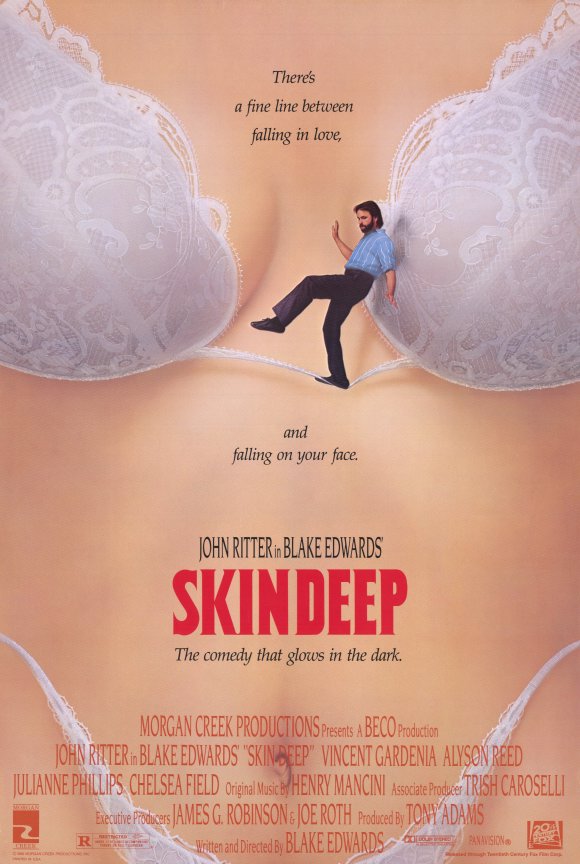
When it came time for something to watch on that night I was going to go with THE PINK PANTHER, partly because I’ve seen “10” and S.O.B. so many thousands of times by now but at the last minute I decided to go with a more unusual choice, one that represented the sort of Blake Edwards film I was able to experience first hand during that run in the eighties when he worked at an extremely fast clip for any director (A FINE MESS, THAT’S LIFE and BLIND DATE all came out within a seven month time span in ’86-’87, for example). Released in March 1989, SKIN DEEP was near the end of that particularly prolific run, playing now as it did then as a very conscious riff on themes he had certainly explored in the past and if it’s not one of his best films it’s certainly one of his more successful efforts during that period. I think for a while I may have been slightly ashamed by how much I genuinely liked what much of the world probably thought of as a goofy John Ritter comedy but I don’t really feel that way anymore. When I saw it at the time of its release, without knowing how to put it into words I recognized that Edwards was openly exploring some of the same themes as past films and it allowed me to approach it as what I understood was an ongoing body of work. This idea probably opened me up to the concept of a director with a distinctive vision exploring serious themes within the context of a comedy and I think that added to my education of what a personal film really could be, only adding to my continued fondness for it. It’s not perfect for a number of reasons but it has a large amount of genuine laughs, a surprising amount of depth and every frame of it feels completely like a Blake Edwards film right down to its core.

Famed writer Zach Hutton (bearded John Ritter) is being held at gun point by his mistress who has caught him with another woman when his wife Alex (Alyson Reed) walks in on all of them. She immediately kicks him out of the house “lock, stock and typewriter” and divorces him. Zach immediately tries to pick up the pieces of his life, living for a time with Molly (Julianne Phillips) but soon is spending much of his time alternating time between his favorite bar run by friendly but pragmatic Barney (Vincent Gardenia) and sessions with stone-faced psychiatrist Dr. Westford (Michael Kidd) as well as getting involved any number of other women. But he soon finds himself spiraling out of control in doing way too much drinking and absolutely zero writing, eventually coming to the realization that Alex may be the only person who can save him but her bitterness over how things ended means that it may be too late.


Apparently when wife Julie Andrews began to write her autobiography Edwards’ one piece of advice to her was, “Characters are your story,” and even more than his films usually are, SKIN DEEP is all character but it’s also about the very essence of character as well and whether it really is possible to change, a concept impeccably fused through every scene of the story as it explores this theme. Like Edwards, Zach Hutton is a very prosperous creative individual married to a woman who is successful in her own field (Alyson Reed does slightly resemble Julie Andrews, come to think of it) but the conflict he has to face within himself and with his ex-wife is presented as very serious in this movie, one which is of course best known for a certain legendary glow-in-the-dark condom sequence. Very much playing like an attempt at redoing his way-too-low-key version of THE MAN WHO LOVED WOMEN, itself a remake of a Truffaut film (the Edwards version had a bearded Burt Reynolds as a sculptor), SKIN DEEP has Edwards approaching this material with a great amount of spark and energy through farcical situations of Zach drunkenly bedding (or at least trying to bed) one woman after another, variations on material he’s explored before but the pacing is always fast and sharp, with displays of anguish that have a surprising amount of teeth to them as well.


Of course the film has a terrific lead actor willing to make every pratfall required of him by Edwards-- when someone has to get knocked over by a flailing Ritter she can’t just be carrying a few files, her arms have to be overloaded with them before they all go flying. And as for the infamous condom sequence which part of the ad campaign was based around, while it’s probably not as uproarious to watch at home as it was in the theater it is still pretty damn funny. It’s all presented with impeccable narrative economy such as how the immediate flourishing and destruction of his relationship with Molly is dazzlingly well-executed in just a few deliberately similar shots. The laughs veer into drama in rapid fire ways that sometimes seem genuinely disarming all through the continually literate dialogue (maybe I should just make “Not being able to write is like not being able to screw” my motto once and for all) and any number of beautifully turned phrases from Edwards’ ever-present knack to presumably amuse himself by tossing big words or discussions of such phrasings into conversations. I just love the flow of in recounting one story to his psychiatrist, Ritter tells how he tried “to be alert to the narrative possibilities of the evening.” Not to mention the presence of the oft-used phrase, “Nobody’s perfect”, most associated with Billy Wilder of course, but which also turns up in several of Edwards’ films here and there as if he’s always trying to remember that there’s only so much you can do to save yourself.


And, yes, SKIN DEEP focuses largely on the problems of extremely wealthy white people who live in large homes complete with manservants. The plight of the rich is nothing new with Blake Edwards films, of course, whether we’re talking about how Charles Litton’s big problem in RETURN OF THE PINK PANTHER is that he’s bored doing nothing but living the high life in the south of France or characters like Zach Hutton here and Jack Lemmon’s near-suicidal architect in THAT’S LIFE! going through problems considerably more desperate. Edwards clearly understood the self-hatred that lurked within the wealthy Malibu/Bel Air milieu as much as he was always trying to make sense of his own depressions and insecurities, at times seeming to view all that wealth around him as if he wanted nothing more than to bring all these mansions crumbling down, letting waves crash into Malibu to wreck homes and expose every bit of rotting hypocrisy that can be found there. There’s also the latest in the long line of sympathetic and layered gay best friends in Edwards films presented in the most casual manner possible, here represented by the interesting pairing of Peter Donat and Don Gordon (Steve McQueen’s partner in BULLITT) and a key death that occurs stood out at the time because it wasn’t the typical AIDS tragedy. Looking at it now, this plays as something which not only doesn’t date the film but also makes the foibles of the characters in question (never specified, just as Edwards must have known his friends went through as much anguish as he did) that much more identifiable, an element which doesn’t badly date things in this well off west L.A. in a way that the fashions do. To be fair of course, any number of his films from various decades feature fashions and references that lock things into their era as much as that bit player in “10” reading a copy of “Rona Barrett’s Gossip”, with SKIN DEEP displaying lots of big hair and shoulder pads on the women and even some of the men’s suits manage to look oddly dated but if SKIN DEEP is going to be a film about a stylized Blake Edwards world of 1989 I suppose there’s nothing wrong with that.


SKIN DEEP has a large number of genuine laughs and the inner conflict of its lead character always feels raw, honest and potent. All this said, the film isn’t perfect, and contains a fair number of the drawbacks people familiar with Edwards’ work would recognize, like my suspicion that only a screenwriter in his 60’s would name a heavy metal band the Moon Rocks, maybe a slight indication that the writer who once identified more with the ‘elevator music’ written by the lead character of “10” was that much more isolated from pop culture by the end of the 80s. Its effectiveness is also somewhat damaged in how surprisingly dingy it looks at times (the Panavision framing as Edwards lets scenes play out in his usual long takes is always impeccable, of course) and there’s a feel around the edges that the budget wasn’t as high as he was sometimes used to. What maybe hurts the film the most is what sometimes hurts any film that amiably drifts along unconcerned about actual plot—by a certain point it realizes that it needs to actually go somewhere and this one slightly fumbles in the home stretch. The occasional presence of what appears to be a false beard on Ritter during the second half—possibly changing from one to the other in the same scene more than once—indicates the possibility of reshoots after principal photography as Edwards was maybe still finding the movie in an attempt to focus more on Zach ultimately choosing to pursue Alex (lengthy aside—examples of severe reediting weren’t all that uncommon with Edwards’ films with several featuring scenes included prominently in publicity that never turned up in the final version, like the sequence in A FINE MESS involving the music box that the entire film was meant to be centered around, but ultimately cut. Trailers for a few other films have tantalizing glimpses of cut scenes forever to be found in the trailers with the occasional remnant still lurking in the actual movies if you know where to look hard enough. For me, I think this has only added to the nature of trying to sort out how character and structure work in Blake Edwards films. End of lengthy aside).


The nonstop speed as it moves towards its conclusion hurts things as well and even when some of the dialogue is surprisingly frank about what the lead character is going through in all the best ways (“I’m so miserable, I want to fucking shoot myself. Only I can’t, because I’m afraid to die,” he desperately reveals to his therapist) that when things are resolved so fast in such a neat way it feels just a little like a reach for a bullshit happy ending. It doesn’t make me dislike the film—the final beats are just fine, actually. But it feels like a case of turning its back on too much of the anguish that propelled Zach’s precarious situation forward and it’s not as effective an ending as it should be. At the movie’s best it’s still the right kind of potent vodka but it still feels like what had the potential to be great just comes off as pretty good. Repeated viewings over the years have only helped to clarify this feeling but I still have a huge admiration for a lot of what the movie achieves and feel it deserves better than it’s gotten. SKIN DEEP is flawed, yes, but it does know to dig deep into its character and is occasionally truly hysterical. Not to mention that with the star and director of this two-decade-old film gone now, listening to the lead character speaking of trying to fix things before it’s too late reminds me how fast time really does move in this forever darkly comic world we live in and makes watching it now all the more wistful an experience.


The cast is just fantastic and every scene demonstrates how much Edwards clearly loved working with his actors, allowing them to continually make a strong impression in front of the camera. John Ritter (who I actually remember seeing a number of times on San Vicente Blvd. in my Brentwood days) does some of his strongest work here in probably the best film role he ever had. As lightweight as his presence might sometimes be he rises to the occasion here totally and completely, tears coming to his eyes while flirting as if just the act of doing this fills him with such indefinable joy he can’t help himself, as well as succeeding in making every inch of his desperation late in the film totally palpable. Plus he pulls off some of the most remarkable physical work of his career and there’s once or twice where I’m a little amazed that they never cut away to let the stuntman take over. He’s also matched well up against Alyson Reed who is more mature looking than the sort of beauty maybe expected to be cast in this film (she seems older than Ritter in every way but if the dates are right she’s actually several years younger) and the film wisely uses her inherently serious nature well, with her character’s bitterness at him in the opening scenes feeling genuine and that carries through the film, always remaining in the back of the mind even as the laughs keep up. Joel Brooks as lawyer/best friend Jake deserves props for the way he says “I gotta get home to the fucking loved ones,” while also standing out in the large cast are Vincent Gardenia as Zach’s loyal bartender, the legendary Michael Kidd as the psychiatrist, Chelsea Field as the brunette in turquoise who Zach makes the mistake of trying to buy a drink for (I once recognized her and blurted out “SKIN DEEP!” to which she responded something like, “Ugh, that was so long ago.” I always had a thing for her), Nina Foch as the angry mother-in-law, Dee Dee Rescher as the wife of Jake who can never stop laughing and Denise Crosby as investment counselor Angela Smith. Herb Tanney, Edwards’ friend and doctor, makes his usual cameo appearance this time playing a Hotel Concierge and credited as ‘Sol Vang Tanney’.


I had the privilege of seeing Blake Edwards at a few events over the years and stood as part of a standing ovation for him several times. The last one was at an Academy tribute only back in September where he spoke in an onstage interview with producer Walter Mirisch before a screening of S.O.B. He was clearly weak but the wit was still sharp and, rather movingly, he managed to rise from his wheelchair to acknowledge the audience after the sold out Academy theater rose for him. Another time I saw him speak was after a screening of WHAT DID YOU DO IN THE WAR, DADDY? at the Aero in Santa Monica, which included a genuinely odd Q&A that he conducted from his seat in the audience, Julie Andrews by his side, and answered one question about his style by simply saying, “I did what I did,” one of those statements that I suppose says both nothing and everything at the same time. But even more cherished than that was his surprise appearance at the same theater after an American Cinematheque screening of THE PARTY a few years back where his presence at the rear of the theater was revealed as soon the end credits finished rolling and the entire audience rose in unison to applaud him for the absolute joy he had just provided for the past 99 minutes. I went to the lobby right after to pay my respects and tried to fumble out words to him of how much I loved his movies, how much they meant to me, but probably didn’t do a very good job of expressing myself. At least I got the chance.

And now I think about how much I love some of these movies, how much they’ve taught me about writing screenplays, their structure, their dialogue, how comedy can be staged, how any kind of genre can possibly be staged and how much I respond to how he tried to explore that indefinable chasm between man and women, madness and sanity, pain and joy, drunk and sober, thoughts that come to mind at times when I meet women like that cocktail waitress I had at the Dresden the other night who was charmingly abrasive in a way that would have made her seem right at home in a Blake Edwards film (maybe I should write my own Edwards-inspired romantic comedy about trying to date her). And I think deep down I emulate some of my favorite films of his more than any other films from any other director. This stuff is a part of me, right down to my core. A number of hours after hearing that he died I sat at my desk and looked at a clip of the quietly touching final scene of THE PARTY, a final scene that bravely allows the hysteria of that remarkable film to die down, coming to a gentle conclusion instead of just going for an obvious final gag. As I watched it and listened to the soothing sound of Mancini’s beautiful “Nothing to Lose” I remembered how those credits rolled the night at the Aero, with Edwards quietly in the back watching unbeknownst to anyone, how much this movie has meant to me every single time I’ve ever seen it and I suddenly found myself crying. I was crying for the loss of this man I never actually knew but who possessed a cockeyed view of the world, and of films, that had come to mean so much to me. And always will. To quote William Holden at the end of S.O.B., “So long, pal.”