Wednesday, October 24, 2012

Friends Can't Be Perfect

If anything, I’ve tried to keep my mind open through the years, stay open to the possibilities of what I’m going to respond to in films whether we’re talking about high or low art, inscrutable elegance or sleaze-filled nastiness. There are some people out there who seem to feel that the films they like are the films they like and they’re so set in those ways that they have long since passed the point where they can waver in those beliefs. Therefore, anything that goes against this dogmatic viewpoint is simply incorrect. Wrong. Bad. I disagree with this way of thinking at least partly because it indicates a certain closed-off mindset but also because it seems to completely suck out any enjoyment of movies. It’s good to analyze films, it’s good to break them down, leading to a fuller appreciation of what they are and what they can be. But there also needs to be pure enjoyment out of it all which is what sometimes seems to get forgotten. This leads to my honest admission is that I haven’t always been a fan of director Tony Scott through the years. Not that I don’t appreciate a good joke about TOP GUN but in my younger days I found his style of visual overkill not a little joyless and downright pummeling. But when TRUE ROMANCE came out in 1993 I found myself not only loving the film for Tarantino’s script but the mix of that with the style Scott brought to it all that seemed absolutely right. As the years went on I continued to find myself admiring some of his films including CRIMSON TIDE, ENEMY OF THE STATE, with MAN ON FIRE in particular thrilling and undeniably powerful in its intensity, a huge step forward for him. Even going back to the very beginning of his feature career, some of the best moments in THE HUNGER remain vivid in my mind years after the last time I saw it. And UNSTOPPABLE, which turned out to be his last film, was an absolute blast and compelling in all the right ways. And then in August of this year the director left us through horrible means that remain baffling and truly sad.
The funny thing is that Tony Scott and his filmmaking style have become so ubiquitous in what has become common cinematic language that even if I haven’t always liked it I’ve gotten used to it so by this point it’s safe to say that it’s ingrained in what I expect from the modern day action film. In the wake of his death I rewatched BEVERLY HILLS COP II which I’ve never really liked and in all honesty still don’t but I’ve just gotten so used to whatever it is--a flashback to the Simpson-Bruckheimer 80s, a reminder of Brigitte Nielsen, memories of a childhood spent seeing movies at Yonkers Movieland, whatever, I’m just kind of glad it’s there in case I need a hit of that particular brand of cinematic crack. Because to be completely honest every now and then I kind of do. And I’ve more than come around on THE LAST BOY SCOUT which I also was hesitant towards way back when, film school-era snobbery I suppose, preferring the DIE HARD/LETHAL WEAPON end of producer Joel Silver’s oeuvre, then such a major part of pop culture (recent news that his long association with Warner Brothers ended made me sad, it really did). I like it more than I did then, but still do have some minor issues and maybe as insane as the film is I almost wish it could be crazier or maybe just cut loose from the expected action formula even further than it does. But in all this mixture of Tony Scott/Joel Silver/Shane Black/Bruce Willis/Michael Kamen that is gloriously violent and profane in all the right ways…ultimately what is there not to like? Can’t I just enjoy myself? Head or gut? Ask me how fat your wife is. Turn up the volume. Cue the explosions. Let’s have some fun.
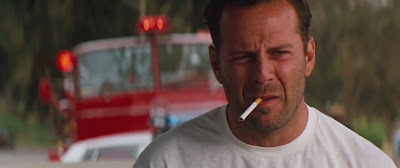
Private detective Joe Hallenbeck (Bruce Willis) hasn’t even started his new job when he discovers the one who recommended him, best friend Mike Mathews (Bruce McGill) sleeping with his wife which is shortly followed by being killed when his car explodes. And then he’s barely able to begin his assignment of protecting stripper Cory (Halle Berry) who believes someone is threatening her when she’s brutally killed by gunmen in the middle of the street. And so Joe along with Cory’s boyfriend, ex-football star Jimmy Dix (Damon Wayans) team up to find out what happened to Cory leading to a conspiracy involving the owner of the Los Angeles Stallions owner Shelly Marcone (Noble Willingham), Joe’s own pre-teen daughter Darian (Danielle Harris), the Senator who former secret service agent Joe has a history with and a hell of a lot of gunfire.
More than anything when I think of Tony Scott’s films, whether I like them or not, it’s the undeniable energy that comes to mind, a determined force that brings unfettered life to the feeling that there’s a determination to get the footage needed for this film in the can at all costs as well as a sense of joy that, I don’t care what you say, has never been present in any of Michael Bay’s films. And when he’s faced with having to shoot something as ridiculous as Bruce Willis running down the middle of the street in slow motion firing two guns at once it’s like he just says, “Fuck it” and films it with every ounce of the most iconic gusto possible. In the best moments of THE LAST BOY SCOUT, it builds to a fever pitch of excitement through every bad joke and nasty comeback that gets spit out in a way that’s kind of glorious. It’s a style that also has its drawbacks—with all those long lenses and smoke there’s sometimes the honest feeling that even in close-ups we’re not necessarily getting a good look at anyone’s faces and there are moments where, yeah, I wish he’d just linger a few beats longer than he does. I sat down to look at THE LAST BOY SCOUT for the first time in several years in memoriam to its director and found myself almost thinking more about the film in relation to some of the people Scott was working with in collaboration, possibly not always that easily.
Throughout its 105 minutes THE LAST BOY SCOUT seems like a unique combination of what I always think of as the Simpson-Bruckheimer aesthetic as displayed in the ferocity of his visual approach mixed with what was then the house style of the Joel Silver excessive violence done in good time 80s pop-style stable, also represented here by the presence of Bruce Willis, Shane Black and even composer Michael Kamen who only worked with Scott this one time--the typical bombast that comes from his action music familiar from many of the films produced by Silver during this period seems oddly like an afterthought as if for the director the feel just didn’t go with his style so it was kind of buried in the mix.
As for Shane Black and his script (Story by Black & Greg Hicks, Screenplay by Black) the plotting is very much of the LETHAL WEAPON school—maybe a little too much, it could be argued—but, though part of the film’s reputation seems to come from how allegedly misogynistic it is there’s also the first thematic inklings later seen in his 2005 directorial debut KISS KISS BANG BANG’s exploration of how women can be treated by the men in charge in the noir-tinged city of angels. But as intriguing as this plays during certain moments there really are just a few inklings of this concept since the focus is ultimately on Joe, Jimmy, the corrupt world of professional football and the revelations of the gambling conspiracy they uncover, so maybe Black didn’t fully know how to address these thoughts burrowing in his brain at this stage, or in this particular storyline, to do something with it that would make people think of it all as more than simple misogyny.
Black’s LAST BOY SCOUT screenplay sold for what was then a record-breaking $1.75 million and it’s strange to be talking about this film that celebrated its 20th anniversary last year (released 12/13/91—after all, some of the best cinematic Christmas gifts to the world are the most violent) like it’s a piece of ancient history now. The pairing of Bruce Willis and Damon Wayans did decent business—while never becoming the sensation that LETHAL WEAPON was it also didn’t fall as short commercially as what happened with Black’s next big spec sale THE LONG KISS GOODNIGHT several years later. More than any number of films made around ’91-’92, THE LAST BOY SCOUT has survived because of its humor and action and just general over-the-topness and, yeah, I like it more than I did then. I probably laugh out loud sitting in my apartment watching this more than I do with some outright comedies and when things propel forward at a nonstop rate once we hit the hour mark the combination of humor, action and incessant nastiness (“Touch me again and I’ll kill you”) feels like it all mixes together in the right way more than it doesn’t. Sure, some of the most memorable touches have more to do with Shane Black’s dialogue and no surprise how quotable some of these lines still are--there are plenty of lines that I could single out but in context ‘we’re being beat up by the inventor of Scrabble’ might be my favorite.
Thinking about all this also reminds me that maybe, like BEVERLY HILLS COP II, THE LAST BOY SCOUT reveals that directing scenes for comedy wasn’t always Tony Scott’s strong suit—for that matter, I still can’t quite get onboard with the broad satire in DOMINO but I’m open to trying it again one of these days. Watching COP II and SCOUT close together, each film at the very least containing similar establishing shots of the Beverly Hills Police Department, actually reveals how much stronger he already he was by this point just four and a half years later, pushing both the actors and action in a way that just feels more ferocious, more energetic, not as fixed in to whoever the star was and willing to go more towards the absurdly profane world he wanted to present. It feels like he’s moving away from being so much under the thumb of Simpson-Bruckheimer towards using that visual style for his own purposes as well as being an early example of not only populating his films with the strongest actors possible whether the size of the part warranted it or not, he makes those moments pop in a way that other directors aren’t always interested in exploring. And it’s a nice, nasty look at L.A. as well—in addition to making it seem like cars blowing up or getting punched in the face are just normal, everyday events the light shining down during daylight hours always seems to be that of a Los Angeles that has just been rained on, making it not as welcoming as it often seems.
Its presentation of a Shane Black script also reveals some of which elements he was interested in when compared to other directors working with that material—Richard Donner in directing LETHAL WEAPON (as well as its sequels which Black stepped away from) seemed to think nothing of basically stopping the plot for extended periods for no reason other than to let us just enjoy the characters. There’s no equivalent of Mel Gibson trying to talk a jumper down from the roof of a building and I’ve never read Shane Black’s script for THE LAST BOY SCOUT but if such scenes were in there it feels like the sort of thing that Tony Scott doesn’t have much use for, instead continually insistent on propelling the plot forward as fast as possible (or at least giving the impression of this) which prevents it from ever being dull and works just great when it comes to the action scenes—the propulsive nature of the car chase to the Coliseum framed from mostly low angles moves so fast that it barely even has a chance to announce itself as ‘the car chase’—but also makes me wish there could have been a little more breathing room, at least to build the relationship between the leads. The notorious attention-grabbing opening sequence doesn’t do much for the plot beyond grab the attention of anyone watching (still, it certainly does that) and Taylor Negron’s Mr. Joshua-equivalent bad guy doesn’t even turn up until over an hour in—of course, he’s the voice heard on the phone in the opening and considering how Gary Busey and Mitchell Ryan were presented in a ‘introduce the bad guys’ scene in their movie I wonder if one was originally here too.
It could be said that until Joe Hallenbeck is captured leading to the events that quickly spiral into the climax plotwise the second act doesn’t consist of much beyond the two of them wandering around looking for clues, finally almost bonding in the requisite hanging out before the tension between the two boils over. In other words, it almost feels like not quite enough happens for the friendship to build to the fadeout, that Scott doesn’t have the patience to hold on the two stars just bickering with each other for a few minutes. Richard Donner wasn’t always the greatest at tonal shifts (his films also have an incessantly cheerful pop flavor that, truthfully, makes me wonder how well they’re going to age) but he at least knew that it was sometimes a good thing to at least do that. When you are going to provide that energy in your films at the expense of every single other element sometimes it’s a good thing, sometimes it isn’t. That’s just the way it is.
For Bruce Willis I suppose this film was considered a minor comeback after the response to HUDSON HAWK earlier in the year but since that film has a villain who proclaims “I’m the villain” and THE LAST BOY SCOUT has a bad guy who announces “I am the bad guy” so maybe they’re not that different after all. Either way, Willis slips into Hallenbeck with every ounce of contempt for everyone oozing through his stubble with a bitterness going beyond his smirk, a decent guy who’s lost his faith in a cynical world where heroes don’t matter anymore. I can appreciate an action movie hero who looks at himself in the mirror and says, “Nobody likes you. Everybody hates you. You’re gonna lose.” Just like I do every single morning. He makes it work. He and Damon Wayans play off each other all right but never seem to fully click, maybe because Wayans doesn't quite have the right weight for the part. This time around I found myself wondering how this would have played with Eddie Murphy sticking to the Shane Black dialogue. Chelsea Field of Blake Edwards’ SKIN DEEP and Danielle Harris of HALLOWEEN 4 & 5 spar well with Willis as Hallenbeck’s wife and daughter, each seeming more than willing to get in his face with their insults, but of course they’re now overshadowed by Halle Berry as Jimmy’s ill-fated girl Cory who’s in and out in just a few scenes. She’s raw in some of her line readings, but looking absolutely gorgeous she’s already clearly got something. Taylor Negron oozes his way across the screen as ‘the bad guy’, pulling off just the right balance of making it seem like he’s enjoying playing the bad guy and making it genuinely seem like he’s thinking the most vicious thoughts imaginable. It’s also fun to see some of the familiar character actors who turn up throughout like Bruce McGill, Clarence Felder and Joe Santos as Hallenbeck’s cop nemesis. He isn’t playing his ROCKFORD FILES character but, even so, I’m not quite sure what the difference is.
I think I could have had more fun back then. I’m referring to the first time I saw THE LAST BOY SCOUT on opening weekend but probably also to a lot of things as well. I’m more willing to now, especially because I’m all too aware of how much of a schmuck I am. Not to mention that it’s also nice to be reminded of an action movie that really is a fucking action movie. As well as being a movie that says you shouldn’t let the good part of you die in a cynical world. It’s a message that rings true today since, as Hallenbeck says at the end, ol’ Satan Claus is still out there. But thinking about it now I do wonder how those involved with THE LAST BOY SCOUT felt about the finished film. Tony Scott didn’t work with Joel Silver again, not to mention either of the stars—at that point he was still a few years away from hooking up with Denzel Washington for five movies. Silver and Bruce Willis, who struck gold with DIE HARD 1 and 2 then had to deal with all the HUDSON HAWK brickbats earlier in ‘91, apparently parted ways after this. Damon Wayans never became the big time movie star he seemed like he might for about five minutes and several years later co-starred with Adam Sandler in BULLETPROOF, definitely one of the worst buddy action movies of any kind ever made. THE LAST BOY SCOUT deservedly has its fans but maybe has fallen through the seat cushions a little as if it was a film made by certain people when they badly needed a hit and afterwards just moved on to other things. When Edgar Wright attempted to program the film at a festival and get Scott come to discuss it the director convinced him to change the selection to TRUE ROMANCE which, it should be remembered, features a Joel Silver-like producer played by Saul Rubinek. Maybe THE LAST BOY SCOUT is meant to be kind of the ugly stepchild of all this but it wears that badge with violently profane pride, an admirable and valuable piece of Tony Scott’s cinematic legacy. One that I may not always be able to embrace, but deep down have a certain amount of love for anyway.

Wednesday, October 17, 2012

Love Is For The Very Young

I don’t know anymore. I don’t have any answers. If I did, I’d have an idea of what to do. At one point in Vincente Minnelli’s MGM opus TWO WEEKS IN ANOTHER TOWN several of the main characters sit down in a Cinecittà screening room to see a film made by legendary filmmaker Walter Kruger (Edward G. Robinson) and starring the recently arrived Jack Andrus (Kirk Douglas), a washed-up movie star who’s been flown in to Rome by his old director to help out on a troubled project. What they’re viewing is never named but the scenes we see are from THE BAD AND THE BEAUTIFUL made a decade before also for MGM, also starring Douglas and also directed by Minnelli who is clearly engaging in a game of mirrors by using clips from this particular film, one that is extended through how both movies are themselves about the movies, the various array of mirrors that exists within them and whatever state the people working in that industry find themselves at that point in time. Released in 1952 in glorious black & white THE BAD AND THE BEAUTIFUL is the one that seems to have been officially sanctioned by the world as a classic but 1962’s TWO WEEKS IN ANOTHER TOWN is the one I find myself continually drawn to, almost feverishly so.
I’m not saying that it’s better (although the presence of Daliah Lavi certainly helps) and if pressed I’ll admit to a few apparent flaws but there have been occasional stretches where I’ve found myself repeatedly returning to this film. Recently has been one of those periods, if that’s what you want to call watching it three times over the course of a week. I’m not even sure I can say why. Maybe part of it is wish-fulfillment, a fantasy of Rome and Cinecittà in the early 60s as seen through the Technicolor CinemaScope phantasmagorical eye of Vincente Minnelli. And from that eye is the fateful stare-into-the-abyss-the-abyss-stares-back-at-you delirium with the logic of a drunken party that you’ve stayed at way too long until suddenly discovering that you’re the only one left. Maybe that’s how I feel a lot of the time lately. The two films have a great deal in common in some surprising ways and if Jack Andrus had been paying more attention to watching what he starred in all those years ago—if it’s even the same film, which doesn’t really matter—then he might have noticed more than a few similarities in the rhyming nature of how some of it corresponds to what eventually happens to him during those two weeks in a faraway city. Films that aren’t sequels generally don’t acknowledge each other as much as BAD and TWO WEEKS do with even composer David Raksin getting into the game with a score that is at times so close to what he did years earlier it’s as if he was never told that it wasn’t really a direct follow-up. Whichever one I prefer, THE BAD AN THE BEAUTIFUL in all its height-of-studio-system glory is no slouch, not at all and I should probably admit that it’s ‘better’ even if the one that I really love is still the one that I really love.
But truthfully, I’m still not sure if THE BAD AND THE BEAUTIFUL is a classic that deserves to be ranked among the greats. Even compared to other films that mine the depths of Hollywood despair it never really gets under my skin like SUNSET BLVD. or IN A LONELY PLACE. It’s a tribute to Hollywood, after all, not an indictment and maybe it’s the soap opera feel to it all, maybe it’s the undeniable MGM sheen of prestige and quality hanging over the whole thing which, at the risk of having the Self-Styled Siren throw something heavy at me, keeps me at some kind of distance aware of how perfectly in place everything is, how calculated every single gesture and emotion seems to be impeccably rehearsed well ahead of time. But regardless the full power of the film is so engrossing and so entertaining even if it all is in a trashy, faux-prestige nature it’s the sort of film that sticks in the brain enough in a CASABLANCA sort of way with scenes, performances, moments, lines, glances, that make me feel like I’ve seen the whole thing 25 times even though I know that I haven’t. But even if THE BAD AND THE BEAUTIFUL is more sumptuous than nutritious it still plays as the sort of rich, juicy meal that could only be prepared by MGM back in the day with all the best filmmaking talents and facilities in the world at their disposal. So I guess it is a classic. Nothing wrong with that, not at all.
Successful Hollywood director Fred Amiel (Barry Sullivan), Pulitzer Prize winning novelist and screenwriter James Lee Bartlow (Dick Powell) and movie star Georgia Lorrison (Lana Turner) all refuse to take phone calls from Jonathan Shields, someone they all clearly have a past with, resulting in the three being summoned to the office of studio executive Harry Pebble (Walter Pidgeon) to try to convince them to hear Shields out on a new project. Pebble recounts to each of them through flashbacks the tales of their relationships with Jonathan (Kirk Douglas)—how Amiel rose up with him through the B-movie ranks and then was tossed aside after developing his own passion project, how Georgia was single-handedly turned into a star by him then cruelly abandoned and the bestselling author Bartlow who came to Hollywood with starstruck wife Rosemary (Gloria Grahame) and thanks to Shields suffered the greatest tragedy of all.
The ghost of CITIZEN KANE hovers over THE BAD AND THE BEAUTIFUL (screenplay by Charles Schnee, based on “Tribute to a Bad Man” by George Bradshaw) all the way through, playing as a more streamlined version of depicting the fall of a great man shifting it from a tycoon to a Sleznic-Thalberg type and considering John Houseman produced the film, references in dialogue referring to Shields as “Genius Boy” probably mean there’s a little bit of Welles also. He’s a bastard, but one with his own reasons and ultimately one who wants to rule the industry not change it. Even the flashback structure is smoothly linear, simply moving from one person to the next and even keeping others alive both before and after their individual stories have been told. And there’s also the reliable presence of Paul Stewart as press agent Syd about as blatant a KANE nod you could make, playing a vaguely similar character and his very demeanor is such that you believe he’s someone who really does know where all the bodies are buried.
I don’t know if THE BAD AND THE BEAUTIFUL is really an incisive view of the industry either then or now in the way it pulls away the curtain at all the backstabbing. In fact, I’m going to guess that it isn’t even if it once may have seemed so to audiences who only knew what they read in fan magazines. He’s definitely no Sammy Glick since Jonathan Shields’ ambitions actually include making good movies in addition to the power that comes from selling himself and the people screwed over by the title character of Budd Schulberg’s “What Makes Sammy Run?” were forever damaged by his actions—the ones hurt by Shields instead thrive so even if he’s abandoned them he’s put them in positions to be able to thrive. And nothing that happens is ever seamy enough for the Hays Office to object so there’s nothing like abortions, drug addiction, not to mention how for what’s supposed to be a biting look at the industry for the most part everyone who works there seems pretty supportive of each other, happy to let extras go a little early in the day to audition for a bit part across town with their ever-loyal agent, one the struggling actress stays with even after she becomes a star, no less.
But through every juicy behind the scenes business is a romance of old time Hollywood of up-and-comers desperately trying to scrape together a movie with nothing, with a card game, rushing the reels over to a test screening before waiting for the cards to come back so you know if the movie will be a hit. Looking up the film reveals a few of the real-life inspirations for its characters even down to the early bit Lana Turner’s Georgia Lorrison plays set in a drugstore playing off of the legend of being discovered. The most obvious would be the creation of the Val Lewton style of not showing very much of the horrors being depicted—a film called DOOM OF THE CAT MEN isn’t a reference that’s too hard to get but it also very obviously doesn’t have much to do with the filmmaker in question—in this tale making that kind of trifle is just a rung up the ladder to getting to the point where you can finally make a film out of that book you’ve been carrying around dogeared for years while crashing ritzy Hollywood parties that are strictly black tie. Through it all the film gets us to taste the addiction that comes from being part of this world, through the silvery eye of cinematographer Robert Surtees and Jonathan Shields remains an enigma, maybe one all the more fascinating in this glossy Hollywood, determined to throw the past as represented by his father and how Hollywood forgot him back in its own face while at the same time never forgetting it—if he sees a kindred spirit in hard drinker Georgia Lorrison’s own obsession with her father he never says so and Jonathan, whose one weakness seems to be the booze he almost never touches, never quite says everything that would completely explain him and his behavior, right to the very end of each of his relationships.
THE BAD AND THE BEAUTIFUL presents a Hollywood that has (seemingly) always been there and presumably always would be, just as the 1954 version of A STAR IS BORN depicted the town only a few years later. By the time of TWO WEEKS IN ANOTHER TOWN a decade on everything is falling apart—the likes of Louis B. Mayer are for the most part dead and gone, the studio system is in its death throes and the money man in charge of what’s being shot cares even less about the quality of the end result than the “Give me a picture with a kiss in the end and black in the ledger!” exec Jonathan Shields had to deal with on DOOM OF THE CAT MEN. The town has been rendered so unimportant as filmmakers flee to far-off places in Europe that none of the film is even set there, only spoken of as a place where the past happened.
In some ways TWO WEEKS thematically picks up where BEAUTIFUL left off with a presumed reconciliation based on the excitement of a new project but the later film reveals the various emotions involved to be more complicated than that—loyalties aren’t always what they seem like they will be and parts, whether whole scenes or even brief dialogue exchanges, continually recall what has come before. A jovial scene on a beach where the leader of the gang seemingly orchestrates a marriage proposal for two lovers becomes a wistful musing on what never really was in the second film. The torch song “Don’t Blame Me” turns from an upbeat singalong by friends on the way home from an all-night party to Leslie Uggams sadly belting it out at a Roman gathering somewhat more unseemly (apparently presented as more of an orgy in the original cut) and a desperate, possibly suicidal drive through the Hollywood Hills filmed entirely from the inside of the car becomes a desperate careen willingly attempting to replicate another such drive as Cyd Charisse screams endlessly next to the frenzied Douglas, with a blatantly fake use of rearscreen projection that becomes genuinely hypnotic in its own unreality. Even the very first on-set encounter Lana Turner’s Georgia Lorrison has with Jonathan Shields in BEAUTIFUL is essentially what happens to her later on after he’s turned her into a star—the seduction followed by the abandonment. For Shields, it’s the only way to live. For Jack Andrus in TWO WEEKS his entire life is taking place after that final abandonment as he finds himself in another town searching for redemption from a father figure who may never have been able to offer it in the first place until he finally discovers that it doesn’t really matter. After all, if you do attach yourself to someone the only thing that can happen is getting hurt and in the end you’re just left there, all by yourself next to a phone that doesn’t ring. In the dead of night, drunk or sober, all you’re left with is yourself and that’s what you have to come to terms with if you’re going to come up with a decent reason to get up the next morning.
As for the man who stars in both films, watching Kirk Douglas as Jonathan Shields is most rewarding during those moments when we can watch the gears in his brain turn, showing the genius that makes him a success. On the other there are those over the top moments where we essentially see him as Kirk Douglas doing Kirk Douglas (making me think of the long ago “Kirk’s Greatest Kirks” sketch on SATURDAY NIGHT LIVE). Top-billed Lana Turner, her eyes bugging out as he screams at her, maybe becomes better the more I see the film with the layers of what remains with her during her low points through the time when she’s a full-fledged movie star. The calmer portrayals of Dick Powell, making some of the best use of a pipe in screen history, and Barry Sullivan balance out well with them as does the forever memorable Gloria Grahame in her Oscar-winning performance as the always-interrupting Southern belle Rosemary. It’s a wonderful cast, also including Paul Stewart as Syd, the infectious enthusiasm of Gilbert Roland as Latin lover Victor Ribera (“Gaucho?” everyone in the world seems to reply when his name is spoken) to, Ivan Triesault as Von Ellstein whose lecture on making every scene in a movie a climax has sadly mostly been forgotten by filmmakers today. Even the bit players stick out particularly Kathleen Freeman, Barbara Billingsley and Ned Glass trying to push those damn cat men costumes on Fred and Jonathan. The ferociously beautiful Elaine Stewart shows up for only a few scenes but gets some of the best lines in the film—“Thought you were swell” is a pretty great kiss-off and her “There are no great men, buster. There’s only men.” is the sort of line which seems designed to be nothing more than a great line but that’s what most of the dialogue seems meant to be anyway which, considering how this movie trumpets each star as loudly as possible during the opening credits, is appropriate. It’s a film that seems designed to be great and important, or at least possess the illusion of that, in the tony style that only the finest artisans at MGM could provide filled with dialogue that feels like it’s trying to be great, memorable dialogue in all the best ways.
And just as appropriate as the proclamation “Filmed in HOLLYWOOD USA” that accompanies the end title card which seems a point of pride like never before in any other film released by MGM. It’s all about selling the illusion. Midway through the film as Jonathan takes an important phone call it’s made clear that he knows Georgia is listening in on another line. She picks up again on another call at the very end, joined by Fred and James Lee this time around and though we never cut to Jonathan in Paris it’s easy to believe that he once again knows very well that she, as well as the others, are listening in. It’s the thrill of wanting to hear what his surefire idea is, of course, but it’s also all about the seduction. We know it’s going to continue. That’s the way it always is. Until it isn’t and the film they made years later where that’s what happens only serves to make the final shot of THE BAD AND THE BEAUTIFUL all the more complex. I can daydream of a third part to all this coming another ten years later—Kirk playing a mogul losing his grip in the EASY RIDER era. That old MGM didn’t really exist anymore by that point and Minnelli certainly didn’t have the same sort of power he used to so maybe that’s best left as a daydream. And since my general daily mindset lately is that of the desperation of Joe Gillis in the first ten minutes of his own movie these are the sort of things that stay with me. Is there anything to do once you feel nothing but that emptiness? Is there anything to do once that loneliness is staring you in the face? Is there anything to do to bring back that feeling of hope, that feeling that you really can accomplish something? Should I watch TWO WEEKS IN ANOTHER TOWN yet again tonight? Or should it be THE BAD AND THE BEAUTIFUL? And, maybe most importantly, does anything that happens in Hollywood ever really happen? Even after living in this town longer than I probably feel like admitting, I’m still not sure.

Thursday, August 30, 2012

Go With The Tie

Earlier this summer I had a birthday, just as I do around the time of the Summer Solstice every year, giving me yet another chance to take a long walk of the soul and ponder all those things I haven’t done yet in life. At the opening of AUTHOR! AUTHOR! playwright Ivan Travaliyan played by Al Pacino arrives home to find his family greeting him with a surprise for his 42nd (or maybe 43rd) birthday leading to various wacky hijinks. I haven’t gotten to this age yet but I’m pretty close and when I was a kid this kind of birthday probably seemed really old, the sort that only a full-fledged adult had. Alas, I don’t have a townhouse in Greenwich Village and I’m not in rehearsals of a play that I’ve written about to open on Broadway but considering I haven’t lived in New York for nearly two decades now anyway maybe I’m just looking for things to complain about. Plus I don’t have a roomful of kids yelling at me but there are friends whose houses I can always go over to for that.
Celebrating its thirtieth anniversary this year (released June 18, 1982) AUTHOR! AUTHOR! is pretty much forgotten by now except for (I suspect) anyone with memories of countless HBO viewings way back in the day. It’s an odd duck of a film considering the ‘Al Pacino family comedy’ subgenre doesn’t have very many entries in it and for the actor the film sort of falls in between the wirey, high-pitched first part of his career and the later, raspier Al starting with his comeback in SEA OF LOVE. The iconic nature of Tony Montana in SCARFACE always seems to fall outside of these periods but AUTHOR! AUTHOR! feels linked to some of his other films from both periods if only for its New York setting. Truth be told, there is a certain pleasant flashback vibe I get from it, down to how when at one point he walks through some slush on a winter New York street I can almost feel the sensation of how cold and wet it must be. Those New York winters stay with you. Idea for double bill: pair this thing with CRUISING just to weird people out. AUTHOR! AUTHOR! is the sort of film that I could never really be too harsh on because, really, there wouldn’t be any point but it never becomes all that great either. Buried within the material is maybe something that could have been more than just a genial family comedy if it had made an attempt to really address the pain and anguish that comes from trying to combine all sorts of things in life just to make it through the day. But it’s really just a pleasant movie. With some good actors. And kids. One that’s set in early 80s New York. A New York where seemingly everyone makes wisecracks from Pacino to Alan King (naturally) to the kids to waitresses in restaurants as they serve the food. I can think of worse ways to spend a few hours even if I’m not going to make a great case for it.
New York playwright Ivan Travalian (Al Pacino) is mounting his latest production “English with Tears” on Broadway dealing with the usual issues of finding directors and moneymen when the frenetic-but-normal world of his homelife comes to a halt when wife Gloria (Tuesday Weld) chooses to walk out on him leaving their five children, one his and the rest hers from various previous marriages, in the lurch. Ivan sends a few of the kids off to live with other parents and rehearsals for the play begin complete with inclusion of film star Alice Detroit (Dyan Cannon). But even when a romance between Ivan and Alice begins to brew and she moves in he can’t help but admit that not only are the kids the ones he really cares about he’s still in love with Gloria. And, with opening night of the play fast approaching, there’s still the pesky issue of the second act to worry about.
I spent enough time in a few certain places down in Greenwich Village back during the 80s that there’s a certain familiarity I get from some of AUTHOR! AUTHOR! which has to say something. Even if Al Pacino was trying to broaden his appeal by taking on a KRAMER VS. KRAMER family-type project (or maybe just trying to do something diametrically opposed from CRUISING) it still seems like a strange marriage with his particular kind of screen energy. While the film certainly goes down easy enough the conflict in the screenplay by Israel Horovitz (of course, a playwright himself as well as the father of Adam Horovitz—apparently the script is, no surprise, somewhat autobiographical) is too minor, the emotions never feel all that tapped in as if there wasn’t a real attempt to dig into any of the complexities and considering that the director was Arthur Hiller who I always imagine as being a genial sort with nice hair who never wants to upset anyone too much (still, any filmography that contains THE AMERICANIZATION OF EMILY, THE HOSPITAL, SILVER STREAK and THE IN-LAWS is in no way a washout), that could very well have been the case. In its own sort of less-jokey Neil Simon vein the whole thing is likable enough, fortunately never becoming overly cloying, but just a little too nice and polite.
Actually, considering the New York setting and various members of the cast I can’t help but imagine a version of this material directed by Sidney Lumet who wasn’t exactly known for family films either but he did know what to do with emotions and if his version wouldn’t have been quite so cuddly for the kids it might have had more resonance. Because as much as this world is familiar to me and as much as there are some stabs at a feel of an actual lived-in world it still occasionally feels a little too cute with behavior that has more to do with the movies than real life, like hitting someone in the face with their own birthday cake or hailing a cab on impulse to go from Manhattan to Massachusetts and back (kind of like what Tom Hanks did two years later in SPLASH). Truth be told, there is more of a feel of reality to it than there probably would be in such a film now and I keep going back and forth in my own mind about how good or not-good it really is, maybe just not wanting to be too harsh about it all--Tuesday Weld has a near-impossible part to play considering how awful her character has to behave but some distant memories of events I had a vague awareness of involving distant relatives make me think that some of it is sadly believable in terms of something that may actually happen between a divorcing couple and the kids affected by those actions. When the character finally has to explain herself the actress makes the words seem about as genuine as they could under the circumstances but even this beat is undercut by how when Pacino finally (and justifiably) chooses to dismiss her the way the beat is cut doesn’t even allow us to see her own reaction robbing the moment of its own emotional complexity so it all feels a little incomplete.
The film vacillates between emotional complexity (like how the chemistry between Pacino and Cannon’s characters doesn’t last beyond their initial tryst) and making things a little too neat (their inevitable break-up). It’s sort of nice to have the runner of characters bickering about the second act, comedy legends Bob Elliott and Ray Goulding lurking on the outskirts of scenes as the concerned producers dropping sly dialogue and various other pieces of business even if there’s the feeling that Pacino isn’t entirely comfortable with some of this rat-a-tat dialogue—just about his best moment in the film is when during a fit of writers block he accidentally crumples up a piece of paper before even putting it into the typewriter. The title is explained late in the film by a reference to a play where people screamed “Author! Author!” on opening night but it immediately closed anyway. The pleasures and rewards aren’t going to be trumpeted by the world but you still need to get through it anyway and maybe you can find your own rewards by doing that. The overall message of AUTHOR! AUTHOR! is a little pat but it never feels as cloying as it would in a Chris Columbus-type movie which is something that, looking at it now, is kind of refreshing. The kids all get along except for friendly bickering but it still treats them with respect and not just as joke machines—when one of them describes in detail the extent of their extended family it sounds outlandish but strangely, sadly, plausible as well. Of course, I doubt that it would be appropriate for any other Al Pacino movie to contain a main theme that features the lyric, “Coming home to you is like coming home to milk and cookies…” and in some ways that odd combination sums up the film—kinda nice and it honestly does provide me with more than a few smiles whether they have to do with nostalgia or just the pleasure of watching it now, but with Al Pacino at the center of everything a little more digging into all these emotions wouldn’t be so bad. It might even make the cheerful stuff mean that much more.
In the book “Al Pacino: In Conversation with Lawrence Grobel” the star doesn’t have much to say about the film beyond saying he liked working with the kids. But aside from seeming particularly engaged with them during many of these scenes his energy doesn’t feels totally there as if he’s realizing during production that there’s not as much for him as an actor to explore in this environment as he thought there would be. As a result it’s as if he puts himself into kind of a zen state with some genuine laughs poking through like when he mutters “Who is it?” after a phone rings at a moment of tension. The issue of the women feels unclear--maybe because the screenplay never fully connects with them, maybe because the character who is clearly the surrogate for the screenwriter never does. The movie star played by Dyan Cannon (who also appeared in DEATHTRAP which of course was the 1982 film about a playwright Sidney Lumet actually did direct), defined by taking aspirin when she drinks champagne more than anything, seems incomplete which is maybe to represent how the two of them don’t fully connect after she moves in and she’s nice enough to have around for a little while—the movie avoids easy jokes about her character being a stuck-up Hollywood actress—but can’t do much with the underwritten role. Weld’s character is also underwritten up until the edge of her final scene but even then it still feels like there needs to be more. I’m sure it’s totally unintended but the enigma that is Tuesday Weld’s career actually adds to the enigma of her character’s behavior here. The always enjoyable Alan King and Bob Dishy are fun to watch bounce off Pacino and Eric Gurry as his son (one of the kids who reprised the role in the later pilot of a TV version that didn’t go to series entitled FULL HOUSE, also written by Horovitz and which starred Dennis Dugan as Travalian) does a particularly nice job in scenes with his onscreen father. All of the kids (including Ari Meyers, later of the sitcom KATE & ALLIE) do at least seem somewhat real in various ways, I’ll give the film that much.
Amidst all the early 80s pleasantness one thing that also warrants mention is the Dave Grusin music heard throughout which gives me the vibe of his score for TOOTSIE, a film that didn’t open until six months later but the basic sound is similar enough that you could almost imagine characters from one film turning up in the other since they’re both set in New York, after all. When revisiting AUTHOR! AUTHOR! not too long ago I was surprised by how abruptly the movie goes to the credits at the very end, barely even giving a chance to see Pacino’s reaction to the all-important New York Times review for his play. I think my memory had the characters all walking off into the Times Square night in full celebratory mode but that’s me probably just confusing it in my mind with NIGHT SHIFT, also ’82, and a film that really does end in such a way with its own infectious pop melody. The film’s imdb page indicates that there may actually be a few different cuts out there (the version aired on FMC that I watched actually credits Johnny Mandel, whose score was rejected, with the music so there may be something to this) but whatever the truth is all this goes perfectly with my long-standing theory that every movie is just one big movie, moments from each of them swirling around in our collective memories until it becomes almost impossible to tell any of them apart. That may sound a little nuts but it’s not as crazy as the fact that I just wrote a piece on AUTHOR! AUTHOR!

Thursday, August 23, 2012

Easier Said Than Done

I’m still here. I swear that I am. One thing I never got to do was interview Blake Edwards. Sure, I shook his hand once or twice and got to see the man in person at screenings on a few occasions but that was really it. I wish I’d gotten the chance. Although, to be honest, if given the choice I probably would have preferred the opportunity to simply sit down for a meal with him--Julie Andrews would have been more than welcome to join us, of course. Maybe that way I would have learned even more about the man than simply asking him boilerplate questions, find out his feelings about the finer things in life and in the end possibly would have gleaned more about why his movies are the way they are. I’ve written about my fondness for some of them here before and recently when I posted some photos of him on my Facebook page during what would have been his 90th birthday, I was surprised when his daughter Jennifer (who I’m FB friends with but don’t actually know in real life) left a comment under one of them saying how it wasn’t an easy day. I certainly wasn’t going to click ‘like’ on that so I wrote her a brief note, she wrote back a thank you and that was really it, nothing much at all. But it was something.
Such a connection, however minor, compelled me to watch a film of his that night and for whatever reason I pulled out a VHS (purchased at the Rocket Video closing sale) of one that Jennifer Edwards is actually in, namely THAT’S LIFE! It’s a particularly personal comedy-drama made by the director under unusual circumstances during a period of heavy activity (released in 1986 two months after A FINE MESS, five months before BLIND DATE) but it seems to have disappeared in recent years—even the one DVD release it ever got, now out of print, was full-frame which as anyone familiar with Edwards Scope compositions would know is particularly unfortunate. It had been a while since I’d seen the film—spring of ’94, actually, at a LACMA event that paired it with THE GREAT RACE and featuring a Q&A with none other than Jack Lemmon beforehand. I guess that was a long time ago now, an appropriate thought to have about a movie in which one of the main characters comments at one point on how it all goes by so fast. Looking at the film again with quite a few more years behind me—the fear of mortality that the lead character dotes on actually feels a little tangible to me now, for one thing—I feel all the more aware how this film wasn’t just personal or even autobiographical for Blake Edwards but almost surprisingly private, laying bear his greatest fears and insecurities for anyone to see more than all the pratfalls Dudley Moore took in “10” ever revealed. I’m not sure it ever gets under the skin as some of his more bitingly comical films do maybe because he’s intentionally holding back on certain elements that he does best but, if anything, it feels honest and sincere.
As successful architect Harvey Fairchild (Jack Lemmon) begins the weekend that is to be spent celebrating his 60th birthday longtime wife, famous singer Gillian Fairchild (Julie Andrews), is undergoing her own crisis as she waits for the results of a biopsy in her throat that she has chosen to keep secret from Harvey for the time being. As the countdown to his birthday party progresses he can’t stop acting feverish about his fear of death, fear that he’s a failure and even fear of intimacy but as family and friends converge all around at their Malibu home, some with their own personal romantic issues going on, he’s not sure how he’ll even make it to the end of the weekend while Gillian silently awaits word of her own crisis even as the party begins.
THAT’S LIFE is an unusual film not only because it was shot almost entirely in the actual Malibu residence of its director with various offspring playing onscreen family members but in how it wasn't made with a typical screenplay (Edwards and Milton Wexler, his own psychoanalyst, are credited). “Returning to the Scene: Blake Edwards Volume 2” by William Luhr and Peter Lehman reports that the closest it had to a shooting script was a thirteen page outline followed by thirty-six pages of character analysis and expanded upon through improvisation during rehearsal—the unorthodox production setup of the non-union shoot resulted in problems with the teamsters but the independently financed film still only wound up costing $1.5 million. The approach almost feels all the more out of the ordinary considering how the final film plays--although a few moments seem to linger on what’s being said between the characters a beat or two longer than you might expect there isn’t really anything about it that comes off in a loose, improv style. Except for how it’s clearly made on a small scale with over half the running time taking place in one location the basic look still has the same sort of glossy feel similar to other Edwards films made right around this period.
Using the actual residence of the family in the plush environs of Malibu far away from many of the real troubles of the world and even making Andrews’ character a singer it’s hard not to think that this film looking at mortality is set in a world totally alien to about 99% of the people who would ever see it and it’s hard not to wonder that there is some validity to the criticism that it’s just about rich people’s problems even if this is the reality that Blake Edwards clearly knew. Maybe the one real concession towards trying to make it somewhat relatable is in not only casting one of the most beloved movie stars of all time in a lead role that pushes the boundaries of likability but also how Harvey Fairchild is not a film director but an architect, at least a somewhat down to earth profession. Edwards certainly had set his films within the film industry a few times in the past—if Judd Apatow ever remade this I doubt he would hesitate—so maybe he just wanted to avoid that angle this time out. Still, anything Harvey says in his “Success Breeds Failure” theory could apply to trying to make films in Hollywood as well and when he’s going on endlessly to his wife in all his desperation about how he could have been another Frank Lloyd Wright it’s easy to imagine Edwards himself at a similar low point saying the same things to the very same woman playing this man’s wife about how he never became the next Lubitsch, Sturges, Wilder, take your pick.
THAT’S LIFE! is very obviously wrenchingly personal in terms of what he wants to get across about himself, his wife, his family, his fears, his life done with maybe a tone that comes off as a little scattershot in how it observes everyone. Some of it is completely earnest, some of it makes stabs at being more comedic but as it goes on the best moments are those that feel surprisingly human in an offhand way that I would imagine grew out of the improv approach--Harvey insisting on the correct way a lobster should be cooked, the talkative neighbor played by Sally Kellerman going on about her own kind of sixth sense or when Gillian finally lays into her husband at the party with everything that’s been building up insider her for the entire film in a way that pierces him right at his core. And even in this decidedly loose structure are touches that feel truly like Blake Edwards in how they’re allowed to build—a minor runner about Harvey not shaving results in a joke turns out to be not only funny but also thematically pertinent. If anything, the emotion holds even if much of the film feels ‘nice’ as opposed to particularly funny but while it’s tempting to wish that the film had been made using just a little more of the acidic nature found in the director’s best darkly comic moments it turns out that the weakest section occurs when it does try to broaden things—an extended stretch dealing with Harvey’s, um, virility problem as he visits a Malibu psychic played by Felicia Farr (Lemmon’s own wife, also in films like Wilder’s KISS ME STUPID) followed by a prolonged sequence where he attends Sunday mass presided over by a priest who turns out to be Harvey’s college roommate played by Robert Loggia feels a little too separate from the rest of the film (that said, I like the way the old tensions between the two of them are shown to build up again without making a big deal about it). All this connected to the ambivalent take on (possible) adultery diminishes the more serious stretches as well as the inevitable happy ending.
Instead of a pungent cocktail with the sort of kick that his best films have THAT’S LIFE! winds up feeling more like a pleasant cup of tea. Not that there’s anything necessarily wrong with a cup of tea, of course, it just needs to be said. Instead of the undeniable anger at all the madness around him conveyed in something like S.O.B. this film has a feeling of genuine desperation as it searches for some kind of acceptance of the way things really are. Maybe it’s appropriate to call it an old man’s movie even if that does sound pretty condescending and it goes down easy enough but the full result never feels as memorable as its best individual moments. Some of these display the razor thin line between comedy and drama that occurs when the Lemmon is portraying his character in near-hysterics over whatever pain he’s in, done in such a way where you could almost imagine an audience not sure how to respond and this isn’t even the only one of Edwards’ films where that happens either (Burt Reynolds plays a very similar scene in THE MAN WHO LOVED WOMEN) but in this case maybe it needed a little more punch. Once Gillian has her blow up at Harvey and things get resolved the final moments seem to drift away providing final glimpses of the various characters as if Edwards is somehow striving to lend just a shade more meaning to all this but it almost feels like the film’s own attention is wandering when suddenly the credits begin to roll. There is emotion felt, but it’s all maybe a little too neat and tidy since it’s hard not to wonder if Harvey really will be totally changed for the better on Monday morning. After all, that sort of anger and desperation never entirely goes away, at least not that quickly so it feels like something is missing in how the film doesn’t take a moment to acknowledge this. THAT’S LIFE is a nice movie which considering how personal it clearly was for Blake Edwards that may be the cruelest thing to say about it but looking at it again now I feel exposed to the depths of his own psyche in a way that doesn’t happen with his other films. I just wish there was a little more to it than the feel of a pleasant home movie, as valuable as it may be to understanding him both as an artist and a person even a little better. After all, watching it is probably the closest I’ll ever get to sitting down for a meal with him. As a film, it’s far from perfect. But it does remind me that he was human.
As for his onscreen surrogate, there’s not a moment Jack Lemmon has here that isn’t real in some way (“I just sat back and let Jack be me, to some extent,” the director once said) and there’s something brave in how unflinching it is. But as much as the actor’s usual tics feel more grounded than they sometimes do in depicting a character which is essentially the film’s director showing himself as being self-obsessed in the most aggravating way possible it’s a problem that almost every single one of those moments has to be drenched in such flop sweat that it winds up enveloping the whole film a little too much. As a result his strongest moments are when he’s doing something else—I find the climactic close-up of him after Andrews’ big speech almost unbearably moving but there’s also the various lighter moments sprinkled throughout where the character is suddenly finding a way to come to life and forget about all the pain briefly. Presumably playing herself at least to a certain extent Julie Andrews has to spend much of her performance simply listening, gazing at him with all the love in the world, while we know inside she’s agonizing over what she’s keeping secret and she’s wonderful, able to come right to the point when necessary. She’s the heart of the film and clearly a display of how for Edwards she was the heart of his own life as well. Using actual family members of those involved (including Jennifer Edwards, Andrews’ daughter Emma Walton and Chris Lemmon as the Fairchild’s three children) certainly adds to the intimate feel so there’s an undeniable feel of intimacy always present but the entire supporting cast, also including Sally Kellerman, Robert Loggia, Theodore Wilson, Cynthia Sikes and Dana Sparks all do excellent work.
To this day I associate Blake Edwards films and the mood they often capture with summertime. But here I am looking at THAT’S LIFE! which is decidedly autumnal, if not approaching winter, and I think about how this hasn’t been much of a summer at all. Am I more depressed these days when I wake up or when I go to sleep? Am I complaining as much as Harvey Fairchild does? I also think about the film’s plea to cherish the time that is left, how it all goes by so fast and I recall that at the Academy tribute to Blake Edwards just a few months before his death in 2010 he told the crowd how he wasn’t much in the mood for celebrating since his old friend Tony Curtis had just died the day before. That’s life, I suppose, forever trying to celebrate the good while reminders of mortality are always there, even if you are fortunate enough to live in a place like Malibu where the waves crash up to your doorstep all day long. It’s a film that is about insisting on literally stopping and smelling the roses, even giving us a shot where Julie Andrews does just that. “It all goes by so fast,” she tells her daughter (both onscreen and real-life) at one point in THAT’S LIFE! which not only reminds me how both Edwards and Lemmon have now left us but also how the depiction of Gillian’s health crisis in this film managed to predict Andrews’ own later real-life problems as well. It makes me wonder about what I’ve done, why I haven’t accomplished some of the things I wanted to in life. There’s no good reason why I haven’t updated this blog lately. Maybe I’ve just been looking for a reason to keep doing it. Looking for a life. Looking for the inspiration to write something on one of those long and lonely nights in the middle of summer. Sometimes I think that I’ve found it, but it’s easier said than done.

Thursday, June 14, 2012

Even The Intolerable

Whether we like it or not, some films exist. That’s just the way it is. I mention this simply because there are no doubt some people out there still pissed about the whole killing of Hicks and Newt thing at the start of ALIEN 3. What with them being fictional characters and all I’ve sort of gotten over it by now. And particularly in these days when it feels like every franchise is processed through a CGI filter to make it as crowd pleasing as humanly possible for all I’ve come to flat out admire the willingness of a summer tentpole to be as unrelentingly bleak as possible. You could make the argument that any film set within the ALIEN universe of Weyland-Yutani is supposed to be a horror film anyway so a certain amount of darkness should really be allowed but there is something to be said for how dangerous it can be to pretty much disregard the previous entry in a series during the opening moments of the next sequel as much as this film does. And if those who made the film didn’t know how people were going to react, if they didn’t know how strongly people really had responded to the characters in ALIENS, it’s a little surprising that no one ever bothered to speak up (an early teaser trailer that implied the film would be set on Earth probably didn’t help matters). The tortuous gestation that the film went through following the smash success of the previous film in 1986 involving multiple screenwriters and directors in different iterations has been reported elsewhere so I won’t go into all that now. The film was of course finally helmed by David Fincher making his feature directorial debut and considering how one alternative would have been to produce a more-of-the-same followup from a journey man director just following orders in a ‘Further Adventures of Ripley and her Friends’ vein at least the resulting film goes down a few paths that really no one would have expected during all those years in between but one thing I’ve long said is that it’s not enough for a film to be dark. It’s an admirable quality, yes, and when done just right the final result can be like a punch to the gut, sticking with you for a long time afterwards whether you want it to or not. But ALIEN 3, for all its sound and fury and doom and gloom and noise and clanging and death and more death, never manages to achieve such resonance maybe because through the clusterfuck of trying to simply get the film made the script was never hammered down into the right form in order to find a reason for its own existence beyond the fact that it’s a sequel. This first look at Fincher as director remains an undeniable glimpse at his potential, particularly now that he’s made a few films where the end result of all that bleakness did have its considerable rewards. And as bad as the initial response was even then there were a few dissenting voices to ponder the thematic implications that came across as Manohla Dargis did in a Village Voice article (which unfortunately can’t be found online) a few weeks after the release entitled “ALIEN 3 and its Metaphors” which delved into the connections to the AIDS crisis amid the politics of the time. But such discussions don’t automatically make something good. It just means there’s more to discuss. As some may know an extended cut (145 min. vs. 115 min.) was released on DVD a number of years ago but I’ve only ever seen pieces of it—I suppose my auteurist leanings make me less interested since Fincher who has nothing good to say about the film to this day (“No one hated it more than me; to this day, no one hates it more than me,” was the quote in a 2009 interview) declined involvement and has apparently never even seen that version. So in writing this I’m focusing on the theatrical cut of ALIEN 3 not only because it’s what I have close at hand but because it’s the movie I’ve known since opening night in Times Square way back on 5/22/92 (Happy 20th Anniversary!) and have seen more than a few times through the years as I’ve tried to reconcile this film with my own expectations as well as my own perceptions of what it’s trying to be. As far as I’m concerned, this is the ALIEN 3 the world has to contend with, the one with a trailer that trumpeted “The Bitch Is Back” maybe the best and worse tagline ever. I even had an ALIEN 3 t-shirt at the time which had that slogan on the back. Still can’t believe I actually wore it. If there’s a great film in there, one we’ll never see, it still feels miscalibrated—it's a film with an onscreen title which makes it look like it should really be called ALIEN CUBED but it doesn’t really mean anything, just a piece of design that has nothing to do with actual film and I suppose the entire film has the feel of an art project that doesn’t quite feel molded to completion which based on what’s been reported about the production appears to be exactly the case. As films that are hated go, at least it feels totally committed to the tone it strives for even though all these years later I still don’t think it ever becomes good enough to defend very much beyond its intentions. Soon after the events of ALIENS, an alien egg hatches on the Sulaco where Ripley (Sigourney Weaver), the young girl Newt, Corporal Hicks and the android Bishop (Lance Henriksen) are in hypersleep traveling back to earth from the events on LV-426. As emergency procedures are activated the ship releases their pod and it crash lands on Fiorina “Fury” 161, a former prison colony populated by a group made of of double Y chromosome murderers and rapists once inmates, now custodians who have taken vows in an environment so treacherous that everyone on the planet has to shave their heads due to prevalent lice. Ripley is the only survivor of the crash but even though she insists on the bodies of her friends be cremated she still suspects that an alien has followed along with them which she conceals from all including inmate leader Dillon (Charles S. Dutton), Warden Andrews (Brian Glover) and the facility doctor Clemons (Charles Dance) which she gradually begins to form a bond with. But as they wait for the rescue team that’s been sent for her, strange happenings appear to confirm that there is in fact an alien on the planet which for Ripley leads to the most horrifying discovery of all… Exactly when the alien queen was supposed to have laid an egg on the Sulaco during the climax of ALIENS is a question that goes unanswered but, really, the best answer to be found of course is that it was decided that an egg had been laid so that this film could be made. In terms of narrative ALIEN 3 (Story by Vincent Ward, Screenplay by David Giler & Walter Hill and Larry Ferguson) is a direct continuation of the previous film even more than ALIENS was to ALIEN but it seems not only uninterested in continuing the threads that people found so satisfying in the James Cameron film the way it plays right from the Twentieth Century Fox logo is as if in making his own film David Fincher wanted to reveal that quintessential product of the eighties to be a lie, a breaking apart of the Reagan-era family unit borne out of the ashes of Vietnam that all those marines represent, to lay bare the feel good rollercoaster and essentially punish the audience for getting even a little enjoyment out of this. Looking at ALIEN 3 as the ignominious death of the eighties—as well the eighties blockbusters I grew up seeing—and blowing what came before to smithereens isn’t all that unappealing and the apocalyptic tone is both undeniable and unrelenting but regardless of what the film’s subtext is the text is never strong enough to support it. A things wind up playing out that subtext doesn’t feel fully thought out on its own either. In a way the film begins in such a place of total darkness there’s nowhere else to go in terms of drama beyond simple nihilism and even watching the film now when the bodies are dug out in the first minutes it’s hard not to wonder what’s the point of going on with the actual movie, what’s the point of Ripley going on and when she makes a few wisecracks to prove to the prisoners how tough she is it’s almost like, who cares? Why does she even care anymore? With no sign of relief the film is nihilistic to the point that it feels as if it’s being made by somebody who just discovered the word in a dictionary and wants to make it all as punk as absolutely possible. The approach is so dark it’s hard not to admire what it’s going for through all its apocalyptic imagery and it isn’t every day a summer blockbuster contains a sequence depicting the (mostly off-camera) autopsy of a little girl leading to Charles Dance as Clemons announcing the cause of Newt’s death, hammering it home with the statement, “Lungs flooded with fluid. Ergo, she drowned,” the sorrow heard in Elliot Goldenthal’s score seems intent on shattering the dreams of anyone who had spent the six long years between entries wondering what could come next. It’s not even a cool science fiction movie death, it’s just sad. For simple drama it’s almost as if the film should end right there and even the ceremonial funeral of Newt and Hicks as their bodies are dropped into Fury 161’s furnace never surpasses this moment of hopelessness, maybe because the insistence of intercutting Charles Dutton’s speech of death in the shadow of new life with the newest alien at last being born is just a heavy handedness that plays as wrong, a first year philosophy student that thinks they’re being deep in trying to provide an APOCALYPSE NOW sort of frisson. And these reaches for meaning intermingle with a narrative that always feels in search of an actual story to frame amidst the elements. Ripley takes up a sort of companionship with Clemons but as good as Weaver and Dance are in their scenes together—the way they play off each other with both of them withholding certain secrets feels refreshingly adult unlike any other relationship she has in the series—but her presumed distrust in telling anyone about what’s going on feels like too much of a contrivance, an attempt to keep some drama going where there just isn’t enough of any, one of the most crippling elements of the entire film. The story never feels solidified to the point that when several minutes are taken up by a plan to catch the alien that ultimately goes nowhere maybe it’s meant to represent the futility of it all as these characters get stripped away of any possible chance of survival but instead it feels like the movie is just treading water for several minutes, waiting for new script pages to come in so they’ll know which way the plot is going. Through this muddle you can feel the roots of how strong Fincher would be in just a few years’ time once the world got a look at SEVEN—there are specific shots in almost every scene so haunting it feels like even more a shame that it all never comes together and there’s a certain energy he brings to the rhythm of dialogue scenes between characters that plays very much as how he would shoot such things even now with a casual realism to certain offhand moments that at least helps with the verisimilitude. Photographed by Alex Thomson, who replaced Jordan Cronenweth after a few weeks of shooting, the craft is certainly strong--the camerawork couldn’t be better and the desolation of this look is undeniable, stripping this future world down to as little technology as possible with the confidence of Fincher’s visual style feeling completely present even at this early stage. As director he always seems interested in both the environment and the actors in it, clearly taken with the sets he gets to shoot on but for all the atmosphere continually present in any given scene but as dark as the aesthetic is it’s never particularly scary and I never get the feeling he has much interest in science fiction as a genre or in the alien itself beyond its metaphorical implications—born of a dog it may be slightly different than the creature in Ridley Scott’s original but the same level of mystery and intrigue paid attention to it is never there. It just feels like a monster, that’s it, period, and ultimately is the least interesting incarnation of the creature during the four films in the series Weaver starred in. The AIDS metaphor feels more blatant now than ever and with so much attention paid to all the snarling bald dudes in this grunge environment (part prison movie/part convent movie, if you will) it’s a reminder of when this was made in the early nineties, almost as if the film was striving to be the first big-budget piece of queer science fiction, maybe shown on a double bill alongside Derek Jarman’s EDWARD II with a woman (one of “the intolerable” as Dutton calls her to her face early on) who has invaded this holy sanctuary eventually accepted by this tribe of men who come to realize that in the eyes of those in charge she’s no different than they are. But the details of the community never feel all that clarified and don’t really matter anyway with the film paying more attention to the attempted rape of Ripley by some of the prisoners as heavy metal riffs play on the soundtrack (this one scene aside, the score by Elliot Goldenthal remains one of the best things about the film, providing just the right fateful tone and giving the film whatever soul it manages to have). And the fact that they all seem to be a bunch of bald Brits--Pete Postlewaithe is one--who we can never keep track has long since become the most clichéd thing to say about the movie but it’s also true. And if there’s a thematic reason why we can’t tell them apart—just wondering if there is must mean I’m really trying to give this film the benefit of the doubt—that doesn’t play either any more than the protracted climax where we never know where anyone is in relation to each other, just playing as a lot of running and yelling while the rescue team takes an eternity to finally reach them. Considering how one commonality the two stylistically dissimilar films by Ridley Scott and James Cameron share are characters that remain beloved to this day makes it all the more clear how much the film fails on this point and it’s interesting to consider how in recent years few directors have provided solid roles for familiar character actors as David Fincher, so lesson learned I suppose. Forget about not being able to care about these convicts—but it could be asked that compared with the working stiffs of ALIEN and the marines of ALIENS exactly why should we give a shit about a bunch of convicts?—there’s never a good reason to maintain even a slight interest in them so with much of the focus on how hopeless things are and Ripley shouting “They don’t give a fuck about you or any of your friends that died!” to drive the thematic point home even further he doesn’t seem to be putting much thought into actually making it scary. There are small touches of offhand humor or bits of business (because, in spite of its reputation, there is some humor in the film) very much in the vein of moments in later Fincher films alongside moments where you can feel him wrenching a genuine feel of loss from it all. The film’s best moment may be its simplest with Charles Dance’s Clemons finally sharing the dark secret of his past with Ripley who offers him salvation in the form of her trust immediately before the inevitable happens. This is shortly followed by the most iconic image of the film and as the tension rapidly builds with Ripley racing to the mess hall it culminates in what feels like it’s meant to be one of the big jumps of the film but the way things are staged it feels like Fincher didn’t have the time to get things right although letting a certain squeezey ball dropping to the floor certainly helps. The controversial ending (spoiler alert? Does it matter?) involving the newborn alien growing inside Ripley finally bursting through her chest right at the moment of her dive into the prison facility’s furnace is both ridiculous and memorable at the same time, not only an appropriate punchline to it all but also containing the sort of HEAVY METAL-like imagery that hasn’t really been seen in the series since the Ridley Scott film. The assembly cut omits this key moment, simply having her fall in to her death which, like any number of conceptual elements even in the theatrical cut of the film feels somewhat lacking. Maybe there’s no way for there to be a version of the film that could somehow be right for all sorts of reasons. I admire things about ALIEN 3. I admire the sense of doom. I admire the bravery in how much of a downer it wants to be and how it carries it through to a brave conclusion. But it’s not enough. If Fincher ever had a concept that could have won over the people who were going to be pissed off—or even if there was a strong enough concept regardless—it’s like he never got to follow it through to its conclusion. Or maybe it was just a bad concept to begin with, even if his talent as shown here is already very much in evidence. As frustrating as the material often is Sigourney Weaver delivers a powerful performance, maybe even better than her Oscar nominated work in ALIENS, and she finds the right pitch of grim desperation in her plight as she continually sizes up what she’s up against. Charles Dance does strong work as well particularly during his final moments and the low key nature of how the character has resigned himself to this place is an ideal balance with the much more dynamic Charles S. Dutton (“It’s Roc!” someone called out on opening night in Times Square) whose character gradually builds in prominence and while the role may be underwritten the film’s energy shoots up each time he’s around with glasses attached to his face that seem at times like a permanent fixture. Lance Henriksen is in for just a few scenes—half his performance is as Bishop from ALIENS though done with a (very impressive pre-CGI) puppet head and the other half as a Bishop lookalike who may or may not be human feels like the actor going for a certain ambiguous menace…but it’s still kind of a gimmicky cameo. As for all those Brits the several who get to interact directly with Weaver seem to up their game whenever she’s around, particularly Brian Glover as Warden Andrews (I like his “This is Rumor Control” patter), Ralph Brown (like Paul McGann who plays Golic, also in WITHNAIL & I) as Mr. Aaron and a pre-fame Postlethwaite but most of them are, well, bald Brits who blend together. One point of the film that does deserve unreserved praise is the score by Elliott Goldenthal, which completely earns every ounce of apocalyptic flavor it’s clearly going for and giving the film whatever soul it actually manages to achieve. The way the closing moment of ALIEN 3 contains the echo of a certain past log recording indicates how much regard David Fincher had for the Ridley Scott original and maybe also how the James Cameron sequel didn’t rank quite so highly for him. I was just a few years too young for ALIEN at the time but have come to regard it as a masterwork along with everyone else. When ALIENS came out I was just the right age and absolutely loved it but the film hasn’t stuck with me in quite the same way maybe partly because it seems so much a part of that decade—really, it’s set in a future where the 80s never ended—and partly because the Syd Field perfection of James Cameron’s structure in his storytelling reveals just how schematic some of it is. With David Fincher’s ALIEN 3 I was one of those who had spent years wondering what the followup could be and was maybe a little puzzled by what I got on opening night but maybe its messiness as well as its refusal to contain even an ounce of catering to the audience has kept it stuck in my brain all this time through further sequels and spinoffs that had nowhere near as much on their mind. Even if it is fatally, irrevocably flawed from frame one. I don’t like the film but as it is sometimes I feel compelled to confront it, not dismiss it, to see it again to study it, not to let my eyes glaze over. And its horrors do feel more internal, more lasting. It’s not about marshaling your forces to kick the alien’s ass as you scream, “Get away from her, you bitch!” It’s a statement that we’re all fucked, especially when ‘the company’ is in charge, a sentiment which has more resonance now in this age of ‘Corporations are people too’ and will probably continue to be more relevant as time goes on. And it’s about the question of if you are fucked, with none of the plasma rifles of ALIENS to defend you, are you going to go out on your feet or on your knees. Maybe there was no way to make a valid continuation to the story told in ALIEN and ALIENS that would satisfy anyone so the film had to die in order for it to be anything at all, but at least it goes out fighting. I still can’t call ALIEN 3 good but maybe sometimes what really matters is that a film which exists is able to express a desire to simply be alive before the credits roll in order to get into our heads, even if it’s for only a few short moments before we go back to dreaming of those happy endings we still hope to someday find.