Saturday, January 31, 2015

Anything That You Can't Avoid

Time goes on and you don’t know what to do with it so one day you wake up and you have vivid memories of things that happened twenty years ago. But in those recollections you’re not even a kid anymore but an adult with actual bills and responsibilities. The nostalgia for yourself has already shifted. And you’re thinking of a few of those paths you never quite went down from the girl you met at a party and just assumed you’d see again but never did to that other girl who years after you last had a drink with her stumble across a photo of with her newborn baby on the internet or that girl who used to live in your building who you still half-expect to get a call from one of these days saying that she’s back. The memories all swirl together and movies are a part of that which means sometimes I find myself back during opening night of PULP FICTION at the Chinese because that seems like a pretty good place to be stuck in. But you can’t be stuck there, any more than you can go back and find one of those girls from long ago. You’re stuck now in the mysteries of now, the films of now. Plus I’m stuck in my apartment trying to figure out what to make of INHERENT VICE. This shouldn’t have been that much of a problem. Paul Thomas Anderson’s last film THE MASTER affected me and glommed onto my gut like few films have done in the past decade and I’m still hypnotically drawn to it. In comparison I am drawn to INHERENT VICE and feel like I’m finding my way in there slowly although the film’s deliberate impenetrability makes that difficult, much as it might seem like the sort of film that I can get a hold on pretty easily. But I have seen INHERENT VICE five times by now and I can say this with absolute assurance: I’m getting close to having an opinion on the thing.
You know that I’m not going to be able to summarize the plot of how in 1970 P.I. Doc Sportello (Joaquin Phoenix) who lives down in Gordita Beach and how his ex-girlfriend Shasta (Katharine Waterston) comes by and asks him to look into the case of her missing millionaire boyfriend Mickey Wolfmann (Eric Roberts) and Doc’s continuing run-ins with cop Bigfoot (Josh Brolin) and how all this and more seems to be connected to the enigmatic warning he receives as a P.S. on a note to “Beware the Golden Fang”. I mean, you know that, right? Not even the moderately detailed plot summary on the Wikipedia page is much help and I’m fairly sure it gets a few things wrong anyway. But I imagine the plot is meant to be only about as clear as what Doc jots down in his notepad--“Something Spanish”--so never mind. All you really need to know is that I was there at the Cinerama Dome on opening weekend to see it in 70mm. I mean, of course I was. What could Doc Sportello have seen at the Dome in 1970? Maybe PAINT YOUR WAGON, maybe DARLING LILI but it’s doubtful he would have wanted to go to either. Anyway, I saw it there just like I saw THE MASTER there in 70mm on opening weekend. Unlike THE MASTER, I didn’t go back in a trance the following day faced with an absolute need to experience it once again. This time, I felt lost even as I was exiting the theater. And not just in terms of the plot although I certainly felt that but I also felt like something wasn’t getting across as if I had to be around in 1970 for total understanding (making me recall Peter Fonda’s remembrance of the time as being a place where you ‘knew the language’ in THE LIMEY) or maybe I needed this film’s version of one of those glossaries they handed out to explain DUNE on opening night. I wasn’t sure what to think, how much this was meant to be arch, how much a satirical glance back, how much a yearning examination of why certain things were the way they were and are the way they are.
Anderson adapted the screenplay from the novel himself and I may as well fess up that the bulk of my experience with Thomas Pynchon, mostly due to pure intimidation, comes from the sight of Denise Crosby reading the Cliff’s Notes to GRAVITY’S RAINBOW in Steve DeJarnatt’s MIRACLE MILE. At the very least I can pick out a few of the presumed influences in INHERENT VICE whether THE LONG GOODBYE or NIGHT MOVES or CISCO PIKE or THE BIG LEBOWSKI or random episodes of THE ROCKFORD FILES. Someone I know on Twitter compared a lengthy section to a sequence in Billy Wilder’s BUDDY BUDDY so let’s toss that one in too while we’re at it because that makes as much sense as anything. But all that aside, it’s the issue of trying to figure out just what INHERENT VICE is beyond the surface, making it seem like a feature length equivalent of the scene where Bigfoot drags out telling Doc something almost to the point of insanity then when he finally does say what happened he adds an additional comment that causes it all to make even less sense. Mix, shake, stir, so we feel just enough disorientation of a long dialogue scene with Doc and someone else immediately followed by him returning home to a phone call from that very same person with even more information. It’s only slightly more important that Doc pieces the plot together than you or I do and he’s definitely trying.
Aesthetically speaking, INHERENT VICE is absolutely its own thing leaving much unexplained down to if Joanna Newson’s enigmatic Sortilège is narrating the movie for us, if she’s narrating it for Doc as a sort of friendly angel in his own head or even if she exists at all whether she’s seen when other people are around or not. I’d be perfectly happy to have her narrate my life. Such ambiguities that might not lead to any clear-cut answer does make it feel of a piece with Anderson’s approach to THE MASTER while attempting to stay somewhat faithful to the book he’s adapting as opposed to the more freeform original screenplay of the earlier film. Both films contain lingering stretches of pure cinema combined with long scenes that focus on nothing more than the faces in the room as they talk to each other. Even the very concept of establishing shots are discarded as irrelevant with nothing more important than those massive close-ups and the mystery of what goes on behind them.
That extension of Anderson’s filmmaking style is a reminder of how his interests have moved away from the flamboyance of the endless tracking shots in BOOGIE NIGHTS and MAGNOLIA and few other directors (and DPs-- Robert Elswit is back for this one after sitting out THE MASTER) have shown such pure skill at filming those close-ups, although the preponderance of similar shots of Joaquin Phoenix in these two films suggests to me that Anderson had gotten a little too set in his ways on how to frame him about midway through this shoot and never wavered from that. When certain cinematic reveries that seem like they can only come from this director do come into play they seem to matter all the more—they’re not just showboating for the camera but recounting something that means so much more it hurts. They’re those moments that we’re reaching for in our heads trying to understand them, trying to know how we fucked things up and wishing we could get back there.
The address 4723 Sunset is given for a crucial scene which actually isn’t far from where I live and doesn’t look at all in 2015 like it does in the film’s 1970 (the scene was filmed in Pomona) but who knows if it really looked like that then anyway, just like how when you go back somewhere hoping for a sliver of times past all that really does is fuck with your head anyway. Fittingly the rain-drenched discovery of 4723 Sunset is maybe my single favorite moment from any film in 2014, more than anything in Best-Film-Of-The-Year UNDER THE SKIN, a hauntingly beautiful memory as Shasta runs through the rain while Neil Young’s “Journey Through The Past” plays and it for just a moment everything in the world is absolutely the way it should be. The moment plays as its own short film, sort of the INHERENT VICE equivalent of the “Get Thee Behind Me Satan” department store sequence in THE MASTER, but it’s also an unexpected, not totally explained memory of past love just like Freddie Quell was forced to recall, even if whatever happened between Doc Sportello and Shasta in the past was more of them drifting apart that Freddie Quell’s fleeing his love Doris Solstad in the middle of the night for reasons he didn’t understand. I’m not sure if one is necessarily more painful than the other, just as Doc and Freddie share last names that are at least vaguely similar. Does Doc care more about Shasta than Freddie Quell cares about Doris? It’s not a stretch to think that Doc is lying there thinking of Shasta at the beginning when she appears in his apartment. In Los Angeles, that’s how this sort of reappearance usually happens anyway.
But INHERENT VICE is a vibe unto itself. For me the funniest moments are so offhand that I wonder if anyone else even notices them. In spite of what was speculated leading up to release there’s really not that much LONG GOODBYE or BIG LEBOWSKI and comparisons to FEAR AND LOATHING IN LAS VEGAS (book and/or film) have more to do with explorations of what was lost of the 60s by the time 1970 hit than anything else. The film is partly about ‘the loss of the 60s’ but goes further than that as if it possesses an awareness that something is dying and it can’t be stopped. Somehow there seems to be another Manson reference in dialogue that I hear on each new viewing, a reminder that things are only going to get worse from then on. Like CISCO PIKE, a film that has all the driving around that I only imagine happens in INHERENT VICE, everything has already come crumbling down. Much as I want there to be more reveries, I want Doc to drive past some of those billboards in ZABRISKIE POINT or MODEL SHOP. In ways that I only partly understand, more than anyone Paul Thomas Anderson’s views of California, whichever the era he’s presenting is, is a presentation of the state, that California in our mind, that feels like the California that was there decades before I showed up, or maybe makes me think of pieces that I saw when visiting long ago. Maybe Johnny Greenwood’s score helps it haunt the back regions of my memory even more than those songs do. Whatever’s in the air is tangible.
One actual location we do get is the exterior of Parker Center which is currently empty and may not be long for this world, which feels pertinent to everything else the film wants to say, about what the ultimate goal of the people in charge really is, the ultimate goal of the massive conglomerate all-reaching Golden Fang in its pursuit of vertical integration combining the drug addicts and the recovery and the real estate thanks to what Reagan has already done and will continue to do. To keep the rich further apart from all the others who have to pay them rent and make sure that Mickey Wolfmann, who for reasons of his own suddenly wants people to be able to live ‘for free’, comes back into the fold falls back in line with all that. A key figure behind it all works at the law firm of Voorhees-Krueger which says something about their ultimate real estate goals for the city, an approach which continues to this day and something that Doc Sportello certainly can’t do anything about. The endless explosion at the end of ZABRISKIE POINT happens offscreen here. It has to. Unlike everyone else in Doc’s world Bigfoot is stuck in between, the middle class Joe who doesn’t fit in with either side, much as he may want to, and there won’t be any place for him in that future. He doesn’t know who he is, only that he doesn’t belong to any of that. “What a wonderful world this would be,” goes the line in the famous song during an exchange near the end as Doc removes himself from this once and for all. As lighthearted as the moment is, it feels like a dirge for what can’t be stopped. “You’re doing good, Doc,” Sortilège encouragingly tells him at one point. But there’s only so much he can ever do. Just like Freddie Quell had to in the end, there’s nothing Doc can do about any of it beyond to just keep moving forward, whether Shasta’s back together with him or not, staying observant of what’s on all sides, maybe because that’s all anyone ever can do.
Joaquin Phoenix makes Doc Sportello half ahead of everyone, half behind everyone but mostly in his own head as the character tries to follow along with whoever else he’s in the scene with. It’s a performance made up of those small, unexpected actions and goes perfectly with the film. The gears in the characters head click away as they’re meant to so he can figure things out but in a way that only makes sense to himself, never knowing if even the people closest to him will reveal everything. Josh Brolin takes every moment where Bigfoot has to face off with Sportello and dives in fearlessly, every gesture revealing something about Bigfoot’s desperate squareness, his haircut irrevocably altering the shape of his head as well as his own personality, how what’s going on is making less and less sense but he can’t tell anyone. I’m still unconvinced on Brolin’s final moments which don’t quite land for me but that’s minor—as bigfoot he’s a desperate force of nature and we can feel how he’s close to cracking eventually. Everything done by the name actors during the long stretches of endless exposition don’t always play beyond the droning although even what doesn’t work is sometimes unexpected--Owen Wilson’s several extended scenes are mostly played in a hypnosis-inducing whisper and yet the way Wilson inserts a few carefully odd bits of syntax into his phrasings always gets me to follow along a little further.
Katherine Waterston as Shasta provides the uncertain grace the film needs, visions of all that is good even if we can tell there’s much more going on under the surface while there isn’t a single phrasing or glance that Joanna Newsom makes as Sortilège that doesn’t make me want her around more. Just let her the way draws out saying, “Doper’s ESP” remain in my head for now and all time. And there’s the delights of the actors who glide in briefly, sometimes for just one scene—Serena Scott Thomas as Mrs. Wolfmann, Jeannie Berlin as Aunt Reet, Hong Chau as Jade, Michelle Sinclair as Clancy Charlock (her final moment is one of my favorite of the film, one of those moments of dialogue, music and silent reflection that works beautifully), Sasha Pieterse as Japonica Fenway, Martin Short as Rudy Blatnoyd, D.D.S. and maybe most unforgettably Eric Roberts as Mickey Wolfmann who with just a few lines offers a tragedy to this fallen figure who doesn’t seem to know why he’s done what he has, only that he’s not allowed to do it anymore. As a key figure beyond it all Martin Donovan is pure ice, a bland Noah Cross who doesn’t need to be a villain. He doesn’t need to care that much. The likes of Doc Sportello are never going to be enough to interest him for very long anyway.
Even Paul Thomas Anderson’s movies are memories now, at least for me. There was a near-riot that occurred on opening weekend of BOOGIE NIGHTS at the now-gone Hollywood Galaxy when the film broke midway, jeopardizing going next door to the Chinese afterwards to catch DEVIL’S ADVOCATE. And then I blinked my eyes to suddenly find myself here writing about this new film. I’m feeling right on the verge of saying I love INHERENT VICE but it may take at least one more viewing to know for sure. Maybe two. I may need to write a whole other piece on it. For now, it stays just as alive in my head as those memories of unavoidable melancholy that I can’t shake no matter how late it is and what I need to dig out of the film to love it may still be buried a little further down (“Does it ever end? Of course it does,” to steal a line from Sortilège). Sometimes when you love something it’s tough to know right away. I may change my mind about all this within five minutes and I’ll be able to declare just how close it ranks to the likes of BOOGIE NIGHTS and THE MASTER. My mind may never change. For now, this is me. But there’s never anything as inevitable as change.

Wednesday, January 28, 2015

Slower Than The Other

The notion that nothing really makes any sense isn’t a bad way to start off the year. Maybe realizing that can free you, keep you from the crippling fear that you’re not going to accomplish a damn thing by the time December comes around again. Sure, it’s a little self-defeating when you come right down to it, but what isn’t? I could just as easily talk about why I haven’t been posting anything in the past few months but no point in going down that road, at least not right now. A few years back I started writing a piece about Arthur Penn’s NIGHT MOVES which is a longtime favorite of mine, put it aside, never backed it up and then lost it when my last computer died. C'est la vie. I know what that piece was going to be about and I actually always thought it was coming along pretty well. But it’s not what I’m writing about right now because, of course, things change. On the other hand, it’s the exact same thing I’m writing about deep down. You think things change in this town but maybe they don’t. Nothing is ever clear enough to know for sure.
Just as L.A. private investigator Harry Moseby (Gene Hackman) discovers that his wife Ellen (Susan Clark) is having an affair he takes on a case to find teenage runaway Delly Crastner (Melanie Griffith). His path leads from Delly’s alcoholic mother (Janet Ward) to movie stuntmen Delly’s been involved with all the way out to Key West on the trail of her where he encounters Delly’s stepfather Tom Iverson (John Crawford) and his mysterious ladyfriend Paula (Jennifer Warren) who know all too well what Delly’s been up to. But what seems to be cut and dried in Harry’s investigation turns out to have much more going on than he first realizes.
The smooth jazz of Michael Small’s main theme kicks in at the start and right away it’s hard for me not to get sucked into NIGHT MOVES, to feel that mid-70s L.A. vibe, the washed-out, laid-back nature of it all but while the film is almost compulsively rewatchable—I’ve seen it multiple times just in theaters by now—it never becomes easy. It never wants to become easy even down to how the narrative seems to deliberately drift in nowheresville for a long stretch until we find out that it isn’t, of course it isn’t, that important events were happening right in front of us only neither we nor the lead character ever noticed. That murkiness never entirely goes away after repeated viewings along with the films undeniable portrayal of the bitter feel that the world is passing you by, or maybe has passed you by already. NIGHT MOVES might be best known these days for introducing the legendary declaration that Eric Rohmer’s films are “like watching paint dry” to the world and it’s an existential film about a character who hates existential films so much that he can’t even see that he’s in one, let alone the truth about the case he’s allowed himself to get close to. Actually the script is filled with lines like that one, each of them fraught with meaning and symbolism. They seem designed to aid the film in a quest to become the most 70s of all 70s films with its combination of character study, angst and conspiracy. As soon as Melanie Griffith’s Delly meets Harry she blurts out that she figures he likes things to stay the way they are—maybe she’s already been hanging out with way too many 40 year-olds.
Delly’s right about him of course and Harry certainly doesn’t want to give up his practice like his wife wants him to but I suspect for him ‘things the way they are’ was actually a long time ago. Or maybe never, indicated by his preoccupation with a famous chess match from long ago he’s always recreating on the tin board he carries around that went bad. Harry figures the player who lost regrets it and so does he, even though he wasn’t born yet. He’s trying to recreate a past he wasn’t around for, trying to prevent a tragedy that he never could have, so it’s no surprise that one of the film’s other most memorable exchanges involves discussing his memory of several Kennedys. And if there’s a more defining line for what we think of as that filmic decade (pre-’77, anyway) than Harry’s declaration that nobody’s winning the football game he’s watching on TV, “One side’s just losing slower than the other,” I can’t think of it. Alan Sharp’s screenplay is taut and piercing in that way with a brilliantly wavy structure that keeps you off kilter as much as possible while the direction by Arthur Penn (who Hackman worked for previously in BONNIE AND CLYDE and later in TARGET) lends the utmost clarity to that murkiness, always aware of what’s in the frame that you’re not supposed to notice, never wanting to admit to itself that there’s not much hope at all. BONNIE AND CLYDE might be what Penn will always be remembered for but NIGHT MOVES, still hidden away from the mainstream, stings more each time I watch it. It knows the way things are but wishes otherwise.
With locations in Malibu, up over Sunset and out in the valley NIGHT MOVES feels like a key Los Angeles film of the period (that Rohmer film is playing at the Magnolia Theater in Burbank, which was long gone by the time I showed up) and of course it’s an appropriate conundrum that no more than half the running time is even set there. For me, it almost makes sense how much of the rest of it is set down in Key West, a place I’ve never been to and don’t expect that to change any time soon so it just makes me more wary--Florida being a mirror of LA, an unfamiliar one for both Harry and myself--continuing to search for clues in every scene as we spend all that presumed downtime spent drinking with Paula at Tom Iverson’s. NIGHT MOVES would certainly work as the more serious half of a double bill with THE LONG GOODBYE (or, to get very recent with it, INHERENT VICE) and the various films in question certainly share the same decade as well as a protagonist’s own relationship to that decade as he drifts through the narrative, powerless to affect what’s really going on. Harry Moseby wants to be Philip Marlowe (or maybe Sam Spade, the name thrown at him by Harris Yulin’s Marty Heller who is sleeping with Harry’s wife) but he can’t get out of whatever inner monologue is going on inside his head that would allow him to notice the truth, any truth. He doesn’t see what the case really is that’s happening around him is about--everyone in the movie apparently knows each other and Harry doesn’t even seem to realize this much. “He didn’t see it,” Harry says when he talks about that long ago chess player as if recounting his own greatest fear, not knowing it’s already come true.
The immediate context of the film is the 70s hangover of the 60s, the depression, the feeling that there’s no way out—even Harry watching film dailies of an accidental death in a car offers a certain Zabruder frisson to it. Everyone in the film, the teenage Delly included, feels old already and they always seem to have some booze close by. Harry’s wife even shouts at him that he’s ignoring their problems “so you can pretend you’re solving something,” as if putting off some unknown inevitable. Not at all one for self-introspection, Harry couldn’t even follow through on a key mystery of his own life when he sought out some answers as he reveals at one point. Chuckling at the bio rundown of someone’s past, he reacts violently when someone does the same to him--the rundown of his own life isn’t a place he wants to visit. He can do the job, he can tracks down Delly, but he never thinks about what comes next. “You’re asking the wrong questions,” he’s told at a key point but his mindset doesn’t allow him to even consider what the right ones might be. Marty Heller, even with his willingness to see Rohmer films and casual affair with Harry’s wife, seems the most together person in the movie even with his limp, maybe because he has a cat. On the other hand, maybe that’s Philip Marlowe’s cat from THE LONG GOODBYE and Heller found him while he was making his way out to find Marlowe at Roger Wade’s house further down the beach. But now Marty fucking Heller has the cat, not to mention Harry’s wife. That doesn’t do us any good at all.
More than anything else, NIGHT MOVES is about loss which is what so much of noir is about anyway. Irretrievable loss that may or may not be pinned on you but it doesn’t matter in the end. The loss of Harry’s youth, his football past, his failing marriage, the case that’s swirling away around him. Harry loses those things because he doesn’t see what’s going on right outside of frame. Sometimes he doesn’t even see what’s right in front of him. He expects things to be straightforward. “You mean you’re gonna solve the case and find the booty?” the more-or-less femme fatale says to him near the end knowing that it isn’t that simple, also knowing that she’ll never convince him otherwise. I talk about what NIGHT MOVES means, at least to me, but I’m ignoring just how good a film it really is in the moment, how expert Arthur Penn is in expressing these themes right down to the blunt effectiveness of the climax. The McGuffin that barely even figures in to the finale that takes place mostly on a boat appropriately called the Point of View (maybe a little too obvious, but it still gets the point across) is discarded as meaningless to us as it always was, certain questions are finally answered but of course those only lead to more questions. That imagery of the final shots, a reminder of how you regret what you weren’t around for leading to screwing up what you are there for, leading to more regret and you couldn’t have changed anyway. You’re trapped in a never ending circle.
Not long ago someone I know who worships Gene Hackman mentioned they still hadn’t seen this film. Seriously, this aggression must not stand. NIGHT MOVES doesn’t just contain Hackman’s strongest work it features one of his most purely vulnerable performances as if he understood the worldview of Harry Moseby almost more than he wanted to admit. It’s a great piece of work, forceful and vulnerable, tough and always human. Jennifer Warren who, if I’m being honest, is one of the key reasons I’m continually drawn back to the film maybe best known today for playing Paul Newman’s ex-wife in SLAP SHOT here makes Paula one of the great noir creations. She takes someone who we can’t pin down right away partly thanks to all that hair she’s hiding at first but everything about her combined, her attitude, her looks, her drinking, her crappy car and making her truly enigmatic as well as fascinatingly memorable. I always want Harry to stick around Key West just a little longer with her but I guess that just makes me watch the entire film once again. “They really get to you, don’t they,” Harry Moseby observes at one point. Yeah. Along with strong work by Susan Clark as Moseby’s wife (when I think of the film I always half-remember this as Joanna Cassidy for some reason), John Crawford, Harris Yulin, Edward Binns and Janet Ward there’s the young Melanie Griffith who in this early role is extremely strong as Delly, nailing just how enticing she is along with her own fragility (some brief nudity by Griffith here—maybe I shouldn’t be asking how old she was) and a young James Woods is just great as an ex of Delly’s named Quentin, making me wonder if it was a favorite performance of another Quentin once upon a time.
The fatalistic nature of NIGHT MOVES needs to be washed down with a few shots of scotch and yet the film always sends a charge through me, a reminder of how alive a film from this era could be along with how well it plays now. “I know it doesn’t make much sense when you’re 16, but don’t worry. When you get to be 40…it isn’t any better,” Harry tells Delly when he attempts to console her. That’s certainly still true. So there are periods like these days where NIGHT MOVES just fits right in with my mood and as much as I watch it I’m still not quite able to know what to make of what happens. I mean, I pretty much know. I just don’t want to admit it. After all, NIGHT MOVES is about how you avoid the truth even when it’s being told right to your face. It’s about how you can never get anything to work because, well, you are who you are and you’re going to screw it up no matter what. It’s also one of the best films made by the people involved and, I imagine, still one of the most underappreciated films of the 70s a time when none of these films had happy endings. This thing came out in the summer, for crying out loud, released by Warner Bros. It opened the same week as NASHVILLE and, if the dates are correct, less than a month after FRENCH CONNECTION II (which has sort of a happy ending, but just barely after what Popeye Doyle’s been through). It also opened just days before the release of JAWS, a film that coincidentally also has a climax set out on the water featuring a FRENCH CONNECTION cast member but one with a considerably more upbeat result. Sometimes I watch JAWS endlessly but right now, during the first weeks of this new year, NIGHT MOVES is up there at the top of my DVD pile, lingering, daring me to watch it again. You never find out all the answers. You’re just left going in circles. What happens after the white-out to end credits is up to you. At the very least, I’d like to think that’s the case even if I know the truth. But I’m trying.

Friday, September 12, 2014

The Ephemeral Is Eternal

“This is an age of movies for children, but it will pass.” Paul Mazursky said that in a 1984 People Magazine profile of John Cassavetes and Gena Rowlands. Putting aside how the idea of that magazine doing an article on those two now seems like it comes from an alternate dimension, Mazursky’s statement sounds like something looking hopefully towards a future that never actually came to pass. After a long, loud summer at the movies it only seems more so. Also out of place back in 1984, not to mention right now, was James Bridges’ MIKE’S MURDER starring Debra Winger which barely even got released at the time. Opening in 80 theaters in March of that year on the same day as Tom Hanks’ starring debut SPLASH, MIKE’S MURDER quickly disappeared in spite of it being Bridges’ followup to the hit URBAN COWBOY where he and Winger had first worked together. By this point Winger was even hotter after AN OFFICER AND A GENTLEMAN and TERMS OF ENDEARMENT but if MIKE’S MURDER is remembered at all now it’s often more for what happened to it than the actual film—after a test screening that the director himself once called “disastrous” the film underwent massive reediting essentially reworking the sequence of the film, straightening out what was originally intended to be a non-linear structure. Scenes were cut, others were reshot and John Barry was brought in to replace the original music score by Joe Jackson. None of the extensive changes did much good in terms of the response when the film eventually was released over a year later--Vincent Canby in the New York Times was mostly dismissive and even now Leonard Maltin’s Movie Guide calls it “one of the worst films by a filmmaker of Bridges’ stature” adding that the only reason the film didn’t receive a BOMB rating is because “several critics thought highly of it”. Over two years after it opened a New York Times TV listing of an airing advised readers to ‘skip it’ leading Pauline Kael to write on the film for the first time, imploring anyone to “please don’t skip it” and essentially giving it a rave, calling it Bridges’ “most original and daring effort”.
The film never really expanded to a wide release and maybe Warner Brothers was more than happy to let it just fade away into one of those clamshell cases their VHS tapes used to come in but often that’s what happens to movies out of time. This was certainly one of them, a 70s neo-noir character study turning up well into the following decade when people wanted, well, SPLASH. Now, 30 years later, the film still has some (if not many) people who think “highly of it”, occasionally turning up in message boards to ask if the Warner Archive which has made the release version available might put out the original cut one day. Even if what we have now isn’t what it was originally meant to be MIKE’S MURDER remains an original; sad and piercing, an L.A.-set mood piece that could be paired with something like NIGHT MOVES but also at its heart a true character piece that’s not about solving a mystery but about the lack of connection you ever really have with people you meet in this town. It’s a flawed film, a sad film as well as a fascinating one as well that in addition to featuring one of the very best Debra Winger performances gets at yearning and loneliness in Los Angeles in a way that few films have ever attempted, let alone express any interest in. It nails how empty the town can seem late at night when you know the phone isn’t going to ring. Whatever its problems and whatever went on in the cutting room it’s a film with a soul deep down than you can’t quite shake.
Brentwood bank teller Betty Parrish (Debra Winger) has had a longtime on-again, off-again (but mostly off-again) fling with Mike Chuhutsky (Mark Keyloun), a tennis instructor and small-time drug dealer who drifts in and out of her life. Shortly after he drifts into it once again, Betty receives a phone call telling her that Mike has been murdered, something going wrong on one of his drug deals. As Betty tries to piece together who Mike was and what he may have been into she learns surprising details about his life without realizing that what he was doing may have placed her in jeopardy as well.
Even though it runs under a minute and a half, the MIKE’S MURDER theatrical trailer contains a number of shots not seen in the finished film, almost as if it’s advertising a different version entirely—even seen out of context a few shots seems more stylized than anything in the final film, making me wonder if this is a clue towards how the original version may have played and it could be argued that the trailer fills in some exposition that the movie itself never quite gets around to. Even if MIKE’S MURDER (also written by Bridges) can’t be called of the great Los Angeles movies—in this form it’s possibly too disjointed to achieve that label—it allows for a look at the city that few other films provide finding the balance between those houses up in the hills that we wish we lived in and those places we probably shouldn’t be finding ourselves late at night where certain drug deals or who knows what are going on. The film’s portrayal of gays, particularly Paul Winfield's record producer, feels both sympathetic and matter-of-fact as well as if being presented by somebody from the inside who fully understands it.
All through the film Bridges pays attention to these people, to their glances, their silences, their surroundings—the few moments of watching the massive chili burgers being made at a Tomy’s (not Tommy’s, the name of the ones I’ve been to—looking up the name, this may be Culver City) early on almost feels like a short film in itself, a reminder that I used to eat those burgers years ago but don’t think I could do it now without fear of a heart attack. Even a brief scene in a sushi place is a reminder of how early 80s LA just the idea of eating sushi was. The Brentwood setting is certainly an echo of when I worked in that part of town (yes, I’ve written about that recently but sometimes in my head I just get drawn back there). MIKE’S MURDER is around a decade before I turned up but it still seems like much longer. Mike’s apartment is at 1020 Granville Ave. (just a short drive over from Bundy, incidentally), Betty mentions jogging up Barrington and it makes me wonder what was really going on with certain people I encountered, people I never knew as well as maybe I wanted to. Even the connections I don’t have intrigue me as a result like the extensive location shooting down in Venice, a place I’ve never spent that much time in and haven’t even known someone who lived there since the mid-90s. A drive down Sunset occurs around the same places where the car chase in AGAINST ALL ODDS, released just one week earlier back in ’84, took place and that’s a slick, enjoyable film (one I should write about, but another time) but the L.A. of MIKE’S MURDER feels like a city that I recognize even now, one that is lonely, sometimes a little too overcast in the middle of the hot days and some nights that go on longer than you’d like.
Along with that examination of the city it’s a character study, probing into the close-ups of Debra Winger’s Betty Parrish as she tries to find out about Mike, not just his murder. She doesn’t really know anything about him. She doesn’t even know why he talked about her to people. He doesn’t seem good enough for her, like he’s trying too hard in his little jokes, but he does represent something that she can’t explain, maybe because it helps her feel like something more than a humdrum bank teller waiting to hear about a promotion that probably isn’t any big deal. As it is, she’s barely present when talking to friends and most of her connection to the world seems to be from her answering machine, even as people try to look at her through their own prism whether windows, video cameras or the photos Mike’s friend Sam incessantly snaps of her without even asking first. Betty, who can’t even feign interest in what her artist friend is pretentiously yammering about over sushi for more than a few seconds, and her teacher friend Patty who doesn’t do anything crazier than order extra onions have no place in this scene. Nobody wants to discover that they’re one of the Rosencrantz/Guildensterns of the world but that’s what the characters of MIKE’S MURDER seem to be quietly--or in some cases not so quietly--dealing with and that’s what L.A. sometimes turns you into. And part of that feeling is learning how little you even knew about how you fit in to certain lives like what Betty finds out about Mike. It almost makes sense how it never feels entirely explained just how much she really knew him. “You still living in the same place?” Mike asks Betty after not seeing her for months. “Same place,” is her reply and it feels like an exchange from my life. Maybe it’s the structural reorganization that makes things feel a little unclear as if whatever happened between Betty and Mike outside of the tennis court feels like somewhere between a one-night stand and something else—-dialogue seems to reference a trip out to Catalina although that’s all we ever hear of it--but how much is never entirely clear and some shots only seen in the trailer certainly indicate more.
Some of the seams from whatever happened in the editing room show at times, like a scene that introduces Paul Winfield which not only seems to play much of its dialogue offscreen as if looping in new stuff after the fact it probably could have been easily lost anyway. The film’s second hour after Betty learns of the murder apparently all takes place during one day and for reasons I can’t quite pin down I wonder if this would have flown better in a flashback structure —that the titular murder was also graphically seen in some form (including being glimpsed in that trailer) is certainly an indication that it once played like a considerably different movie. Since the main character is where much of the interest lies when the focus moves away from her to scenes involving Mike’s friend Pete played by Darrell Larson the interest doesn’t hold, as if the movie is trying to convince us that there’s more plot than there really is. Music by Joe Jackson was dropped—although the album billed as the film’s “soundtrack” came out anyway and listening to just one track makes me imagine how different the film would have been with it—in favor of a new score composed by John Barry but while it’s well done is almost too familiar, too BODY HEAT while still getting at something within these people and the feelings they just can’t shake. It’s the moments that linger, the loneliness in the air, even the detour into the party made up of early 80s performance art, another place where Betty is observed through the prism of video cameras—it’s one of those early 80s films where you can tell the decade hasn’t fully decided what it wants to be yet, just like Betty hasn’t decided who she is—that you remember. This is the 80s in L.A., the film seems to be saying—drugs (“the only thing that matters,” Mike’s friend Pete cries) and videotape.
In this context, the stripped-down climax as Betty’s home is invaded by one last strand of her connection to Mike is queasily effective, selling us the isolation of Betty’s tiny house and keeping to her point of view, as Darrell Larson’s Pete screams “You’re like all the rest!” when she’s about to betray him. “No,” she as if to simultaneously mollify him and deny the real truth to herself, that her relationship with Mike could never really turn her life into anything more special than it is. There’s a bluntness to the way Bridges plays the suspense, he knows exactly how to stage the moment and not suddenly turn the film into something else. “Where’re you going, Mike?” she asks early on as she drives him, her voice indicating she wants to know more than whatever his destination might be. And she never really gets the answer. It’s not about solving Mike’s Murder. Betty’s even told she doesn’t want to know anyway. It’s about the realization that there can be no solving the mystery of Mike. We don’t get those answers. We rarely do. Some brief connections are just never what we want them to be. Chaz Jenkel’s “Without You” played over the end credits sounds a little incongruous after the ending but it serves as a reminder of when it was heard on the radio earlier as Betty drives Mike up to the house on Doheny. It’s those songs that stay in your brain because of those moments that remain with you because of that other person for reasons you never fully understand. Maybe since things are missing those moments are what MIKE’S MURDER can be in the end which if anything is a lot more than some films have.
Without having to be an appendage to the likes of Travolta or Gere it allows for MIKE’S MURDER to give us a Debra Winger performance that is totally untethered, allowing us to simply observe what makes Betty unique enough that someone like Mike is drawn to her but also what makes her completely ordinary as well and it’s that strength, that defiance, which holds the film together, regardless of what happened in the cutting room. Paul Winfield (reportedly essentially playing himself—the film is partly based on what happened to someone he knew) is searing in his own intensity as well, much of his performance in just one extended scene. “Help yourself, everyone else does,” he says to Betty, a person resigned to being host of the neverending party, shrewd enough to understand his connection with Betty and how they’re both in love with the same person while very much aware that it’s never something they can fully explain to each other. Much of the rest of the cast is made up of unknowns although Brooke Alderson as Betty’s friend was also in URBAN COWBOY and William Ostrander as one of Mike’s friends was Buddy Repperton in CHRISTINE. Mark Keyloun, a Barry Miller-type whose other credits include SUDDEN IMPACT from around this time, plays Mike as the enigma he has to be but is maybe too callous, too immature. We don’t quite see what everyone else does but we know they believe it. In comparison, Robert Crosson as Mike’s quiet photographer friend Sam who has his own feelings for Mike is where we get the true amount of regret and loneliness from. That’s where the sadness lies. Maybe it makes sense that Mike would never pick up on what all these people around him are feeling but it still feels like a void at the center.
It’s an ongoing question—what is better, the quality film that doesn’t have much staying power or the flawed film that even months later we can’t quite shake, wondering about the holes in there. What are movies in the end, really? What do we take from them? When the film came out Bridges was quoted as saying, “I think this is a better picture than it was and I never would have allowed it to be released otherwise” but let’s not forget that he was in the process of publicizing the picture at that time. Betty plays the straightforward chords on her piano—a remnant of the non-straightforward original structure—the one with the C scale out of tune that Mike spoke of, her life out of tune. It’s a movie about being an adult. In some ways, a film about lost innocence, how that innocence is impossible. Whether we’re seeing what the movie was meant to be might be open to question—interestingly, also from Warner around this period was Jonathan Demme’s SWING SHIFT, another film with a female lead which went through a similarly protracted postproduction process leading to people through the year’s wondering what might have been. The final moment of the only MIKE’S MURDER we’ve ever seen feels a little like a reshoot, whether it was or not, to give us some semblance of hope in a story that really can’t have any. In some ways that final moment feels like an acceptance of loneliness. Sometimes you have to do that in L.A. Like the song over the end credits, certain people stay with you in moments like that whether you want them to or not. There’s not as much hope found there as there usually is in an age of movies made for children but how important that is in the end is maybe up to you.

Thursday, July 31, 2014

How Infinite In Faculty

The night before my birthday in June this year I revisited Jonathan Demme’s STOP MAKING SENSE at the New Beverly. It seemed to make sense for the occasion and this was one of those cases where even though that Talking Heads album had long since been seared into my brain I hadn’t seen the actual film in years. Even though the performance of “Once in a Lifetime” was in heavy rotation on MTV back in the day I think revisiting the number again in context after all this time was almost emotionally overwhelming for me. It is kind of a perfect birthday song, after all, much like how I once decided that Boorman’s POINT BLANK was a perfect birthday film. After all, how did I get here? How old am I now, again? The next morning I drove up to Griffith Park Observatory and looked out at the city, silently thinking about these things, the lyrics continuing to echo through my brain. I dug out an old cassette of the soundtrack and kept listening to the song, wondering about myself just as I imagine anyone in the world wonders about themselves while it plays. It’s still with me now. Maybe more than usual, maybe just as much, as I try to figure out where I’m going. And maybe more than ever it all seems murky, every day another reminder that I don’t know what the hell I’m doing. Some may have forgotten but “Once in a Lifetime”—and, specifically, the STOP MAKING SENSE performance of it—is heard over the opening and closing credits of Paul Mazursky’s DOWN AND OUT IN BEVERLY HILLS, one of the biggest successes to ever come from the director who passed away at the age of 84 on June 30.
I’d heard rumors for some time that Mazursky wasn’t doing well but he fortunately had been able to witness a small sliver of tribute in the months before at a tribute when Cinefamily programmed a few of his films over several nights including an evening where he took part in an onstage discussion with screenwriter Larry Karaszewski, followed by a showing of his 1971 film ALEX IN WONDERLAND. They covered the bases of his career from The Monkees to Fellini to Kubrick to the films he directed and while he was obviously somewhat weak he seemed genuinely pleased to be there and it was a thrill to hear his stories. Several weeks later, Illeana Douglas presented a rare 35mm screening of his 1978 smash AN UNMARRIED WOMAN at the theater, finally giving me the chance to see that film—the DVD is out of print and something should really be done about its availability particularly now. That film isn’t as known these days as well as it deserves to be but maybe that’s one of the conundrums of Mazursky’s career, a director who made films that were smash hits in their time but are maybe so locked into the era in which they were made so haven’t stuck around in the consciousness of filmgoers beyond those who take the time to remember. And now, there really aren’t any directors like Paul Mazursky left at all. Same as it ever was.
Released at the end of January 1986, DOWN AND OUT IN BEVERLY HILLS wasn’t the first picture released by the Disney Studios offshoot Touchstone—SPLASH had come out nearly two years earlier—but it was the first under the Eisner-Katzenberg regime. It certainly feels like the first real Touchstone film in how it featured recognizable stars in big splashy vehicles as a cheery voiceover guy excitedly blurted out “Touchstone Pictures Presents!” in the trailer. It also has considerably more depth to it than the formula eventually allowed but DOWN AND OUT IN BEVERLY HILLS was also an R-rated adult comedy where the gross actually went up in its second week of release (as an aside, I saw it opening weekend—the first Saturday afternoon showing at the Yonkers Central Plaza was sold out. When I returned for the next show it had been moved into one of the big theaters, I think kicking the Rob Lowe hockey movie YOUNGBLOOD into the smaller screen) and went on to be the 11th highest grossing film of the year. It was a different time, of course. DOWN AND OUT is very much a Paul Mazursky film of that different time, comical and poignant, deeply personal, extremely funny at times, unavoidably dated and yet there are scenes that wouldn’t really need to be changed at all if someone were to remake it in 2014. Broader than Mazursky’s 70s output and not as essential now as some of them feel, I’m not sure it’s quite as uproarious as it was in ’86. I’m not sure that matters anymore.
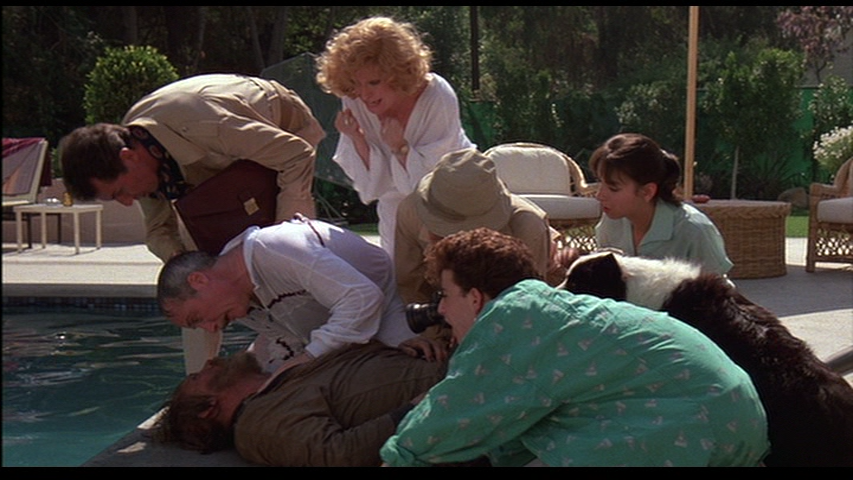
Wealthy Beverly Hills clothing hanger manufacturer Dave Whiteman (Richard Dreyfuss) is feeling unsatisfied with his life, unhappy in his marriage to Barbara (Bette Midler), having an affair with his maid Carmen (Elizabeth Pena), daughter Jenny who refuses to eat and teenage son Max (Evan Richards) going through his own sexual confusion. When one day homeless Jerry Baskin (Nick Nolte), having lost his beloved dog, enters the Whiteman’s backyard to drown himself in their pool. After saving his life, Dave tries to help out Jerry but Jerry soon is changing the lives of the family members in ways that they never would have imagined.
Based on Jean Renoir’s BOUDU SAVED FROM DROWNING and the play by René Fauchois with a screenplay by Masursky & Leon Capetanos, DOWN AND OUT IN BEVELRY HILLS has a tighter pace than many of the director’s films, getting right to the point and not overstaying its welcome at 103 minutes. Looking at them now it feels like the Paul Mazursky cinematic view of the world made the most sense in the context of the 70s, in the BLUME IN LOVE and AN UNMARRIED WOMAN period, a decade which he portrays the journey of in his Truffaut homage WILLIE AND PHIL. Coming six years after the release of that film, the more blatantly comical DOWN AND OUT IN BEVERLY HILLS is just as much about its own moment, coming within the ever-growing rot of the Reagan era and the harsh sunlight caking down onto the cement. Maybe it’s because of the weather in L.A. lately but I look at the shots of the Whiteman’s house and surrounding neighborhood and it always seems so hot and garish, no shade to bring a moment of peace to anything. Even though the film is set during the holiday season it never feels that way in the slightest (the inherent Jewishness of the Whiteman family feels intentionally buried as well). Dave Whiteman feels guilt that no one else around him feels, the guilt that no one in the 80s felt—ultimately, the film is about coming to terms with that guilt and doing something with it. He’s another Mazursky protagonist who, as successful as he is, doesn’t understand how he actually got to this place, as certain song lyrics declare, and isn’t sure what to do about it now that he is.
The director clearly looks at Beverly Hills as a place everyone wants to be and when they get there everyone suddenly becomes the same, all with the same gleaming white Rolls Royce, with each person forced to find themselves once again just as Barbara seems to surround herself with mirrors in her bedroom as if to somehow try to remind herself that she’s still a person. In his own films Blake Edwards always gives the impression that he would be perfectly happy to burn that world he lives in and loves down to the ground, letting the homes crash into the canyons below. With Mazursky the self-loathing feels more internal as if he’s trying to knock down the walls that are within himself and come out the other side somehow changed. Achieving his wealth via clothes hangers feels so deliberately absurd that you wonder if to him it makes about as much sense as being a film director.
Even the memories of the director’s past films linger in the air—Dave observes, “It’s like the 60s,” when Jerry takes him down to Venice Beach, that place where HARRY AND TONTO had its final moments, it’s an odd reminder of the past for the director, a place that he hasn’t thought about in a long time. There is screwball at the heart of DOWN AND OUT but for a movie that’s essentially a comedy, an attempt at a light Shakespearean romp, it feels almost surprisingly introspective and curious about its people. From the nitpicky dialogue where characters obsess over enough white meat in their Thanksgiving turkey, Dreyfuss’ aggravation or the growing insanity of the climactic New Years’ Eve party, he laughs don’t interest Mazursky as much as the open therapeutic nature of it, as if the film itself is as thrown by Nolte’s bluntness as the characters are. It’s a film that acknowledges that sometimes people don’t know what the hell to say to each other. The Touchstone formula hadn’t quite been cemented yet so there’s still some ambivalence about it all, particularly concerning him, it’s willing to let itself breathe at times.
What strikes me now is a certain distance I feel from some of it—maybe the 80s broadness gives me bad flashbacks, maybe the fashions do, maybe the more character oriented BLUME IN LOVE sticks with me in the end since it’s that much more about probing into the angst of its lead characters. DOWN AND OUT doesn’t want to go that deep (it does dig deeper than your average studio comedy digs now, to be fair) but it does let the characters deal with each other, making that uncertainty about itself. Plus there’s Mike the Dog playing the family pet Matisse, a joke that shouldn’t work as well as it does, one of the best dogs ever in a movie and could very well be as much of a reason for how big a hit the film was as anything (well, that and the sight of Nick Nolte eating dog food). Maybe I shouldn’t like how much Mazursky uses him as such an obvious button but it works and for that matter few directors were ever so lucky with a dog to cut away to. Matisse even has a dog psychiatrist (played by Donald F. Muhich who played essentially the same role for the director several other times), which plays now as an example of how the film as dated since the joke doesn’t seem as zany as it does then.
It’s one of the problems of the movie now--the sexual confusion of the son isn’t as riotous as it might have seemed then and even if Jerry’s immediate acceptance of him plays as somewhat sweet it does plant the film into the time. But there’s still cockeyed affection for all the people in it and as silly as he might portray some of them you can tell that deep down he likes all of them. Mazursky doesn’t claim to have all the answers (his films are often about people who come to the realization that they don’t have all the answers) which seems brave now when most films seem to want to have a character espouse whatever the theme is. He knew that no one has the answers. We still don’t—revisiting this film in 2014 is an uncomfortable reminder that there seem to be more homeless in my own neighborhood these days than in past years. In the film’s final moments there’s a look on Nolte’s face that displays a certain ambivalence about the decision he’s making, even if he knows that it’s the right one, a moment that I don’t think would have been found in certain Touchstone films later on and almost by itself causes the film to stick more than it might have. It may be one of Paul Mazursky’s minor films but, as broad and commercial as it is, it’s as essential as any of them.
This was actually the first film in several years for both Bette Midler and Richard Dreyfuss so it served as something of a comeback for each of them and they mesh with the style perfectly, both with expert timing and a willingness to dig into these characters, making their interplay achieve a music within the familiarity the characters feel with each other. They’re clearly rendered speechless in some ways by Nick Nolte’s character and that lends an unpredictability to it all since everything he does is totally unexpected, not even aware that he’s in a comedy. He doesn’t reveal anything to us except for that one look at the end so even then Jerry feels like a mystery to us, let alone everyone else and Nolte wisely keeps that enigma going. Little Richard drifts in and out of the film commenting on the action as next door neighbor Orvis Goodnight while Mazursky, who turned up in all his films as well as many others, plays the Whiteman’s accountant.
It had been a long time since I’d seen this film but was able to find a DVD at the Barnes & Noble in the Grove, right near the area of the Farmers’ Market where he famously presided over many breakfasts with friends for years. That seemed fitting--someone I know said that there should be a plaque commemorating him around there and there should, preferably somewhere over near Bob’s Coffee & Doughnuts. DOWN AND OUT IN BEVERLY HILLS was one of Mazursky’s biggest hits and perhaps his last although ENEMIES, A LOVE STORY garnered a good deal of acclaim when it was released several years later. For the record, I also worked a lowly crew position on SCENES FROM A MALL when it shot in Connecticut but I’ve tried to put that out of mind (I don’t blame him). And now, all these years later, I’m still wondering how I got here. Through his long career Paul Mazursky’s films didn’t always connect, with either myself or the rest of the world, but his intensive exploration of personal was at times brave and it was nice knowing that he was there, somewhere in the city of Los Angeles, presumably having breakfast at the Farmer’s Market. In May I tweeted a photo of the wreckage of Hollywood Boulevard as portrayed in the recreation of Saigon in ALEX IN WONDERLAND. Mazursky himself retweeted the photo, adding simply “i was there”. And he was. Maybe, in the end, it doesn’t matter how you got there and whether you belong, something that Dave Whiteman in DOWN AND OUT IN BEVERLY HILLS seems to spend too much time obsessing over. Maybe all that really matters is that you were there, somewhere that mattered to you, and that you spent the time you had doing something. Because, no matter what, there will only ever be a limited amount of time to do it. Same as it ever was.

Monday, June 30, 2014

How We Lower Our Sights

June 17, 1994: the now-legendary O.J. Simpson slow speed Bronco chase. The world was riveted. Everyone was watching. And yet you just know that there were a few people out there who missed it because they were in a movie theater seeing Mike Nichols’ WOLF which opened that day. The summer of ‘94 is a time that I have particularly vivid recollections of since I was actually working at a bookstore job in Brentwood. It was in the same shopping plaza where Nicole Brown stopped off for Häagen-Dazs on the way home, right across the street from Mezzaluna and just a few blocks away from 876 S. Bundy Drive. Kind of like being in Dallas when the assassination happened, if you get my meaning. I’ve got a few stories that I used at cocktail parties through the years about encounters I had with certain people connected to what had happened (ask me some other time) but none of them have to do with the Bronco chase since I wasn’t around--I had the day off, part of which was spent across town in the first showing of WOLF at the Cinerama Dome earlier that afternoon, of course. But the fact remains that this is one of those things where the release of the movie has been inexorably tied into what was happening that day and for all we know caused the film to slip through the cracks for some people. Ultimately making a not-bad, not great $65 million at the box office, WOLF is a good film, one with goals and thoughts behind it but for a variety of reasons feels like something that was aiming at multiple targets and didn’t quite hit each of them. Compelling all the way through but maybe not completely fulfilling, twenty years later it still engages with a wit to its look at the world that helps greatly. It’s clearly from another time—very much a pre-O.J. film released just as O.J. happened, if you will, and even if Mike Nichols’ ultimate goal in exploring the material doesn’t feel one hundred percent clarified it plays now as refreshingly adult even if the intellectualization behind the approach doesn’t hold all the way to the end.
Shortly after being bitten by a wolf up in Vermont while driving home New York book editor Will Randall (Jack Nicholson) is informed of the termination of his position after billionaire tycoon Raymond Alden (Christopher Plummer) has bought up the company. He’s even faced with the humiliation that protégé Stuart Swinton (James Spader) is to replace him and although immediately resigned to this fate Will’s personality soon begins to undergo extreme changes which leads to learning a secret involving wife Charlotte (Kate Nelligan) and his decision to finally take action over his place at the company. Things change for Will even more when he meets Alden’s wild card daughter Laura (Michelle Pfeiffer), finding in her another person he can actually talk to and connect with, just as the animal side of him brought out by the wolf bite is beginning to make itself known.
Not even 15 minutes into WOLF Jack Nicholson’s Will Randall lays out an intriguing thesis: “You could make the case that the world has already ended. That art is dead….that instead of art we have pop culture, daytime TV, gay senior citizens, women who have been raped by their dentists confiding in Oprah, an exploration in depth of why women cut off their husbands’ penis…” Spoken by a character who believes with reason that his world is about to collapse in on itself, it partly works as what WOLF is about but even more than that is a reminder of how the film opened on one of the key pop culture events of the last decade of the twentieth century, an event that led to most of us hearing the name “Kardashian” for the first time, where everything would become one giant hellish reality show. The end of the world, you could say. Bit player Allison Janney (THE WEST WING still five years in the future), presumably playing some sort of la-di-da New York media type, tries to naively argue that money doesn’t imply ruthless ambition which is something that even the hardened billionaire she’s talking to doesn’t try to deny. WOLF is aware that polite, pipe-smoking way of doing business is fast on its way out, equating what is to come with a certain animalistic way of humanity, where talent doesn’t matter anymore, where the notion of civility flat out doesn’t matter. The “old fashioned way” of begging isn’t how it’s done anymore and what happens to Will isn’t just inevitable but in some ways actually for the best if this is what the world is to become, turning him into a wolf but also a man, with a capital “M”, for the very first time and not just a polite suit.
On a conceptual level WOLF plays as a horror film made by someone with no particular affinity for the genre or even awareness of how to pull off things like jump scares but is presumably attracted to the concept anyway, possibly with other goals in mind. Kubrick’s THE SHINING, coincidentally also starring Jack Nicholson, certainly contains elements that allow it to fall into this category and based on WOLF I don’t think that Mike Nichols has disdain for horror so much as him never having given the subject much thought at all. It really feels like Mike Nichols making a Mike Nichols film set in a Mike Nichols world where people drink fresh ground coffee from Zabar’s invaded by something else, a straight horror film crossed with the metaphor of embracing one’s inner beast in this day and age. There’s a constant feeling that the director is trying to bring something to the material above and beyond just shooting the script he was given (more than you could maybe say about several other latter day Mike Nichols films) it’s just that he’s not sure exactly what that should be. Since it doesn’t seem to know the basic pattern of a horror film it doesn’t know what clichés it should or shouldn’t ignore which allows for its own unique approach how characters interact in ways. The themes are there, very much so, but it also feels like through multiple rewrites and reedits and working out the effects and all that by a certain point exploring the metaphorical implications had to be dropped in favor of just making the film and getting it finished. Which had to be done, of course, and it’s not particularly surprising that the result isn’t a straight ahead horror film that goes heavy on the gore.
What Mike Nichols is interested in is going to be more interesting than what he’s not, what he can immediately connect with is going to be that much more tangible cinematically. But it does leave WOLF slightly wanting in the end, an array of engaging elements dropped during the second half as the film closes in on a conflict with just a handful of characters along with a climax, apparently greatly reworked during production, that is maybe a little too rote in how some of it plays out. Nichols seems to embrace the imagery and how the mood brought on by Ennio Morricone’s score affects the multiple helicopter shots gliding through New York at night (something else that gets me to think of THE SHINING) plus to his credit makes the ‘Jack Nicholson is a werewolf!’ element of it all much more low key and ambivalent than you would expect. But it’s almost a shade too polite making the occasional overly hyper zoom to underline something feel not quite right as Nichols searches for something to do with his camera. The wit and energy of the publishing house setting is what has the most zip to it all and, maybe like Nichols, I’m more intrigued by how the great director of photography Giuseppe Rotunno shoots the famous Bradbury Building (a familiar L.A. location even though the film is set in New York) than the delirium of the wolf’s runs through the woods at night.
As the film goes on the camera seems to push into close-ups more and more, omitting the world around the few characters, and since Nichols is definitely a director who knows what to do with close-ups, that’s where he finds the most to be interested by. When he’s not in his element the ideas just aren’t there in the same way so when the climactic action kicks in it feels like he’s finally agreed to make the film the studio probably wanted all along. The werewolf makeup effects feature the expected strong work by Rick Baker (along with some intriguingly subtle changes to Nicholson over the course of the film) but I don’t think Nichols has much interest in that either. It’s the intimate moments that have the most impact, such as Nicholson’s confrontation with Spader at a urinal that includes a particularly good offhand mention of “asparagus” to cap the scene. In comparison, the climactic showdown is a little more what’s expected and while it actually doesn’t go on forever like such a sequence might today in my memory it sort of seems like it does. It’s not a bad climax, as these things go, it’s professionally done. It’s the climax to a movie. It just may not have been the right climax for this movie as much as it was the right climax for a major star vehicle released in the summer of ’94.
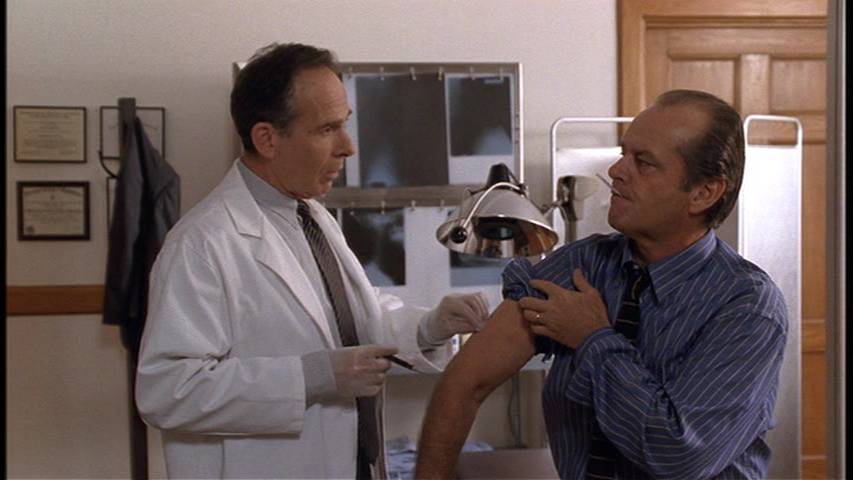
Much of it remains intriguing, more on a human level than anything and thanks to the lunchtime conversation between Nicholson and Pfeiffer few other films ever made have made me want a peanut butter and jelly sandwich so badly. As the connection builds between Will Randall, a good man fighting against the wolf inside him, and Michelle Pfeiffer’s Morose Pixie Dream Woman he simply tells her exactly what’s happening to him, with no thoughts of trying to conceal the truth like other films might waste time with. She accepts it, with thoughts of supernatural never coming into the dialogue and the chemistry between the two actors as they play this material is palpable, unexpected in how it comes off. Elaine May reportedly worked on the script (credited to Jim Harrison and Wesley Strick) and the recognizable sharpness of her dialogue brings the drama into focus so it pops for much of the first half even during the small moments like the dryness of Ron Rifkin’s doctor or how Will is continually trying to talk his way around what’s obviously happening, looking for some sort of rational explanation that “medical science has overlooked”. The bulk of his drawn out visit to Om Puri’s Dr. Alezais is almost too sedate in comparison blatantly laying out the themes in a way that feel designed to get people to check out of the film for a few minutes. Maybe Dick Miller’s Walter Paisley from THE HOWLING wouldn’t have been such a bad idea here (Nicholson and Miller together would at the very least be a cool Corman connection) and while WOLF definitely gets points for taking the serious approach, it that sense it doesn’t always have the right maverick sensibilities to fully click.
It’s an understated, mannered film about a world that is beginning to burst apart at the seams but no one reacts to such changes with anything other than mild puzzlement, another element that removes the events from horror movie logic—the matter of fact response by David Hyde Pierce (FRASIER had just completed its first season when this was released) to Will no longer needing his glasses and the cop played by David Schwimmer (right before FRIENDS premiered) more concerned about his handcuffs than the impossible event he’s just witnessed happen. Even the police investigation during the final third as Richard Jenkins’ detective comes to the hotel room to inform Randall of the brutal murder of the wife who has been having an affair with a younger man (yet more shades of O.J., even if the reality of that event doesn’t quite match up) is portrayed as dry as possible so the big final showdown between werewolves, a word that I’m not sure is ever spoken, can’t help but seem ordinary in comparison. A widely circulated still not in the film showing Nicholson about to transform while Pfeiffer lays beside him in bed speaks to how low key the approach ultimately became. Once the subtext becomes text and the transformation as actually taken place it’s not as intriguing anymore. But the film’s own curiosity about its themes remains intriguing throughout. Just as Will Randall tries to piece together the truth of what’s really happening to him it’s a film that is always trying to understand what it is and it makes the end result that much more compelling even if it doesn’t always hold.
Jack Nicholson gives an intriguingly low key performance, not only going against the expected but seeming continually engaged, just as curious about how to explore what’s happening to Will Randall as the character is, always holding the reality of the film together. Michelle Pfeiffer makes sense out of what seems to be practically an impossible role, barely a person at all, giving both her co-star and the film a surprising amount of empathy, indicating how she’s just off enough herself to be the right woman for him and it’s maybe one of her most underappreciated performances. James Spader approaches his role as trying to be the uber-version of his familiar yuppie scum portrayal—compared with characters he played both before and after this I don’t know if that quite comes off but it is a nice turn, playing him as an asshole who not only knows he’s one but revels in the mindgames that it entails. Christopher Plummer brings the expected chilly intelligence to his billionaire that balances just enough disinterest in all this publishing stuff to get momentarily amused by the back-stabbing around him while Kate Nelligan as Randall’s wife has kind of a thankless role but she nevertheless kills it in her last scene. Nichols makes something out of the bit roles as well, particularly Ron Rifkin, David Hyde Pierce and Eileen Atkins as Randall’s loyal secretary. Playing a stock investigating cop role, Richard Jenkins becomes an unexpected off-kilter glue for the film in its last half hour, a refreshing link to the real world while the plot gears of the climax have to turn and Elaine May makes an uncredited vocal appearance as a hotel phone operator—hearing her chipper voice immediately after a brutal werewolf attack says about as much about the dual nature of the film, and the approach taken to it, as anything.
WOLF is a film that I still feel an inquisitive fondness for as I continue to try to find my way through it, trying to understand what it is as it fights against expectations. The end result may be uncertain, it may be battling against its own two halves, but it seems fascinated by that battle. The incessant, haunting score composed by Ennio Morricone which provides the film with an undeniable shade of melancholy that I don’t think is present otherwise feels like a part of that battle as well. But melancholy for what—for Will Randall? For the unexpected romance between the two leads? For revisiting this film 20 years later? It’s about a lot of things that don’t exist anymore, whether the idea of a summer movie aimed at adults, a portrayal of a New York media world that I imagine would be somewhat different now or just people in the world in general. Maybe it’s a reminder of what things were like for a brief period back in the early 90s. One of the final images of the film indicates that the transformation we’ve been witnessing for the past two hours is now complete. If a similar transformation began within the world we live on June 17 1994, I can’t help but worry that we still haven’t witnessed the end of that particular metamorphosis.