Wednesday, July 28, 2010

And Dream It Never Ends


I’m sitting here, wondering what I should do now. No car. It was recovered but there’s the minor issue that it has no engine. Or carburetor. Or any of that other stuff that’s supposed to be in there. So that’s that, I guess. As a result, I’m just sitting here staring at the wall, trying to avoid the issue of just what I’m supposed to do next. Not to mention, just how am I supposed to get to the New Beverly now? Comic Con happened and I was there briefly, somehow managing to get into Hall H for the amazing TRON: LEGACY panel but I never had any decent encounters with one of the other films which got a lot of press during the weekend, namely Edgar Wright’s upcoming SCOTT PILGRIM VS THE WORLD. This doesn’t really upset me. I’ve got more things to worry about.
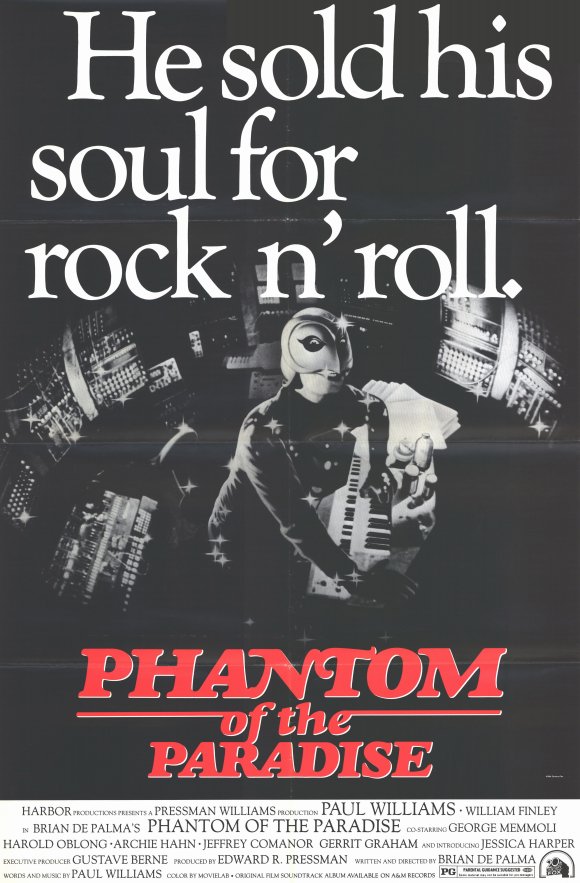

I mention the film because it was a few months ago now that I was at the New Beverly having a conversation with a certain correspondent for a well known film news website. The subject of Wright’s film came up and he was saying how the film was the director’s way of paying tribute to Brian De Palma’s 1974 rock horror comedy PHANTOM OF THE PARADISE which he’s more than a little obsessed with, his chance to make his own version of that movie. I nodded, remembering how I already knew that the film was a favorite of Wright’s and that that he had even screened it at the New Beverly once several years ago but, embarrassingly, it had been so long since I had seen PHANTOM OF THE PARADISE that I couldn’t add very much to this part of the conversation. I must have been too busy seeing HONKY TONK FREEWAY over and over again or maybe my rock comedy needs were filled by GET CRAZY. I also have never read the Scott Pilgrim comic book and as I write this I’m still waiting to get to see the film which doesn’t open for a few weeks though from the looks of Twitter quite a few have seen it already (I should add that Edgar Wright isn’t even following me on Twitter! What’s up with that?). I guess they could say something about these apparent similarities more than I can. Anyway, thanks to Netflix as Wright’s film was screening at the Con down in San Diego I took a look at PHANTOM for the first time in years, so long that it was almost like seeing it for the first time. It’s a truly unusual film partly because its satirical slant seems to be such a personal touch by the person who made it and yet on the surface it stands so far apart from the rest of De Palma’s career. If I had seen it more often and under other circumstances when I was younger it might very well be a favorite of mine now as well. As it is, it’s an enormously enjoyable movie and while I can kind of understand why it never became some sort of ROCKY HORROR-level cult favorite something about it feels more endearing, more personal, more edgy. And it’s a safe bet that it’s going to stick around more in my memory from here on out.


When mega mogul record producer Swan (Paul Williams) spots struggling songwriter Winslow Leach (William Finley) performing a song that he must have, he arranges to have the composition, actually an excerpt from Leach’s own musical version of FAUST, stolen. Winslow of course only thinks that Swan is taking a look at it but after stumbling into an audition that he realizes is for his own music and instantly falling for the beautiful Phoenix (Jessica Harper) who can sing his song like no one else his repeated attempts to get it back from Swan go bad by the time Leach realizes just what had happened. After being framed and thrown into prison he escapes but his attempt at getting back at Swan goes wrong and Winslow, hideously injured and scarred, is presumed dead…but he soon returns as a figure known as the Phantom, haunting Swan’s grand new theater known as the Paradise and intent on finally seeing his music performed his way although Swan has a few surprises of his own to reveal.


What strikes me about PHANTOM OF THE PARADISE is how much on the surface it seems to have nothing to do with Brian De Palma’s other films—honestly, if I encountered this movie without credits I doubt I would have pegged it as being directed by him. But not only does every frame feel completely and totally personal in the sort of cinematic way that the more De Palmaesque films are but it does in fact contain certain similarities the more I think about it from various stylistic traits to the elements of satire which can certainly be found elsewhere in his filmography, not to mention the as well as the odd Hitchcock reference. But what PHANTOM does is to reconfigure various elements of legendary stories with the horror legends like Phantom of the Opera and Faust being the most obvious examples along with some DR. CALIGARI nods, taking these themes and combining them with a bizarrely satirical look at what must have been De Palma’s own take on what the music business was becoming during the early 70s. Waves of nostalgia, beach music, glam rock and whatever else come into play tossed together with Winslow’s strangely haunting Faust creation. Some of this certainly sounds like the work of Paul Williams—goofy, emotional, haunting—yet in its own exuberant fashion doesn’t feel particularly dated at all or at least not dated in a bad way. I also can’t imagine many end credit numbers I love as much as “The Hell of It” and in context it comes off as a full celebration of everything that this movie achieved.


Written by its director, the story feels paced within an inch of its life in all the best ways with a continuous array of invention in scene after scene lends itself to a tone that feels not just uneasy and uncertain but genuinely dangerous, setting itself apart from the simple camp of ROCKY HORROR. It’s satirical, but never arch. There’s a passion to it as bizarre as every scene ultimately is with this world of the Paradise coming off as a place of mirrors, layers—it’s a film where reality can’t be easily determined because there is no reality. There is a certain frenetic feel to the film which means that reading up on how it was apparently a somewhat disorganized production (as discussed in the very comprehensive website The Swan Archives) such as how they had to deal with the total removal of the name Swan Song Enterprises (sometimes just seen as Swan Song) as the name of Swan’s company for legal reasons and it added touch of chaos to the editing by Paul Hirsch actually feels appropriate--it’s hard for me not to wonder if this is one of those cases where the editor deserves a huge amount of credit for what’s achieved--even if within the chaos of the climax there is a slight feel of abruptness to how everything ends.


The tone is so truly off-kilter much of the time that I can imagine when I first saw it years ago I may not have even quite known what to make of it all. In some ways I think I still am but looking at it now its portrayal of the literally soulless world of popular music co-opting the ambition of someone like Winslow Leach after years of American Idol make all this strangeness seem all the more real. I guess you could say the madness of the world has caught up with the madness of PHANTOM and the result is at times exhilarating, shot in a way that you can feel De Palma pushing himself even when his inspirations are obvious—an extended take which builds to a bomb in a prop car is an obvious TOUCH OF EVIL homage but also incorporates a split screen effect (an obvious De Palma troupe) and the way it is staged with the timing between the two works extraordinarily well, combining the warring portions of audio and incorporating trickery that may make it one of his most successful uses of the device. Even an obvious PSYCHO shower scene parody feels like De Palma was deliberately trying to make it as little like a PSYCHO parody as possible—as it happens, the joke becomes something else altogether. The entire film is satirical and energetic but it’s never just simple parody—you feel De Palma’s love for music even as he skewers it, his love for difference kinds of horror as he embraces it, making it his own through continuous invention and as a rock/visual phantasmagoria—which I’m guessing is what Edgar Wright is trying to do with his own movie—it’s just thrilling. There’s no other De Palma film quite like it. There certainly isn’t another rock horror comedy like it.


Just as Winslow Leach does when he meets her, I watch this movie and find it impossible not to fall in love with Jessica Harper, a beguiling screen presence that makes her stand out instantly from all the other girls and this combined with SUSPIRIA just makes me want to bow down to her. When she sings her audition of “Special to Me”, sliding around the stage in that absolutely bizarre dance and giving beguiling looks to the camera I can’t think of anyone who could have pulled this off the way she does. De Palma seems to be in love with her too, making her seem like the perfect seventies waif and yet near the end photographed as if she would be right at home in a thirties movie. Give an 'introducing' credit, her screen technique still feels unformed somehow but the effect she gives off is totally adorable, utterly beguiling and her talent is undeniable. It makes me wish that we lived in a world where more movies worshiped Jessica Harper like this one does (now I’m curious to revisit SHOCK TREATMENT, the ROCKY HORROR sequel where she plays Susan Sarandon’s role). The very oddness of Paul Williams is extremely well-utilized as Swan, making it clear how in this extremely bizarre world he is able to rule over everyone around him. He embraces the part completely making it truly memorable. It’s hard for me not to love Paul Williams because of things like THE MUPPET MOVIE and yet even normal close-ups of him here look somehow indescribably creepy to me. William Finley, one of the leads of SISTERS and seen recently in THE BLACK DAHLIA, is absolutely fantastic as both sides of Winslow and the Phantom infusing the part with the right amount of pathos and danger just as any monster who has been wronged should. I also wonder just how he’s able to bulge out that eye visible through his mask so wide. As glam-rock star Beef, the great Gerrit Graham of USED CARS owns every single second he’s onscreen, making it seem in retrospect that he has a much bigger part than he actually does. Archie Hahn, a future Joe Dante regular, is one of the Juicy Fruits (and the Beach Bums and the Undeads) and with CARRIE still two years in the future Sissy Spacek is listed in the credits as the set dresser.


Even without seeing SCOTT PILGRIM yet, knowing Edgar Wright’s approach to things I could believe there are a lot of obvious influences throughout the film. Naturally, I’m looking forward to it, although from the looks of the Internet when opening day finally comes I may be the last person to see it. As for PHANTOM OF THE PARADISE, it does have a devoted following, if not an outright cult, with websites devoted to the film as well as fervent appreciations of it that I’ve read over the years. It’s so full of life, energy and cinematic daring that I can definitely understand this, even if my head is elsewhere right now. I feel a little like Winslow Leach, I suppose—no success with women, dealing with something valuable being stolen, feeling trapped in some bizarre dark comedy with wide angle lenses. Part of me is a little afraid to find out what happens next. Maybe I’ll just drink some wine and listen to “The Hell of It” one more time while I try to avoid thinking about anything else for the time being.

Saturday, July 24, 2010

Everyone Has Their Faults


So my car got stolen. Not fun. Not cool. I’m still looking for work and the dollars are dwindling. Again, not much fun at all. It’s been a pretty lousy week. You know how in movies when somebody gets their car stolen it’s all part of some wacky farcical mix up or the Dude getting mad in THE BIG LEBOWSKI? Yeah, in real life it never feels as funny. For the record, it was legally parked, I had no outstanding tickets or anything. It was just gone. Strange thing is, it happened when I was in the middle of writing about a movie where an entire running gag centers around a pair of car thieves and the film itself could even be looked at as the sort of dark comedy one feels when they’re trying to figure out what happened to their car. So I figured I’d continue writing about it. What, like you’ve got a better idea? Right now I’m finding it difficult to write very much about anything so please just go with me here.

Fifteen years after Richard Lester came over from England to direct PETULIA, a satirical, heartbreaking look at a changing America, the director covered the same territory with SUPERMAN III, another comically skewed look at the U.S. but from a much more sour, angry perspective making for a somewhat unpleasant experience. Only twelve years after making the Oscar winning MIDNIGHT COWBOY, an even sadder look at the USA, English director John Schlesinger returned to the States to make his own comically sour, cynical look at present-day America with HONKY TONK FREEWAY, with much of it actually set in the very state that Joe Buck and Ratso are trying to get to at the end of their movie. Two directors, responsible for some of the most iconic films of the 60s, returning to similar territory in a way that reveals how the sadness they once expressed in a time of dwindling hope had become what feels like outright anger towards things at the beginning of the Reagan eighties. HONKY TONK FREEWAY doesn’t have a scene set on an unemployment line, unlike how SUPERMAN III begins, but it certainly feels like it could have. Costing a then-huge $24 million in an effort to make a sprawling, multi-character comedy clearly going for a Robert Altman vibe (“NASHVILLE on wheels” said Variety, though that was more a point of description than actual praise) crossed with the crass flavor of a post-SMOKEY AND THE BANDIT road movie, HONKY TONK was a huge flop at the time of its release in August 1981 and looking at it now doesn’t offer very much evidence that its director had any real sense of humor. I never saw it in the theater though I do remember countless viewings on cable back in the day, where I imagine that much of the satire and a few of the racier jokes went right over my head. Those memories as well as the fact that I like this sort of multi-character comedy anyway means that I still have a fondness for the movie and while there might not be much of a case that could be made for it, I could still try.


A huge new Freeway is constructed in Florida and the small resort town of Ticlaw is denied an exit even after town mayor Kirkby T. Calo (William Devane) personally arranges a payoff to the construction coordinator, delivered in a Kentucky Fried Chicken box. As Kirkby marshals the town to figure out alternatives to their dilemma, which includes literally painting the town pink, a diverse array of people are making their way to Florida heading down that new freeway in the direction on Ticlaw, including a pair of New York City garbage men (George Dzunda & Joe Grifasi) who have recently robbed a bank, Duane Hanson (Beau Bridges) writer of children’s story “Ricky the Carnivorous Pony” who meets up with the beautiful Carmen Odessa Shelby (Beverly D’Angelo) who is taking a promised vacation with an urn containing the ashes of her late mother, a husband and wife (Howard Hesseman & Teri Garr) vacationing in an RV with their two kids who do nothing but watch TV including a son (Peter Billingsley, two years before A CHRISTMAS STORY) with his own particular phobia, a pair of nuns (Geraldine Page & Deborah Rush), a retired ad man (Hume Cronyn) who "invented bad breath" with mixed drink-swilling wife (Jessica Tandy), a pimp (Sledge Hammer himself, David Rasche) traveling down to Miami with one of his girls (Sandra McCabe), a drug-peddling hitchhiker (Daniel Stern) and a truck driving songwriter (Paul Jabara) headed for Ticlaw with a Rhino for the local safari park. There’s also a water-skiing elephant named Bubbles in Ticlaw who Kirkby hopes will be their star attraction.


Written by Edward Clinton (no other credits), HONKY TONK FREEWAY at least has a lot going on in every scene. It’s energetic, acted by a high-spirited cast and features a great amount of activity in the frame throughout (legendary production designer Ferdinando Scarfiotti is credited as “Visual Consultant” just as he was on AMERICAN GIGOLO and SCARFACE) but it’s never particularly likable and just winds up a sort of hodgepodge even while being entertaining. Schlesinger’s point seems to be that all of America is the same, a nonstop freeway of cheesy motels and restaurants populated by people who are just drifting aimlessly, eventually drawn together to the tiny “wonderful, beautiful” town of Ticlaw populated by good-hearted citizens representing the little guy who stay attached to their roots and bring all these wandering travelers who represent America together. Daniel Stern’s hitchhiker comments how ever city is the same and Beverly D’Angelo’s beauty mentions how she sits at the same table in every single IHOP restaurant she goes into, smiling as she says, “The International House of Pancakes is the one constant in my life,” so they’re the perfect people to wind up in Ticlaw, a place striving to be unique while still being recognized by the world and given that greatest of prizes, an exit to allow the tourists to reach them.


It’s a big, sprawling character comedy but if it is sort of a mess it’s the kind I guess I’ve always enjoyed (shades of 1941). I didn’t laugh all that much while watching it this time around but did find myself smiling pretty consistently, much of it due to the high spirits given off by the various actors and though I’d never call the tone endearing it still treats everyone better the outright contempt Richard Lester regards his characters in SUPERMAN III. In the case of this film, it’s more like Schlesinger looks at these people from a bemused distance, shaking his head with a slight bit of sympathy but not wanting to get too closely involved. Nothing too much ever really happens in the various story threads except for the main one and everything screeches to a halt with massive car-crash ending, which is definitely impressive but just feels kind of cruel with ‘funny’ sound effects--even if the movie shows us that nobody is injured it still feels like a few of them are being punished for no reason other than they were just being themselves on the big Honky Tonk Freeway that is America. One of the few real grace notes in the film, involving Deborah Rush’s novice nun taking a private morning swim, seems to express the ambivalence Schlesinger feels for these people, possibly not quite sure how he should be treating them. The final punchline involving ‘Ricky the Carnivorous Pony’ and some Asian orphans is pretty awful and there’s also some running gay jokes, which seems notable considering it’s coming from the director of MIDNIGHT COWBOY—well, since Schlesinger was gay if he was ok with them then whatever. And there’s the car thieves, but they’re nice car thieves—they take the car but always leave whatever was inside because to take the stuff would be wrong. When Hume Cronyn lets loose all his frustrations about his life after his prized antique car has been taken it now kind of hits close to home, maybe the first time I’ve ever found myself identifying with Cronyn in anything. Interestingly, Janet Maslin in The New York Times (It opened in New York at the Ziegfeld! Damn!) seems to have had a similar reaction to the film when she reviewed it that I have now—thinking it’s a mess, the racier jokes are no good and yet finding it “almost as surprisingly funny as it is silly.” Maybe it’s the enthusiasm of the whole thing, the willingness to get out there on the road to make this movie and present all these people for better or for worse. Maybe I can’t really defend it to any great extent but I still kind of like it.


IMDB reports that the first cut was around three hours which with this type of film seems possible but because it’s all so loose it feels like very little is getting short shrift, with the possible exception of Hesseman and Garr’s bickering married couple. The production is large and impressive with some footage of the freeway construction over the opening credits that would probably have some interest for somebody who lives down there as well as, in addition to the huge crash scene, a massive explosion late in the film which possibly didn’t get the right kind of coverage when they shot it since we never seem to cut to a fully satisfying angle. Of course, John Schlesinger was never exactly a director noted for shooting huge explosions so maybe getting the big money shot wasn’t as necessary to him. William Devane also responds to that big explosion by saying “Holy Shit,” a pretty guaranteed laugh getter way back then. Adding to the fun is a diverse array of music from the title number which we hear about five separate times throughout (sometimes I think I hear this song in my sleep), “Faster Faster” which is sung by Paul Jabara as the truck driver and written by him as well, a country ditty on the soundtrack sung by Beverly D’Angelo, the memorable “Ticlaw Anthem” (again, something that probably haunts me during odd hours) co-written by George Martin and an extremely energetic main theme by Elmer Bernstein some of which sounds so similar to the score for STRIPES, out the same summer, that I almost wonder if he was working on the two at the same time and got them confused or something.


My good feelings about it extend to the actors and there really isn’t anyone in here I don’t enjoy watching. The very best of them make their characters more likable than I suspect they were on the page, including the boisterous Devane (also in Schlesinger’s MARATHON MAN), the ultimately endearing relationship of Cronyn & Tandy, Beverly D’Angelo’s adorable glances that indicate her own ambivalence about herself (she slept with 300 men in Paducah, Kentucky adding, “It wasn’t easy”), the double act of Dzunda and Grifasi, a sort of Laurel & Hardy act done as PG-rated sleaze and, maybe my favorite, Deborah Rush (familiar from numerous TV and film roles) as a nun clearly having doubts about her choice. The very familiar Celia Weston makes her film debut as a waitress who gets recruited by Rasche, Jerry Hardin plays the Governor (he has what I think is the one F-word in this PG film and the way he says it gets a laugh out of me) and Anne Ramsey, before her voice changed, can be spotted as a TV chef. Twins Jason and Shane Keller (graduates of the Scarsdale High School Class of 1989, thank you very much) appear briefly as Beau Bridges’ sons.


The slightly cruel undercurrent which is definitely there keeps me from being more favorable about it, but any anger the film expresses about the state of things (or at least, the state of things in 1981) is something I can kind of understand this week. After all, right now I’m not able to go driving out on the freeways like the characters in this movie in search of something better. I didn’t even get to keep the stuff that was in my car. But while watching the film again I’m reminded that its energy keeps it moving, some of the characters are endearing, the music is catchy, Beverly D’Angelo sure is cute and sitting here right now I can’t even say I think the movie’s cynicism is all that wrongheaded. It’s just not always as funny as it should be. Which doesn’t prevent me from thinking fondly of it and I could imagine popping the disc in once again sooner rather than later. In the meantime, could anyone out there please buy me a plane ticket that would send me someplace faraway like the Amalfi Coast? I really could use that right now. It’s been that kind of year.

Thursday, July 15, 2010

A Genuine Taste For It


You should probably know that I’m a pretty dull person with relatively boring taste in things that can sometimes fall right in line with the mainstream. I think CHEERS is the best sitcom ever, to me THERE’S SOMETHING ABOUT MARY is the funniest film the Farrelly Brothers have ever made and I may as well admit that in all honesty when it comes to films based on the novels of Thomas Harris I prefer Jonathan Demme’s THE SILENCE OF THE LAMBS to Michael Mann’s MANHUNTER. Demme’s film was justifiably deemed a classic so quickly that it’s allowed the hardcore auteurists out there to pick up the slack in favor of the earlier film. It’s probably helped that Mann’s career has come a long way in the past few decades while Demme’s career has gone in other directions away from the mainstream, clearly showing that the man’s interests lie elsewhere (speaking for myself I can respect someone who marches to their own drummer but still feel that Demme’s post-SILENCE career has to be one of the biggest disappointments of the past twenty years of film). THE SILENCE OF THE LAMBS was of course a massive hit (domestic gross: $130 million), won five Oscars including Best Picture and so much of it has seeped into pop culture that its most famous elements have long since crossed the line into parody. In contrast, MANHUNTER, based on the novel “Red Dragon”, is the more sedate procedural, critically respected but a box office disappointment (domestic gross: $8.6 million), eschewing blatant serial killer thrills for instead attempting to truly examine how such things get under your skin and doesn’t necessarily deliver in the way you might expect. It also offers a presentation of its most famous character in a way that, whatever else you might want to say about it, doesn’t offer much interpretation for spoofing.


At least part of my preference is due to my own personal experience. Seeing THE SILENCE OF THE LAMBS on its opening weekend back in February 1991 was an electric experience of the sort that I have rarely experienced in a theater before or since, where I genuinely felt a charge through the audience as if it was witnessing something truly exciting, truly memorable. That memory is certainly an emotional response for me, a feeling I retain to this day and such a reaction is not something that MANHUNTER, released less than five years earlier in August 1986 by DEG, ever goes for—it’s not so much a more intellectual approach as it is a clinical one and while it doesn’t work as well for me its best moments are there, unavoidable, in some cases unexplainable. And yet those scenes and moments never quite coalesce into a whole as effective as some of it truly is. With MANHUNTER’s reputation growing through the years along with the status of its director the film recently screened at the New Beverly for a Saturday midnight show. As it turned out, I didn’t think the movie exactly came off as ideal for the late hour—it may actually be the quietest serial killer movie ever made, the famous use of “In-A-Gadda-Da-Vida” excepted, but even in this context getting to study some of these images on the big screen had its own rewards.


Retired FBI specialist Will Graham (William Petersen) who has the ability to think just like the killers who he pursues is talked into coming back to the job for one more case by his former boss Jack Crawford (Dennis Farina) against the wishes of wife Molly (BRAZIL’s Kim Greist) to help catch a serial killer who has been snidely dubbed the ‘Tooth Fairy’ who has been known to brutally kill entire families. Graham’s investigation includes him having to meet with Dr. Hannibal Lecktor (Brian Cox) a brilliant psychopath whose capture was the reason for Graham leaving in the first place. As Will continues to pursue the Tooth Fairy he once again has to deal with these feelings he has been able to keep buried as his family is suddenly forced to go into hiding and the Tooth Fairy himself, actually named Francis Dollarhyde (Tom Noonan) finds himself falling in love with a beautiful blind co-worker Reba McClane (Joan Allen) who he thinks may be his one chance at a normal life.


It diminishes both films to compare them so directly and the two directors are different enough in their basic approaches that it really seems pointless--one imagines Mann and Demme not having enough in common to carry a conversation over dinner, let alone taking source material that shares certain characters and approaching them in the same way. In comparison to Demme’s much more humanistic approach with the Bernard Herrmann-like power of Howard Shore’s score, MANHUNTER is much quieter, introspective as if its trying to force us into paying attention to what’s happening—its opening credits are just a few steps close to being totally silent as if reminding the audience to listen (and look) closely for the next two hours. MANHUNTER has appeared in several different versions over the years including a single network airing back in the nineties which nonsensically retitled it RED DRAGON: THE PURSUIT OF HANNIBAL LECTER in order to capitalize on the growing Lecter popularity. The different cuts (even reading up on the film I can’t tell how many there really are. Four? Five? Six?) seen on tape, disc and cable in addition to the original theatrical release are par for the course for Mann who never seems to tire of tinkering with his films past the point of theatrical release (I imagine him at home right now, recutting some section of THE LAST OF THE MOHICANS for a new Blu-Ray release. Does he work on old STARSKY AND HUTCH scripts too?). Since I’m not an expert on this film like some people are I couldn’t state all the differences but I certainly noticed that the 2001 Anchor Bay DVD I’m checking out as I write this for reference is missing what for me seeing it at the New Beverly was a key point of dialogue spoken by Will Graham, providing a point of clarity to his feelings on who he’s pursuing (“As a child, my heart bleeds for him. Someone took a little boy and turned him into a monster. But as an adult... as an adult, he's irredeemable…”) so the whims of Mann in reworking his films clearly know no end of frustrations. The degree of obsession his films express makes this understandable but no matter what, MANHUNTER, watching it at home or at the New Beverly, is always MANHUNTER. It’s a work that at times reaches almost masterful levels yet I constantly feel at a distance from it as if a silk screen is in the way preventing me from reaching some further understanding of it all.


Maybe Kubrick is an obvious point of comparison in its portrayal of obsession but more than that the film puts me in the mind of William Friedkin and not just because Petersen had just starred in TO LIVE AND DIE IN L.A. the previous year. Actually, it’s not even that the style of MANHUNTER feels all that much like Friedkin but there is a certain attention to detail as well as the basic idea of observing process which causes certain moments to stick out—those crime scene photos left out on the plane so the young girl gets an unfortunate look at them is one, or Graham somehow trying to focus on the grass in front of him after the trauma of his meeting with Lecktor--but I feel distanced from the cool style, stark angles with architecture to match, the overwhelming feeling of Blue & White that screams some of my least favorite traits of the eighties (I never got into the MIAMI VICE TV show all that much back in the day either—maybe I’ve got a mental block to this type of thing) along with some music that works great and some that is, for me, the worse the decade has to offer such as the song “Heartbeat” over the end credits, for one. It causes me to mentally check out on occasion, wondering if this is deliberately elliptical storytelling or if we’re just missing a reel of vital info, searching for that extra layer just as I get lost in gazing at those birds flapping behind Petersen in one of his reveries as the character gazes at his wife. Part of Mann’s M.O. seems to be to avoid the expected suspense at certain points and the late appearance of Joan Allen’s surprisingly forward character throws us just as it throws Dollarhyde—we don’t know what to make of this expression of seeming warmth any more than he does. Elements like this mean that I always feel like I’m studying MANHUNTER more than watching it. This isn’t a bad thing at all but there are points where I wonder if there aren’t a few drawbacks.


The fractured narrative of MANHUNTER, screenplay adaptation written by Mann, includes not introducing its ‘villain’ until nearly the halfway point but even if the already incarcerated Lecter/Lektor character didn’t happen to become much more famous later on (in a film which used the spelling of the character from the original novel), it’s possible that the Tooth Fairy would still be overshadowed by the handful of appearances of Dr. Hannibal Lecktor as played by Brian Cox. With only a fraction of the screen time Anthony Hopkins had in SILENCE OF THE LAMBS, a performance which became legend by the end of that film’s opening weekend, Cox brings a chilly force to his few minutes, a power that is unexplainable in its own way—several years after I first saw this film for the first time on cable just about all I remembered was the calm, chilly power he has in casually getting Will Graham’s home address during the phone call scene. If it were his only appearance it might be considered one of the best one-scene performances of all time but his earlier meeting with Graham is almost as powerful in how the two actors play it (his third scene, where he and Graham confer via phone late in the film, isn’t at all bad but doesn’t feel quite so essential to me, maybe because the narrative has moved past Lecktor by that point). The humor of this character, tossed off as he places a stick of gum in his mouth feels almost offhand, just as any of the spare pieces humor in the film does, like the technician who offers, “You’re so sly, but so am I,” when making a discovery, which I know was once said by Phil Hartman on an episode of NEWSRADIO.


With the meaning of the Red Dragon and its relation to Dollarhyde that the novel took its title from (for the record, I’ve read the books of SILENCE and HANNIBAL but never this one so all I have to go on is my perception of the film) feeling like it has been de-emphasized in accordance to its removal from the title (the existence of certain stills indicate how much was really shot to tie into the mythos) it seems to mean that when Dollarhyde’s death pose recalls the look of the Dragon doesn’t have as much resonance as it probably intended to at one stage. The point of MANHUNTER appears to be observing the process of how these characters studiously move through this case to a point where its no longer safe for their own stability, but Mann as director also somewhat makes it about his own experimentations with structure, with periods of silence and oblique jump cuts in the climax (not as noticeable in the print as it’s always been on video for me, but maybe it was the late hour). He’s not interested in the machinations of the plot as much as examining what this is all doing to the character of Will Graham as he studies this case of a killer who invades white upper middle class households. It’s a world that I imagine Graham would like he and wife Molly to be a part of, but it’s not something he’s able to do and his tiny beachfront house with no backyard (how the Tooth Fairy seems to gain access to each of the homes he invades) feels appropriately like a place to hide out from the world. Mann prominently focuses on the trauma that the lead character once went through and is now going through again, feelings he articulates to his son played by David Seaman in the strangest supermarket scene ever shot and even if it didn’t contain the most distracting continuity errors in the history of film it would still feel like these several minutes are more about the Kubrickian prominence of the cereal boxes behind William Petersen more than anything the two are discussing. It doesn’t help but the child actor playing the son isn’t particularly good either (among other non-actors distractingly sprinkled throughout the film) and it occurs to me that all of the strengths and weaknesses in the film are best exemplified in this one scene. A foreground we desire to pay attention to in danger of being overwhelmed by a background that for reasons which come off as mysterious makes its presence known whether it should or not. It winds up revealing the best and worst of what Michael Mann is capable as a director, all in what would in most other director’s hands be a simple dialogue scene. I’ll gladly state that I worship at the altar of HEAT, THE INSIDER as well as parts of COLLATERAL and don’t wish to hear from anyone saying otherwise…but there are times in some of his other films where the flaws that result in spite of (or is it because of?) his obsessive quest for perfection are impossible to ignore. They’re just as clear in the frame as those damn cereal boxes.


Petersen delivers a strong conviction to the character, bringing the viewer into his eyes and selling the scenes where he does nothing but talk aloud, piecing together the puzzle, not something every actor could pull off without getting bad laughs. Greist and Farina both strong support, Tom Noonan’s inherent oddness as Dollarhyde barely seems to warrant calling him a villain…he’s just somehow other, compulsively watchable every single second he's onscreen. Stephen Lang (one of the best things in Mann’s PUNLIC ENEMIES is enjoyably sleazy as Freddy Lounds and Joan Allen is greatly effective in her relatively brief screen time, making me wonder what her character is like when she’s not suddenly finding herself in a serial killer thriller. Chris Elliott turns up briefly as one of the FBI analysts (in an interview years later he confessed to feeling bad that his presence may have caused some unfortunate laughter), Benjamin Hendrickson brings some intriguing officiousness to his brief portrayal of Dr. Chilton (an extra Chilton scene exists, just not cut into the film) and Frankie Faison, Barney the orderly in the three Lecter films with Hopkins, is seen as Lt. Fisk. A number of bit players seem to be non-actors, some more distracting than others in their appearances—this is one of those areas that I think Friedkin succeeds at more.


Even if I feel somewhat resistant to it, the nature of what Mann and cinematographer Dante Spinotti achieve with their framing of these stark images is at times impossible to shake and reminds me of Tarantino’s comment spoken once at the New Beverly that when Michael Mann went all-digital we lost him as an artist. Whatever my feelings on its drawbacks, the film’s approach to the serial killer format has been influential—I’m no fan of the TV show CRIMINAL MINDS but I see much more MANHUNTER in there than SILENCE (For the record, I haven’t brought up Brett Ratner’s RED DRAGON, the film that remade this with Hopkins because, really what’s the point?). Taken on its own, MANHUNTER exists as a record of Mann’s style in development on its way to greatness which hadn’t revealed itself yet. If there’s something in there I don’t respond to it may be me, it may be the film. It may be my own expectations or even limitations. Or maybe I just haven’t looked closely enough yet. But, like every film I encounter, I can only really judge what I see with my own eyes.

Saturday, July 10, 2010

If You Can't Say Something Nice


THE ADVENTURES OF FORD FAIRLANE is now twenty years old, but what the hell are we supposed to do with that piece of info? Am I supposed to actually try to explain who Andrew “Dice” Clay is to kids out there or have they already heard of him at some point? Shouldn’t we just forget the whole thing ever happened? The film opened during the summer, during the heat of all the controversy surrounding the shock comic, how people found him and his routines hugely offensive. Just a few months earlier an uproar occurred when he hosted SATURDAY NIGHT LIVE, an event that included cast member Nora Dunn refusing to go on with him and the night before FAIRLANE opened was probably Dice’s most notorious TV appearance ever, a spot on THE ARSENIO HALL SHOW (oh no, am I supposed to explain who Arsenio Hall was to kids now too?) where he looked right into the camera, explained himself and started to cry. The film opened the next day, July 11, 1990 and I was there at Yonkers Movieland with Twizzlers in hand to see the first show. Sure, I’d gotten sick of all those damn nursery rhymes by that point but it was summer. It did decent its first weekend (it finished behind GHOST, also released then, but ahead of QUICK CHANGE) but it soon after crashed and burned, dropping over fifty percent in its second week which was a much bigger deal then than it is now and stopping dead at $21 million. Fox didn’t release the concert film DICE RULES that August like they were going to at one point and Andrew “Dice” Clay, as movie star, was pretty much done. THE ADVENTURES OF FORD FAIRLANE is crass, sloppy, stupid, juvenile and maybe a little offensive. It’s nothing that I can defend or even should try to defend. And yet, truthfully, against my better judgment, I’ve never really minded it. I probably should be embarrassed to admit that, but there it is.


Ford Fairlane (Andrew “Dice” Clay) is the hottest rock n’ roll detective in Hollywood living a dream life complete with a car that bears his name, swank pad out in Malibu and loyal secretary Jazz (Lauren Holly) but constantly in need of cash due to his famous clients paying him off in expensive trinkets. When old friend Johnny Crunch (Gilbert Gottfried), the sleaziest DJ in the west, hires him to find rock groupie Zuzu Petals (Maddie Corman) no sooner is Ford on the job than Johnny is brutally murdered on the air. When uber-wealthy Colleen Sutton (Priscilla Presley) turns up the next day also looking to hire Ford to find the same girl he finds himself mired in a case involving the recently O.D.’s rock star Bobby Black (Vince Neil), record mogul Julian Grendel (Wayne Newton), annoyed cop Lt. Amos (Ed O’Neil), a hitman named Smiley (Robert Englund) with a habit of turning up unexpectedly and the mysterious Art Mooney who Ford believes holds the answers to all of his questions.


Renny Harlin was directing FORD FAIRLANE when Fox and producer Joel Silver decided that he was the man to helm the eagerly awaited DIE HARD 2. The films wound up opening a week apart with the film that had been shot second coming first, to much bigger box office. Gene Siskel, who went bonkers for DIE HARD 2 calling it “the best film of the summer” (not when GREMLINS 2 had come out, it wasn’t), expressed disappointment in his review that it came from the same director but, seriously, this hardly seems like an auteurist issue. It was probably impossible to ignore the furor surrounding the film’s star but I can’t help but think that critics were reviewing him more than the actual movie which really does have a fair amount of invention going on throughout. A totally fanciful look at Los Angeles circa 1990, THE ADVENTURES OF FORD FAIRLANE (Screenplay by Daniel Waters and James Cappe & David Arnott, Story by Cappe & Arnott, based on the character who appeared in stories by Rex Weiner) has about as much to do with real life as BEYOND THE VALLEY OF THE DOLLS did in its day and I’ll bet that film’s screenwriter Roger Ebert probably noticed, calling this one “loud, ugly and mean-spirited” in his negative review, none of which I have any real argument for. It’s a Dice vehicle through and through but even if you hate him there’s plenty of other stuff to pay attention to going on in the constantly busy frame. It’s a completely immature film, with the sequence at the I Ata Pie sorority house filled to the brim with hot college girls either the high or low point depending on your point of view and it’s safe to say that if an inanimate object like a camera can actually leer, it definitely does so during these scenes.


The tone is pretty much all over the place--spoofy but surprisingly violent, violent but pretty damn goofy, a story that never makes any sense at all. There are a surprising number of nasty deaths, the cute-as-a-button Lauren Holly gets thrown through a second story window as well as brutally punched in the stomach at various points and then again there’s the blatantly fake Koala Bear that figures into things. It’s also got its share of clever dialogue that is pretty obviously the style of HEATHERS screenwriter Waters, who I could believe was more interested in doing a Los Angeles music satire/private eye spoof (if Waters is responsible for the name Zuzu Petals, as I suspect he is, the man deserves as much praise as he can get) more than a vehicle for the guy starring in the movie, with the written material sometimes clashing uneasily with stuff (sometimes in the constant voiceover narration) that are either adlibs by Dice or just bits pulled from his routine—a gay joke, a reference to getting banned from MTV. And with lines like “I’m sorry that I made you clean the toilets and the bathtubs, who did all the work in bed?” that he asks his hapless assistant Jazz, I could believe that some of these adlibs actually make the character more unlikable than he already was, pushing him over the line from scoundrel into outright sleazoid. In an attempt by the film to not get us to totally hate him, Ford befriends a kid (Brandon Hall) who wants to hire him to find his father, with only a Fred Flintstone ring as a clue, but it doesn’t really work. And I’m not sure the film even cares, which is actually a little admirable. When the camera lingers on him during a few points as if he was just told to adlib like crazy, it’s some of my least favorite stuff in the film and it wouldn’t be too much of a stretch to say that I like this film almost in spite of the guy who’s starring in it. And there are bits where he doesn’t much matter that I always look forward to like Jazz telling some bad guys, “If either one of you ever has a son, I hope his dog dies,” the chant the sorority girls make when inducting Ford as well as the ultra-sleek look it provides of Los Angeles which to me once seemed like it may as well have been another planet. Once during an appearance Daniel Waters made a sarcastic reference to ‘the comedy stylings of Renny Harlin’ and, yes, there probably isn’t a great case to be made for him as a director who understood what made something funny. For that matter, he probably took some of the action more seriously than he need to and I almost wonder if he even realized how ridiculous the action scene where characters climb down the side of Capitol Records really was, or maybe should have been.


All of that said, there’s a definite energy to the film the whole way through and, almost surprisingly considering how DIE HARD 2 is one of the most overcut movies of all time with numerous scenes using seemingly dozens of angles FORD FAIRLANE is much, much more fluid in this regard and the style gives a certain life to the world around the lead character. It feels like Harlin is constantly tossing stuff into shots to keep the film engaging to look at, always willing to feature a supporting character doing some kind of business on the side of the frame. For me this approach is definitely preferable to the recent rock world comedy GET HIM TO THE GREEK which at times feels like it consists of nothing but scene after scene of alternating close-ups of two people talking, making it about as dead a film experience as I could imagine. FORD FAIRLANE at least has some life to it, even if I do need to shower afterwards and what’s wrong with taking a shower, anway? There are probably more than a few topical jokes (“The Rob Lowe Channel”) that are pretty dated now but it does contain an early device of computer-disc-as-McGuffin as well as what has to be one of the first uses of a cell phone in an action movie to make things seem as high tech as possible. There are also some pretty random film references both in dialogue (CHINATOWN is the most obvious) as well as a few of the band names handled by “Fred’s Condom Company” as glimpsed on a computer monitor at one point. There are a few cameos by rock stars I didn’t care about then or now and some of the music’s actually pretty good, even if it does give me flashbacks to 1990 that I’d just as soon not have. There’s no great case to be made here for the film as a satire which hasn’t gotten its due but at least it’s not a boring film even if it is constantly all over the place—hell, if it never quite settles down into a disciplined style that makes sense at least it still feels somewhat unique . Besides, it’s hard for me to hate a film that features a party at an obscenely wealthy Bel Air estate complete with a serving of shark meat. FORD FAIRLANE may be lewd and immature and sleazy but it’s unapologetic about all those things and, while hardly perfect on its own level, is still true to its principals.


I’ll give Clay some credit—as least his portrayal as a sleaze is consistent but as an actor he’s got genuine presence and as a comic personality he’s not afraid to look (or act) totally foolish on occasion. Lauren Holly couldn’t be cuter playing the Velda figure to his Mike Hammer and she brings a genuine spark to her scenes. Maybe the actress wouldn’t want to hear this, but it’s probably the role of hers that I have the most fondness for. Priscilla Presley probably deserves some kind of good sport award for her few scenes here, Robert Englund looks like he’s having a total blast as the nasty henchman complete with British accent, Ed O’Neill is fun as Ford’s cop adversary still upset about something that happened in the past, Wayne Newton seems totally in on the joke and brings a comic edge to his character that goes beyond just playing this as camp (“In-A-Gadda-Da-Vida, Baby.”), but Maddie Corman, Eric Stoltz’s sister in SOME KIND OF WONDERFUL, damn near skips off with the whole film as the insanely stupid groupie Zuzu Petals. Diving into this role with such a lack of fear, she turns the standard ditz character into a zen kind of thing that is frankly awe-inspiring by a certain point. Kari Wührer is Melodi (“As in, a pretty girl who’s like a.”) who wears a short dress that inspires one of the film’s most oft-quoted lines spoken by Morris Day, David Patrick Kelly is a stalker Ford has to deal with named ‘Sam the Sleazebag’, Willie Garson of SEX AND THE CITY turns up as a frat guy and there’s also a New Beverly calendar spotted in one scene, so I’ll just add that I hope they run this at midnight one of these days.


Plenty of rock-oriented musical comedies that wind up feeling somehow wrongheaded in how they were conceived have acquired cults through the years. There’s probably no such following around FORD FAIRLANE and I suspect that if anyone out there does like it (after all, there’s always somebody out there who likes something) they’re probably too embarrassed to fess up. I won’t say that I like it or even think that it’s actually any good…but even though I know I shouldn’t there are a number of elements that I honestly find enjoyable. And besides, if for this film I’ll bet very few people would still know the name Art Mooney. Since it’s now twenty years old the music world that’s being spoofed has now probably become much more insane than is portrayed here—it sounds crazy to say it but it really does portray a simpler time so watching it for a little while does kind of take me back. And at its best it’s actually, so help me, kind of entertaining. But don’t tell anyone I said that. And remember to always answer your phone by saying ‘Hit Pay Dirt With KDRT.’

Wednesday, July 7, 2010

Over The Next Valley


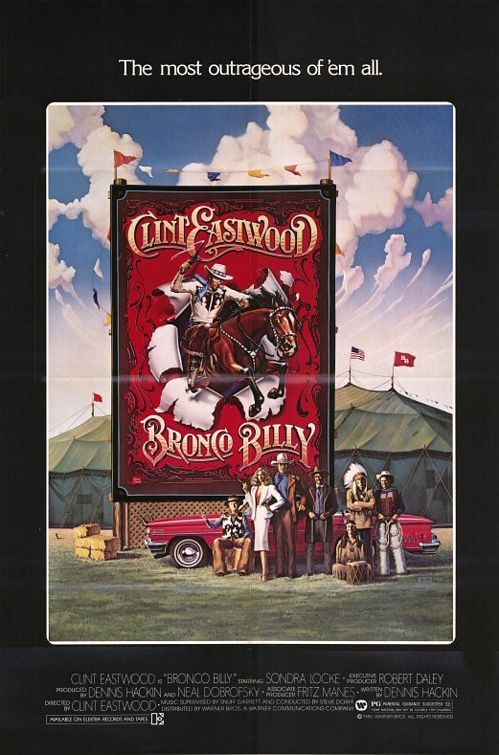
The Fourth of July is always a weird time for me. Too many odd things have happened over that weekend in the past as if the date is some kind of conduit designed to drive me mad and question everything I’m doing in life. It’s gotten to the point where I don’t even want to do anything on the actual day anymore, like I’m worried that some other kind of fateful event will happen, terrified that it won’t. So I wind up keeping to myself for much of the weekend. I eat a few hot dogs, drink some beer, go for long walks and ponder all sorts of things that I won’t talk about here. And then when night falls on the Fourth I go up to my roof to watch fireworks happening all around the city and wonder even more about the meaning of it all, what’s happening to me, what never has. Seriously, a few of those Fourths in the past have really fucked with my head but I suppose that’s all part of the fun of living in Los Angeles. I happened to get BRONCO BILLY from Netflix that weekend partly because Clint Eastwood seemed appropriately patriotic and I had never gotten around to seeing it. I actually wasn’t even sure how much of a comedy or drama it was going to be so I didn’t have any particular expectations of the film. As it turns out, what I got still wasn’t quite what I expected and on a day like that one it turned out to be a good thing. But when you come right down to it, Clint has often been able to offer a few surprises. I never seem to hear anyone say much about this film—hell, THE ROOKIE is probably better remembered—and suddenly I think it might very well be one of his most endearing. I think I feel like watching it again right now.


Bronco Billy McCoy (Clint Eastwood) is the owner and main attraction of “Bronco Billy’s Wild West Show” billed as ‘the greatest, most entertaining wild west show in America’, a ramshackle traveling circus made up of Billy and several others, going from town to town putting on their show to sparse crowds, making very little money. When setting up for a new show and badly in need of an assistant, Billy happens upon heiress Antoinette Lilly (Sondra Locke) who has just been abandoned in a small town by her new husband John Arlington (Geoffrey Lewis) who has run off with all her money so she has no choice but to accept the job as Billy’s job offer. When a series of events results in Arlington arrested for the missing heiress’s murder, “Miss Lilly” decides to stay with the show for a while but as problems begin to overwhelm Billy, she’s suddenly branded bad luck just as she becomes more a member of this small family.


I pretty much realized this wasn’t going to be quite what I thought it would be at first when about fifteen minutes into this film that up to then had a fairly naturalistic feel Sondra Locke appears in her first scene smoking a cigarette using a giant holder like she’s in some 30s screwball comedy. Somehow I doubt many heiresses were using such an affectation in 1980 but my guess is that Clint thought she looked charming holding it, which she kind of does. Knowing very little about what the actual story of BRONCO BILLY was going to be ahead of time at first I thought it would be one of those scrappy seventies comedies that play much more depressing now than it did then, maybe a little like THUNDERBOLT AND LIGHTFOOT. Released in June 1980, BRONCO BILLY is as it turns out actually a very lighthearted screwball update done in Clint’s relaxed directorial style, a little of IT HAPPENED ONE NIGHT, quite a bit of a Howard Hawks feel with Clint as the John Wayne figure who performs gun & knife tricks on his assistant complete with blindfold leading his ragtag bunch around the country, each with their own specialty in this show. An easygoing Clint Eastwood doesn’t always work in his movies and EVERY WHICH WAY BUT LOOSE really does nothing for me—Yes, I know saying that is tantamount to sacrilege to some considering how that was a massive hit at the time (of course, Eastwood didn’t direct that film or its sequel but we all pretty much know he was in charge), certainly bigger than this film ever was. Loose and breezy all the way through, featuring laughs and a completely likable nature, BRONCO BILLY was the ideal movie for that lousy mood I was in. Containing a snappy script written by Dennis Hacklin with lots of fun patter, it’s filled with small moments that go together beautifully and an enjoyable rhythm to the dialogue, like when each person names the soda they really wanted Billy to get as he hands out Cokes for the gang. I watched the film very early in the evening as the sun started to go down, still dealing with my mindset so you’d think I barely would have been able to focus on anything and even at nearly two hours it seemed to go by in about five minutes.


Each of the show’s members are extremely appealing, their camaraderie is endearing and even touching. Even the screwball elements connected with Miss Lilly in how she reluctantly becomes a part of this group are so disarming that I found myself breaking out into a huge smile. There’s something so damn unpretentious, so eager to please about the film that I found myself liking it more and more as it went on. And within its lighthearted tone a small amount of weight is given as we learn more about the past of Billy and everyone else in this show but it never kills the fun. Even when a bar fight turns from one that’s as breezy as you’ve ever seen to something considerably more serious, it still doesn’t feel like there’s any sort of tonal issue. It all just works. There’s something extremely confident about how Clint approaches all this with his direction, as if he knows how to tell this story without even thinking about it and he keeps it on this steady pace that is sometimes goofy but not too much, always assured. It also manages to acknowledge the considerably Quixotic nature of these people avoiding the big cities and just driving around through the heartland, becoming whoever they want to be in living a life they think is fulfilling, as well as refusing to face facts of what an antiquated concept this really is (much more so when looking at this movie thirty years down the line).


Maybe the whole thing says something about how Clint looks at making his movies, being out there on the road doing something, working with people he knows and likes. There are even a number of familiar faces from some of Clint’s other films from around this time, giving it all as much of a feel of a traveling company just as the movie portrays. It’s not perfect—an early bank robbery doesn’t affect things much at all, a subplot involving a local sheriff feels like a little too much of an ellipsis to the point where I can barely tell what happened and one of the big plot points would probably seem more plausible in the context of a genuine screwball comedy made back in the day. Locke’s transformation to a truly likable person almost has to be taken on faith but the movie itself is so likable and endearing that I’ll gladly give it that faith. Clint also doesn’t even make how things are cleared up in the end all that complicated as if there’s no real reason to. What seems to matter most is feeling good in the end, celebrating these people we’ve spent the past two hours with and the exuberant feel of the closing moments is totally earned. Even now, watching the final scenes once again makes me smile as I realize how much I’ve come to love these characters.


Clint fits this part like a glove, truly relaxed and confident. He perfectly makes is character larger than life at the right times, someone who kids can believably look up to and yet still plays the more serious sections just as he should. It feels like he loves playing this character in every single scene. He’s rarely been so truly likable, so loose. As for his female lead, I’ll make an honest admission: I like Sondra Locke in these movies she made with Clint during their lengthy relationship. She’s got presence, spunk and there’s something I find truly charming in how she turns from spoiled heiress to a full-fledged member of the troupe, yet it doesn’t feel at all inconsistent. When she looks at Billy and asks him, “Don’t you find anything about your life bizarre?” she hits just the right tone. I also think she’s a better actress than Jill Ireland, in case we’re going to make a comparison with Clint and Charles Bronson, but that’s just me. Geoffrey Lewis is enjoyably smarmy as the no-good husband and the other members of the show are played by DELIVERANCE’s Bill McKinney with a hook for a hand, Sam Bottoms, Dan Vadis, Sierra Pecheur and, maybe best of all, Scatman Crothers—apparently this was the film Scatman worked on after THE SHINING where Stanley Kubrick had him go through some scenes dozens of times. According to some sources soon after beginning this film he shot a first take after which Eastwood said “Print it,” and the actor nearly burst into tears. Each of the members of Bronco Billy’s show get their own moments that add to the feeling of camaraderie that goes through the entire movie. Old time western actor Hank Worden is the gas station mechanic who has to deal with Locke’s snobby heiress and tells her that the station phone ‘works on dimes’—some might also recognize him as the waiter Kyle MacLachlan’s Agent Cooper had to deal with in the opening of the second season premiere of TWIN PEAKS.


The movie didn’t exactly transform the mood that permeated me through the holiday but when it ended I did feel a little bit better and I knew that I’d made the ideal choice for what to watch as the sun went down on the Fourth of July. I went up to my roof and watched the fireworks, thinking about this film that seems to have been forgotten through the years as its director has gone onto bigger things, thinking about my life and what has gone on with me out here in the west. Wondering if I can still be what I want. Trying to reconcile myself with certain things that have happened in the past and how a few of those events have driven me near crazy. I still haven’t come up with an answer to why those things happened to me once upon a time but BRONCO BILLY was a help for a little while on that day as a reminder that there are still possibilities for the future out there that are up to me. Even if it did take me a full thirty years after it was released to catch up with this particular Clint Eastwood film, one that really does deserve to be better remembered now, it was there for me at just the right time.

Monday, July 5, 2010

First Time For Everything


Since I wrote about meeting Paula Prentiss at the American Cinematheque tribute to her husband Richard Benjamin I think he probably deserves a little equal time. The night was meant for him, after all. So I’ll start by mentioning that as much as I’m sometimes not crazy about driving all the way across town to the Aero in Santa Monica, a double feature of Richard Benjamin films featuring a Q&A with the actor/director is definitely one way to get me make that trip. And a pretty unusual double bill too, of WESTWORLD and DIARY OF A MAD HOUSEWIFE, a pair of films that don’t really have much in common at all beyond sharing an actor. The chance to see him speak was pretty enticing too because, after all, how many stories must the guy have? He could probably command an entire dinner party all by himself with tales of the people he’s worked with through his career.


The first film of the evening was clearly the more famous of the two, but probably because of its place in pop culture more than its actual content. Michael Crichton’s 1973 theatrical directorial debut WESTWORLD can easily be seen as a forerunner for the sort of themes the author/director later explored in JURASSIC PARK with the technology it presents very much playing like an early version of the character Arnold Schwarzenegger played in THE TERMINATOR, not to mention any number of other films that fuse human and android. The film is extremely dated at times, like we’re being presented with a futuristic version of the eye-piercing garishness of 1973, as well as being extremely light on plot but this filmmaking approach turned out to play much better on the big screen than I imagined it would and while it may not be a film which necessarily shows off the talents of its star who was being paid tribute to that night it was nevertheless a good choice to revisit in this context.


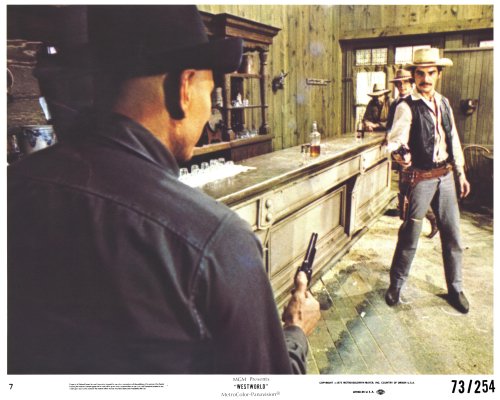
Some time in the near future (or I suppose the near future for 1973), friends Peter Martin (Richard Benjamin, with giant mustache) and John Blane (James Brolin) travel to Delos, a high-tech amusement park for adults which consists of three sections—Romanworld, Medeivalworld and, their destination, Westernworld, where you can live out all your fantasies of what it’s like to live in one of these places among the locals who are all played by very advanced robots. The two friends soon begin to take advantage of every part in this western town, including tangling with a gunslinger played by Yul Brynner in his MAGNIFICENT SEVEN getup. But behind the scenes the technicians running Delos begin to notice problems with the robots as some sort of “disease” seems to be spreading through them that they are unable to stop. Almost before they realize it the robots have entirely taken over Delos with no one able to shut them down, meaning that Peter and John are in for quite a surprise when they wake up one morning.


WESTWORLD never did all that much for me on TV, I’ll admit, maybe because the plotting is so simple that it perhaps wrongly gives the feeling that there’s not really all that much to it. Seeing it in a theater with no distractions like you would get at home is a considerably different experience because its very sparseness allows the viewer to think about everything they’re seeing, to focus on the process of what is being presented to illustrate just how this park works. With a running time under 90 minutes, the three acts of the film basically make up the introduction to Delos, the breakdown of its systems and finally the chase. The lead characters don’t even have to deal with anything resembling real conflict until a full hour into the movie as we tag along with them through their western adventures (shootouts, jailbreak, bar fights) with scenes depicting the breakdown in Delos and the scientists attempting to deal with it done in an intentionally colorless style as if to avoid playing it like a disaster movie. In its straight-ahead fashion, it’s an early look at the now familiar concept of putting too much faith in computers, even if the ideas are still being formed. No money men are present, just the scientists and even they seem to have given over much of how the almost totally automated resort is run by the computers, ‘almost as complicated as living organisms’ and we’re even told that some of those have been designed by other computers (hard for me not to wonder about certain things like what sort of waivers people would have to sign before going to such a place but maybe it’s best not to dwell on that point). So the scientists, usually the ones who can be depended on in this sort of movie, are totally clueless at how to deal with this metamorphosis the computers are going through, which is essentially a very early computer virus--‘life finds a way’ said Dr. Ian Malcolm in that other Crichton tale of an amusement park run amok several decades later and these machines have somehow found a way as well.


Crichton’s directorial style is an interesting combination of elements—the gaudy look of the future according to 1973 glimpsed in the opening scenes slightly carries over into how all of the sets in the parks seem to be intentionally shot in a somewhat flat style, as if to emphasize their artificial nature (maybe that was how MGM films often looked during this period anyway, but it still works here). Much more interesting are the eerie sections of the park late at night as the ‘cleanup’ occurs, removing the various robot bodies gunned down during the day, which feels very much like the sort of mood that John Carpenter later specialized in and the unstoppable nature of Yul Brenner’s gunslinger comes off as very much an early inspiration for both Carpenter’s Michael Myers and James Cameron’s Terminator. A slight glowing in the robot’s eyes feels like the forerunner of a similar tactic in Ridley Scott’s BLADE RUNNER as well. With no kids to annoy the adults paying high prices and no long speeches about the morality of everything that’s allowed, WESTWORLD is both an obvious antecedent to JURASSIC PARK but also somewhat the opposite. With its occasional pausing to let us take in the dead eyes of its robots (that’s what they call them—no fancy terms like androids or replicants) it’s as if the film is allowing the viewing to consider for themselves the morality of all the ‘fun’ killing, jail breaking and sleeping with prostitutes (the most prominent played by Linda Gaye Scott, seen briefly in Blake Edwards’ THE PARTY) that goes on. And when the movie turns into the chase, we’ve learned enough about what’s gone wrong in the park that it becomes genuinely suspenseful.


WESTWORLD is definitely thin on the plot front but the approach it takes as just a presentation of the nature of this park makes it more interesting than it might have been if it had been swamped by story. Whatever it did inspire in future science fiction concepts explored further by directors like Carpenter, Cameron or Paul Verhoeven in ROBOCOP, some of it still remains striking on its own. The genuine strangeness that results when the Gunslinger is damaged during the big climactic chase is particularly effective and the way he begins malfunctioning is truly creepy. As Brynner continues the pursuit there’s something unexplainably off in a way that the Terminator never is and the movie sells us on how we can’t be sure what he’s going to do. Apparently the point of view shots used were the first film to make use of such digital imagery but in spite of this breakthrough it’s not all about effects as much as it is the mood that Crichton successfully sells. One of the film’s most effective shots, when it gets confirmed for one character just how much things have gone wrong in the park, is also one of its simplest and it’s to Crichton’s credit that he had such a sharp eye. Once the chase begins there’s no more than a few minutes of dialogue—if that much—in the final third and what’s maybe most surprising about seeing WESTWORLD now is that considering it was made by someone who began as a novelist, it feels like a genuine attempt to make an actual movie, not just a filmed version of a book. It’s more interested in telling its story visually instead of with words and as slim as that story might be when looked at today it has my respect for doing that.


The big star is top billed as the Gunslinger but Yul Brynner has literally a handful of lines as the robot version of his MAGNIFICENT SEVEN visage--Arnold Schwarzenegger as the Terminator practically had Paddy Chayefsky-length monologues in comparison (our current Governor was once attached to a remake of this and that casting always seemed a little too on the nose to me). It’s all in the way he moves and it’s a great use of the actor as iconic figure with some fantastic close-ups--Crichton and cinematographer Gene Polito definitely know how to place him within the frame to maximize his presence. Benjamin and Brolin make an enjoyable pair and the surprise waiting for them is still pretty effective even though the way it goes against expectations probably wouldn’t be as much of a shock to a first time viewer as it may once have been. Benjamin seems like particularly appropriate casting for the seventies, a time when a lead character in a science fiction film could have been such a schnook. Dick Van Patten plays one of the tourists in the park and STAR TREK’s Majel Barrett is Miss Carrie, the madame in the local brothel. The score by Fred Karlin is also quite effective in a jangly way—like the film, it’s sort of done as a western but not really.


Because it deserves to be mentioned, Frank Perry’s 1970 film DIARY OF A MAD HOUSEWIFE was the second film shown that night and it’s a fascinating, very darkly comic exploration of a woman trapped in a marriage to a man who essentially treats her as a servant and her attempt to have an affair with an artist which doesn’t go much better. Benjamin plays the husband opposite Carrie Snodgrass, who earned an Oscar nomination and is borderline brilliant in the lead role. Snodgrass sort of dropped out soon after this film, getting married to Neil Young and not appearing in anything for several years when she returned in De Palma’s THE FURY, after which she worked regularly in film and TV until her death in 2004. I actually remember her from a particularly effective guest shot on THE WEST WING in 2003 and seeing her in this early leading role makes me think that if she had kept on working after this film she would be widely known today as one of the key actresses of the 70s. I hope to see DIARY at some point again but it’s long out of print on VHS now and not on DVD. It deserves much better.


Richard Benjamin appeared between films with Larry Karaszewski, co-screenwriter of ED WOOD and THE PEOPLE VS. LARRY FLYNT, for an enjoyable discussion that went on for quite a while, though not much time was spent on the movie we’d just seen. Of course, it’s not like there was a lot for Benjamin to say about the dramatic challenges in playing his character but having said that he seems like particularly appropriate casting for the seventies, a time when a lead character in a science fiction film could have been such a schnook. Benjamin mostly spoke wistfully about Brynner and director Crichton, both of whom are no longer with us, specifically recalling going to lunch with his co-star at a sushi restaurant on Pico and that the top-billed actor had no problem with so few lines of dialogue, basically feeling that stars should never say a lot. Karaszewski delved into DIARY OF A MAD HOUSEWIFE about which the actor claimed that he just approached it as a comedy while shooting it, never considering the darker elements until later on. Other subjects discussed when they opened things up to questions included his cult TV show QUARK, THE LAST OF SHEILA, working with George Burns on THE SUNSHINE BOYS, Woody Allen on DECONSTRUCTING HARRY and the process of getting Peter O’Toole to star in his directorial debut MY FAVORITE YEAR. Most surprisingly, Benjamin revealed that they offered the role to Albert Finney first.


As long as the talk went for (and I doubt anyone there would have minded if they’d gone on longer) not that much was said about WESTWORLD, possibly because there really wasn’t that much to say about it. It might not be the film to display the particular dry humor that we always associate with this actor (for that, I got to see LOVE AT FIRST BITE at the New Beverly recently) but while Benjamin may have been secondary to the success of WESTWORLD, something I could believe he was very aware of, it could be seen as an example of an actor like him bringing a little something extra that may not have been there on the page. He didn’t transform the piece but he wasn’t hired for that anyway. What he did do was bring an extra level of humanity, something that is essential when dealing with a technology-driven story like this and in some ways that’s the sort of personality we don’t get to have in these films anymore. As for the film, the future presented in WESTWORLD works best when seeing it in a theater where its best moments remain effective and entertaining, leaving what followed in the genre much later a lot to live up to. As for the people there that night, Richard Benjamin and Paula Prentiss make it worth driving all the way across town.