Friday, February 25, 2011

They Don't Have Roads


The world turns, the weeks go by in a flash, you wake up and things are changing. Things always change. I don’t buy when people pretentiously declare they’re not interested in the Facebook thing, the Twitter thing, the internet thing like they’re above it all somehow. They want to live that way, fine. It doesn’t mean that anyone else who chooses to take part in these things is discounted. Someone in the world probably still uses a rotary phone. Doesn’t mean that everyone should. And I’m saying all this speaking as a guy who knows how much he sometimes feels overwhelmed by these new additions to the world, who sometimes wonders about how much things have really changed for the better because of them. And I’m also admittedly someone who wishes that the use of celluloid to make movies wasn’t in such jeopardy at the moment and yet here I am praising to the sky as the best of the year a movie filmed using the Red digital camera and directed by one of the most tech-savvy filmmakers of our time. You think I’m going to win that argument? You think I’m going to convince him not to make his movie that way? And why should I really care what kind of camera he uses? Of course, it’s the way you use those tools that matters and sometimes it’s that undeniable display of true craft in the making of a film that separates the men from the boys, the women from the girls, the smart from the silly, the ones who look to the future from the ones who talk about the way things used to be and nothing else. And sometimes the forward-looking ones really are the assholes but even as they brood on those particular women they still pause for a second and remember how she has a nice face. Which may really be what it’s all about in the end, anyway. “This film is written to go like a streak,” was what William Goldman apparently wrote at the top of early drafts of ALL THE PRESIDENT’S MEN and the same could certainly be said about the pure speed of David Fincher’s THE SOCIAL NETWORK, a hugely entertaining film which also tells the story of recent events which have impacted our world. And like his own ZODIAC (alas, one which still hasn’t received the acclaim it deserves) it’s quickly become one of those films I’ve gotten in the habit of putting in the DVD again and again to rewatch just a few scenes then before I know it I’m sitting through the whole damn thing once again. Seriously, I’ve become addicted to it. Of course, this alone doesn’t make something a great film. But the film has plenty more to it than just that.


As scripted by Aaron Sorkin, THE SOCIAL NETWORK of course tells the story of the creation of Facebook by Harvard undergrad Mark Zuckerberg (Jesse Eisenberg) in the wake of his breakup with girlfriend Erica Albright (Rooney Mara) and his dispute over how this happened with friend Eduardo Sanchez (Andrew Garfield) as well as twins Cameron and Tyler Winklevoss (both essentially played by Armie Hammer), who had their own social networking idea they attempted to bring Zuckerberg in on. And, yes, I’m very aware that the narrative it presents apparently diverges from what really went on in ’03-’04 in any number of ways. I don’t know all of them. I haven’t bothered to read the source book “The Accidental Billionaires” by Ben Mezrich so I couldn’t say very much about that and I should probably state right up front that whenever any of them are mentioned here I’m referring to them as characters in this film, not the real people. What I do know is the rush I felt from seeing the film on opening day and it’s the same rush I continue to feel as I look at certain sequences over and over. What seems clear more than anything is that in structuring the script Aaron Sorkin sat down, looked over what he had to work with, found his themes and went from there. And even those concepts are subjects that he’s broached in the past, restated here for the new milieu. SPORTS NIGHT, his office place sitcom which ran from 1998-2000, is possibly no longer his greatest accomplishment but it may always be the purest expression of those themes, the I Ching of Sorkin if you will in its exploration of men, women and the way things should really be in this crazy modern world and the variation on those themes continue to this days in every scene of THE SOCIAL NETWORK. “It's for the same reason anybody does anything: to impress women,” goes the final line of one SPORTS NIGHT (sounds about right to me, frankly), something which seems to be the primary driving force of Mark Zuckerberg only as presented here he seems to be coming at this point of creativity in the birth of his landmark website in the complete wrong way.


The language of Aaron Sorkin dialogue (“Sorkinese” has kind of entered the lexicon) can be a little like a particular kind of jazz, a precise form whose rhythms were seemingly perfected once he teamed up with Thomas Schlamme for both SPORTS NIGHT and THE WEST WING when they first aired in the late 90s. Looking at the films he wrote that were directed by Rob Reiner—namely, A FEW GOOD MEN and THE AMERICAN PRESIDENT—they haven’t aged so well not just because Reiner’s directorial style has become all the more sour and milquetoast as the years have gone on but due to how since the language of Sorkin has been heard in its seemingly perfect form by now looking at them again the way the words flow in those earlier films seems, well, off. Not quite right. The nature of how those speeches should spill out from the actor’s mouths out can be very tricky and even the man himself doesn’t always find the right way. Several years after it mercifully ended after one season the wipeout of STUDIO 60 ON THE SUNSET STRIP still stings for me a little, not only because of the high standard he set for himself but because I had read the pilot script, maybe one of the best I’ve ever read, months beforehand so I had a glimpse at how that good that could have been. Something was just simply lost in translation as the show developed and it became not just overly bitter in its display of whatever he wanted to say at the time but little about it ever made much sense even on its own hyped-up level. I don’t know if it’s at all accurate to call THE SOCIAL NETWORK a revitalization of Sorkin’s use of his own language, of his approach to examining the inner-workings of screwed-up smart people, but scene after scene feels sharp, right on, absolutely what it should be in every possible way in how it takes what seems at first glance seems like a story about people sitting writing code and making it not only constantly gripping but on occasion hysterically funny–in context, “punch me in the face” was without a doubt one of the biggest laughs I had in a theater all last year and it’s nice to see that the man still loves his asides like a stuffy British guy making a disparaging crack about French literature. Certain Sorkin phrasings may be familiar to those who have been paying close attention through the years and countless viewings of various things have made me aware of how his style sounds to the point that I can spot them a mile away (“I'm not sure you can get AIDS by burning down your house, but I get your point,” mutters Warren Beatty to a speechifying Paul Sorvino in BULWORTH, a film he’s not credited on but clearly a line that couldn’t be written by anybody else). Writing out a full list of how this kind of syntax turns up in THE SOCIAL NETWORK would be lengthy, not to mention extremely dull to read, but one line in particular did stick out for me--speaking as somebody from Scarsdale I can’t help but notice that this film written by Scarsdale High School graduate Aaron Sorkin included a line disparaging an email address that includes the word Jabberwock as using "the world's most obvious Lewis Carroll reference”. I still can’t help but wonder if this writer had a bad experience at the school literary magazine, which has long been named Jabberwocky, and this is just his own inner Zuckerberg making a cameo appearance in the dialogue, getting a small sliver of revenge.


As brilliant as he is, David Fincher may not have been my first pick to handle all this very specific dialogue but he seems to understand every single cadence and how they should go together. He doesn’t dial down his expected visual approach so much as he finds a way to get it to flawlessly work for the film, occasionally taking a moment to linger from one beat to the next like Eduardo dancing across the room at Caribbean night towards Mark or letting the Ivy League atmosphere seep into us during the opening credits. But for the most part he directs his scenes dead ahead, always finding ways to frame those close-ups, reveling in the words that are being said, finding ways to keep Mark Zuckerberg apart from everyone else, always observing, never letting anyone in right from that remarkable opening scene racing through the dialogue at a speed that Howard Hawks and Ben Hecht would have approved of. The rare director these days who seems to know how to make actors talking seems totally cinematic without falling back on tricks like lame handheld nonsense to make it more “real”, his approach is light years more intelligent than that and the preciseness he delivers to each shot seems to matter every step of the way. And just as at times Sorkin decides to sit back and enjoy himself as he does what he does like a duck in water (which is maybe the best way to describe the introduction of Sean Parker as played by Justin Timberlake) the much-discussed Henley Royal Regatta sequence is Fincher taking one chance in this film to do his thing, framing it all in a style that places it all in this miniaturized insular world that still hasn’t been affected by the way the world changing, content to “stay in one place” just as the Winklevoss twins do in everything they do, representing the old school of the country club world of Bush I, not realizing anything has happened until it’s happened. Fincher does a beautifully assured job of directing the movie down to every last shot (hard not to notice that this film marks the second time he’s used a timelapse shot of the Transamerica tower) and the combination of what the two men bring to it all truly does allow the film to go like a streak. All of these elements, to say nothing of that exhilarating score by Trent Reznor & Atticus Ross that has had steady play on my ipod for the past several months, make it all a thrill to watch every single moment on each new viewing.


I’ve sometimes thought that maybe what Aaron Sorkin did best simply didn’t fit into the post-9/11 world. The infectious optimism found in the best of SPORTS NIGHT may not have worked at all if that show was still on the air several years later and the upbeat, peppy spirit of the early days of THE WEST WING, no doubt a carryover from the Clinton days when he first started researching THE AMERICAN PRESIDENT, certainly didn’t continue past a certain point. A darkness descended on THE WEST WING as the third season began in the Fall of ‘01 which was sometimes effective, sometimes not and whatever backstage goings-on happened as a result it ended in Sorkin’s ousting from the show in 2003 in a space of time that seemed to happen in less time than it takes to have a meal at The Palm. By the point of STUDIO 60’s premiere in 2006 the bitterness became just too unwieldy to qualify as compelling or entertaining television and that was a show that seemed to have about four or five possible approaches that it never chose from. The dialogue in THE SOCIAL NETWORK is familiar and so is the non-linear approach which he first did back in those WEST WING days but unlike many of those earlier films these characters don’t spend much time focusing on all the good that will result of what they do, all of the higher aspirations to bringing the world together through the internet. I wanted to be those people and I may not want to be anyone in this movie but they’re at least proactive which can certainly be admirable in spite of everything else. And not always as right as they think they are, like in how Eduardo seems like a smart guy but a bad businessman, although he does make the suggestion to expand to Palo Alto which of course leads to—well, that’s sometimes how life works.


Some of the drama keeps things on the surface in how it doesn’t necessarily examine much of their intent and probably because it’s the way the characters view it, the concept of privacy being broken down is pretty much taken as a given. But they’re young. Instead of the high & mighty employees of CSC and the White House, these techno geeks aren’t looking to be the best them they can be but simply to get ahead. They’re not breaking down the walls of social structure for anyone but themselves, to get into the places they won’t be allowed, to climb over the heads of the massive guys who row crew and make it to the top. Not for the betterment of anything in particular and in Mark’s case certainly not for the money—at least, not simply for the money but to prove how cool they are. And, yes, for the women. The characters of SPORTS NIGHT and THE WEST WING were people who truly aspired, demanded, to be better in how they continually seemed to say how this is the way things should be. The arrogant tech geeks of THE SOCIAL NETWORK instead say this is the way it’s going to be. Like it or not. The future is coming. The future is here. And something that occurred to me while once again watching Erica Albright dump Mark Zuckerberg in the first scene how much it strangely resembles the opening restaurant breakup of Albert Brooks’ near-brilliant 1981 comedy MODERN ROMANCE. For that matter, both films are also about the subsequent fallout that occurs as a result of that opening scene and it could be argued that MODERN ROMANCE wouldn’t be all that inappropriate an alternate title for THE SOCIAL NETWORK—the breakdown of Mark’s close friendship with Eduardo, his longing from afar for Erica, his own relationship with himself. And his relationship with a world that changed since Facebook emerged. I know it changed for me. Hell, if it wasn’t for Facebook I wouldn’t have seen the movie about Facebook with the girl I saw it with. And I’m sitting here wondering about her, too.


That non-linear structure which flows out effortlessly from the page, bracketing the main drama of the site’s rise with the dual depositions of the two lawsuits, is nothing new for Sorkin or any number of films and TV shows by now but of course sometimes the effect it has is greater than others--one example that comes to mind in particular is a two-part WEST WING that came early in that third season entitled “Manchester” (incidentally written and filmed pre-9/11, aired post 9/11) which alternated the hours immediately after President Bartlet’s MS announcement with the kickoff of his reelection campaign several weeks later. It’s one of those cases where the approach, which was more overtly experimental in those days, doesn’t come off as entirely successful and even watching it now I’m still not entirely certain what the purpose of the device is, with it even coming off as a little confusing at times. The conclusion of the “before” portion in that two-parter seems to drift off into a non-ending, not entirely unlike how the concluding moments of THE SOCIAL NETWORK’s narrative showing Mark Zuckerberg gazing at that business card after Sean Parker gets busted at an underage party in the wake of the break with Eduardo for reasons we never fully understand may not be it’s most satisfying element, so it’s clear that while I could go on for hours about my love of his work but he’s definitely not infallible. Maybe it’s all an offshoot of the rush I get from his work, from how it’s presented in this film that causes me to gloss over such points but they are there and may possibly account for the lack of emotional impact some feel from the film, whatever that emotion would be. And it may very well be a valid question to ask if the movie is ultimately confused as to whether the narrative focus should be Mark/Eduardo or Mark/Erica. Maybe, ultimately, it’s just Mark/Mark. As I’ve learned in life we never find out a lot of things about the people we think we know, even when our lives are put on the internet for all to see. For Aaron Sorkin, the end result of THE SOCIAL NETWORK is like he’s finally figured out the algorithm on his own window of how to get this all to work, to make his style this seamless, to make every single moment feel like the adrenaline rush that it does and he makes it seem easy. “Shit,” says Mark Zuckerberg in wonder when Sean Parker tells him to drop the “the”, discovering that sometimes in life it really is that simple.


And adding to the mystery of it all is the glaring face of Jesse Eisenberg playing the ultimate Jesse Eisenberg role, finding an inner life to the enigma that is Mark Zuckerberg as every single line of dialogue flows seamlessly out of him, making this guy (Prick? Genius? Asshole? Someone who just wants to be an asshole?) absolutely human, always compelling. He deservedly received a Best Actor nomination but you could easily say that several of his co-stars deserved similar recognition in the supporting categories, particularly in the desperation of Andrew Garfield’s Eduardo, Justin Timberlake’s star-in-his-own-world Sean Parker and Armie Hammer as the bickering Winklevoss twins, drowning as the self-confidence which has made up their entire being erodes. John Getz, Denise Grayson and particularly David Selby ace their attorney roles with every bit the precise demeanor needed—when Selby appeared recently at the New Beverly for a showing of THE SUPER COPS part of me really wanted to ask him to say “Do you think I deserve your full attention?” I also have to mention the hysterically funny Douglas Urbanski, not really an actor, with his dead-on perfect timing as Harvard president Larry Summers, the spitfire Brenda Song as the slightly crazy Christy, Joseph Mazzello who gets me laughing with every twitchy move he makes as Dustin Moskovitz while Rashida Jones’ mostly silent presence as one of Mark’s attorneys pays off hugely as she lowers the boom at the end. And as far as I’m concerned, if Beatrice Straight got an Oscar for less than six minutes in NETWORK then the amazing Rooney Mara (soon to be seen in Fincher’s THE GIRL WITH THE DRAGON TATTOO) absolutely deserved an Oscar nomination for her performance as Erica Albright whose part is mostly confined to the pre-credit breakup but it still feels like her face is superimposed on the frame in every scene that comes after, which is really the way it should be.


Whether or not it’s the best picture of 2010 (and, what the hell, I say it is) it’s still a film that in it’s own small way is a piece of this time, something that makes me think about what this world has become, makes me think about the various reasons a person does things. Of what happens to friends, what happens to those women we know, or think we know. We can find out the answer to that a little easier now thanks to every single new thing that appears on the internet, but does it really matter in the end? Does it have anything to do with the price of rice? THE SOCIAL NETWORK is bracketed by two clearly-smarter-than-we-get-to-see women passing judgment on the guy who is responsible for all this but in the end he’s still just left with his own Rosebud and nothing to do but obsess over that. I can’t fully say what makes the Mark Zuckerberg shown in this film tick any more than I’ve been able to figure out certain things in my own life but as I watch this film yet again, continually thinking about all those final clubs (not finals clubs) in the world that I’m aiming for in my own way I’m reminded about how THE SOCIAL NETWORK captures a small piece of the madness of what’s happening right now. Of why I’m doing certain things. Of what’s happened with certain people I’ve known. Since there are so many films made nowadays that seem to do everything possible not to say anything about anything in the slightest, the film seems to matter that much more. And years from now, I think it will continue to.

Sunday, February 20, 2011

Never Mind About The Evil


I think about Velda, Mike Hammer’s, um, secretary, lying there in bed, perspiring as she tries to sleep off that hangover and so genuinely happy to see him when he wakes her up. She obviously has a full backstory we’re never told that might somehow explain her relationship with Mike Hammer (at least, this iteration of Mike Hammer), as well as why she puts up with a guy she obviously cares for but who has no qualms about pimping her out, not to mention how he freely ogles all the “goodies” walking past him with her right there. Looking at posed stills of the actress who played Velda, Maxine Cooper, in relation to KISS ME DEADLY it seems like the studio publicity department is trying to make her a touch more traditionally glamorous than she ever appears in the movie where it’s a little easier to notice those not-quite perfect teeth and the vague feeling of sleaze that emanates from her, aware of what she’s openly taking part in. Described as “real woo bait” by some wisecracking government suits in what she does to assist Mike in his divorce cases she’s definitely no innocent and yet she totally is, with her strangely caring demeanor coming off as the one porcelain doll in this universe who I never want to see anything bad happen too. Maxine Cooper didn’t make too many films after KISS ME DEADLY was released in 1955, retiring to a marriage with screenwriter Sy Gomberg who she remained with until his death in 2001. She became a photographer, had several children, was involved in various civil rights causes, protested the Vietnam War and marched in Alabama with the Rev. Martin Luther King. When she passed away in 2009 at the age of 84 I was in Santa Fe and reading the obituaries it occurred to me that until then I had never known a single thing about Maxine Cooper beyond her appearance in this movie. As I read about her life my admiration for her only grew and I was surprised to find myself strangely sad that Velda was really gone, with not even the ferocious temper of Mike Hammer enough to keep her around.


The dynamic of Mike and Velda is just one of many things I think about as I watch Robert Aldrich’s now-legendary KISS ME DEADLY and lately I’ve gotten in the habit of making it my go-to movie to put on when it’s very, very late as if there’s some hidden revelation within its mysteries that I’ll only be able to discover at that hour. By this point I’m not even sure that the movie would make any sense to me if I watched it before midnight, let alone during the day and that’s probably the way it should be with noir. At its best, most potent, the vibe films like this can exude as they seep down into you, never releasing it’s grip as you spend just a little too much time imagining yourself as Mike Hammer driving over to Velda’s for a few minutes in his snazzy convertible. The film is ideal for such a late hour anyway, with that Nat “King” Cole number drifting out of Mike’s car radio in the darkness and the frantic attempts by Cloris Leachman’s Christina Bailey to catch her breath over the opening credit crawl. I’d rather have the blues than what I’ve got, goes the song which is heard again later on as Mike starts to do some hard drinking…and by the film’s end there’s little doubt that Mike Hammer would rather have anything than the world he’s stumbled into, one beyond even his hard-boiled sleuthing abilities. Mike Hammer never seems to have the answer to what he’s looking for just as I don’t quite know what I’m looking for when I watch this movie yet again. I just know that a world without KISS ME DEADLY would be a real cause of the blues.


So for those who haven’t fallen under its spell just yet, here’s the plot: While driving one night on a road outside of L.A. private detective Mike Hammer (Ralph Meeker) is stopped by a mysterious woman standing in the middle of the road wearing nothing but a trenchcoat. It soon becomes very clear that this woman who calls herself Christina (Cloris Leachman) has escaped from a mental institution but Mike agrees to drive her to the nearest bus stop so she can get away from whatever she’s running from. Before they reach it, however, she obliquely tells him that if they don’t make it to “remember me”. Immediately as she says this the two are captured by faceless thugs who along with torturing and killing Christina in a manner that we can only ever imagine they leave Mike for dead. He wakes up several weeks later in the hospital to loyal secretary Velda (Maxine Cooper) and his adversarial cop buddy Lt. Pat Murphy (Wesley Addy). Mike isn’t letting anyone else know what happened, least of all any police, but as soon as he’s released he makes it a point to find out exactly what was behind the plot to catch the woman and why she was running from them. His investigation leads him to Christina’s oddly nervous roommate Lily Carver (Gaby Rodgers), a mysterious beach house, the meaning of Christina’s last words and the identity of, as Velda herself puts it, “the great whatzit”, something which turns out to be deadlier than Mike could ever have imagined.


Or should that be DEADLY KISS ME? Just as the opening titles fall down from the top of the screen in backwards fashion much of the film seems to occur in some alternate dimension as well, a Los Angeles that I find almost impossible to believe was ever really there. It’s funny how I look at something like Wilder’s DOUBLE INDEMNITY (another film where I’ve gone through periods of watching it repeatedly) and for all its Golden Age, Paramount-glossed snappy patter artifice what with it’s dialogue mentions of places I walk by every day and views down towards the Hollywood Bowl it sill somehow seems like a recognizable part of the world I’ve known here all these years. KISS ME DEADLY, released more than a decade later, feels like it’s from another planet, a Weegee-infused world where every new camera angle seems like another punch in the face like Cloris Leachman’s legs hanging down as her piercing screams ring out, something unspeakable happening to her off-camera and it all seems to unfurl like some hazy, alcoholic dream with the oddly flat way all that classical music flows out of speakers (“She always had it tuned to that station,” says Christina’s building super, who presumably has been paying close attention to her activities) that sometimes confuses me if we’re hearing score or not along with those glimpses of the city that I spend half the running time trying to place. Mike Hammer’s address given as 10401 Wilshire looks sort of like a Los Angeles I can recognize if I try hard enough and of course the Bunker Hill landscape of downtown where a fair amount of it is set as he goes on his investigation is long gone now, existing forever in a world I never got to know first hand. Every achingly gorgeous black & white frame of it is somehow a mystery to me—even a brief series of shots showing Mike walking down a quiet street in what appears to be the dead of night (featuring a news vendor and popcorn salesman nevertheless) contains what to me is probably my favorite continuity glitch ever, where within a few shots a prominently illuminated clock in a storefront seems to jump ahead a few minutes each time it’s seen. Was this a continuity error? Do these shots give an indication of how fast they were filming this sequence? Doesn’t it just add to how otherworldly every single moment feels?


This version of Hammer is brutally nasty, forever unstopping in whatever he wants to know from whoever is unlucky to get in his path and hesitate for a few seconds before giving him his answers, much of this emphasis coming not only from director Aldrich but from screenwriter A.I. Bezzerides who in moving the story from New York to Los Angeles, from a mafia-related plot of drug runners to the greater revelation of the Great Whatzit, was admittedly performing a critique of Mickey Spillane’s famous hard-nosed character (he said he had contempt for the book; Spillane, likewise, wasn’t too fond of the movie). It says something how no matter how nasty Hammer gets thanks to Ralph Meeker he remains strangely likable and fierce as he gets sloppy in his methods might be, the actor inhabits this role completely. He may roar through his own movie like a bull in a china shop, destroying everything in his path, but it’s not like he’s totally unthinking in what he does—the mysterious Christina in that trenchcoat who seems to have his number right away is obviously haunting him for reasons even he doesn’t understand, brooding in the dark for hours as he tries to figure out even why (the odd nature of Cloris Leachman along with that mysterious closeup as she briefly talks to the service station attendant totally sells this). I’m not dead, Velda says as she throws herself at Mike. Maybe that doesn’t make her as appealing.


It’s also hard to imagine Mike Hammer ever being nasty to that poor, clearly haunted guy “who drove the truck that ran over Kowalski” in a plot thread I still can barely follow after countless viewings and I still don’t really care (like many detective and noir films that I return to constantly, I spend much of the middle section getting lost in the atmosphere, loving every single moment while still barely following every detail). Not to mention how Nick the mechanic always blurting out “3-D Pow!!” over and over without a care in the world looks up to him so how bad could he really be, right? His gleefully sadistic grin as he smashes that coroner’s hand in his drawer is undeniable but Hammer keeps his nastiness within his own world, only taking it out on those who aren’t going to play by his own script, fully determined to follow that thread that turns into a string which turns into a rope. Whatever else, it’s clear in the scene where Velda wakes up with her hangover that she wants nothing more than to open her eyes and see Mike sitting over her, even if he’s going to ask her to do certain things. And she’ll do them because she loves him, hating that she does it, hoping he’ll ask her not to. She knows what that thread he’s been following could become for him, that it can’t lead to anything good and she’d rather he stay there with her, in their 50s private eye world that they both understand and not leave to search for that atomic future he’ll eventually find in that box, that one he discovers is strangely hot. (“Hot, sir?”) The trail leads to not the crime bigwig that might be expected but to Albert Dekker as Dr. Soberin, who in how he seems to be deliberately overwriting every single phrase he utters for himself ahead of time is the most useless intellectual in the history of mankind, eventually felled by the mystery that he keeps to himself.


It says something that the blonde named Friday (because she was born on Friday—she’s played by Marian Carr who played Sam Wainwright’s wife in IT’S A WONDERFUL LIFE, of all things and somehow it seems right that there’s a direct connection between these two movies) Mike has a moment with by that pool where he goes to meet Paul Stewart is the most traditionally glamorous, yet still somehow the most totally unmemorable female in this world with the likes of Velda (so cute when she’s doing that workout in her apartment), Christina and the almost unspeakably odd Lily Carver with her genuinely dangerous eyes much more intriguing. Each one of them get giant close-ups at various points--so do the men, for that matter and Wesley Addy’s cutting, no-bullshit “just a few harmless words, scrambled together” speech absolutely kills. Aldrich seems to love the full-on examination of these faces, so as a result rarely has a screen presence like Gaby Rodgers come off this way. When she makes her move on Mike in a wide shot of the two of them in comes off as a little goofy but by the time we get that giant view of her face leering “Kiss me, Mike…” there’s never been anything else every like it with the effect seeming genuinely unhinged. On a traditional level it might not even be considered a good performance but here it becomes something somehow other, totally frightening and alluring, which is the exact same thing that could be said about the film as well.


Part of the ongoing legend of KISS ME DEADLY has to do with how for years the film seemed to exist in a version where the finale was cut off somewhat abruptly as if presenting some sort of pre-Godardian narrative apocalypse to substitute for an appropriate conclusion. This wouldn’t have been the only time Aldrich ever attempted an ending with a full-fledged narrative breakdown (just check out his THE LEGEND OF LYLAH CLARE some time for the evidence) but that was never meant to be the case for KISS ME DEADLY and the current DVD presents the film’s ending as it was always supposed to be according to the director. As it stands now the final moments are still pretty abrupt and we never even find out for sure if Mike Hammer is out of danger (he has been shot, after all) but the power of that run along the beach as they try to get away from those flames, from that noise, from that scream, is undeniable. From a purely narrative perspective the information we get here is minimal but it pays off how much Mike has never been fully aware of the truth what he was really looking for and in many ways he still doesn’t know. Truthfully, I still haven’t seen every Robert Aldrich film that I need to see but by now I’ve seen enough to know that sometimes what he does in making his films comes together amazingly well and other times…not really at all. In this film, every single nasty image is absolutely beautiful. By this point I think there are few films I love quite as much as it continues to pummel me over and over again.


“What’s in the box” asks Lily Carver of Dr. Soberin several times and it’s a mystery that carried over decades later into the likes of BARTON FINK and SEVEN among others (not to mention PULP FICTION of course—Tarantino is an unabashed Ralph Meeker fan and though her part was cut from the final film it seems notable that he also used Cloris Leachman for a bit in INGLOURIOUS BASTERDS) just as the house can be visible in the finale of Aldrich’s own WHATEVER HAPPENED TO BABY JANE several years later. Maxine Cooper can be spotted as a bank teller in that movie too. For me, KISS ME DEADLY survives. Mike Hammer survives. Velda survives. I’m not sure I could ever imagine it any other way. Not when I still don’t know how my own personal film noir set in Los Angeles may someday end. Within certain women I’ve known here I suppose I see pieces of the ones in KISS ME DEADLY, causing me to wonder even more about the great whatzit in my own life. And I think it’s sometimes harder to keep from thinking of them than it is for Lily Carver to keep from finding out exactly what’s inside that box. They’re the women I still can’t forget any more than I can stop watching KISS ME DEADLY once again in the middle of the night, something I’ll likely continue doing for some time to come. I guess like that message Christina leaves for Mike I want them to remember me but in the end maybe all that matters is how much I remember them.

This has been Mr. Peel’s contribution to the For the Love of Film (Noir) Blogathon, as hosted by the Self-Styled Siren and Ferdy on Films, which is raising money to restore the 1950 noir THE SOUND AND THE FURY. For more information visit the Siren and to donate go here.

Wednesday, February 16, 2011

Works Every Time


I’ll always have a fondness for those genre films that open in the first few months of the year, the ones way outside of award contention that almost seem to be only appropriate for cold weather and you go see them at a theater in some suburban shopping mall on a cloudy, freezing Sunday afternoon. You know probably know what I mean, the thrillers that are set in a house up in some deserted rural area with snow on the ground and the opening credits are set to some deceptively gentle piano theme as one of the main characters drives up to where the whole movie will be set. Obviously I’ve got some rose-colored memories of doing this sort of thing back in the day when I lived in a place where the temperature dipped below freezing and maybe not all of these films are good or even worth remembering but part of the pleasure of all this is how you never know when you’ll get a nice surprise, making it worth that trip out into the cold. In my mind I think this is all a combination of various films lingering down in my memory but one of them is certainly Arthur Penn’s DEAD OF WINTER, which appropriately came out in the dead of winter way back in early ’87 but no one seems to remember it anymore (with a gross of $2.4 million, not many people seemed to know it at the time). It’s not at all a great film and a fair amount of the setup’s inherent absurdity alone might be too much for some people to swallow but there are times when you find yourself just willing to go along with these things almost as if the movie has put you into some kind of trance. Within it you find the right kind of twisted suspense that this sort of film should always have and allows it to be as effective as it still is when watched now. Maybe if you don’t want to swallow any of it and just take the whole thing as a joke it’s still a cleverly told one with a few extra twists of the knife in there for good measure.


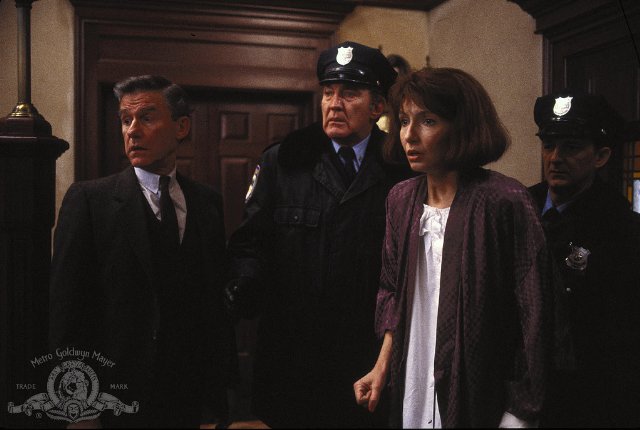
Soon after a mysterious woman who has received a satchel of money from a train station locker on New Year’s Eve is strangled to death in her car we meet Katie McGovern (Mary Steenburgen) an actress in New York who attends an audition for an independent film where the casting director Mr. Murray (Roddy McDowell) hires her almost immediately to audition on tape for the lead role. Leaving behind her live-in boyfriend Rob (William Russ) who is laid up with a broken leg and her visiting brother (co-screenwriter Mark Malone) she travels with Mr. Murray to a secluded house in upstate New York where she meets Dr. Lewis (Jan Rubes) the elderly wheelchair bound producer of the film where she is made over for the videotaped audition, an unusual speech that seems to indicate the film is a thriller and which greatly impresses the two men. But soon enough, with the phone lines down due to the ongoing blizzard and with nothing to do but wait, Katie spots her drivers license burning in the fireplace and quickly begins to realize that she is a prisoner in this place, one who may not be able to escape from the house alive.


The harsh wind heard blowing through the bitter cold night in the opening shot is combined with a joke that won’t be evident on first viewing and the two elements together display state right up front a genuine sense of perverse humor that will mix in with the suspense all the way through. A mixture of such tones can sometimes be fatal but in this case it turns DEAD OF WINTER into not a piece of camp but a nastily clever ride that enjoys turning the screws on both the viewer and its lead character however it can. Because of the first scene we know something is amiss right away with Katie being hired so quickly by the avuncular Mr. Murray, we just don’t know exactly what (makes more sense than spending forty-five minutes pretending this is some other kind of movie) and the narrative gambit adds an extra level of suspense to every scene as we wait for the other shoe to drop, something the movie seems to gleefully resist doing for as long as possible. Nowadays that slow burn might seem about a reel too long but for me the steady buildup felt genuinely elegant in its effectiveness and the film goes through a nice, steady striptease of unveiling small clues for Steenburgen’s heroine that are clearly not quite right. They’re just never enough for her to actually realize she’s in genuine danger, not until she finally reveals how grave her situation is in the most unambiguous way possible, prefaced by an excellently sustained shot where it is revealed in one elegantly simple set up something about her room that she hadn’t yet realized.


Directed by the great Arthur Penn who just died in September 2010 (this was his penultimate theatrical feature—I wonder how his last one, PENN & TELLER GET KILLED, holds up now) he keeps the tension building all the way through with just a few characters—I shouldn’t say how many—along with a steady pace, continually displaying a great amount of subtle cleverness in exploring the layout of this single house. The script by Marc Shmuger and co-star Mark Malone (apparently based on the 1945 noir MY NAME IS JULIA ROSS though this is never indicated in the credits) knows how to set everything up without ever letting things fall into Idiot Plot territory unless, of course, you count Katie driving up to this house in the middle of nowhere to begin with but considering she’s getting into a car with dear, sweet Roddy McDowall can you really blame her? What happens to her winds up going to some surprisingly twisted ends and maybe the worst of it is nothing all that shocking anymore but pretty far for what you’d expect to be a standard damsel-in-distress thing, something that a much more benign version of which could have been done as a TV movie in the 70s. In spite of some blatant nods to Hitchcock—a woman’s lookalike double, a photographer’s leg in a cast holed up in his New York apartment, a sinister glass of milk being carried upstairs on a tray—the suspense is never really that type approach at all but rather a modern day version of an old B movie with a strong female lead, always knowing how to walk the fine line between awareness of how ridiculous it is and being keen enough to keep the suspense going just right. It maintains a sharp, almost gleeful sense of pleasure to all the danger in an old fashioned popcorn kind of way which I say with the highest possible praise.


Not to overstate its effectiveness, things do go a little slack at a few points (it’s only 100 minutes but maybe could have lost a few) including a climax which doesn’t feel quite there in how well it works but the whole thing maintains an admirable pitch of tension all the way through at least partly since we’re informed of just enough that we can’t be certain how many other surprises are coming—in this context, even the briefly heard voice of an annoyed telephone operator manages to be just unnerving enough so every little piece added like that manages to add to the tension. Is any of it plausible? Not really at all. And I say so what. I started to watch the movie for my first viewing in decades fairly late at night, appropriate considering this would have been right at home on the late show during another era but wound up gladly staying with it all the way through into the early morning hours so that right there has to say something. Even the absurdities never really bothered me in this context and in a weird sense almost added to its effectiveness, so just like those goldfish collected at a gas station in a patently silly plot point, I was trapped right along with the movie the whole way through and perfectly happy to be there. DEAD OF WINTER never goes far enough to be truly transgressive or anything more than what it is and I don’t think it even wants to but it is a thriller that achieves a pitch of genuine tension that it manages to sustain constantly throughout. Wisely, it picks a correct tone and knows to stick with it, not something that seems to happen nearly enough with these kind of things. It’s nasty fun, with equal emphasis on both words in the best possible way and, maybe best of all, it always seems bitterly cold when I watch it. Some might think it old-fashioned in this day and age. I liked it.


And it should be said how much the film offers a terrific role for Mary Steenburgen who ultimately gets to play several roles—for the purposes of spoilers, I shouldn’t actually say how many—and it makes for an interesting stripping away of what is thought of as her basic screen persona, introduced with that familiar frizzy hair where she seems a little flightly but still grounded then when her look gets altered as her situation becomes more grave her basic nature seems to change as well. Any more layered thread of her playing an actress who gets to be an actress seems to come more from her than the material and she does a dynamic job, achieving perfect pitch with every single tense moment that occurs. Roddy McDowall—at that point on a slight high from the success of FRIGHT NIGHT— has a slightly tricky role also because of what we expect him to be and everything that presence signifies but as much as his sly, arch nature comes through he knows to never lower things to a level of playing it as a goof or an indication that he’d never do anything all that bad. With an early likable moment in particular toying with all our expectations of him it’s a very sly example of playing with his inherent style and it could be considered a case where his secondary villain becomes so much more than the main one does. As Dr. Lewis, Jan Rubes has undeniable screen presence but I’m not sure he ever totally sheds the sort of friendly uncle nature so near the end he’s a little more of a scary old guy than a villain who needs to be vanquished. With McDowell’s Mr. Murray doing much the dirty work it’s like he’s the one that a good deal of the inherent suspense ultimately comes from. William Russ has some nice moments with his cigarette dangling from his lips as the laid-up boyfriend and the cops played by Ken Pogue and Wayne Robson are familiar from any number of other films shot in Canada over the years—Pogue was instantly recognizable to me from Cronenberg’s THE DEAD ZONE and Robson has many credits including CUBE and Richard Lester’s FINDERS KEEPERS.


It’s that wind, damn it. I think again of that wind blowing and it reminds me of this kind of thriller that doesn’t get made these days which even within its ludicrousness displays a degree of intelligence, stylishness and actual suspense. Not to mention that all of the characters are actual adults and it’s not designed to start a franchise. Crazy, I know, the things I get nostalgic for. Arthur Penn was a key figure in the rise of the New Hollywood of the 60s and 70s, directing such titles as BONNIE AND CLYDE, LITTLE BIG MAN, NIGHT MOVES and THE MISSOURI BREAKS. I won’t make an argument that DEAD OF WINTER in any way ranks among those key titles or is at all a key title in any way and I almost wonder if I’m being a little too effusive in what I have to say about it. But as Jan Rubes watches over Roddy McDowell sharpening that knife and icily stating “If you wish to master your trade, Mr. Murray, you must first master the tools of your trade,” as they prepare for what will happen, with the old man finally concluding with “Sharp knife, no tears. Works every time,” as things are ready to go. That seems to say something about Penn himself making this movie with an approach that indicates he knows it won’t live up to past glories but he’s still going to make it as cutting and effective as he knows how to do. Whatever I thought of DEAD OF WINTER back then, it’s a pleasant discovery to discover how well it still plays, even if it makes the most sense to see it in that context of a late-night viewing, when issues of hard logic aren’t always what you’re necessarily thinking about. Thrillers such as this one that we go to see on all the cold, lazy Sundays early in the year throughout our lives may not be the most prestigious we’ll ever encounter, but I’m wondering if that’s ultimately a good thing. Maybe it’s the films that surprise us, the ones that go a little further than we would expected them to when we sat down with our popcorn, that are occasionally the ones we wind up remembering with just a little more fondness than the others. Maybe sometimes those are even the films that turn out to mean the most to us of all.

Wednesday, February 9, 2011

Not Even The Rain


It’s now twenty-five years since I walked through a blizzard to see Woody Allen’s HANNAH AND HER SISTERS at Yonkers Movieland on opening day. And, I swear, I’m really not exaggerating. February 7, 1986. It was a snow day. School was closed. I had recently figured out how to traverse various side streets to walk from my suburban village of Scarsdale to Central Avenue at the edge of Yonkers where there were two multiplexes right near each other. The first show on that opening day was at noon and I walked. In the falling snow. I can’t even remember what I may have told my parents about where I was going. What can I say, I was a weird kid and I’m not sure much has changed beyond that I don’t have to deal with all the snow anymore. The suburban theater was mostly empty—of course it was, there was a blizzard outside—but I’m sure the Beekman downtown in Manhattan did considerably better business that day with David Edelstein’s recent review in Rolling Stone blaring “Woody Makes a Masterpiece” in its headline and Vincent Canby in The New York Times that morning declaring that the film “sets new standards for Mr. Allen as well as for all American moviemakers.” Looking up the numbers, the film grossed $1.2 million on only 54 screens coming in tenth place in its opening weekend, which would be pretty damn impressive even now. And I’m still glad I went that day.


In the end, HANNAH AND HER SISTERS played for months, received seven Oscar nominations a year later, won three (Original Screenplay, Supporting Actor, Supporting Actress) and became the rare Woody Allen film to receive mass acceptance. It remains the only time in his career he’s cracked the $40 million mark (some of his other hits during the previous decade of course came out at a time of lower ticket prices) and was generally beloved by all. As many times as I’ve seen it over the past several decades recently it hasn’t been one of the ones I’ve returned to the most—ANNIE HALL and MANHATTAN top the list, which is probably the way it is for a lot of people. So to mark the occasion I decided to revisit the film in an attempt to remember a little of that day and as things turned out what I got was a much deeper, richer experience than I ever could have imagined all those years ago when I was, after all, pretty young and stupid. In fact, I’ve wound up watching it twice over the past week and have been a little blown away each time, genuinely moved by this film even more than I might have expected, moved by all that is has to offer. Twenty-five years old now, it remains a beautiful piece of work from start to finish.


The movie spans several years in the life of an extended family in Manhattan whose most stable member appears to be Hannah (Mia Farrow), an actress who is currently focusing her life on her children and husband Elliot (Michael Caine), a well-to-do financial advisor who is secretly in love with Hannah’s sister Lee (Barbara Hershey), an aimless woman currently living with her former professor, the humorless artist Frederick (Max Von Sydow). While Elliot tries to figure out whether to admit his feelings to Lee, there’s also the problems of the third sister Holly (Dianne Wiest), an aspiring actress always looking for other possible careers on the side while dealing with the continuing troubles of her own love life. And of course there’s Hannah’s ex-husband Mickey (Woody Allen), a television producer and extreme hypochondriac who thinks that he’s finally about to get the bad news he’s always feared but then realizes that there’s an even greater problem within himself that he suddenly has to contend with.


There’s something about the film which for me is so welcoming in its spirit that winds up feeling like all the good things that deep down I want to associate with memory, making me believe that I can actually breathe in the air of every scene set out there on the New York streets. Everything about HANNAH AND HER SISTERS flows together, every moment seems absolutely ideal. I can believe that the reasons I haven’t returned to this movie quite as much as a few others simply has to do with how I’m going to respond to a film dealing with the foibles of the singles world these days more than the inter-connected lives of an extended family. And maybe it also has something to do with the warm and fuzzy 80s-ness of what it all builds to in the end with everything working out yet the perception of that representing the entire film seems a little unfair. Many of the film’s characters are in situations that make them about as desperate as they could be in their lives and their genuine desire to make things better, what they’re striving for in their dreams, is palpable through every moment. What sticks out for me is how much true empathy HANNAH AND HER SISTERS has for each of its characters and how non-judgmental it ultimately is towards all of them no matter what they do. As misanthropic as he can be in his thematic goals at times, this is most likely Woody Allen’s most purely human film, the one that seems to believe that everything good can be possible and most completely felt when we all look over at all our loved ones at that annual Thanksgiving dinner. There are laughs throughout, and I could easily name favorite moments like Mickey’s explanation involving his family of the logistics of why he can’t just shoot himself as well as that reference to the Nuremberg Trials, but this one time Woody doesn’t seem to be going for as many quotable lines that might distract from the story he wants to tell. Broken up with title cards as if indicating chapters in a novel, the scene order at times seems random yet each piece of the narrative flows into one another beautifully, taking the mixture of laughs and seriousness further than he had up to that point and as funny as some of it is, particularly during the scenes focusing on Mickey, I may have needed to grow into a full appreciation of a lot of things in life to fully understand it all. Because, really, what the hell was I doing going to see this movie at my age? What did I think I was going to get out of it? And why did I go back several more times? Now, of course, the question is what I will continue to get out of the film when I return to it as the years go on and I get even older myself.


But I suppose I was trying when I was a kid and regardless, so much of it has such greater resonance now, even related to things I’ve experienced relatively recently thousands of miles away from where I first saw it. It’s the awkward way that these characters grope towards trying to figure out how to communicate, like how Barbara Hershey’s Lee keeps dwelling on having to go get her teeth cleaned while trying to think of something to say to Elliot aside from what she’s thinking, it’s the fear that arises when the worst thing is about to happen to you in life, followed by the greater fear that occurs when it doesn’t. To Woody, wisdom means nothing when it comes to what the heart wants and those feelings eventually all have to be reconciled. Of course, it drives some of us crazy sometimes, particularly when it comes to certain enigmatic women. The film treats each one of its characters with affection as they try to figure one another other out and so much of the story ultimately seems to be about those silent beats as they gaze at each other, whether due to thoughts of love or just trying to decipher what they’re saying. People don’t always go together in life, just like a few of those buildings Sam Waterston points out during his architectural tour of Manhattan, but if they keep pushing and remain resilient, refusing to remain what everyone thinks they are, maybe they can somehow figure out how to allow themselves to change. You need to find that balance within yourself, Woody as writer/director seems to be saying—Von Sydow’s Frederick may in fact be a brilliant artist, but he comes off as so miserable and self-serious that I can’t imagine him ever deigning to watch the Marx Brothers, to do anything that might actually give him some pleasure and as a result not only Lee, but the film itself turns its back on him.


A few of those biggest changes occur gradually, almost off screen, and much of the family dynamic is just laid there throughout with no explanation so this may have been my first viewing where I realized just how screwed up this family really was. The showbiz parents vividly portrayed in just a few scenes by Farrow’s own mother Maureen O’Sullivan and Lloyd Nolan (in his last role—he passed away before the film was released) have presumably been going through a nonstop circle of drinking, bickering and making up for decades, resulting in two of their daughters becoming addicted to drugs in one form or another which they have fortunately recovered from by the time the movie begins. The one who tries to keep everyone afloat is meanwhile silently grappling with her own insecurities, never knowing that the perfection she represents is what probably drives her husband away towards her livewire of a sister. That lunch scene between the three female leads is stunningly well done, one of the very best and most truly cinematic ever directed by Woody Allen, building some of the tensions between the sisters to a boil before the climactic point you’d expect, utilizing the directorial decision to cover the scene in three separate shots in a row, moving around the table with each beginning on a close-up of one of the sisters and allowing us to observe each of them during various points of the discussion. The device focuses on what each one is saying, as well as their silences, paying attention to the tensions that are going on between them as well as what they aren’t even aware of, what they never become aware of even when the end credits roll.


In recent years even some of Woody Allen’s better films have felt a little too put together on a whim, at times seeming like he’s not bothering with a second draft or take two, but everything here feels totally sharp, totally focused, the man working at the absolute top of his game. Accounts on the film indicate that the undeniable warmth it exudes was something which happened gradually during production as some of the darker plot turns Allen was going for didn’t quite come together and he later called these aspects the biggest weakness of the film (to Richard Schickel: “And so I had to put a more upbeat ending on the picture, because I just had not justified that level of sort of Chekovian sorrow. So I put in the ending that HANNAH has.”). It could be argued that some of the films he made soon after were an attempt to compensate for what couldn’t be achieved here—the very serious SEPTEMBER and ANOTHER WOMEN as well as the comedy-drama CRIMES AND MISDEMEANORS are certainly a few of his chilliest films but in the case of HANNAH the result that’s achieved feels like exactly what it’s supposed to be.


Much of that emotion is actually set in what much of the time appears to be a grey, cloudy New York (photographed by Carlo Di Palma) that I find truly beautiful in its distant familiarity, with a few locations like that Tower Records near Lincoln Center making me remember what it was like to be in those places--since when Mickey is approaching it he appears to be coming from the old Regency Theater, still a revival house in those days, I imagine he’s just seen a double bill there and wonder what it was. Various musical standards used as themes recur throughout (as well as an on camera appearance by Bobby Short) just as they no doubt recur in the character’s own lives and maybe because of this even the places I never went to in real life seem familiar to me—I never went to the Pageant Book & Print Shop (which apparently still exists, but only online) where Elliot buys that book of e.e. cummings poems for Lee but I watch this film and it’s almost like I can remember the sensation of actually being there.


Woody’s Mickey Sachs (strangely, I never realized before now that he plays the only main character given a last name—an attempt to avoid dealing with the family’s inherent goyness?) does seem to exist a little outside of the rest of the film, with some of his character background feeling maybe a little too much like a mixture of elements from earlier films—also, that whole sperm donation thing involving his former partner could very well have deserved its own movie—but the themes expressed are a very much part of everything else and the way he ultimately becomes part of the overall narrative feels totally organic, two distant pieces on a board finally coming together. Regardless, each male role here feels like something of a real-life surrogate for him anyway, even Sam Waterston’s architect to a certain degree. Michael Caine’s Elliot is all ticks and insecurities in his love life while Frederic as played by Max Von Sydow, the Bergman surrogate, seems very deliberately designed to be the darkest side of Woody’s own self, the one who sits up late at night brooding about everything that’s happened to civilization and maybe even the allegedly serious artist that he wishes he could be thought of. Mickey’s quest for religious enlightenment in the wake of his health scare feels a little glossed over as if Woody the director couldn’t figure out a way to be as interested in it as his character is and the Krishna joke feels at least a half-decade out of date for the time, but what matters is how these characters are able to grow enough to figure themselves out along with the eternal truth that gets learned, the right way to “be logical and put the world back into rational perspective”—really, if the existence of DUCK SOUP doesn’t count as a reason to go on living in this world I don’t know what does. It reminds me of another personal connection I make with this film in how when Woody wanders in to see that Marx Brothers classic the theater in question is the Metro, now closed of course, which really was a revival house at the time and where I once saw that very movie with my father on a double bill with HORSE FEATHERS. In some ways that memory I have is about as important as what happens to Mickey here.


The apparent center of it all, Mia Farrow has never gotten as much acclaim for this film as a few of her flashier costars and my own feelings about her performance have varied through my multiple viewings over the years. Sometimes she seems to blend in with the scenery, a character struggling to break out of what everyone’s expectations of her are, maybe even missing that one big moment where she could explain everything. And at other times the way she is framed in close-ups becomes rather magical, allowing it to fully be understood why there’s a reason that everything in this family’s world has become centered around her, this actress who decided to focus on family and always try to be perfect. After this viewing I think she’s just amazing. Playing the role that won him his first Oscar Michael Caine really is phenomenal, taking what may have been written as a part that Woody himself might have played and doing something totally different with it, infusing it all with an inner life that makes him understandable, even if what he does can’t possibly be defended. Also winning her first Oscar, Dianne Wiest is just wonderful, selling every ounce of insecurity and abrasiveness along with those moments where the charm comes through, making the end of the journey she reaches in the final shot genuinely rewarding. Maybe not as acclaimed since some of her story is by nature offscreen, Barbara Hershey is nonetheless luminous as Lee, making it clear why anyone would fall for her and doing some particularly strong work in her final scene with Von Sydow, who is excellent as well through every harsh moment he has. Having to spend a fair amount of his screen time alone, Woody himself delivers one of his best performances, making every desperate moment he has seem genuine and at times hysterical. In fact, there’s not a bad performance in the entire cast which also includes Julie Kavner, Carrie Fisher, Daniel Stern and Joanna Gleason. Tony Roberts and Sam Waterston are unbilled and there are brief early appearances by the likes of Julia Louis-Dreyfus, John Turturro, Lewis Black, J.T. Walsh and Richard Jenkins. Just to state for the record, apparently Soon-Yi Previn is also in there at some point.


It’s strange to say how completely rewatchable the film is for me considering how I’ve already admitted that this was my first complete viewing in some time (hey, is that my ANNIE HALL disc over there? I haven’t watched any of that for nearly three weeks) and how often I return to it in the future may have as much to do with my own place in life as much as anything. Will I need to feel this sort of nostalgia just as Lloyd Nolan’s father stays forever at that piano going down memory lane, hearing those songs I’ve heard before, continually dwelling on the day I first saw this film? I really can’t answer that right now. I only know how much it’s staying with me this time and I have little doubt that the movie will still have as much to offer to me in another twenty-five years. Woody Allen really did make a masterpiece with HANNAH AND HER SISTERS…it’s just that with some films they become so familiar to you that it’s easy to forget just how meaningful and important they are to you. And in many ways that’s what the movie is trying to say about all the things we love in life as well.

Friday, February 4, 2011

Straight To The Happily Ever After Part


One Saturday long ago, in May 1990 to be precise, I spent pretty much the entire day in a multiplex with various people I was going to college with and when it was done we had seen a full total of four movies. I won’t get into the specifics of it all but it’s safe to say that it was one of the more extreme examples of theater hopping that I’ve ever undertook and over the years I’ve done quite a few. Three of the four movies weren’t even all that good but part of me still wouldn’t mind going to see any of them if they were playing in theaters now. Anyway, in order they were TALES FROM THE DARKSIDE: THE MOVIE, CLASS OF 1999, Friedkin’s THE GUARDIAN and, to finish out the day, George Armitage’s MIAMI BLUES starring Fred Ward and Alec Baldwin, which was definitely the best of the bunch and it wasn’t even close. It’s funny how thinking about it now I remember that day and how miserable things were for me due to what had been going on in my life at the time and yet in retrospect the whole thing just seems so carefree, the sort of extreme kind of moviegoing I love that you only do when you’re young and I know that I wouldn’t have the patience to do it anymore even if I wanted to. But now all these years later on the final night of Edgar Wright’s amazing The Wright Stuff II series at the New Beverly Cinema I found myself once again closing out such a run of seeing various movies with MIAMI BLUES. The more things change, you know? It was the second on the double bill, following Michael Cimino’s eternally fantastic THUNDERBOLT AND LIGHTFOOT with the two films maybe not having much in common beyond just not being as well known as they really deserve to be. MIAMI BLUES isn’t a great movie and I’d go so far as to say that I wasn’t as excited about it as some people at the theater that night were but it is a good movie, a nasty piece of darkly comic mayhem which at its best turns out to be genuinely disarming in all the right ways. Edgar Wright seemed particularly pleased by how it went over, saying that as far as he could remember he’s never seen it with another person let alone in a theater and, as was proven that night, it really is terrific to watch with a big crowd.


A mysterious, but clearly dangerous, man who is using a stolen ID that enables him to go by the name “Herman Gottlieb” but who prefers to be called Junior (Alec Baldwin) has arrived in Miami and is looking for trouble. Before even leaving the airport, he’s stolen some luggage and broken the finger of an overeager Hare Krishna which results in the Krishna falling over dead. Once at his hotel he immediately hits it off with the prostitute he has sent up to his room who calls herself Pepper but is actually the very innocent Susie Waggoner (Jennifer Jason Leigh) and almost instantly the two decide to move in together. Meanwhile, the police in the person of Sgt. Hoke Mosley (Fred Ward) begin investigating the Krishna’s murder and Mosley soon turns up looking for Junior as a possible witness to the crime. After a dinner of pork chops cooked by Susie, Junior seeks Mosley out at his hotel and assaults him, stealing his badge and gun, looking to use them for his own means as he tries to begin his new life.


Based on the novel by Charles Willeford, who featured the character of Hoke Mosley in several other books, MIAMI BLUES establishes its own level of nastiness early on and never looks back, playing right up to the end as the ideal film version of the sort of darkly funny crime novel it’s based on. As pointed out by Edgar Wright in his introduction the mixture of nasty violence and arch comedy of the film which didn’t do so well when it was released (just under $10 million domestic) certainly anticipated what would become more prominent in just a few short years with the first films from Quentin Tarantino and others but of course we didn’t know that at the time and I suppose we just took it as an especially fierce, yet still very funny, crime tale with some terrific performances particularly by Baldwin and Leigh. Directed by George Armitage, who also wrote the screenplay and seven years later helmed GROSSE POINTE BLANK, it’s a nasty character piece with a genuine sense of danger to it all the way through, centered in its own odd way with the weirdly angelic presence of Leigh’s prostitute who dreams of owning a Burger World, someone who has to be one of the most innocent creatures ever put in the middle of this sort of thing even while having several nude scenes that still play a little surprising in terms of how willing the actress seems to be to just take off her clothes and simply do it.

Jonathan Demme was one of the producers and it certainly has the feel of his films of this period, no doubt helped by the presence of crew members like cinematographer Tak Fujimoto, and the somewhat freewheeling approach results in a tone that comes off a little like a version of MARRIED TO THE MOB where the violence was allowed to become truly nasty, where the jokes suddenly turn a little darker as the blood becomes real. It definitely has a certain vibe that the other Demme films from the period have and, no surprise considering Armitage began his career working for Roger Corman several decades before, in some ways it plays like a 70s film that was somehow allowed to be released in 1990. It’s not perfectly arranged and the pacing is a little lax but it’s effectively scrappy in its own way and seems willing to never tells us exactly how to take certain things, how much sympathy we should be feeling for Jennifer Jason Leigh’s character or even how much we should dislike Junior, saying he’s going to take care of her immediately after laughing in her face about wanting to own a Burger World franchise (presumably the same Burger World with the jingle that Dean Stockwell sings in MARRIED TO THE MOB). In spite of all this she sees “some good qualities” in him, no doubt from the earnest admission he makes when they first meet and she still wants to do everything possible to make him happy, even agreeing with him about the air conditioning when she probably doesn’t feel the same way. He’s a total sociopath, of course, but he is fun to watch and it’s never clear from one moment to the next if what he’ll say will make him sound like a polite child or if he’ll suddenly pick up a jar of spaghetti sauce to use as a weapon.


Armitage knows how to keep the frame busy and while the story moves fast all the way through it’s definitely more interested in the characters than anything—with Junior just going out and stumbling onto crimes that he takes advantage of with his new badge in various ways there’s no big heist to build to and he probably wouldn’t have the attention span to put something like that together anyway, so it never gets too bogged down in plot mechanics that George Armitage doesn’t seem too interested in anyway. It’s more about the question of if Junior can somehow recreate himself in a domestic life while still living outside of the law in the guise of a cop and how Susan is finally going to react to all this when she admits to herself what kind of person this guy really is. On occasion the funniest things in the movie just glide in and out of scenes like when Ward and fellow investigator Charles Napier are laughing over something while looking over the dead body of the Krishna or Baldwin’s Junior amusing himself as he counts out all the money he’s just stolen, with Armitage presumably just stopping everything for Baldwin to do an improv. I knew the movie was working with the New Beverly crowd when there seemed to be a collective intake of breath over a certain bit with an Uzi gun before the gag was revealed and that right there says a lot about MIAMI BLUES—a film that doesn’t always state right away whether it’s a joke or not but it keeps the nervous energy going as Junior becomes even more unhinged, more than just a regular crook and that sense of danger moves through the whole film. By a certain point Junior seems to decide that if he says he’s a cop then for all intents and purposes he really is one, a strategy maybe best displayed in a convenience store scene which plays like what would happen if Travis Bickle taking out the crook in the tiny grocery store in TAXI DRIVER went very, very wrong for him. Baldwin taking in the answer to his question, “Where is the whipping cream?” before he leaves might be my favorite moment in the whole film.


There’s also a slight structural issue in how Hoke Mosley would presumably be the franchise character who might return in future films but a lot of it really becomes about Junior and Susie, resulting in the alleged main character playing a supporting role in his own movie which causes things to be slightly lopsided. He gets laid up in the hospital for a fair amount of the running time and it would be nice to see a little more of the character in his element—suddenly I’ve come up with the random idea of starting with a pre-credit character scene involving Mosley so we meet him first. When this cop who has willingly gotten a set of false teeth and loves sharing recipes really gets to do his thing rather than just sit on the sidelines it’s like both sides of the movie are totally clicking together, like in the supermarket scene with that girl trying to hand out samples of sausage feeling right in that Demme road company wheelhouse, becoming one of the best acted scenes for both Ward and Leigh as well. The bursts of action are fun particularly when both Mosley and Junior are screaming “Freeze! Police!” as they shoot at each other, but it’s the little things sprinkled throughout, Baldwin going over a haiku as he breaks into an apartment or just the lounging of the leads having a tense dinner of pork chops and beer that make it a fun movie to spend time with and return to. It totally sells how crazy Junior is and because he seems capable of anything at any time, so does the film. MIAMI BLUES is good to the point where I wouldn’t mind much at all if it had been even better, maybe just a little sharper at the script stage, but who am I to complain? It played fantastic with the packed house at the New Beverly especially with the continued reactions to a certain scene involving a needle and it was particularly memorable to hear the response to that scene in the pawn shop where…well, if you’ve seen it you know what I’m talking about. The effect the film has best exemplified in the smile Baldwin gives at one point when he realizes just how much power this badge is going to give him so it’s like both he and the movie can’t believe they’re getting away with this. It’s that kind of movie and the feeling becomes infectious. Some of it is uneven at times and I might make the case that GROSSE POINTE BLANK works better as a mixture of violence and dark comedy but that film never quite displays the sense of danger that gets achieved just from Junior staring somebody down in any given scene, the sort of thing that makes moments like what Baldwin is doing in the back of the frame as Jennifer Jason Leigh explains her ultra-simple pork chop recipe so completely and disarmingly effective.

No stars turned up to discuss the film with Edgar Wright but we did get executive producer Edward Saxon who also plays the role of the ill-fated Hare Krishna and they were also briefly joined before the film by GROSSE POINTE BLANK co-screenwriter D.V. DeVincentis. Saxon talked about the genesis of the film, telling of the glory days when Orion just let filmmakers go off to make their movie but this time was slightly different when the studio was presented with the package of Fred Ward playing Junior and Gene Hackman as Mosley. The studio hesitated at this, fearing the movie would skew a little too old, resulting in Hackman being let go and Ward, attached to the project from having bought the rights for himself early on, switching roles (also a character who could have appeared again if the movie had been a hit). Baldwin had already worked for Demme in MARRIED TO THE MOB, was about to explode and certainly wasn’t someone the studio was going to object to. Though the film was shot before HUNT FOR RED OCTOBER, the release was deliberately held back until after to let his stardom happen. The reason why there were never any films made out of other Hoke Mosley books (apparently Curtis Hanson owns the rights now) was no more complicated than that it didn’t do very well, although Saxon agreed with Wright’s suggestion that Baldwin would be terrific playing Mosley now. Interestingly, he also mentioned that there were some extra scenes featuring Mosley that were shot but they were all pretty much ‘plot’ and he acknowledged that by a certain point Armitage just became more interested in Junior and Susie than the cop on their trail. Maybe it doesn’t make the film come together as well as it might have but moments like that particular way she winds up making that vinegar pie have always stayed with me. For that matter, so does the film’s final shot of Leigh, a moment of unresolved contemplation that I doubt many others who might have made this film would have bothered with.


Pulling his teeth out, Fred Ward (“Beer’s gone, I’m gone.”) is a lot of crafty fun as Mosley even if it does feel played a little more like a character part than a lead role, just a few scenes short of maybe what his character needs to really pay off and, yeah, it would have been cool to see Ward play the role again if it could have happened. Playing one of the most sadly unsung roles of his career, Baldwin is truly fierce and unpredictable with beats like that glare of his when realizing he has to have dinner with a cop, barely seeming able to comprehend things people say to him during conversations as if to him they’re some other kind of lifeform. Leigh is phenomenal, infusing every single moment with her character’s sweetness and pep, finding touching moments where you wouldn’t have expected them to be like in the way she looks at Junior, eyes, fully open, when they kiss. I couldn’t agree more with Wright when he pointed out afterwards that if the film had been received better at the time it’s not a stretch to imagine her being nominated for an Oscar. One thing’s for sure, no one has ever been more adorable when saying the word “teapot”. Nora Dunn and the legendary Charles Napier are a few of Mosley’s fellow officers, Paul Gleason is a corrupt vice cop, Shirley Stoler of THE HONEYMOON KILLERS is the imposing pawn shop owner, Bobo Lewis is the landlady who hopefully knows what she’s doing with that needle (Baldwin’s “Your husband must have been glad to die” pretty much sends me into hysterics when he says it) and DR. JEKYLL AND SISTER HYDE’s Martine Beswicke appears for a flash as a waitress.


For a film I may admittedly have a few small problems with, MIAMI BLUES was an ideal choice for the series to end on and not just for my own weird personal reasons. It’s a film that is messy, yes, but it’s also a film with massive pleasures, with engaging characters that feel alive in their own twisty ways and at its best displays a willingness to go down some unexpected avenues. And the rush I get from a film as alive as this one is really is what I took away with me at the end of this festival. In its aftermath I’ve felt on a definite cinematic high after seeing this diverse batch of fantastic movies Edgar Wright programmed—actually, there’s been a lot of great stuff shown in L.A. lately, like the Roman Polasnski series at the American Cinematheque which played a double bill of gorgeous prints of REPULSION and ROSEMARY’S BABY that genuinely set my soul on fire. Things feel in a little bit of a tailspin for me these days in terms of the pressures of looking for a job and all that but during the best moments of this series I was reminded of how much I love films, reminded of how I have that flicker of celluloid always running through my veins and it’s not a habit I have a desire to ever break. And realizing what Edgar Wright and all the people who work at the New Beverly did with this amazing series that packed the house each night with people who were also there to love these films, to see them as they were really meant to be seen, it’s clear that there are others out there who continue to feel the same way.