Friday, November 15, 2013

Every Age Is The Same

It’s hard for me not to cherish certain memories from when I was a kid and got taken to the movies out of nowhere. A few of those are still favorites of mine now, at least partly because of the surprise that was always part of it. There was the Sunday when my parents asked if I wanted to go see a new movie that had just opened named RAIDERS OF THE LOST ARK, there was the time we were down in Manhattan and decided to see a new comedy with Dudley Moore named ARTHUR (so I’ve always said that my parents always took me to films where the lead picked up a hooker in the opening scene) and a few years before either of those, I’m guessing around the Fall of 1979, there was the weekend afternoon when my dad decided out of nowhere that he wanted to go see a movie named TIME AFTER TIME. I have a vague recollection of seeing television commercials and thinking it would be entirely a film about a chase through time. The movie as it turned out was slightly different from what I had been expecting but I loved it anyway. The directorial debut of Nicholas Meyer, TIME AFTER TIME has always been fondly recalled by some, maybe not enough people to make it a cult film but I imagine there are others out there who smile at the memory of it. It’s that sort of movie but it’s also one which overcomes certain flaws due to an engaging and surprising story, an excellent trio of lead characters and a genuine likability which allows it to stand out even now. The mechanics of the story’s time travel plotline is something that has been done other times in the years since (even by the man who made this movie and we’ll get to that) and like a few of those other examples there are holes you could poke into the story but, really, so what? TIME AFTER TIME is still endearing in spite of its flaws, almost to the point where I don’t care very much about those flaws at all. Some movies just have that sort of staying power.
London, 1893: During an evening gathering with several friends at his home, writer H.G. Wells (Malcolm McDowell) shows off his newest invention, a time machine which he has yet to use. As he muses over whether to go forward or back the night is interrupted by the police, in search of the notorious Jack the Ripper who they believe to be in the area. Quickly, it is determined that the Ripper is one of Wells’ houseguests, Dr. John Leslie Stevenson (David Warner) who has used this opportunity to get away. It doesn’t take Wells long to discover that Stevenson has used his time machine to travel forward—-to 1979, to be exact. After the machine returns to the origin point as it is designed to do, Wells follows him and soon finds himself not in London but in San Francisco where he sees what the future utopia that he imagined to truly be filled with violence and anger where his friend Stevenson fits in perfectly. Wells soon tracks his friend down with the help of liberated bank employee Amy Robbins (Mary Steenburgen) and the two begin a romance but not only does Wells eventually have to reveal who he really is but he also must stop Stevenson when he realizes that his killing spree has begun yet again.
Every now and then you revisit a favorite movie from long ago and discover that the magic has died. The story doesn’t hold, the acting isn’t actually very good, the style has become irrevocably dated in ways that are unfortunate. Then there are those cases where even if you know that some of it isn’t quite as perfect as it once seemed the magic still doesn’t totally diminish and I suppose TIME AFTER TIME is one of those cases. Do these feelings have to do with the memory of when I first saw it long ago? Is it just a dream of the feeling I used to get going to the movies when I was so young, when everything about it was still so mysterious? I honestly don’t know, but it’s not like I sit up nights fondly remembering the time my father took me to see HOT LEAD AND COLD FEET. In the case of TIME AFTER TIME not only do I still vividly remember details of that day down to how it was dark out by the time we exited the theater, much of what I remember fondly about the film is still there. It’s continually endearing, no matter how grisly things get, while never allowing itself to get bogged down in overexplaining the science fiction elements of certain plot points beyond our awareness that a certain key is basically the McGuffin. However you may want to accept or not accept the time travel logic the pieces nevertheless fit together beautifully, with continually engaging use of the San Francisco locations and there’s always a snap to the scenes particularly in how the actors play the dialogue.
As a director Nicholas Meyer displays more confidence in his own story structure (official credits: screenplay by Meyer, story by Karl Alexander & Steve Hayes) than in his visual style with the occasional awkwardness evident at times. You can feel his direction veering from normal coverage of the scenes to the occasional wilder idea tossed in with little middle ground but he’s clearly going for getting as much out of every moment as possible, whether for comedy, suspense or the growing romance between the two leads which doesn’t require much from the camerawork other than allowing us to see the genuine chemistry. The film does have a few shortcomings like how Wells’ journey forward through time plays a little like a cut-rate 2001 Stargate sequence even for ’79 and a foot chase where Wells pursues Stevenson through a modern-day shopping plaza not only feels haphazard in how it is staged the sequence also seems misconceived as if the man who is Jack the Ripper shouldn’t be so worried about actually being captured by someone who can barely throw a punch. Meyer also doesn’t seem up to staging a car chase at this point in his career and these sequences are an interesting counterpoint to the visual flow of his next film STAR TREK II: THE WRATH OF KHAN where every shot, every cut, involving effects or otherwise, seems to go together beautifully. That’s not always the case with TIME AFTER TIME but it is a movie which pays much more attention to its story and performers--in some ways the effects involving a time machine built in the 1890s don’t need to be more complex than they are. It’s the energy from the actors that makes such a difference here particularly in the affecting courtship between Wells and Amy (McDowell and Steenburgen, who met on this film, married the year after its release and were together until 1990) and it gets us to care about what happens next.
The opening sequences set in 1893 London come off as not only an enjoyable homage to the original Wells novel and George Pal’s classic 1959 film but also as a fanciful dream compared to the much more earthbound San Francisco which in this context comes off as charming as I always imagine it to be, while never ignoring the underbelly of the place which allows the Ripper to thrive just as he did back in London. As a setting it’s a perfect bridge between the more fanciful past and the realities of where the future has arrived at where Wells encounters McDonald’s for the first time. Some of it might be a little overly broad in how it plays, like the behavior of certain extras at times, but the more sober concepts stand out—Wells learns of multiple ‘world wars’ as well as noticing concentration camp numbers on the arm of one person but he interestingly never learns what they really mean while as much as he may speak of utopia and equality he still doesn’t know how to react when presented with a woman who is the living embodiment of that. And even if Amy Robbins is determined to be identified as a liberated woman she’s not ideal in every way--Wells asks where her books are, for one thing, only to discover that she doesn’t have very many. These are some of the themes that help the real world poke through the fantasy and keep the film going through some of the clumsier passages, the suspense pieces that don’t really go anywhere. There’s continued invention in how the film will just observe McDowell as Wells walking down the street, a wit to how it plays. When he gets into a cab and the driver guns the engine racing down those steep San Francisco streets it sure sounds to me like the sound effects used are library tracks from BULLITT—hey, they’re both Warner Bros—and it’s a cute joke. Plus the unbridled majesty of the old-fashioned score by Miklós Rózsa (his penultimate) is infectious, as if Wells is scoring the unbelievable experience he’s going through in his own head. The movie is earnest in the ideals of what it wants to get across of how far we haven’t come since Jack the Ripper walked the streets of London and yet it wants to enjoy itself, to live up to the movie-movieness feel promised by the Max Steiner Warner Bros fanfare that opens it.
There is also some intriguing foreshadowing of Meyer’s own involvement with the outer space franchise he would become identified with after this film. The director himself has written about how he disagreed with the Gene Roddenberry take on the future, that there will be some utopia occurring within a few hundred years. On revisiting TIME AFTER TIME it’s surprising to see his argument laid out explicitly during the opening of the film to demonstrate the ongoing chess game between the believer, H.G. Wells, and the realist in the form of Dr. John Leslie Stevenson not yet unmasked as Jack the Ripper. What Wells finds in the future just a few generations later (now our past in a film going on 35 years old), the world we know all too well, is one that will never make any sense for him, as baffling as the Mickey Mouse phone that Amy insists is there only because her (presumably more immature) ex-husband wanted it there. The villain is ultimately correct in predicting what the world will become. It doesn’t mean Nicholas Meyer is pleased about that.
Some plot mechanics of the third act seem to anticipate the climax of BLOW OUT in a ‘wait, why are they doing this again?’ sort of way but certain pieces pay off beautifully (in addition to skirting the edge of the PG rating—still amazing that my parents took me to this but with that rating I guess they didn’t know) that it doesn’t really matter. The fanciful intelligence of TIME AFTER TIME allows much of it to hold together. The story keeps things moving and the optimism of the lead character placed up against his ultimate despair at certain times makes it an extremely rewarding film to return to. It’s not a deep film and it doesn’t try to be but there is enough in there to add to a return to it all these years after first seeing it. Plus a certain look between two characters at the end, the sort of thing that can fascinate a kid, can get a film to resonate long after you’ve forgotten the last time you saw the whole thing.
Somewhat unusually so, TIME AFTER TIME really is a three character piece, all respect to someone like Corey Feldman here who makes one of his earliest appearances, playing “Boy at Museum”. Considering how young I was at the time this was of course the first film I ever saw Malcolm McDowell in meaning that for years I was one of the few people on the planet who associated him with a heroic role. Maybe that’s not so much the case anymore but he’s still wonderful in the movie charming and funny but more than anything he’s human, always displaying Wells’ determination to achieve what is right. Mary Steenburgen enters late and almost takes over the whole thing, playing her role as about as laconic as a Hawks Chick could ever possibly be and yet the vulnerability of what happens to her in this situation comes through. Meyer seems to get as much of a kick out of creating Steenburgen as a movie star here, as a genuine screen presence, as he later did with Kirstie Alley in WRATH OF KHAN. David Warner is utterly charismatic as Stevenson, taking full charge of the screen whenever he’s on it. He’s fascinating to watch here and few bad guys this side of Alan Rickman in DIE HARD seem willing to show how much thought they’re putting into their actions, as insane as Warner’s Ripper genuinely is.
In 1986 Nicholas Meyer co-wrote STAR TREK IV: THE VOYAGE HOME which of course took the crew of the Starship Enterprise back to present day San Francisco. More specifically, Meyer wrote the middle of the movie where all that happened but even as that movie became such a success at the time few seemed to notice the similarity. It’s interesting to compare the approach taken by the two films, including where each one allows certain jokes to go--a newspaper headline reading “Colts Maul Rams” in TIME AFTER TIME becomes a more sober report on nuclear arms talks in TREK IV. In 1990 Mary Steenburgen appeared in Robert Zemeckis’ BACK TO THE FUTURE PART III as the love interest of Christopher Lloyd’s Doc Brown, getting another chance to play a scene in which someone tells her that they’ve come from the future/past. (Screenwriting exercise: TIME AFTER TIME, like FOUL PLAY, is set in late 70s San Francisco. What if the Mary Steenburgen and Goldie Hawn characters switched films?) Meyer even used David Warner again in STAR TREK VI: THE UNDISCOVERED COUNTRY when he directed that film in 1991. In her WRATH OF KHAN review in 1982 Pauline Kael points out that one thing that film has in common with TIME AFTER TIME is a lead who when despondent near the very end breaks down by declaring, “I know nothing.” In his autobiography “The View From The Bridge” Meyer takes note of what he calls some “startlingly bitter social commentary” in this film which of course he is responsible for. It doesn’t strike me as being that bitter, to be honest. It seems real and the relationship that develops between the two leads is ultimately optimistic because of this. Maybe I can’t be so critical about TIME AFTER TIME. Hell, I don’t really want to be. I have little desire to revisit the past and become a kid again but if I could somehow close my eyes and appear back on that day when I first saw it, I would. Even if for just a few minutes. And, really, returning to movies like this where I love them for reasons that go beyond what’s on the screen is as close to time travel as I suppose I’ll ever get.

Wednesday, October 30, 2013

The Dark Inside Ourselves

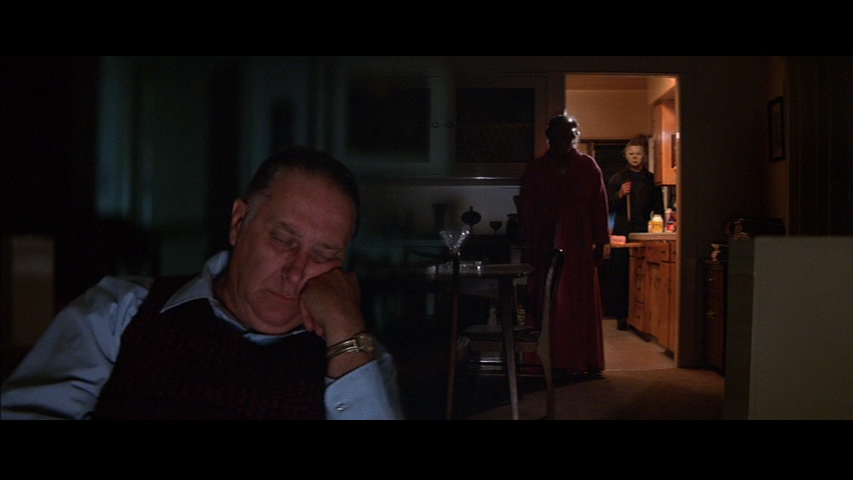
Some things in life are impossible to recreate. You come to a movie for the first time several years after it was first released and there might be some baggage, something about the film’s reputation that you’re automatically aware of. Seeing JAWS in a theater now can be wonderful but we’ll never be able to recreate the thrill of what it must have been like to see it brand-new in a packed theater back in 1975. But we can take that film by itself, discarding the later sequels if we so choose. With something like HALLOWEEN, it’s as if we don’t have that choice. Not in just how we can’t go back to the 70s to see it but the sequels, all of them, are largely where what we know of as the HALLOWEEN mythology really came from and those plot points are always going to be there in the back of our minds when we watch that original film. Whatever of John Carpenter’s classic 1978 original was meant to be a simple scary movie gets somehow lost in all that. Coming three years later, HALLOWEEN II is one of those sequels meant to begin immediately after the original as if the goal is to have both films play back-to-back and the conceit really does work about as well as it possibly could, even if there is an undeniable slickness to the sequel that indicates the bigger budget right from the start not to mention how the returning actors really do look a few years older. The thing is, as many who have seen HALLOWEEN II are aware, it’s nowhere near as effective as the original. Not as scary, not as potent. I doubt there was any way it could have been. Of course, I’ve still seen the movie plenty of times by now anyway and as much of a comedown it might be, as much of a cash grab as we all know it is deep down and even as puzzling as some of the story choices are, compared to plenty of other slasher movies made during the last thirty years HALLOWEEN II is flat-out elegant at times. Maybe that’s an odd thing to say about a movie where a beautiful topless girl is horrifically scalded to death but sometimes these things need to be pointed out and recognized.
On Halloween night, 1978 in Haddonfield, Illinois: Immediately after Dr. Sam Loomis (Donald Pleasence) has shot the escaped madman Michael Myers (Dick Warlock) six times while attacking Laurie Strode (Jamie Lee Curtis) the doctor discovers that he has unaccountably escaped into the night. As the authorities are faced with who has been killed, Lauie is taken to Haddonfield Memorial Hospital and Loomis continues his search, not knowing that Michael is already on his way to the hospital to finish what he started. But soon enough Loomis learns the biggest secret of all about Michael Myers, one that reveals why he really came back to Haddonfield and why Laurie is the one he’s been focused on.
The decision to stick to the same night without any sort of time jump probably placed some limitations on where the story could possibly go. But there’s also a mood to the original film which remains primal even today in how the killer in question is never a character named Michael Myers so much as The Shape or just ‘He’ as in ‘He came home’ when Dr. Loomis refers to him, somehow connected to that house where he grew up, somehow connected to Laurie Strode in a way that can never be put into words and his presence only has a power on this particular night. The film is so sparse in its design and Carpenter uses this to his advantage—in the daytime scenes the streets of Haddonfield with those leaves blowing along the ground feel emptier than even a normal street in a small town would ever feel and it adds to our sense of impending dread which continually lingers so we forget to watch for just how small scale the production really is, just a few locations and characters along with a top-billed actor who doesn’t do much more than wander a few streets while spouting off exposition.
Directed by Rick Rosenthal, HALLOWEEN II dispenses with this approach either knowing that it can’t be recreated or just willingly going along with the larger budget provided by Universal—it’s all much more kinetic and even the rendition of the famous theme is more hyper this time around which does effect the ongoing mood. It’s of course set later at night now but nevertheless there are more people out on the street, even more lights illuminating the sleepy town of Haddonfield. This is really the point in the ongoing series where the killer ceases to be The Shape and is very much Michael Myers—as if to underscore this, the slight recutting of the end of the first film at the start omits the glimpse of his pathetic face as if to keep ‘Michael’ that much more of a threat as time goes on. From here on his name emerges more and more, making him less of that Boogeyman Loomis once confirmed he was, represented by the human skull lying within the Jack O’ Lantern seen in the opening credits. And if Michael Myers kept his goals in the first film mostly limited to the characters somehow connected to Laurie Strode in this one he goes all over the place dispatching strangers and just random people in that deserted hospital while the star of the film lies catatonic for a fair chunk of the running time. In a weird way the not-quite-right recreation of the original film’s setting is part of the charm, as if wanting me to try harder in pretending that there really is a mythology to all this.
John Carpenter and Debra Hill wrote the script (they produced as well) and it’s hard not to think around the half-hour mark that very little has happened with the sparse plot causing too much to play as filler like a security guard’s interminable walk around the hospital that finally arrives at a predictable conclusion. Of course, the same thing could easily be said about HALLOWEEN, a film which was more about mood than anything else, including the plot, and one in which its lead character isn’t even put in any sort of jeopardy until the last fifteen minutes or so (that’s not a criticism of HALLOWEEN, for the record). But maybe that’s a trick which can’t be repeated, at least not in a way that can feel satisfying so maybe the clutter and sudden plot revelations of HALLOWEEN II almost overwhelm the simplicity, one of those cases where both too much and not enough is happening all at once. A big thing is made out of Michael stealing a knife early on but I don’t think he uses it once during the entire time at the hospital. And again, not much happens which involves Laurie until the last fifteen minutes. Loomis learns the secret truth about Michael’s connection to her while she just winds up getting chased around again and this endless night just goes on and on.
Much of the credit should certainly go to the great director of photography Dean Cundey for impeccably adding to that continuous sense of dread—one particular shot involving The Shape emerging from pitch darkness still gets a gasp out of me. And I will give the movie this: it has moments, whether in its use of deep focus in the gliding Panavision frame, displaying the dark humor of the holiday like the unexplained story behind the kid who has had an unfortunate accident with a razor blade or the odd touches that seem so correct in this context, the nurses’ shoes that drop to the ground as she dies, Lance Guest’s Jimmy slipping on that large pool of blood (I always find it hard to watch this, actually), the way The Shape’s Shatner mask seems to be getting more tattered as the night continues. The little touches involving the supporting characters don’t stick as well as they did in the other film but they’re there, like ambulance driver Leo Rossi offering love advice to Lance Guest in a way which recalls the conversations between the three girlfriends in the first film (there’s even a little pot smoking) along with a few touches involving people we only heard about previously like the fate of poor Ben Tramer. Plus the various swirls of red and green colors that turn up, giving the overall film a more fantastical feel than the original—the moment when Michael’s blade almost causes an elevator door to open back up again feels very Argentoesque.
The studio slick vibe, along with a certain occasional crassness, does give the film a feel that is more similar to the following year’s HALLOWEEN III than the original and even what we briefly see of downtown Haddonfield is a location reused in III (along with a few odd similarities—both share a deserted hospital where the doctor on duty has presumably just come from the bar). But there’s a reason why I keep watching at least some of this film every year along with the original and the non-Myers SEASON OF THE WITCH (but not the subsequent sequels, forget about those)—it’s that feel that John Carpenter and associates captured which always puts me in the mindset of films from that time, the shiver I gets whenever I see the Scope Universal logo from the period. It’s as if for a few moments I can forget that this story structure was slammed together to get a sequel out of nothing and accept it. That deserted hospital still doesn’t make much sense at all but the darkness stays with me and so does Michael swatting that scalpel with that whoosh in the air or the blood dripping down from the sockets of his mask even as we see the eyes. HALLOWEEN II went through changes in post-production which included some Carpenter-shot pieces so for all I know that’s why certain characters like Gloria Gifford’s sensible nurse just disappear and why certain threads like where Laurie’s parents are never get followed through on (I wonder if the novelization answers a few of these questions). The ending originally wrapped up the story of Lance Guest’s character, last seen in the release version having banged his head pretty bad and passed out with us never knowing what happens to him, but that was trimmed out too. So the film is a little sparse in closing out this long one night three hour story of Laurie Strode but the more I watch it the more it makes sense. There is no happy ending. This is one holiday that will never end and can never be fully explained, mysteries that only the Sandman will ever understand. Happy Halloween.
The lack of people to follow for us to care about almost makes the whole thing that much more clinical, as if it wants us to watch the movie from a distance. No longer being ‘introduced’ Jamie Lee Curtis gets top billing this time but doesn’t have much of a role to play at all, spending most of the movie either catatonic or just trying to get away, barely able to scream. At the very end she asks if she can ride in the front of the ambulance that’s taking her away, a nice touch which displays how much she’s refusing to remain a victim but it’s literally her only piece of characterization in the movie. Unlike P.J. Soles and Nancy Loomis (briefly seen as her body is being wheeled out) they don’t feel as much like real characters just the slasher movie fodder familiar from so many of these films and not many of them make an impression. Leo Rossi and Pamela Susan Shoop do manage to stick out a little and enough time is spent with them that the timing of how fast they’re eventually done away with is actually a little bit of a surprise. There’s a slight feeling that Lance Guest is meant to be some kind of equal to Laurie, if not her full-on love interest but it ultimately comes off as half-baked so she’s really the one we care about. The returning Charles Cyphers, third billed as Sherriff Lee Brackett, departs early to tell his wife about their murdered daughter and is never seen again. Jeffrey Kramer from JAWS gets fourth billing for one tiny scene. Nancy Stephens appears again as Nurse Marion Chambers, not looking much like she did in the first film--“Oh, I didn’t recognize you,” says Loomis when she turns up even though he last saw her a day ago. Dana Carvey makes his film debut and seen a few times but is really just an extra. Donald Pleasence goes full throttle with the no break between movies conceit and while everyone talks about his hamminess, his speeches, his endless speeches, going on about the evil he’s pursuing long after everyone onscreen and in the theater has gotten the point, revisiting the film this time I found myself strangely drawn to his brief description of the festival of Samhain, referring to the end of summer and the meaning of Halloween. It really doesn’t have anything to do with anything but lends such weight, such gravity to it all that these few seconds alone manage to make the movie that much more haunting.
To be honest, when I sat down to write this I was approaching this film with an ‘it’s not very good’ approach but now that’s changed a little. Maybe because I don’t want to stop watching it, along with the first and third films, at least until the sun comes up on November 1st. It’s also one of those Universal movies that has such a pull for me from my childhood along with being one of the films they put out that like JAWS 2 includes an ‘ALL NEW’ on the poster for anyone still confused by the idea of a sequel and I have a fondness for that quaint notion as well. I always remember that it’s ‘just’ a sequel. By nature it’s not even really a complete movie. But it’s become more than that. I want films like this to be there. I need films like this to be there. Yes, it will always be unfortunate that we can never again look at HALLOWEEN as just HALLOWEEN. It really is a film where there should never have been a sequel, let alone many of them. And yet, no one ever said that the reasons why we can’t stop watching these things and continue wondering about those bogus convoluted mythologies ever had to make the slightest bit of sense. Maybe if they ever did that would take all the fun out of it.

Thursday, October 3, 2013

The Illusion Of Continuity

I’m not going to use any names here, but sometimes I can’t tell. Is there fondness? Is there respect? Is there hate? Is there contempt? Is there some sort of affection mixed in there somewhere deep down? Is there, worst of all, total apathy? In some cases, I’m still not sure. Maybe someday I’ll get a partial answer and finally be able to get a full night’s sleep, but I sort of doubt it. I can think of a few who I’d like to call and ask them. One I’m not talking to right now. One isn’t talking to me right now. There are a few others who I’d be curious to ask but my relationship with them isn’t of that nature. It’s late. No point in trying to get someone on the phone.
In the first few years of the twenty-first century Woody Allen signed a multi-picture deal with DreamWorks leading to a run of films that could pretty much be called ‘funny’ ones. The response varied and so does the quality—SMALL TIME CROOKS actually did decent business due to a strong campaign, CURSE OF THE JADE SCORPION is one that I’ve always liked (not everyone agrees), HOLLYWOOD ENDING didn’t come together for me (not everyone agrees about that either) and ANYTHING ELSE, released in September 2003, was possibly the most unusual of them as well as the most disdained. Sold around a campaign that not only tried to present it as much more of a normal romantic comedy than it is the trailer doesn’t even feature any footage of Woody Allen, which I’m guessing is a first for the films he appeared in. Of course, Woody Allen is very much in the film, one which is about as far from a charming romantic comedy you can get while still somehow being in the same ballpark.
Generally thought of as Woody’s nadir before he regrouped and took off for Europe, nobody seems to like this movie very much except for Woody Allen himself who in a 2008 interview said that it’s the film which best sums up his world view, adding “There’s a lot of me in there.” Also, Quentin Tarantino of all people in 2009 named it one of the twenty best films released since he made his first film in 1992 (“that’s the Jason Biggs one” he says in the video after revealing the title, without further elaboration) and I’d love to hear him expound on that sometime. I won’t go as far in defense of the film but I do think there’s enough there to warrant not simply dismissing it outright. At least it’s an interesting one. Interesting in how Woody, perhaps increasingly aware of his age, for the first time places himself in a supporting role and just what the context of that part is. Interesting in how it’s his first film shot anamorphically since MANHATTAN and an example of how the widescreen format gives the narrative a dynamism it wouldn’t have otherwise with a more open-aired look at Manhattan than his films sometimes contain. Interesting in how genuinely bitter it becomes through the prism of what you’d expect to be a light romantic comedy but also interesting in terms of what he’s trying to say about himself at two different points in life. The film is somewhat similar to the Alec Baldwin segment in 2012’s TO ROME WITH LOVE and one other thing both have in common is how Woody, as if deciding that such deference to ‘reality’ is unnecessary, seems to have dispensed with clarifying such matters to overexplain things. It’s a movie, after all, so why be so literal? It’s just like anything else.
On the day that writer Jerry Falk (Jason Biggs) celebrates his anniversary with girlfriend Amanda Chase (Christina Ricci) he meets another writer, the beyond misanthropic David Dobel (Woody Allen) who seems only too willing to give his opinions on life and love to Falk. And the more he learns from Dobel, in addition to various pressures supplied by Amanda’s mother Paula (Stockard Channing) and his manager Harvey (Danny DeVito) coming at him from both sides, the more suspicious he gets about what Amanda really has going on, leading to Jerry being forced to learn some of the toughest life lessons that Dobel has to offer just as his career is getting off the ground.
Proposal: If Woody Allen himself felt at all that he was in a creative rut around this time then even if ANYTHING ELSE isn’t one of his strongest efforts it still feels like an attempt to break out of that rut. People have been saying for years that as a filmmaker he seems strangely out of touch with the real world and this is the point where that notion seems to irreversibly pivot with a New York that really doesn’t seem like the actual place, where intellectual comedy writers who have already been divorced by the time they’re twenty-one are hired to write jokes for ‘intellectual comedians’ and head off to see Diana Krall at a jazz bar with their friends at night. Maybe this doesn’t matter. Maybe Woody has no idea. Either way, I don’t think he cares. By a certain point it becomes very clear that the film more than a portrayal of Manhattan life in 2003 is basically about Woody Allen at the age he is talking to the younger self in his own head, observing him, trying to offer advice but none of it makes any difference by a certain point. The reality of the situation is never really explained and isn’t important anyway—Dobel does interact with other people so it isn’t like he only exists in Jerry’s head but, really, who cares?— as Woody figured that if he doesn’t need to pay attention to strict reality in a short story for the New Yorker why do the same for a film, even if it is allegedly set in the real world. And maybe he’s got something there.
Secondary proposal: If an artist declares that a work is ‘significant’ should we therefore pay more attention to it? What does his own fondness for it say about him as an artist or as a person for that matter? And how does the relationship Jason Biggs’ Jerry Falk (one of two Woody surrogates in the film) has with Amanda Chase as played by Christina Ricci recall certain characters in the past played by Diane Keaton or Charlotte Rampling or Jessica Harper or Judy Davis or others that could be mentioned? Amanda harps on how fat she is, insists that she can’t do therapy—“Shrinks don’t work for me. I know how to fool them,” she believably claims—while occasionally coming off as the most charming, supportive girl imaginable but ultimately those moments aren’t enough either for Jerry or the film. I want to find something charming in ANYTHING ELSE beyond the pessimism, just like I want to find something charming in certain relationships that I’m a part of which could be a big reason why the film gets under the skin and maybe even is why people were so turned off by it. While watching this film now, much more than when I saw it on opening day ten years ago, the relationship it portrays becomes more like nails on a chalkboard the more the film goes on, as the arguing continues, he tension slowly building each time Amanda’s behavior keeps things from being as ideal as Jerry wants them to be, how it becomes more maddening the older I get. Part of this is believable but it doesn’t make viewing the film any less frustrating and at some points it’s hard not to want to strangle someone onscreen. Maybe more Riggs’ character than Ricci because of what he allows to happen, which for all I know is the point of it all.
This element is really only one of the things about ANYTHING ELSE that makes it come off in some ways as the most misanthropic and cynical of all of Woody Allen’s comedies with very little about it playing as likable or endearing. Tonally it goes even further than the drinking, whoring, swearing lead character played by Woody in DECONSTRUCTING HARRY ever does, a film where even its bitterness plays out in a more effortless manner, and in the case of this film too often there’s not much respite to make it seem worth it. It’s an unusual approach to take and I suppose that no one other than Woody Allen would bring discussion of the Holocaust into a romantic comedy—Dobel is mad enough to try to give Falk a rifle to keep in his apartment so when the day comes “they don’t put you in a boxcar”—but too many jokes like the psychiatrist who almost never speaks just become as annoying to us as they are to the lead character. The older character as played by Woody Allen, essentially the first time in which he’s been supporting to a single lead, expresses this cynicism in both action and words --in MANHATTAN Isaac Davis rebuffs the idea of satire in favor of bricks and baseball bats which ‘get right to the point’ but it’s all just words spoken at a cocktail party. In this film when Dobel is threatened by a tough looking guy who has just stolen his parking spot and Jerry suggests they write something to make light of the event the older writer takes a tire iron and bashes in the car driven by the meathead in question. Whether doing this or living through all those big words he somehow tosses into casual conversation Dobel (or Woody?) is old enough to not care anymore. The really bad stuff has already happened, or maybe he just knows that it’s going to happen no matter what.
I doubt it’s intentional but sometimes Woody Allen movies reflect each other—SCOOP came off as a sort of comic answer to MATCH POINT just as the very bitter YOU WILL MEET A TALL DARK STRANGER, a film in which the only people happy at the end are the morons who aren’t even trying, was followed by the extremely upbeat MIDNIGHT IN PARIS which was of course his most successful film in decades. Maybe in its look at a relationship ANYTHING ELSE attempts to be some sort of middle ground, saying something about the futility of it all while trying to somehow be positive and willing to move onto the next point in life beyond what has been holding you back. I want to find more good in the film but it still frustrates—the pleasant feel of springtime in the imagery mixing uneasily with the harsh tone, the deceptively relaxed Scope compositions courtesy director of photography Darius Khondji whether keeping multiple people in the frame or isolating Ricci in her close-ups, no one allowed to be near her, clashing with the occasional sloppiness. Mixed in with some solid characterizations in the supporting cast is a clearly nervous Jimmy Fallon who turns up for a few scenes as Amanda’s previous boyfriend and visibly looks at the camera a few times, no idea what to do with himself when he doesn’t have dialogue, not receiving any guidance from his director. Some of the jokes—“I had some wine.” “Wine? Why? It’s not Passover.”—feel like relics of another era in their rhythms but more than that the film frustrates not because I’m made uncomfortable by any point of identification but because it wants to keep some sort of distance, maybe an offshoot of the Scope framing, in its cold and misanthropic look at the world, observed by Woody Allen as both onscreen character and writer/director.
And yet there are moments throughout where everything clicks, where the chemistry between Jerry and Amanda shows why their relationship makes sense in the first place and the mercilessness of a particular scene involving Danny DeVito’s old school manager is extremely well played in just how believably awkward it is but at the same time it feels like a case where the odd energy of the moment just somehow happened. In comparison, a scene where Falk has to deal with Amanda and her mother deciding to try some coke brought over by a ‘horse whisperer from Topanga Canyon’ just winds up sitting there, maybe with the memory of the famous ANNIE HALL moment hanging too closely over it. Then again, there once was a time when I did bong hits with a girl I was dating and her mom so maybe there’s honesty to that particular moment as well. When a character has to go to the hospital late in the film the character played by Woody Allen isn’t worried and afterwards in voiceover we’re told by Jerry, “As Dobel predicted, he survived.” The worst happens and we still live through it whether we like it or not, leaving us alone and wondering how much we’re like that prize fighter who won’t punch back in that joke Dobel tells at the beginning of the film. At one point Stockard Channing as Amanda’s mother who’s been yammering on and on about the nightclub act she may or may not do sits at the piano and plays “There’ll Be Another Spring”, the moody shakiness of her voice somehow causing everyone to quiet down in spite of itself. When she gets to the lyric, “We’ll surely be together” the words seem to hang there in the air, Jerry and Amanda seen in separate shots not sure about anything anymore. Sometimes you just need to sit back and breathe, even if you know it’s still not going to get you any closer to the answer.
One thing that is a little surprising about the film is its ambivalent attitude towards Los Angeles, maybe indicating that Woody has either mellowed towards the town (including a stint directing at the Los Angeles Opera a few years back) or was never all that harsh about the city in the first place--“All the action is out there. It’s not here, it’s out there,” says Dobel when he talks about making the move. In promoting MIDNIGHT IN PARIS he spoke of wondering how his life would have gone if he had stayed there after making WHAT’S NEW PUSSYCAT and in ANYTHING ELSE, unlike the days when Tony Roberts was automatically seen as a sellout for living a tony lifestyle in Beverly Hills, moving to Los Angeles is simply seen as another possibility in life, a fresh new start. Maybe he’s wondering if it wouldn’t have been so bad after all. I doubt Woody Allen regrets spending much of his life in New York, but nothing wrong with wondering a little about where those other paths could have led. Maybe this element as one part of the visit to his younger self makes ANYTHING ELSE more optimistic than I’ve been able to realize.
Pretty much everyone in the film seems game, that’s for sure, happy to be working for Woody Allen in what looks like a very pleasant New York spring. Christina Ricci is particularly good and the “offbeat sexual quality” she has leaps off the screen in her close-ups that make wonderful use of her eyes, with the balance of how appealing or not she is correctly varying at times from moment to moment. Jason Biggs seems eager and willing to do a good job with some ingratiating moments, I’m just not very sure I always believe that what’s coming out of his mouth in his multiple talks directly to the camera are his actual thoughts. Woody correctly seems a little freer in his performance than he sometimes does, not shackled down by having to be the lead character or the slightest bit likable or sane and maybe the darkness in him is closer to what he is than we sometimes realize. Stockard Channing and Danny DeVito add to the darkly comic tension in their various scenes—they’re the pros you’d expect them to be, they know how to make each moment count. KaDee Strickland and Erica Leerhsen as both Jerry’s former and potential future girlfriend are each intriguing in their own beguiling ways and a pre-ENTOURAGE Adrian Grenier (also in CELEBRITY, actually) plays an actor Amanda knows who Jerry instantly becomes suspicious of.
As Amanda says to Jerry, “Idiots who are total losers in New York go to L.A. and become millionaires.” All right, so I’m proof that this movie isn’t entirely accurate. “Too much rejection causes cancer,” says Dobel to Jerry at another point. Christ, Woody, don’t you want me to get some sleep tonight? ANYTHING ELSE isn’t a Woody Allen film that I want to pull out as much as some of them but looking at it again now there is something there. The movie is enraging and yet honest to a certain extent with an edge that makes it stand apart from other films during this latter stretch of his career, even if it isn’t always for enjoyable reasons. Maybe someday when all is said and done we’ll be able to boil down the conflicts of Woody Allen’s films, or just Woody Allen himself, to five or six basic questions one of which would have to be ‘What’s underneath her?’ And just like Jerry Falk we never get an answer, only the continual asking of the question. Which, after all, is what life is. Just like anything else.

Tuesday, September 24, 2013

An Infinite Number Of Truths

Sometimes I’m tempted to just write down everything I’m thinking, everything I’m feeling. But I choose to keep things private. This isn’t about depression, at least not now. This is about dissatisfaction, the stress that happens and makes me unable to breathe, the wish that you could somehow flush all the nonsense out of your head and just relax. So that’s how it’s been going lately. I suspect I’m not alone in the world in feeling this way, but whatever. I wish I could just take a moment somehow but I don’t expect that to happen any time soon while trying to deal with the insanity of the world, the madness of those things that happen day after day.
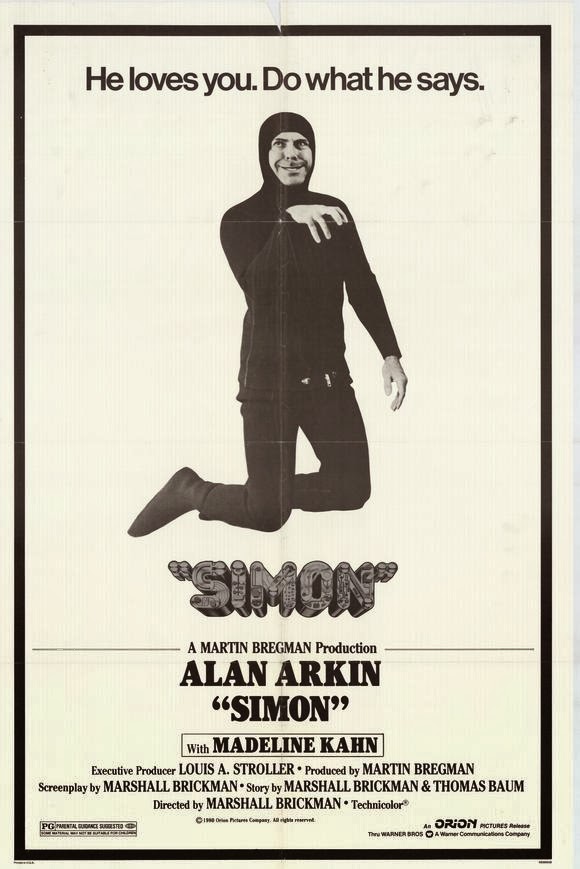
The definitive study of how American society was changing as things rolled over from the 70s to the 80s seen through the Hollywood prism has yet to be written. This will not be that examination. But there is something to be found in films made right around 1980 which seem caught between decades, between tones, between approaches, as if something is in the air only the filmmakers are not quite sure what that is so they have to plow ahead regardless and make whatever film it is they’re going to make. Maybe that’s just how they play to us all these years later. The science fiction-tinged social satire SIMON, starring Alan Arkin and released in February 1980, seems like a very good example of this. The film was also the directorial debut of Marshall Brickman, the sort of person who just skimming his bio makes him seem like the sort of person who it would be fascinating to listen to their stories for a few hours. He was a member of The New Journeymen, the band John and Michelle Phillips were in before The Mamas & The Papas. His TV credits include working on THE DICK CAVETT SHOW and CANDID CAMERA as well as being head writer on THE TONIGHT SHOW during the late 60s. In recent years he’s co-written the books of Broadway musicals including THE ADDAMS FAMILY and the smash JERSEY BOYS but he’s also been the screenwriter on a number of films including, most importantly, co-writing several with Woody Allen particularly SLEEPER, ANNIE HALL and MANHATTAN. Those titles are probably all anyone needs to know but he directed a few films as well and while that portion of his career didn’t last very long something like SIMON is still of interest, a science fiction comedy caught between those two decades that isn’t quite a home run but is still very much of interest not only for anyone who’s seen certain Woody Allen films several dozen times but because the satirical elements that the film explores makes it somewhat unique.
The secretly all-powerful think tank The Institute for Advanced Concepts headed by Dr. Carl Becker (Austin Pendleton) who along with his fellow scientists (Max Wright, William Finley, Wallace Shawn and Jayant) engineer the events that cause such chaos in the world like nationwide tampering with the Nielsen ratings--did you know that DONNY AND MARIE is actually only watched by 1,200 people in the entire country?--and what’s known as the “Nixon Substitution Scenario” comes up with a plan to invent an extra-terrestrial and present it to the world to see what the possible effect on the population might be. Aided by super-computer Doris (voiced by what is presumably an unbilled Louise Lasser) they decide their test subject to serve as this figure will be psychology professor Simon Mendelssohn (Alan Arkin) who they invite to the clinic and proceed to brainwash through various means including a prolonged stay in an isolation tank and the friendly charms of a woman who they introduce as Dr. Cynthia Malloy (Madeline Kahn). When Simon emerges from isolation with his plans to change the world the ensuing publicity frenzy makes the doctors realize their plan may have gone a little too well. After deciding to get rid of him, Simon escapes with girlfriend Lisa (Judy Graubart) and, on the run, becomes even more of a celebrity than he was before using a handy TV signal to speak to the world and spread his genius.
SIMON feels serious-minded in its satire and yet scattershot at the same time as if its disparate parts are glued together in a frenzied state to try to make them coalesce. With a screenplay by Brickman and story by Brickman & Thomas Baum, it certainly has ideas, which counts for a lot even if they are all over the place, as well as a genuine point of view of mirthful anarchy in its satire. After a documentary-style introduction to explain the nature of The Institute of Advanced Concepts SIMON settles into a straightforward approach that is pretty random in its plotting at times with various elements popping up for intervals after which they’re forgotten about—the Madeline Kahn character, the commune devoted to television worship— along with its various targets that include these scientists, the media, the government, the military and just society in general without setting its sights on any one goal for very long but the ideas it presents do contain some bite, playing as genuinely funny part of the time or at least relatively amusing in its exploration of what can happen when an unencumbered mind is given permission to run wild. Among other things, SIMON is the only film I can think of aside from NETWORK to contain a reference to the MARY TYLER MOORE spinoff PHYLLIS and a portion of the satire here isn’t actually all that different from the goals of NETWORK, depicting a world that is becoming obsessed by the media that is swarming all around, by the messages it produces whatever they are, willing to latch onto whatever it can. If it ultimately has a problem it’s that there are a few too many of these thematic conclusions thrown at the wall.
The Preston Sturges-like potential of some of this never quite reaches a full steam of hilarity and the lack of a more relatable lead character may be why I feel a certain amount of clinical distance from the film but it is consistently enjoyable in a loose way, with bits throughout like Alan Arkin single-handedly depicting the evolution of man after he emerges from isolation (sort of an abstract concept to depict so we get voiceover from Wallace Shawn explaining it, along with a brief Also Sprach Zarathustra burst on the soundtrack) and how the top of the TV-worshipping commune’s steeple contains not a cross but an antenna. Not much sends me into hysterics but the film is pleasant, blithe and the small scale feel of the production actually works for the shaggy nature of the humor. The plot construction may be a bit haphazard and undisciplined to put it mildly but SIMON seems to take an actual interest in the science of things and how people behave out of the madness of the world around them. Certain conclusions are reached in terms of how the mind works and the isolation tank element would make it play as a comedic rejoinder to ALTERED STATES (the second film authored by Paddy Chayefsky that I’ve mentioned here and I don’t know what to make of that) if SIMON didn’t actually come out ten months earlier.
When people learn of the existence of this supposed alien they argue over whether it means this is proof there is a God or isn’t a God and during a quick headline montage we see a Time Magazine cover about Simon with a headline that reads ‘The Answer?’ while the Newsweek equivalent headline asks ‘The Question?’ The America in SIMON is one where absolutely no one knows what is what. SIMON is, among other things, ultimately about a world where the smart people are only asking questions because they’re bored, not because they need to be asked and no one really knows what exactly needs to be asked or answered anyway. Mixed in with all that are myriad other ideas, like the concept of smart men with next to no idea of how to handle the women in their lives—Simon ignores the pleas of the reasonable Lisa, the brainwashing procedure gives Simon a ‘mother’ to implant the false memory of his extra-terrestrial origins, Madeline Kahn’s Cynthia Malloy is a plant but she intimidates all the men anyway and even Carl Becker’s relationship to the supercomputer Doris which is depicted as a giant slimline telephone receiver (a very SLEEPER-like element and since this computer is depicted as female not all that different in concept from MUTHA in THE PHYNX) results in him declaring his unbridled passion for her.
There are also references to things that were prominent in the world at the time like Muzak and diet books and Bess Myerson and the secret formula of Orange Julius which probably don’t get the laughs they might have gotten back then (secondary headline on a New York Post front page: “Margaret Trudeau Seen At Studio 54”) but more interesting than that is the point the film makes in depicting how people are only going to follow someone up to a point, checking out when they become aware of how they’re being lectured to. They want to believe they have power and greatness as individuals but when someone is lecturing them about how dumb and hopeless they are or bringing out the Tolstoy to enlighten everyone with it’s all going to go south. A quick cutaway of a guy shooting out his TV in response to this it almost feels like there’s another level of satire the film could move on to but instead we get the main character’s realization of what he finally needs to do which is followed by a sort-of action climax to wrap things up.
“You can move the world with an idea but you have to think of it first,” is an idea that’s repeated in dialogue but the film could also add that you can’t force people to live in the version of the world that you want to live in. You can’t tell them what to like or how to think. Maybe some of its themes are muddled but the message of the film is basically that we’re not going to change the world or learn some grand revelation about our past but there are good things to make it all worthwhile—what gets name checked like Fred Astaire, Penicillin and air conditioning sounds a little like they could have been given as reasons in a Woody Allen film as well—and maybe if we’re lucky we can make some small, if absurd, difference in the end. All we can hope for are some small victories coming out of our own personal madness mixed in with normalcy, which maybe makes it sound like a science fiction version of King Vidor’s THE CROWD and that’s not really what SIMON is since there are too many other ideas swirling around the way the film seems to build to this sort of quiet acceptance is a little refreshing considering how most such movies now are about how special the lead character is. I don’t know if SIMON completely lives up to the potential of the multiple concepts it tosses into the mix but at the very least it’s willing to put them out there, particularly if these thoughts are being voiced very loudly by Alan Arkin while acting like a lunatic. That’s something I’ll never have a problem with.
And Alan Arkin fully embraces the cracked ego that allows the messiah lunacy that emerges out of his own Arkinness (it’s an intriguing daydream to imagine Woody Allen playing the part) and he dives into it fearlessly, giving it an engagingly different look at his familiar persona, that look in his eyes totally unable to conceal his own particular madness. Playing Lisa, Judy Graubert is a Gilda Radner-Paula Prentiss type who like Arkin has a background in Second City and knows how to bring just the right spin to her dialogue like her mistakenly talking about how Simon is from “out of space”. She seems somehow familiar to me, maybe long-dormant memories from watching her on THE ELECTRIC COMPANY (she was also in a lot of commericals in the 70s—turns out there’s a good amount of Judy Graubert on Youtube), and even though she’s offscreen for much of the middle Graubert provides the somewhat cold film with any real warmth that it has. Austin Pendleton, presumably done up to resemble Carl Sagan, enjoyably straddles the line between dweeb and villain while the foursome of Wright, Finley, Shawn and Jayant are all given moments to pinpoint their particular characterizations. In spite of her high billing Madeline Kahn’s role comes off more as a ‘special appearance’ as if they only had a few days with her, Fred Gwynne is an uptight military guy who reacts to the existence of a ‘stupid’ gas by imagining how it could be used in combat and Adolph Greene is the leader of the TV worshipping cult who confides with Simon that before his nervous breakdown he was ‘head of programming at the American Broadcasting Company’ to which Arkin pats him on the shoulder sympathetically. David Susskind and Dick Cavett appear briefly as themselves but considering when this film was made and who made it I’d be surprised if at least one of them didn’t turn up.
Brickman only made other two films—1983’s LOVESICK and 1987’s THE MANHATTAN PROJECT both of which I haven’t seen in decades—so SIMON can’t quite be placed in the context of a full directing career. Listening to Brickman interviewed during a podcast on The Projection Booth it makes clear that some of his interests are in science—not science fiction—which certainly makes the link between this film and SLEEPER more intriguing but what he has to say in this interview also makes me appreciate the film a little more. SIMON, available on disc from the Warner Archive for anyone who’s curious or hasn’t seen it since early 80s cable, is the sort of film that I find myself thinking about way too much sometimes as I try to dig into just what the film is, what about it works and what doesn’t. Sometimes I’m willing to give a movie that’s trying for something out there a little leeway. Sometimes I’ll watch these things over and over and find something in the themes, a piece of madness that I find myself relating to and wish that I could reconcile with what I’m expecting to find, no matter when the film was made. Among other things, SIMON is about the madness in the world that can result from no limitations. Of course, I often feel like I have madness with limitations all around me every single day or just while I lie awake at night. Nothing is ever perfect.

Thursday, September 5, 2013

Into An Untroubled World

Some nights I cook for myself. I don’t claim to be any good but it’s something I like doing especially when I make pasta, probably more often than I should. I chop up onions and garlic and other things to put in the sauce while listening to music that you’d probably hate but particularly on Sunday nights it’s a ritual that I’ve developed a weird attachment to by now. It’s something that I look forward to doing and that’s just the way it is. So, anyway, the remake. Commonly known these days as the reboot. Which, I suppose is one way to avoid actually saying that it’s a remake and is also a way to avoid having to come up with an idea for something. Beats working for a living, after all. There are actually many points to make in favor of the remake—hey, it wasn’t until the third version of THE MALTESE FALCON when they got that one right and something like HIS GIRL FRIDAY was of course a remake of THE FRONT PAGE, only with an arguably better spin on it. But unlike back then the very concept in this day and age behind any given remake is to not offer anything new beyond making the overall approach more ‘grounded’ and ‘real’—the skeleton of whatever the structure might have been made of is still visible and the story may make sense but the way it ultimately plays out is lifeless, a movie going through the motions of its own self. The title has as much to do with it as anything else and the days when the classic noir OUT OF THE PAST was updated to the 80s and titled AGAINST ALL ODDS to bring an updated spin to the story are long since gone. These days the point is to remind people of the original in the most hollow way, bringing very new little to the table, to streamline the story, removing things like irony and satire while maybe tossing in a cameo from someone who was in the original while they’re at it, maybe to give the impression that the whole thing is authorized. There have been good remakes. It’s just tough to remember what they are sometimes.
Edgar Wright’s new film THE WORLD’S END which you’ve hopefully seen by now is about many things one of which is the danger of nostalgia, the folly of one person attempting to remake what he remembers as the greatest night of his life and what happens next from that return to one’s hometown. As I’ve written about before I may remain haunted in the dead of night by images of where I grew up, a place I don’t have much of a desire to go back to—members of my family have all moved elsewhere so it’s really not a concern for the time being. To mangle a line from MAGNOLIA, I may be through with the past but that past doesn’t seem to have very much interest in me either. In addition to being hugely entertaining, THE WORLD’S END struck a nerve in me down to the bone and Edgar Wright is one of the few directors of this generation who displays a love of films, as well as being someone who has some of the best story sense around but you can also tell how personal some of this is for him and with this new film you can tell that he’s setting the bar for himself higher than before and I’m looking forward to many repeat viewings. It gets a lot of things right, not the least of which is to point out that eventually you have to say Fuck Nostalgia. Fuck where you came from. Sure, there’s going to be some love mixed in all that way deep down but you can’t live there. You shouldn’t live there. You need to do something new, to keep moving forward and face what the future might conceivably hold. Something remakes don’t do. New things in life are good. That’s forgotten way too often these days.
Which makes this the perfect opportunity to talk about a remake that actually is excellent, one that is willing to expand on the original, turning it into its own thing while keeping the spirit of where the story came from very much alive. After all, the metaphorical possibilities in science fiction and horror do lend themselves to updating a concept to another time in order to take advantage of the new era. Martin Scorsese’s 1991 remake of CAPE FEAR became a giant swirling mass of cinematic imagery combined with how the south of the original had changed in the thirty years since it was made. Even if Cronenberg’s THE FLY and Carpeneter’s THE THING had nothing to do with the AIDS crisis as the world responded to it in the 80s in terms of intent it’s hard not to think about the subject while watching those films. In comparison you could make the argument that since the 2011 prequel/remake of THE THING was also set in 1982 it isn’t really about anything at all. The 1978 version of INVASION OF THE BODY SNATCHERS directed by Philip Kaufman was very much about something that was in the air at the time the film was made, just as any version of that particular story needs to be, has to be. There’s always going to be the fear of losing ourselves, losing our individuality, becoming lifeless and going through the motions of its own self. Of course, exactly what that loss means, what we are in the greater context of society, means something a little different in each decade. As part of the lead-up to the release of his new film, the ‘78 BODY SNATCHERS was programmed as part of Edgar Wright’s two-week “The World’s End is Nigh” series at the New Beverly and it was a great thrill to see it in 35mm for the first time, even if the print was slightly faded, since it’s one of those 70s films that even if it was a hit at the time has maybe fallen through the cable TV crack a little more than it’s deserved to. It stays in the brain and maybe haunts me now more than it ever has.
Almost as pure cinema, the first remake of INVASION OF THE BODY SNATCHERS essentially tells us what’s happening right away, beginning with an opening credit sequence that details the process of these lifeforms departing their own world to eventually arrive on Earth in San Francisco. Matthew Bennell (Donald Sutherland) works for the Health Department whose co-worker Elizabeth Driscoll (Brooke Adams) has discovered a strange new flower and the day after bringing it home her live in boyfriend Geoffrey (Art Hindle) is suddenly acting strange to the point that she genuinely believes that he’s not Geoffrey. Matthew has Elizabeth talk to his friend Dr. David Kibner (Leonard Nimoy), a well-known psychiatrist, for advice, but even he speaks of a strange hallucinatory flu that seems to be going around. As Matthew’s married friends Jack (Jeff Goldblum) and Nancy Bellicec (Veronica Cartwright) get involved he genuinely begins to believe that there’s something going on around him, that people really aren’t who they seem to be anymore.
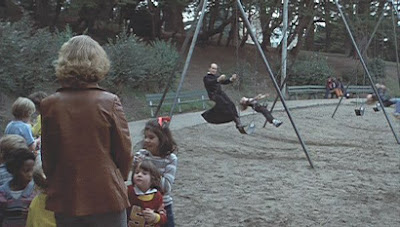
Shortly after the opening credits as the webs make their way down into the Bay Area we get a now infamous Robert Duvall cameo, with the actor briefly seen dressed as a priest on a swing set as one of the lead characters pass the playground nearby. And that’s it. It’s unexplained. We never see him again. And yet the recognition of the moment sets us perfectly on edge. Almost unnoticed as everyone is paying attention to how this really is Robert Duvall are two things: the teacher who has just been suspiciously glaring at the passing Brooke Adams is encouraging the kids to take the flowers home to their parents so she is obviously already a pod person, just as the priest Duvall probably is as well, and the kid on the swing next to him is behaving particularly goofy, something that probably won’t be happening for very much longer. These elements in each shot are laid into things all the way through, continually keeping us on edge while maintaining a sly wit in just about every scene. Almost as if contradicting itself it’s one of the best San Francisco films ever while at the same time somehow making the charming city seem totally cold and hostile. With a screenplay by W.D. Richter (SLITHER and BIG TROUBLE IN LITTLE CHINA, along with directing BUCKAROO BANZAI) based on the original novel “The Body Snatchers” by Jack Finney, this version of the story has been greatly discussed in the past as taking advantage of what the 70s were just as much as the small town original version had lent itself to the McCarthy 50s whether about communism or people simply staying at home to do nothing but watch television from then on. The San Francisco of the Me Decade seen here containing book readings filled with people looking to pour their hearts out to the latest big name in pop psychology and live-in boyfriends more focused on the game he’s watching with his headphones don’t seem that different from certain equivalents that would be around today. The context of post-counter culture sixties is there even if it remains under the surface and it’s not a reach to look at the film 35 years on and see it as being about the ultimate nightmare of the sixties generation in that city as everyone just sits back and lets Reagan take over—it’s not for nothing that one of the possibilities suggested of what may have happened to Geoffrey that he’s become a Republican, which before the truth is learned may seem like the most horrifying possibility of all.
There’s continuous snap to the dialogue whether discussion over whether anyone expected ‘metal ships’ or a decidedly ominous “I’ll see you soon…I hope” one woman who has turned says to Adams at one point. Every beat of the narrative is laid out expertly and even the relationships between the characters are vividly mapped out through shorthand without overexplaining why certain people are friends or how they know each other, particularly in the unspoken flirtation that’s been going on between Sutherland and Adams as well as whatever he’s told his friends about her (“This is THE Elizabeth?” is heard when one of them meets her). There’s also Nimoy’s teasing of Goldblum, a successful psychiatrist and author who seems to be pulling the appropriate advice from the filing cabinet in his head instead of listening versus the jealous poet who takes six months to think of a single line, the hack who’s a success placed against the artist with his principles jealous of that success. Scenes like these offer a consistent immediacy to the film’s tension and humor making it stand out all the more—maybe since Kaufman was never a horror director along the lines of John Carpenter the tone he’s going for here feels that much more jaggedy, distorted like through those funhouse mirrors in the bookstore. It’s as if his uncertainty of what would play correctly for the genre works for the uncertainty of the narrative, dangling on the precipice between suspense and satire as people about to be forcibly turned are earnestly told to not ‘be trapped by old concepts’, between the blank stares of Art Hindle’s Geoffrey and the insistent humanity brought forth by Sutherland’s lead performance, playing a person who seems relaxed in his daily life as he cooks for himself yet seeming to enjoy the exacting nature of his power over fancy French restaurants.
Maybe best known now for directing THE RIGHT STUFF (as well as his co-story credit on RAIDERS OF THE LOST ARK), Kaufman’s work here is some of the best of his career containing metronome-like pacing to every single scene with those ominous garbage trucks everywhere. It propels itself forward through the enshrouding dread of the second half and a certain pop feel to the social commentary while being always serious about the threat as the utter blackness of the sequences where the characters are being pursued feel like the worst possible nightmare yet still very real. Right from the start Kaufman is planting suspicious-looking extras around the edges of the frame which seems almost too obvious and yet you could imagine in real life people wouldn’t pay much attention to that sort of thing. It’s to the film’s credit that many of those strange glances could be just about anything. It’s also to the film’s credit that every single one of them are probably exactly what we suspect they are in the end, an encroaching threat that seems like a shroud of darkness literally making its way over the film. The logic of the film seems to be that everything has already happened before the characters in the film have had a chance to even begin to realize it and the result is almost unnerving in its normality at times—when it becomes clear that one character has turned he doesn’t come off as a monster so much as someone simply annoyed that it wasn’t allowed to happen sooner.
There is some middle-of-the-movie juggling in the narrative when all it can do is stand in place for a few minutes while the threat intensifies, so a meeting with a city official is barely seen and doesn’t result in anything afterwards. But the best things stand out, like the genuinely eerie depiction of exactly how the change takes place when the pods are nearby as well as the score by Danny Zeitlin which maybe could better be described as a full-on soundscape (I could write a whole piece on my favorite uses of sound in the movie—Ben Burtt of STAR WARS legend is credited with the sound effects) along with the tiny touches like the strip club barker promising that what’s inside is “Guaranteed to make you feel like a new man!”, a genuinely memorable use of “Amazing Grace” or just the basic paranoia of the big city, the people who won’t stop staring, the cab driver (played by Don Siegel, director of BODY SNATCHERS ’56) repeatedly asking where you’re going. Like the San Francisco-set FREEBIE AND THE BEAN from a few years earlier barely a sequence goes by without a glimpse of the Transamerica building—on Kaufman’s DVD audio commentary he speaks of wanting it to appear to be pod central, a notion that certainly comes off in a few shots and considering how this is film was released by United Artists when they were owned by Transamerica the concept comes off as meta in several ways.
The question of what exactly remains of the former person inside is intriguingly not completely answered, all the way up to the famous final image and a moment near the end where we get to see people at their job, take over, zombified, changed, having already slept, doesn’t seem that far off from the real world these days. In spite of its placement in the series at the New Bev and however much these themes tie into the plot of THE WORLD’S END it feels a little like the film was at least as much of an influence on Wright’s earlier SHAUN OF THE DEAD, particularly the growing tension of the first half and a similarly unexplained shot of a man running in terror down the street—the constant attention paid to the angling of the houses on these San Francisco slopes makes me wonder if this film was also a large inspiration for how Steven Soderbergh photographed the city in CONTAGION. But the more I think about THE WORLD’S END and how bitterly its characters display their regretful feelings towards the past it at times makes me wonder if there really is more to the comparisons under the surface. The genuine enjoyment of this BODY SNATCHERS stands out and makes the film continually engaging on repeat viewings, yet the emotion that comes to the surface near the end makes me think about similar thoughts of regret and waiting around, not doing anything about what you deep down want to change. Matthew tells Elizabeth that he loves her, something that only happens because of the situation they’re in. And then suddenly it’s too late. Before then he was doing his thing, enjoying his casual flirting with her, cooking his food, doing his job, trying to be casual about it all. But he couldn’t say it. Not until then, when there was nothing more that could be done about it. Since she was living with a guy anyway, there probably wasn’t anything that could have been done earlier. Life isn’t fair. Which I suppose is an emotion that the pods want to rid us of. They want to make it so that doesn’t matter anymore. Either way, there are no happy endings.
Donald Sutherland is outstanding, using his height to intimidate when necessary but allowing his confidence to shrink down as he becomes more unsure about everything and the chase grinds on—I can’t think of many other examples of a hero begging for his life as nakedly as he does late in the film. Everyone is excellent and add to the flavor of each of these people mattering—the down to earth goofiness of Brooke Adams, the nebbish insecurity of Jeff Goldblum (seen in three films throughout the ‘World’s End is Nigh’ festival—INTO THE NIGHT and THE BIG CHILL were the others), Veronica Cartwright who is particularly good at balancing her exposition with the growing freak-out of her character and Leonard Nimoy in a sly use of the baggage that comes with his most famous role which he plays as if overjoyed at the chance to balance himself between the two halves, making every statement seem like he’s processing a quantum equation. Of course, Kevin McCarthy of the 1956 original 1956 makes a cameo appearance early on essentially reprising his most famous scene from that film, one of the first times this sort of cameo appearance ever happened and probably still the best—not at all shoehorned in, the moment plays perfectly well if you don’t know the original and if you have makes it all the more unnerving. As directed, McCarthy seems to go through the reprise of his most famous dialogue faster than we’d expect as if he doesn’t have the energy to shout it anymore. He knows what’s coming. He already knows.
On its release Pauline Kael went gaga for the film proclaiming, “For undiluted pleasure and excitement, it is, I think, the American movie of the year—a new classic.” The shrieking of the pod people has since become iconic and I suppose that a few lines of dialogue have as well, particularly, “How do you know my name? I didn’t tell you my name,” additions that have become as familiar to the BODY SNATCHERS lore as anything in the original. And it’s been officially remade two more times to date, by Abel Ferrara as BODY SNATCHERS in the early 90s and by Oliver Hirschbiegel as THE INVASION in 2007. Both productions had their problems—Warner Brothers barely released the Ferrara version to theaters (I’ve always liked that film) and the latter film, which even featured Veronica Cartwright in a supporting role, underwent extensive reshoots with another director. It’s a safe bet that it’ll be remade again eventually. The fear of losing someone you love, losing yourself, while you ‘sleep’, is too good a concept to not explore as our world continues to change. To be optimistic about this inevitability I’ll say that at least it’ll be another chance to prove my belief about the worth of remakes wrong. And I’ll be happy to let that happen. In the meantime I’ll return to my kitchen on Sunday nights making my pasta, listening to “Sinatra at the Sands” or whatever weird Italian lounge music I’m in the mood for and dream of being myself, thinking about the certain women I’m avoiding declaring my real feelings to. After all, it’s not too late yet. And if it is, I’ll try not to think about that for a little while.