Saturday, December 30, 2017
Not At The Expense Of The Moment
There is truth and there are details. The truth is that shortly after seeing THE FORCE AWAKENS when it opened back in December 2015, I collapsed on the sidewalk sobbing. This is the truth. The details behind that, in all honesty, have nothing to do with the film. At the time I was going through a few things (aren’t we all; like much of life, some of those things continue) but we don’t need to go into what they are. Nevertheless, the other secondary truth is that I still didn’t think THE FORCE AWAKENS was particularly good, playing as an empty homage to what STAR WARS is apparently supposed to be with director J.J. Abrams bringing less visual style to the series than anyone has ever done; this is the only STAR WARS film where characters go from one planet to another and you can’t tell the difference. This is all a lead up to recalling how my initial response to STAR WARS EPISODE I: THE PHANTOM MENANCE wasn’t quite so dramatic. It’s not that I thought it was particularly great or even good so much as that it simply was. But I’ve been forced to have a response to it ever since and to this day it feels like that will never end. May 1999 is a long time ago now but I remember so much. The unending wait for that film, the awareness that it was coming, the trailer, the second trailer, the toys getting released, that damn line of people waiting on Hollywood Boulevard to get tickets for the first show at the Chinese (which I didn’t get, so my first viewing was the second showing at 3:30 AM). And then the movie. It was all a long, grueling process that maybe drained out a lot of optimism in the film geek circles. By 2005 when REVENGE OF THE SITH hit that was mostly gone and there was a vague feeling we just wanted to get the damn thing over with already. The Chinese wasn’t even showing it. But to go back to ’99 is the reminder that STAR WARS EPISODE I: THE PHANTOM MENACE is not what we wanted it to be but in some ways it’s exactly what it’s supposed to be. It may not be good, but it is pure. This part gets forgotten.
Not much happens in STAR WARS EPISODE I: THE PHANTOM MENACE and in many ways that makes it the perfect film for 1999, a period where no matter how much was really happening it seems like nothing compared to now. Of course, there were many better films. ELECTION, THE LIMEY, THE INSIDER, EYES WIDE SHUT, FIGHT CLUB, MAGNOLIA, THE STRAIGHT STORY, THE MATRIX, THE VIRGIN SUICIDES, THE SIXTH SENSE, OFFICE SPACE, GALAXY QUEST, the remake of THE THOMAS CROWN AFFAIR. Not a bad year as things go but, regardless, THE PHANTOM MENACE still doesn’t go away. The characters in the film don’t know what’s coming and at the time we didn’t know what was coming either. What that was became clear by the time Lucas made REVENGE OF THE SITH and with the war on terror in full swing gave the film a fair amount of metaphor to dig into, as obvious as it was. In THE PHANTOM MENACE that metaphor hasn’t taken shape yet which means a good deal of stalling, an empty film that is mostly about stage setting, filling in a few blanks and appealing to little kids. And more CGI in every frame than we could possibly imagine at the time.
When the Trade Federation blocks all access to the peaceful planet of Naboo, Jedi master Qui-Gon Jinn (Liam Neeson) and apprentice Obi-Wan Kenobi (Ewan MacGregor) are sent there as representatives of the Galactic Senate in an attempt to negotiate and prevent a full scale invasion of the planet. But when Federation representatives immediately attempt to have them killed the Jedi escape to the planet where, joined by a native Gungan named Jar Jar Binks (Ahmed Best), finally make contact with Queen Amidala (Natalie Portman) and escape Naboo. But when a ship malfunction strands them on the planet Tatooine they soon encounter a young boy named Anakin Sywalker (Jake Lloyd), a slave who lives with his mother Shmi (Pernilla August) owned by junk dealer Watto who Qui-Gon, accompanied on the planet by the Queen’s handmaiden Padme (also Portman), soon comes to believe is the one spoken of in a prophecy to bring balance to the force. As he anticipates, Anakin turns out to be their best hope to make it to the Republic capital of Coruscant where Naboo Senator Palpatine (Ian McDiarmid) awaits Amidala in a desperate attempt for action to be taken and put a stop to the invasion.
Thus concludes just about the most useless paragraph ever written on this blog. Is there really anything left to say about this film? Maybe more to the point, is there anything new to say? You could easily fill a book with all the facts and opinions and feelings surrounding this film, I’m just not sure if it would be anything we haven’t heard. At the very least, in this case writing out a brief plot summary is a useful way to determine just how problematic this storyline is in terms of, well, telling a story. With the film so broken up into separate pieces there’s no one single person to lock into as a lead, no one to really connect with. There’s a reason why people respond to Mark Hamill gazing at the binary sunset way back when and even if the result had been better, and I like the film more than some, it still never feels like there’s a protagonist to follow through the film. The Jedi are essentially monks, Amidala’s plotline is based on a twist which keeps her as a sort of abstract concept for much of the film and Anakin is a little kid who we’re meant to feel sympathy for but, well, we all know his future. When first introduced, Luke Skywalker was as much of an avatar for Lucas as AMERICAN GRAFITTI’s Curt Henderson or even the character of THX-1138, each of them dealing with the ambivalence of whether or not they want to leave home but the closest this film has is a young boy living as a slave on a desert planet who is abruptly taken away from his mother so it’s not quite the same thing in terms of audience identification. As much as the film is packed with incident much of it feels clinical, concepts in search of a story.
There are good things to say about THE PHANTOM MENACE at the very least in terms of sheer ingenuity and the way it just throws us in to the middle of the action seems more radical now, even more than it did in the original movie. Lucas was still using film at this point, at least part of the time, and there’s a crispness to the imagery at times particularly when there’s something tangible in the frame as opposed to all those green screen shots—at other points where I suspect he was trying out digital (and Ewan McGregor looks considerably different) the look doesn’t fare so well. But he clearly still knows how to compose a shot so it often feels like he’s using the right angles to tell the story even if there’s not as much pulp flavor to the way things are staged as he might have done in the 70s. It’s the overall flatness of what the scenes become that is the problem which is helped by some enjoyably dry humor in the early dialogue between the two Jedi (sadly, I’ve never been successful at making “There’s always a bigger fish” into my own personal catchphrase) at least there is until there isn’t. The story is vague enough that it doesn’t stand on its own so there have to be allowances made for how things may or may not pay off later. Lucas wrote this screenplay himself and while there was a big deal made about Lawrence Kasdan returning to the franchise in recent years with this film I can’t help but wish that he’d sat down in a room with Willard Hyuck & Gloria Katz, who worked extensively on STAR WARS uncredited as well as writing TEMPLE OF DOOM, to maybe add some Howard Hawksian flavor to the dialogue and plot mechanics in order to loosen things up but it feels like the emphasis on effects in every shot are designed to prevent such a thing from happening (Lucas had produced the flop RADIOLAND MURDERS for Hyuck & Katz in 1994 so maybe that soured him on any potential collaboration).
Looking at STAR WARS ’77 (Don’t make me call it A NEW HOPE, I hate calling it A NEW HOPE) these days it strikes me how much is left vague. The beats of the story were figured out and clearly magic was accomplished in the editing room but it’s clear that one thing which appealed to people was the potential richness of the universe and how much was left unanswered about it. Of course, more sequels means filling in some of those blanks and having to answer some of the questions there might be in terms of how things work, what people do for a living—are there newspapers? Is there entertainment? Do people live in fear of the empire and nothing else? The concept of government was vaguely answered in the first film and Lucas’s depiction of how fascism can rise in a galactic senate where almost nothing can ever get accomplished becomes clear in the later films. But it’s possible that the dreamlike flavor which can be found in the original trilogy, set far away from the capital of Coruscant and other such places, was ideal in leaving those explanations vague just as the first film never needed an explanation of The Force that was any more complicated than a single sentence. So the explanation of ‘midichlorians’ as Gui-Gon describes them to Anakin to ground The Force is some sort of science is an even greater mistake, almost willingly blurring the lines between the fantasy we thought this was with a stab at hard science fiction, grounding what was once meant to be oblique in a way that hurts it in the long run.
What’s even more strange is how much of THE PHANTOM MENACE (and for the record I still like that title, much more than a few of the others) is still legitimately dreamlike much of the time with images that almost manage to justify the existence of all this new technology, whether the view of Coruscant outside of the Jedi Temple, the underwater sea creatures chasing the Jedi in their transport or just the character design of Darth Maul who has famously little screentime but each second he’s onscreen is still arresting just from his presence. But in addition to the introduction of midichlorians to the mythology is what Shmi claims is the virgin birth of Anakin so along with the presumably virtuous Jedi who are essentially monks (unless you want to believe that Qui-Gon and Shmi Skywalker spent the night together, which seems like a possibility) and a group of children in the other main roles you have a film with no sex drive and no other sort of drive to the film, one where everyone comes off as so virtuous that you wonder if laughter even exists in the Star Wars universe and the tone becomes stifling as if none of the actors can breathe while reciting dialogue against all those green screens. Too much of it plays as a kids movie, as opposed to how the earlier films seemed to be aimed at kids of all ages, and the level of humor is mostly a reminder of the goofiness that can be found throughout Lucas’ brief filmography only not at its best here. Of course, it’s also a kids’ movie with extensive dialogue about senate politics and trade negotiations which is a balance that sometimes plays as flat-out odd. At the very least, it provides more complications to the plot than I would have expected and I always remember the friend who told me about seeing the film after smoking weed all day then when the opening crawl began with its intricate details about trade negotiations thought, “Oh fuck, I need to pay attention.” But there’s an irreverence needed to maintain that balance which never appears, a sense of fun missing that doesn’t even seem to be part of the original intent. The film is so focused on the big moments courtesy of the groundbreaking effects that it forgets to find pleasures in the small moments, the character bits so famous from other films throughout the series which would mean more than any spectacular effect ever would. Simply put, THE LAST JEDI, to name another film, fucks. THE PHANTOM MENACE doesn’t.
But this is pure Lucas uncut for all that’s good and bad about it in a way that the following prequels weren’t, probably because of whatever course correction was done with discarded plot elements and characters pushed to the background after the response to this film. Not all of these choices can be defended particularly the, um problematic depictions of the likes of Jar Jar and the Trade Federation, each almost designed to recall stereotypes that you might have found in cheesy serials made during the Golden Age of Hollywood but since the film was made in the 90s it can’t really be defended (this could probably be said about Watto too but I have a soft spot for the guy, I can’t help it). But just as Yoda makes his comment about how always two there are, a master and an apprentice are such halves found throughout the film whether the two identities of Amidala, the two Jedi or the people of Naboo and the Gungans living underwater, a symbiosis that effect each other as the Jedi point out but they still remove Anakin from living with his mother because of Qui-Gon’s certainty, whatever that really is, as if to say that since he’s deliberately breaking apart a symbiosis which may be his undoing, along with the rest of the Jedi. Along with these themes is the film’s undeniable grandeur, particularly during the pod race which is still a phenomenal set piece today, even if the film does stop for it. But it contains just the right pacing and cinematic ingenuity just as some of the imagery seen on the city planet of Coruscant which resembles the covers of science fiction novels I only half remember from when I was a kid.
During the best of these moments I get lost in just the vibe of it all and John Williams infuses even the quietest moments of his score with a true sense of myth as well as the way the music seemingly screams out “DARTH MAUL!” at that famous appearance as the doors open. Deep down I think the “Duel of the Fates” track and the imagery of the climactic Light Saber duel was what I imagined in my head for all those years when we wondered if there would ever be another movie. But it’s a little too episodic, things are broken up a little too much as if for all that was done in post-production some details were paid attention to more than others, like the Yoda puppet which is such a letdown (maybe the look is just more appropriate in the organic setting of Dagobah) that it almost feels like Lucas wanted to prove that the character would be done better digitally. The climax is broken into four separate places of action, which is fine, but the freneticism of the editing causes the Williams score to be constantly broken up, starting and stopping throughout so there’s no flow to the action in the way there is in the final Death Star battle STAR WARS or the desperate escape that climaxes EMPIRE. Individual moments hit like the icy coolness of Darth Maul bouncing his saber off the force field as he waits, but it never snowballs into a series of events that flow effortlessly from one beat to the next.
That’s part of the thing with STAR WARS EPISODE I: THE PHANTOM MENACE. Everything feels so hemmed in, there’s no sense of joy to the filmmaking and there’s not enough of a real sense of these worlds even when it’s presumably filmed on location whether Italy or Tunisia. As miserable as Lucas may have been at Pinewood back in ’76 there’s a sheer feeling of kineticism throughout that film in the camerawork and the way the actors play all that dialogue which was supposedly unreadable that it all somehow popped. THE PHANTOM MENACE feels like a movie where every day was finished on time and they got what was needed. And that’s it. In some ways, it’s a revolutionary piece of work and looking at just about any random comic book sequel now shows how much Lucas was ahead of the curve. But the film seems to think that revolutionary effects work and unique cutting patterns are all that is required. It hints at what we responded to in the first place, there are vague echoes if we look, but it’s not enough. Near the very end of EPISODE III: REVENGE OF THE SITH we’re finally told why Qui-Gon didn’t disappear when killed in this film and why Obi-Wan did back in ’77, something I think we’d long since stopped wondering about. The moment rushes by too fast for us to really register the implications of all this but one of the things it feels that the STAR WARS saga is really about more than anything is the idea of wrestling with the past and what it really meant, fearful of what we’re going to lose, worried about rushing too fast into the future. One of the key images of the film is even of Anakin as he stands alone, uncertain of whether to take the path to becoming a Jedi or stay with his mother who tells him that you can’t stop change, “any more than you can stop the sun from setting.” Qui-Gon Jinn for that matter reminds apprentice Obi-Wan Kenobi to be aware of the future but always live in the moment and he knows that’s the only place you can find peace. These are themes that Lucas has explored in his films since before he thought of STAR WARS and now we’ve projected our own versions of that onto whatever these films mean for ourselves in our lives. They’re ideas that remain in STAR WARS even now. At the very least, THE PHANTOM MENACE raises these questions. But maybe not much more than that.
More than any other actor here, Liam Neeson is the one who seems at ease among everything going on infusing his character with a total inner life and finding more between the lines on the page than you’d ever expect. Up against him Ewan McGregor is cooped up in the ship on Tatooine for so long that there’s not much for him to do. He’s definitely energetic and has the air of someone who wants more to do which at least makes sense for the character but he mostly comes to life during the final light saber battle. Natalie Portman seems a little lost with steely determination coming through as Amidala but bland confusion of what she should be doing in various shots while in the Padme guise. Pernilla August also finds weight in her role while Ian McDiarmid projects the right sort of icy cool as this bad guy in plain sight—Lucas really hit the jackpot by casting him back in the 80s. Considering how distracted much of the film is, some of the other performances don’t register very much. Sometimes this doesn’t matter and Samuel L. Jackson playing Mace Windu clearly has little idea what’s going on and doesn't particularly care since he’s got dialogue with Yoda in a STAR WARS movie but Terence Stamp just looks confused, no direction, no idea how anything he’s doing fits into anything. As Anakin, Jake Lloyd is a kid. Not the best kid actor I’ve ever seen, not the worst. In some ways his awkward uncertainty is right for the direction we know the character is going. Let’s leave him alone. Even the occasional bit parts which feel like they’re not played by professional actors whether the cameos by Lucas’s kids (can hardly blame him for doing that) or even the old woman who says “Storm’s coming up, Annie, you better get home quick!” on Tatooine give the film its own unique feel, an awkwardness that almost becomes the most human element found in the entire film.
The truth is I don’t need to see the STAR WARS films I’ve already seen before much anymore. Sure, it’s nice to have those Despecialized Editions around just in case but in many ways there isn’t anything left for me to take from them. There’s so many other films to see. But, yes, this one is still there. It will still loom large. It’s not a question of whether STAR WARS EPISODE I: THE PHANTOM MENACE is a good film. It doesn’t really matter anymore and if we’re going by Art or Not Art it qualifies as Art. That in itself doesn’t mean it’s good either. Anyway, there’s no point in getting into why I collapsed on the sidewalk that night back in December 2015. Not much has happened since then and in other ways way too much has. Certainly we now live in a world where Qui-Gon’s line “The ability to speak does not make you intelligent,” has more truth than I ever thought possible. And at least in December 2017 we all got a pretty great STAR WARS movie that I really do look forward to multiple viewings of. I wonder what sort of metaphor the world will provide future films that get made in this saga although it’s starting to look like STAR WARS will outlive everyone I know. And by this point it’s ok with me.
Wednesday, December 27, 2017
When Things Don't Fit Precisely
You need time. That’s what you need to remember. Maybe a year ago I tried watching Lawrence Kasdan’s film of THE ACCIDENTAL TOURIST for the first time in ages but couldn’t do it. Something about it felt too stifling to me, the anguish too buttoned down and I couldn’t continue. Maybe a year ago wasn’t the right time to watch a film having to do with pain and loss. It probably isn’t now either, but never mind. Trying it again recently via the Blu-ray that the good people at Warner Archive put out earlier in 2017, the film immediately felt like a warm bath and I was completely receptive to the mood it gave off while at the same time still aware of its shortcomings. I know they’re there but in spite of this the film has a humanity to it that I can’t shake and while it’s about people struggling with loss it’s not about loss but how you force yourself to hold on to certain things, drowning in them until you don’t have a shred of emotion left to give anyone. And it’s about what you’re supposed to do next. It’s a film I wanted to live in for a little while and just try to center myself within its calm while getting to know the characters once again. Maybe I’m just as much of a screw up as some of them are anyway. Of the films that Kasdan has directed which also include BODY HEAT, THE BIG CHILL, SILVERADO and WYATT EARP this might be the one I feel the most affection for. It’s still hard to let go of all that pain sometimes. I’m feeling it right now just as many others are.
Around a year after the brutal death of their young son in a robbery, Macon Leary (William Hurt) is informed by wife Sarah (Kathleen Turner) that she is leaving him to try to find some sort of future for yourself. Macon, the writer of a series of travel guides for reluctant travelers called “The Accidental Tourist” is left to his own devices in their home when the need to have his dog boarded while on the road leads him to meeting Muriel Pritchett (Geena Davis) a dog trainer who is more than willing to help out and soon her own designs on Macon are made clear. Once he finally lets her in on his past after meeting her sickly young son, their relationship develops. But when Sarah reenters Macon’s life he is tempted to leave Muriel and finds himself having to decide if he is going to face the future or return to another version of the past.
Based on the novel by Anne Tyler with a screenplay by Frank Galati and Kasdan, THE ACCIDENTAL TOURIST lingers almost as if it’s just as reluctant to meet new people as its main character is. Played with wry humor while still observing the drama with a careful eye, it’s a film that is overly precious at times, complete with people who alphabetize the way food is arranged in their kitchen which in itself feels like a neon sign reading QUIRKY as if it’s an early version of what indies became in the 90s, done with a deliberately paced sheen of quality that was still fairly common in the 80s. But it’s a film that always feels lived in, one where you get a sense of the wood and leaves and even the clothes the characters are wearing so it always feels real and comfortable, it always feels like a film I want to settle down in. While somewhat calculated, it still has an uncertain pulse that is just as unpredictable as people often are as they desperately try to keep moving, looking to find a reason to.
After spending a few scenes with Macon Leary it’s a little surprising that he was able to even partly break away from his siblings at all, how he could possibly have broken away from that routine. Each of them are terrible with directions even when going to the local hardware store, making him the perfect author for his travel guide series, and they literally speak their own language while playing their own self-made card game every night. They’re only as different as how they apply condiments to their baked potatoes but it’s one of the small pleasures that this is the sort of film that takes a minute to show such things. Macon walks through life like in those first groggy seconds after you wake up and there’s forever a formality to the way he speaks including referring to someone by their name; even when he calls loved one on the phone from overseas in a display of affection he may as well be ordering insurance. Even when he breaks his leg or throws his back out none of it affects his mood much at all. When he drives through Muriel’s lower class neighborhood in an attempt to alienate her further the film pauses as he looks around at people presumably worse off than he is and you just know that he has no idea how to relate to any of them. Muriel is, yes, a sort of early version of the Manic Pixie Dream Girl with quirky mannerisms and a quirky son who is allergic to seemingly everything. But she has a vulnerability to go along with her freely singing out as she washes dishes, the feeling that she knows she’s trying too hard on occasion. The film never denies that in some ways Macon and the much more orderly Sarah were always perfect for each other as if she was able to provide the direction in his life. “Not really,” she answers when Macon asks if she’s living with anyone and you just know that she’s had stuff going on that she wants to tell him, that she needs him to know, an adult female who she approaches life in a reasonable, logical way and is just as lost as anyone else.
Looking over the films Kasdan has directed it can be difficult to tell exactly how they fit together unless you take into account his recurring cast members or maybe just a vague interest in ensemble stories. As a screenwriter on things like THE EMPIRE STRIKES BACK, RAIDERS OF THE LOST ARK and up to the new STAR WARS films the work feels like it comes from a different person, maybe one willing to get a little looser; his own films never play so lighthearted even when he’s trying to. As a director he always seem most comfortable at taking a low key approach that goes well with a film mostly populated with white people wearing sweaters and the one great visual flourish in THE ACCIDENTAL TOURIST comes at the very beginning when his own credit is seen with an effects shot of a plane shooting through the clouds, a clever depiction of how Macon Leary sits through life while nevertheless shooting forward against his will. Even what appears to be a complicated tracking shot during the wedding sequence is really all about Hurt’s face in close-up and what he’s seeing so although the Panavision framing occasionally makes use of the family members relating to each other it’s mostly a film about William Hurt and what he sees around him, down to the very last shot, no matter how good the other actors are. Even the two female leads never seem to attain control of it in the same way, even when they’re in close-up since it keeps so much to his point of view. They women never actually share an onscreen moment together, even though we hear about it happening, and the film is unwilling to break away from him. But maybe more than anything it’s a film that always feels willing to pause and soak in moments of silent contemplation to let the John Williams score take over, with the Baltimore setting providing a certain old world east coast flavor and though the story spans several seasons maybe what I think of most when the film comes to mind are those leaves on that wet street as Muriel walks off to her car after a session training Macon’s dog Edward as the voiceover comments but avoids facing the reality of her presence directly.
At times it works best as a very dry comedy, particularly when Amy Wright’s fussbudget sister matches up with Bill Pullman’s interest in her, his eagerness to actually enter this world and be part of this family continually baffling Macon. Ed Begley, Jr. as one of the brothers also gets a moment that I love where he mentions that he makes bottle caps (“It’s not as exciting as it sounds”) although considering it’s a film about people whose young son was shot in the head during a robbery it feels a little strange to see it in the Comedy section in video stores. The tone always wants to hold steady as if avoiding that real emotion that maybe the world wants to stay away from as well. The stifling nature keeps the pain at a distance but it’s always there. The extensive deleted scenes on the Blu, ported over from the older DVD, make it clear that there was a lot that could have gone in, particularly in the case of two confrontation scenes between Macon and Sarah are collapsed into one at the beginning, which makes sense for pacing reasons even if it keeps Kathleen Turner out of the film for over an hour. It also deletes some of her character’s bleakest dialogue as if trying not to take the pain she must be feeling too far, things that you wouldn’t blame a grieving mother to actually say. Even if it never quite goes too far into that darkness the way editor Carol Littleton paces things is impeccable in getting just the right tone. The film is found in the looks the characters give each other between the words and it almost believes they have strength when they’re able to look someone in the eye, waiting for them to return their gaze. Always waiting.
The film remains amused by the characters but never mocks them and the affection is clearly genuine, but it also knows to not spend too much time with some of those elements since it knows things can’t be fixed by any one thing, whether Edward the dog, Muriel’s son Alex or any of the family members. The last half hour makes an excursion to Paris that leaves them behind, isolating Macon with just the women in his life and even here in the romantic place on Earth the landmarks are kept in the background to focus on their faces. It says something that one of the key uses of a location is when Macon and Muriel stop in at a Burger King on the Champs-Élysées, something that even Vincent Vega in PULP FICTION never did, with the Arch de Triumph far in the background and even the final scene is on a fairly anonymous side street. Kasdan practically turns over the last few minutes of the film to John Williams, providing one of his most underappreciated scores, and he lifts the emotion as if desperately trying to reach the characters to get them to move forward, that there really are reasons to keep going. No matter what happens in life, people move on from where they were. Sometimes they get drawn into a new place simply because it’s where they need to be and it all clicks together when they make that revelation. Things change in life. They have to.
THE ACCIDENTAL TOURIST is the sort of film that used to be more common from major studios, a prestige picture meant to have the sheen of ‘quality’ that used to be an expected thing from films that used to come out at the end of the year by major studios looking for Oscars, one featuring white people wearing sweaters and all that. And yes there are moments where it feels too calculating in search of those things. But what sticks with me is the feeling that there will always be a hole, that some things can never be fully reconciled and you either accept that or not. “Ever since Ethan died I’ve had to admit that people are basically bad. Evil, Macon.” If there’s one thing I’ve learned over the past few years it’s that nothing is as true as this. People revel in this fact, it brings them joy. And I’m not sure the movie ever really tries to refute this. It just tries to move on to things you can actually change. Maybe in that sense it tries to be hopeful and if it succeeds at all, it’s because it makes me believe that one person can be that way. Maybe two. We’ll have to wait and see about three. It doesn’t make that decision for the world but for one character. You try to accept that and move on with the hope that maybe there will be one person who can be part of the world you try to make for yourself. You yearn for that, you try. Eventually life goes on, even with the baffling appearance of joy on occasion, but it’s never easy.
William Hurt acts like his very soul is unmoored and that he doesn’t even know how to stand in a room anymore, playing his behavior with a dryness but also soulful enough that connecting with someone else is almost an impossibility yet playing it with a wryness that shows how he’s able to stand outside of himself just enough to get how absurd it all is. Geena Davis might be remembered for playing the quirks in her Oscar-winning role but what stands out for me now is how genuine it is, the silences as she seemingly waits for Macon to finally make up his mind about, well, anything. It’s also a small surprise that she doesn’t really have a ‘big’ scene—her response to a possible breakup is presented in a brief flashback that may not even be real—and even the small touches she brings to moments, like how she clearly really likes that dog, add up. It may not be my favorite Geena Davis performance and I’ll probably always wish Sigourney Weaver had won for WORKING GIRL but her vulnerability is always a reminder of what can still be found out there in the world. I’m sure Kathleen Turner knew that Muriel was the flashier role but she balances out with a maturity and confidence of someone who in some ways will always know Macon better. In some ways it’s a character who is through with arguing after all that’s happened but her eyes indicate how much pain there is, something that can never be fixed no matter how hard she tries. There’s also pleasure coming from Ed Begley, Jr. and David Ogden Stiers as Macon’s brothers and Bill Pullman underplays very nicely as his publisher but it’s Amy Wright as his would be spinster sister who really pops and for a character meant to be totally predictable, every line reading from her is somehow unexpected making it even more clear how any sort of debate to get her to change her ways won’t do any good.
Maybe real communication with other people you think you’re close to is impossible. Maybe it always will be. The extras on the Warner Archive Blu-ray are pretty much ported over from the old DVD and the extensive deleted scenes (including a phone call Macon makes to Muriel from the top of the World Trade Center during a panic attack) shows how delicate the tone was, what needed to stay in this essentially character-driven piece to get the balance right. The picture on this Blu captures not just the feel in the air but the mood that is so crucial to what the characters are feeling, whether it’s their irretrievable loss or the small sense of hope that they might be able to bring themselves to aim for. You can’t get rid of pain any more than you can get rid of people. And you feel that pain these days, especially right now, especially for the past year, the year before that and possibly the year to come. But no matter what there will always be totems of your own past out there to guide you. And with luck they’ll point the right way. Life may sometimes be about that pain but it’s also about how much you try to let go of things if you’re willing to walk away. It’s hard to do that and it still hurts more than you can ever put into words. No matter how much time has gone by.
Tuesday, December 19, 2017
Just What It Wants
The opening credits of Michael Ritchie’s PRIME CUT roll as cows are led into a slaughterhouse to be turned into hamburgers and hot dogs with the sound of soothing muzak eventually filling the air. We soon realize that not everything in there being chopped up is strictly animal since that shoe must have come from somewhere but regardless the music is perfect for this particular moment in our lives as we all feel like we’re being led down a conveyor belt towards doom. It’s the America we have no choice but to live in right now so relax. We’ll all be turned into sausage soon enough.
To say that PRIME CUT would never be made today might very well be the most obvious thing you can say about the film. It’s almost hard to believe it even happened in 1972. However much the old video box made it look like a typical Lee Marvin action movie, watching it at this point in time makes clear that the film is about right now, about an America that has rotted out from the middle in its destructive belief that the real country is what exists there while grinding all that gets in its path down to nothing. The very concept of what winning in America means permeates Michael Ritchie’s films through the 70s, whether the flag seen in the final shot of THE BAD NEWS BEARS as the team celebrates their loss or the girls competing in the Young American Miss pageant of SMILE. It’s a world where it’s never clear what winning really means but it doesn’t matter since it was probably never going to happen anyway. And when Robert Redford actually achieves victory at the end of Ritchie’s THE CANDIDATE it’s not a reason to celebrate but the end of the dream. In PRIME CUT there is no real dream anymore since this is an America that has been left to fend for itself with the cities full and the long stretches in between mostly empty. It’s a short, violent, twisted, blood red hunk of an action movie and never at all subtle while still doing an appropriately offhand job as the Lee Marvin vehicle that it always appeared to be.
Chicago mob enforcer Nick Devlin (Lee Marvin) is tasked with heading out to Kansas City, Kansas where local meat magnate/white slavery pimp Mary Ann (Gene Hackman) owes half a million to the mob and instead of paying up has taken care of the last few guys who have been sent to collect, even turning the last guy literally into sausage and mailing the links back to the city. With a few other guys in tow as muscle, Nick heads out to Kansas City where he encounters Mary Ann lording over a livestock auction of, not cattle, but of young girls who have been raised to be prostitutes. When one of them, a girl named Poppy (Sissy Spacek) whispers “Help me” he takes her on account until they meet Mary Ann again for the payoff. But it soon becomes clear that Mary Ann has no intention of paying his debt and will be perfectly happy to do away with Poppy, Nick and his men as well.
PRIME CUT is almost so deceptively straightforward in how it’s shot and staged that it can be tough to get a handle on just how weird, how unrelentingly batshit, the whole thing is. Yet somehow the tone almost completely works, a mishmash of Lee Marvin revenge thriller with Americana satire, piercing below the surface to the rot that lies there and the people who insist on keeping things at that level. Somehow Michael Ritchie finds the naturalism in all this perversity, acknowledging what an insane world it is but completely deadpan about what’s really there. The midwest has been left on its own presumably with the mob in charge and even the luxury hotel has stopped using the term Presidential Suite because “they don’t stop in Kansas anymore.” So the likes of Mary Ann’s Meats (“Butchers to the World”) is fully intent on taking the power back as they show off their livestock to prospective buyers only it’s not cows found in the pens but young girls, naked and drugged while the men stand around admiring them. This is, as the film seems to view it, perfectly natural. It’s all just flesh anyway. It’s not clear why Mary Ann, introduced stuffing his face with a literal plateful of guts, hasn’t paid the half a million he owes back to Chicago aside from that he simply doesn’t feel like it. Why should he, after all, his world is the real America that he’s taking back, the place where everyone speaks English like they’re supposed to and places like Chicago being run by the Irish mob that represent the formality of the old world are dying a long, slow death anyway. Oh and, by the way, fuck you. The unexplained moniker of Hackman’s Mary Ann even indicates that he’s perfectly happy to take women’s names away from them as well as their freedom, such is his deep hatred of all things female possibly because he can’t get it up when they’re around. Sissy Spacek’s Poppy, introduced naked and drugged, isn’t even a human being to him, just one more piece of meat who thanks to Nick wakes up into a fantasyland that is the real world (or this film’s version of it) and her innocence turns into curiosity to learn the truth almost immediately. Meanwhile, the much argued over Clarabelle, played by Angel Tompkins, seems to have a past with each male lead character and literally has the name of a cow as if to prove how much she knows that she’s meat herself. Going by appearances, she seems fine with that, going from one guy in the mob to the next while luxuriating in a houseboat by the side of the road, always looking for the next guy she can fuck over and content to do nothing but graze in her own private field.
Written by Robert Dillon, all of this walks a very fine line between gritty and satirical and what-the-fuck-is-this, with dialogue that is forever cryptic presumably referring to past events which will remain mysterious yet the wit it contains is always sharp and it makes even the bit characters pop. It’s a tone that the screenwriter went for again a few years later with 99 AND 44/100% DEAD, another oddball crime film set in its own hermetic universe but in directing that film the great John Frankenheimer seemed to have no idea what tone he was going for and it’s pretty much a total botch, one of his worst films (when he later brought Dillon along as one of the screenwriters on FRENCH CONNECTION II things turned out considerably better). But the way Michael Ritchie, who I’ve long thought of as Hal Ashby’s scrappier younger brother, approaches PRIME CUT he seems to casually accept the nastiness of the tone required so each moment grabs us as we try to figure out just what the fuck is really going on. Right from his first moment onscreen Lee Marvin gets some of the best close-ups of his career, always willing to use the pure force of his presence as a part of the humor as he walks around Kansas City ready to kick the crap out of people in his white shoes. Willing to get right in Marvin’s face, Gene Hackman chews all over his glorious dialogue like, “Chicago’s a sick old sow, gruntin’ for fresh cream. What it deserves is slop. Someday they’re gonna boil that town down for fat” as if he’ll still possess his balls as long only as he keeps talking. The film revels in the shots of the two guys going at each other and when the plot meanders it still brings something unexpected to each scene, something even more surprising in case we were sure we had a handle on it all. The silent touches also catch just the right particular vibe like the moody, all-night limo journey Marvin takes through the heartland out to Kansas City and the swank hotel they stay at while they’re there, complete with a dining room overstaffed as if waiting for a civilized society that will never return. The drive out to the big climactic shootout features thunder rumbling overhead also lets the fiery Lalo Schifrin score kick in big time, letting us soak into the anger that’s been bubbling up and the nasty groove of what the film is ultimately going for.
In a Middle America where the girls are desired for their flesh, the women tend to the milk while the men are all about the meat and guns, barely seeming to care who they’re gunning down. No one seems bothered when all the guns come out at the fair anyway, maybe because it seems so normal. If you’re searching for civilized society, you won’t find it here. The big chase setpiece through the wheat field involving a thresher chasing Nick and Poppy is just as absurd while still becoming a NORTH BY NORTHWEST centerpiece that feels even more dangerous no matter how crazy it gets and Ritchie shoots the hell out of it, with the machine somehow becoming an otherworldly monster in the Kansas heartland with the way the film dwells on it going on longer than you’d expect, the action combined with the farmland that is totally unfamiliar to these guys. Even a shootout in a field of sunflowers almost becomes more about the serenity of the way they’re placed in the frame than anything but the action is still pulled off in a way that I doubt even Walter Hill could have done any better.
Since it’s a film about the behavior of men coming at each other like bulls more than an airtight plot the best moments where we can separate from what’s going on in this bizarre world and just go with it. When Nick comes looking for Clarabelle out on her houseboat I’m not even entirely sure what they’re talking about or why he needs to be there but everything about the scene feel like the correct kind of sleaze, even the way the shots framed in a way that comes off as the living embodiment of pulp novel covers. The energy to the camerawork keeps things moving even if the dry aesthetic makes it feel like it could have been shown cropped on the 4:30 movie, naturally with all the nudity cut out. There’s also some very 70s nastiness that takes things beyond the comic book satire but looking at the film now it plays like how the real cartoonish villains of 2017 also take things far beyond the buffoonery they’re best at. Goddamn them, as one of Nick’s boys repeats a few times and he’s right. The film may be a satire about misogyny set in an openly misogynist world but it still features those elements anyway and doesn’t apologize for lingering over the details, the see-through dress that Nick gives to Poppy and when she wears it an old guy can’t stop staring at her. This is not a pleasant world for women and maybe teaming up with someone like Nick Devlin, whose name indicates that he’s no angel himself, might be their best bet. He isn’t any better than anyone else, definitely not in this world, but the way he instinctively seems to know to treat Poppy almost as an equal feels like a small miracle.
It’s a nasty piece of work in multiple ways, an ultra-tight 86 minutes that never dwells on the moment but thanks to editor Carl Pingitore (who cut DIRTY HARRY right before this, but most of his credits are in TV) it keeps moving and ends before we’ve totally figured out the thing. It focuses on the twisted mood and what it’s trying to say more than the story so a few elements feel underserved; Marvin’s cohorts who he travels from Chicago with aren’t particularly memorable and even when the film becomes truly nasty the overall satirical undercurrent possibly keeps it from leaving too much of an impact. Maybe with such a minor plot focused so much on the milieu of the whole thing coming up with something more drawn out was never a big priority. This isn’t Don Siegel directing CHARLEY VARRICK where the plotting allows all the pieces to fall together beautifully, this is Michael Ritchie directing what may be a little too much of a goof but one that never loses its edge so PRIME CUT is unique and still a little jaw-dropping in its commitment. It’s a film with bad guys who may be vicious, who have no ideas of what to do with women beyond locking them up or just raping them but in the end they’ve got nothing, as limp as that sausage Lee Marvin gets attacked with near the end. They’re just not smart enough to have other ideas. Which sounds familiar these days. Near the very end Poppy is told that Chicago, which she’s never seen, is as peaceful as any place on Earth. The way PRIME CUT views things, it just may be the truth.
There’s an elegance to Lee Marvin’s work here even down to the smallest gestures and he seems totally comfortable in his skin, fully aware of where he’s supposed to be in the frame. He’s not the deadly machine Walker in POINT BLANK but a man with his own code that he doesn’t reveal to anyone (“He is who he is,” as his driver correctly describes him at one point) but he still gives the sense that he’s a little off too, a misfit that fits in with this world perfectly, not worried so much about loyalty to his job as just making sure that things are taken care of and still, since he’s Lee Marvin, the coolest. Up against him, Gene Hackman is playing a son of a bitch who’s all talk and he doesn’t hold back, making every word out of his meat loving mouth count which reveals his power and his impotence all at once. One shot of him lying on his back near the end anticipates his position near the end of UNFORGIVEN twenty years later and it’s a reminder of what Hackman could do in the ferociousness that he was able to bring during his best moments. As Poppy, Sissy Spacek comes off as a tiny revelation, unaware but never naïve, still a lot to learn but never stupid, making the way she describes her closeness with best friend Violet unexpectedly sweet in this context. She’s completely fearless when certain amounts of nudity are required and her interplay with Marvin is the one part of the film I wish it could spend more time on before the credits roll. The unapologetic vibe Angel Tompkins gives off as she lounges around on her houseboat makes you wonder how much backstory she really has with each of these guys, Gregory Walcott of PLAN 9 FROM OUTER SPACE is Hackman’s brother Weenie, Janit Baldwin is Poppy’s best friend Violet and Eddie Egan, the real-life Popeye Doyle, plays the Chicago mob boss who hires Marvin.
Even now while watching PRIME CUT I find myself half waiting for it to turn into the normal version of what I expect it will be and that never happens. That’s one of the things I like about it. The film moves, burrowing into its nastiness while acknowledging how fucked up it is, aware of how darkly twisted in its blunt force that it is every step of the way. Oddly, the film seems to have opened the very same week in June 1972 as that other Michael Ritchie film THE CANDIDATE which is also focused on America just with a little more naturalism mixed in with the satire. This sounds like a good double bill to try sometime. Vincent Canby in The New York Times liked one more than the other (you can guess which; he called PRIME CUT “somewhat sick-making and essentially silly”) but although he saw connections between them in how the country was portrayed by the two he didn’t really care and he was never one to go much below the surface of a film anyway. As for post-70s Ritchie, his output in the 80s included THE SURVIVORS (doesn’t work, but has an ending that’s always stayed with me) as well as FLETCH (still pretty good but you already know that) along with a number of junky, sloppy star vehicles like WILDCATS, THE GOLDEN CHILD, FLETCH LIVES, films where the happy endings are as hollow as everything else in them. But as for right now, I suspect that as long as we keep eating meat the America of PRIME CUT is still going to be there. So I’ll keep trying to eat more vegetables. For Michael Ritchie, who passed away back in 2001, it wasn’t about winning, it was just about being alive. It’s hoping against hope for the next day. It’s being human. It’s being free. Right now things seem more complicated than that but there are days where it feels like little else matters quite so much. And if we’re ever going to treat human beings like human beings, it’ll have to start somewhere.
Sunday, November 12, 2017
So Did They All
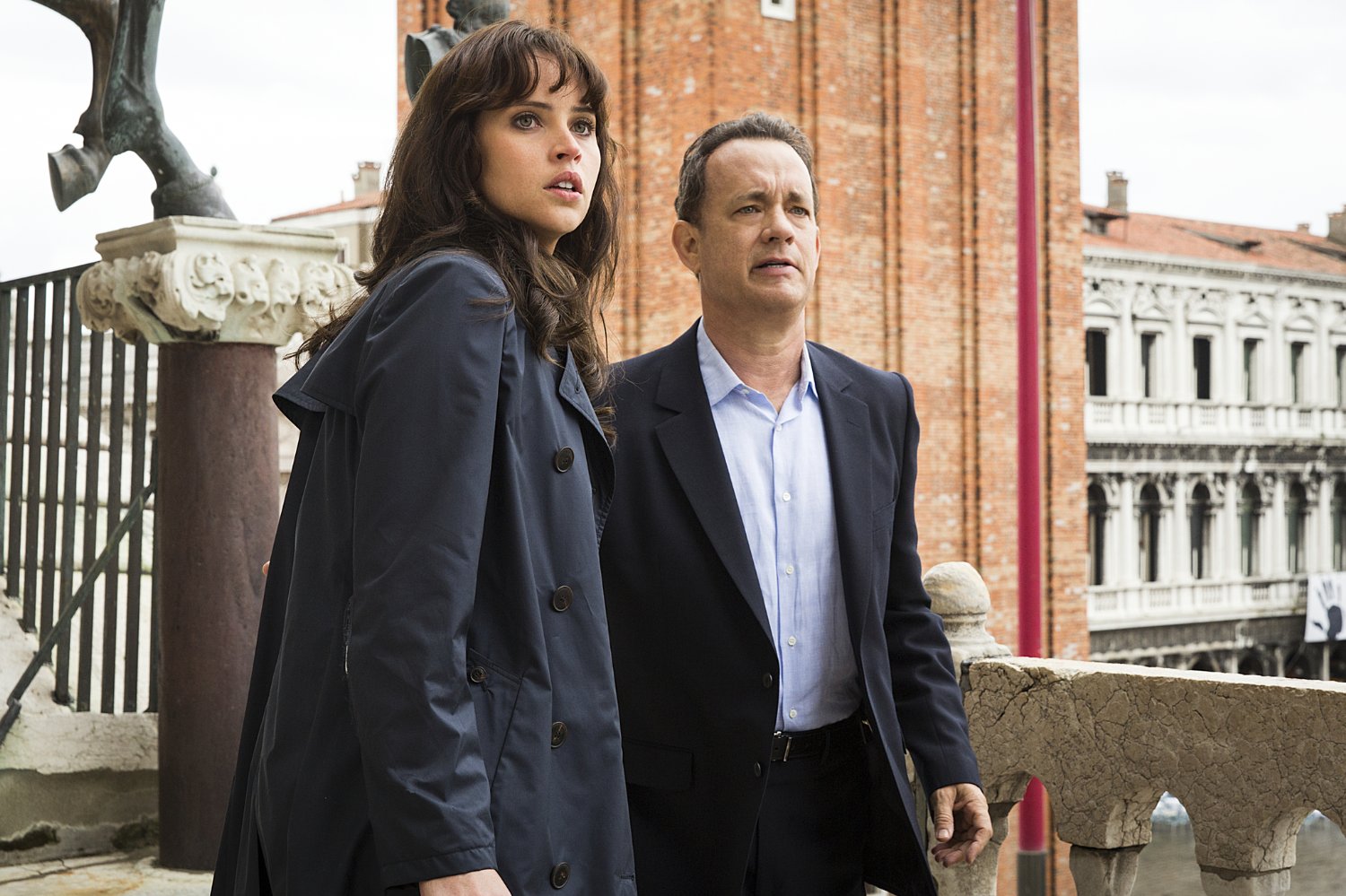
Autumn 2016 will be remembered for many things in the years to come but the fact that we got two Tom Hanks movies during that time will probably be considered of only minor importance. Everybody had something else on their minds, I guess. The first of the two was Clint Eastwood’s SULLY which we were all ok with partly because it turned out to be surprisingly emotional and, even better, it was only around 90 minutes. The second came deeper into the season at the very end of October, right at that moment when all of our attention was focused elsewhere. So it wasn’t much of a surprise that Ron Howard’s INFERNO, the third film adapted from Dan Brown’s Robert Langdon series, didn’t do much business. As for the first two, THE DA VINCI CODE came out in 2006, a long time ago with the memory of the surrounding frenzy now feeling like some sort of Bush-Cheney era relic that no one needs to revisit. The follow-up ANGELS & DEMONS came in 2009 and it’s a film I can’t think of a single thing to say about. So if you’re going to make a third film in a series that no one thinks about anymore and wait seven years to do it there’s always the chance the audience will have long since scattered. Even the SNL hosted by Tom Hanks the week before which featured the instantly legendary David S. Pumpkins sketch couldn’t get anyone to go. Naturally, I was there opening weekend. You think I’ve got better things to do? Something about how the film seemed off in the present climate was appealing in a why-does-this-movie-exist way, a franchise aimed at an adult market that didn’t really seem to exist anymore. So that Saturday afternoon I walked over to the Vista where I correctly guessed there wouldn’t be much of a crowd, got some popcorn and sat down, ready to enjoy a bad movie. Sometimes you know what you want and that’s exactly what you’re going to get. But thinking back on that time now it feels like the film was somehow a portent of what was to come and even Tom Hanks, who we all like to think of as our dad, couldn’t prevent that.
With no memory of how he got there, Professor Robert Langdon (Tom Hanks) awakens in a hospital room in Florence, Italy and finds himself instantly in jeopardy. In between hallucinatory visions of a form of hell engulfing the earth, he finds himself almost immediately under siege but is rescued by attending doctor Sienna Brooks (Felicity Jones) who informs Langdon of his condition and gets him out of the hospital with them being chased by an assassin dressed as a police officer (Ana Ularu) in pursuit. Hiding out in Sienna’s apartment the two begin to piece together what brought Langdon to the city in the first place, connecting it to the suicide of billionaire geneticist Bertrand Zobrist (Ben Foster) who had instigated a plan to use a virus to literally bring about Dante’s Inferno as a way to solve the planet’s growing population problem. On the run from both the assassin and members of the World Health Organization led by Elizabeth Sinskey (Sidse Babett Knudsen) with their own interest in Langdon, the path leads them to the recent theft of a Dante Death Mask on display in the Palazzo Vecchio and who is really behind the plot to unleash the virus.
It wasn’t necessary for me to look up the plot summary on Wikipedia to clarify a few plot points that I zoned out on but it didn’t hurt. I still have a few questions, to be honest, but it doesn’t really matter. I’m not going to make any great case for INFERNO but I’ve seen far worse and in some ways it’s more entertaining on its own mediocre level than the other two films in the series, or at least my memory of them. At the very least, it feels like there’s some sort of weight off its shoulders to live up to whatever the DA VINCI CODE phenomenon was so there’s not as much self-importance this time with maybe a little more pulpish fun. It’s a film that at least seems to know it’s designed to be watched on airplanes or via On Demand in hotel rooms and accomplish little more than just letting us know how it’s going to turn out. I’ve never read any of the Dan Brown books and I have no plans to revisit the earlier two films in the series but flipping by a few minutes of ANGELS & DEMONS on cable recently made it clear that INFERNO, screenplay by David Koepp based on the book by Dan Brown, is a little stripped down in comparison and the reported budget of 75 million vs 150 million back in ’09 makes that clear, with less of an emphasis on special effects and sets that were clearly digitally created as well as a cast of supporting actors this time out who while just as capable were clearly somewhat cheaper. Instead of figuring out a way to digitally swoop down on the characters as they enter some massive cathedral, the film instead has to concentrate on telling the story. Much of the first half hour is largely set in a single modestly sized apartment before the chase really begins and it’s even shot (digitally, unlike the others which were on film) in 1.85 unlike the Scope framings of the first two as if to further scale things down visually, but I’m not sure Ron Howard is a director who depends on 2.35 anyway. Even better it’s only a sliver over two hours so it even feels like it moves faster which alone makes it an improvement over the other Langdon films. The plot gimmick of partial amnesia is always good in a noir-ish way particularly here since it not only takes away part of the hero’s intellect, it means we don’t always know what the intentions are of people who claim they already know him. Plus I’m never going to be too unhappy about a film partly set in Florence anyway, even if it barely gets a chance to pay attention to the surroundings.
Much of Howard’s direction seems to consist of portentous close-ups of characters as they debate plot points with the occasional wide shot as they enter a new locale along with the expected action scenes where we can only partly tell what’s actually going on but he does keep it moving. You’d expect it to simply go through the paces but, if anything, the film is over-directed in an attempt to add more flash than the story requires, trying way too hard with CGI Dante-inspired visions of a world turned into hell that Langdon has which seem to be there mainly to make the whole thing acceptable for an IMAX release. They seem to disappear after the first hour and never amount to very much anyway. As it is, one of the most effective visions is also the simplest, when Langdon finds himself alone in a suddenly empty hall at Florence’s Palazzo Vecchio, the naturalism of the brief moment proving much more effective. The film does at least do a good job in portraying a world in strife amidst all this history, with Howard always keeping us aware of the teeming hordes streaming through these tourist spots as a reminder of the population problem the film dwells on plus it turns out that the date the virus is set to be released is my birthday so the villain’s apparently more of an asshole for trying to ruin that for me. There’s even a fairly decent twist in the second half that I didn’t see coming along with a plot device seemingly borrowed from John Carpenter’s ESCAPE FROM L.A., of all things, although I’ll give this film the benefit of the doubt that it’s not a direct lift. Hans Zimmer’s score serves as wallpaper much of the time as if it wants to maintain a semblance of seriousness by not being too bombastic but a little more energy wouldn’t have hurt.
Like the other two films, all the main action is crammed into basically one day and the way Howard films things it’s more about how the people in the frame relate to what’s around them, not so much on the epic sweep; really, the entire series tries to make actors shouting exposition while on the run into a new art form. But even though the film takes itself seriously every single second it still manages to feel somehow looser than the other two films and maybe all the location shooting gave it an extra shot of adrenaline. There’s nothing particularly notable about how the climax set in the Basilica Cistern in Istanbul is shot but at least the actual location has a unique look and the film even seems to know that it doesn’t need to bother spending too much time wrapping things up. For something so plot driven and centered around Tom Hanks running with a pained expression on his face, a few of the most interesting touches have very little to do with that plot, whether it’s a memory of a lost Mickey Mouse watch or visions of a woman that Langdon can’t quite recall. The subtext of INFERNO isn’t exactly deep, but it does contain tinges of regret in portraying someone so consumed by work that it’s become his life and in doing that asks himself what he’s waiting for and, really, what are any of us waiting for, whether we’re thinking about the world or the things we’ve missed out in our own lives, as if we just assume we’ll wake up one day and it’ll all be taken care of. One character references Dante’s Inferno and how it was written by him as a journey out of hell to reach the woman he loves, a parallel to what this particular INFERNO turns out to be for Langdon who seems to be preoccupied with how he’s single, maybe wondering about what he’s leaving behind at his age. It’s too bad the movie needs to explicitly state the parallel in dialogue as if we couldn’t pick it up on our own but at least it’s something.
There are a lot of serious matters to bring up about the state of the world today and what the problems of population are doing to it but ultimately INFERNO is a chase movie, one that wants to be hopeful and remind us how we need to strive for a better world. It’s trying really hard to believe that but I’m still not sure it does. But it knows that sometimes we need to retreat into those Mickey Mouse watches that represent where we once were while desperately hoping that the future hasn’t been too screwed up because of the past. One thing about this film, and I suppose the others in the series, is that at least it involves people from the world of academia with knowledge of art, religion, history, people who believe in intelligence and what that represents. As it turns out, not everyone in the film agrees with that and certainly not everyone in the world these days. It even feels somewhat conservative in its overall message of believing that institutions will save the day from the maverick youngsters (“Young people are disappointing. I find they become tolerable around 35,” someone says but Langdon’s silent reaction indicates even he won’t go that far) and even the diabolical private security firm that figures in turns out to only have the best interests of the world at heart. “Things fall apart if you don’t look after them,” goes one line which feels like a moral and a reminder to us for what may happen in the future. We like to think that Tom Hanks is supposed to save all of us since he’s our dad, after all. The bad guys of INFERNO are tyrants who attempt to destroy the world to turn it into what they want. A year after seeing the film in that nearly empty theater I’m starting to wonder if they actually pulled it off. But I guess we can’t blame Tom Hanks and Ron Howard for that.
Tom Hanks, his goofy hair from the first film long gone, definitely knows what is required here and, sure, this is basically the equivalent of Jack Lemmon starring in AIRPORT ’77 but he always seems fully committed to the moment and Langdon essentially trying to restart his brain adds to the tension; there’s a moment where, trying to hold back his impatience at someone telling him something, where you can see how well he engages with even the bit players. Felicity Jones, who I guess now will always be Jyn Erso, adds a refreshing sense of aggression in how she bounces off Hanks which goes against just being ‘the girl’ and, without getting into spoilers, plays things with just enough hesitation so we can’t always be sure what she’s thinking. All of the supporting actors are pros and do a good job in not revealing right off where their allegiances lie, particularly Irrfan Khan as the head of ‘The Consortium’ who more than anyone else in the film seems to be exploring all the possibilities in his dialogue. With the male lead spending a good amount of the running time in a daze it makes some of its strongest characters the women, particularly Sidse Babett Knudsen, also seen in WESTWORLD around this time, who offers authority as the World Health Organization head as well as Ana Ularu who as the assassin who unfortunately falls out of the story way too soon.
Plus Ida Darvish as helpful Palazzo Vecchio representative Marta Alvarez turns out to be the most likable character in the film, maybe all three of the films for that matter. For once there’s actually some refreshing intentional humor when she rolls her eyes at Langdon’s introduction of the much younger Sienna Brooks as his ‘niece’ and the brief exchange, along with an earlier bit where Langdon tries to ask for a cup of coffee, makes me wish the film could be that much more of a romp through European locales but soon enough it’s just back to the furrowed brows. Darvish is such a refreshing presence after all the Sturm and Drang of the plot that you wish they could knock off the chase for a while, go to a nice restaurant down the street for some pasta and good conversation. I mean, we’re in Florence after all, why do we have to run everywhere? Her character’s pregnancy not only provides an extra layer of confusion for Langdon when she first appears but in the end provides hope for the future which makes sense considering she gives the film more life than anyone else does.
And in case I need to mention it, this particular INFERNO has nothing to do with the Dario Argento film of the same name, which you should see if you haven’t, nor is it connected to the 1953 noir with the title directed by Roy Ward Baker and starring Robert Ryan which I’ve never even seen but I’d like to. I also never saw the past few Ron Howard movies before this one but it was nothing personal. He still seems like a nice guy and I’m sure we’re all going to be seeing that Han Solo film when it comes out. Anyway, we all have pasts. Right now, a year later after all this, it feels like the past stopped at INFERNO and David S. Pumpkins. The YouTube page for the sketch even includes a comment reading, “I think David S. Pumpkins resonates because it was the last really pure thing we had before the whole world went to shit.” Which in some ways is true and, yes, it was a funny sketch but let’s all calm down for a few minutes. To go back to INFERNO, on opening weekend it came in second to BOO! A MADEA HALLOWEEN which already in its second week and while international numbers were fine, as much as people love Tom Hanks they obviously don’t care much about this anymore. To compare it to another sequel from a year ago, JACK REACHER: NEVER GO BACK opened just a week earlier and was also DOA at the box office but at least INFERNO has more oomph, even if it never attained the cache of Film Twitter approval, maybe because Ron Howard’s approach actually gives the vibe that it’s a film he’d like to see. For now, INFERNO is a reminder of that brief moment in time even if I may not need to return to it very much after this. And if there’s actually going to be a future, the film is a reminder that I need to see Florence again one day although I may pass on the INFERNO experience. We should always remind ourselves that history never dies. History will be remembered. These days, I have to hope.
Sunday, November 5, 2017
Gliding Over The Water
Maybe with age comes acceptance, whatever that means, even if it’s just being more open to what you should have liked in the first place. I’ve written before about my long ago aversion to Tony Scott films and how it feels like I was too snobbish about them when I was younger. Don’t worry, I’m not going to change my mind TOP GUN or DAYS OF THUNDER anytime soon and you’ll never convince me that his TAKING OF PELHAM 1 2 3 remake is worth spending much thought on. THE HUNGER, however, is a different story. Years after I first saw the film, probably during the laser disc days, all I could flash on were specific moments and images, maybe the same ones that have stuck with anyone else who half-remembers it. Looking at the Warner Archive Blu-ray is a reminder of those things, of how seductive the film really is in the pureness of those images and how I still can’t quite shake them, not even if I wanted to. Even now I’m not sure if THE HUNGER works as anything more than a particularly stylish vampire story with its own take on the mythology but then again I’m not even sure if I think of it as a vampire story at all or just a sustained mood piece about a certain way of life (and death). Maybe it’s just a movie about the things you remember and what they mean. Even though it’s never particularly scary, which in fairness is probably something you’re allowed to expect in an alleged horror film, the themes that emerge from the visuals refuse to diminish. Then again, maybe with age you also come to accept who you really are.
Miriam Blaylock (Catherine Deneuve) and her companion John (David Bowie) are a pair of vampires who have been together for several hundred years, currently living in a New York townhouse and once a week search for people they can feed off of. It was Miriam who turned John in the first place, promising they would be together “forever”, but when he suddenly finds himself aging rapidly he seeks out Sarah Roberts (Susan Sarandon), a doctor who specializes in forms of rapid aging. His attempt to see her is unsuccessful, left in a waiting room only to have her realize the truth of what he’s saying too late and returning home, the rapidly aging John soon learns that he will not in fact die but simply wither away into bones, left in a coffin alongside the remains of all of Miriam’s other former disciples nearby. When Sarah comes to the house in search of John she only finds Miriam who doesn’t waste time in her search for a new companion and after they are together Sarah has no idea what has infected her blood or what she is in fact becoming.
His debut feature released in April ’83 after a start directing commercials, THE HUNGER is like the embryo version of the Tony Scott style that emerged even before we realized it, seen here in the very early days of MTV before the likes of Simpson-Bruckheimer and Hans Zimmer got a hold of him. When his approach was finessed over the years it was sometime better than you expected and sometimes simply hollow but here everything about that rawness clicks into place as part of his sheen of pure cinematic crack. It grabs you right from the start with an opening sequence that overwhelms as much as a pure strobe effect combined with that perfume commercial aesthetic where you’re always aware of what’s happening but never quite sure what it means until too late. Even the long ago promise of ‘forever’ that John repeats back to Miriam sounds like a slogan for a new fragrance, the product of immortality being sold with an unspoken catch. Every single frame seems deliberate and yet it feels like Scott is always searching through those images that he catches for things that can accentuate them, looking for just the right movement from the actors, just the right gesture to hold on and use it to tell the story instead of dialogue. He’s more interested in the appearance than in exploring just what these vampires are so while the opening with “Bela Lugosi’s Dead” performed by Bauhaus might be a little on the nose these days it still feels like the closest the film comes to actually saying the V word. Based on simply watching the film I wonder how long the script (screenplay by Ivan Davis and Michael Thomas, based on the novel by Whitley Strieber) even was or needed to be, the essential story beats stripped down to basic essentials with some shots running only a few seconds that let us either piece things together or not, moving to the next scene whether it makes sense or not. It lasts through each moment whether it’s the sight of Catherine Deneuve crossing the frame or the quiet observance of David Bowie in the hospital waiting room, aging before you even realize it.
You could call it a case of style over substance with the focus on the visuals, the smoke and all the pure atmosphere in the air or just think of it as pure cinema, the way Scott and DP Stephen Goldblatt frame the close-ups of their godlike stars, not quite seeming like they’re in the same hemisphere of anyone else they come into contact with. Even the concept of spatial relations throughout the film occasionally throws us off, whether intentional or not, the way in one scene Sarandon keeps glancing off towards people who seem to be in another location entirely turns out to be in a restaurant overlooking a swimming pool (huh?) or when a scene cuts from her at a phone booth to someone inches away they could just as easily be way across town. It never feels like everything can be explained, not even what would usually be called normal human behavior.
These vampires don’t even seem to be any kind of representation of pure evil, at least not according to the film or even how many people they’ve killed. They’re just two creatures floating through New York (or maybe this film’s particular version of New York with streets that always seem rain soaked) and the film doesn’t pass judgement any more than it does Sarandon’s doctor for leaving Bowie in that waiting room for hours. It’s hard for me to ever hate porcelain doll Catherine Deneuve in any guise regardless and I suspect we’re not meant to, not even when she’s slashing some sleazoid’s throat or when she abandons her former lovers in wooden coffins locked up in the attic, essentially ghosting them as they remain there for eternity calling out her name (hey, I’ve been there). That’s all you remember more than any strict plotting and Scott clearly knows that the purely alien imagery provided by Deneuve and Bowie, supernaturally beautiful as they are, will be more visually compelling in their purely sexual way than any long speeches explaining plot points. If you’re going to be brutally killed then it might not be so bad if it’s Catherine Deneuve or David Bowie doing it, after all. Compared to that, it’s a close-up of a smiling old woman that is truly monstrous in this context. In addition to the beats of the original score by Michel Rubini and Denny Jaeger dripping along towards the encounter between the two female leads that we’re waiting for, the music gives it all a sheen of class whether the recurring use of Schubert or the Lakmé excerpt by Delibes described by Deneuve to Sarandon as part of her seduction later used again by Scott during the most notorious scene in TRUE ROMANCE during a display of a completely different kind of love. As a reminder, this is the film about which Leonard Maltin, bless him, in his star-and-a-half review says to avoid it “unless Deneuve and Sarandon in bed together is your idea of a good time” which doesn’t exactly qualify as woke criticism these days although if I asked what else was cinema invented for anyway since it’s almost the very reason why we’re watching the movie in the first place I’m not entirely sure that’s much of an improvement. But it’s still true.
Thematically it does feel a little scattershot as it explores that desire, that hunger the characters feel which is partly about addiction (essentially a real world issue) and partly about immortality (not so much) so I’m not quite sure if they work as equals although in a way the film is basically saying that the very concept of addiction makes pain eternal, an unending cycle that will destroy others whether they’re a part of it or not. On the disc’s audio commentary Susan Sarandon talks about how some of that was lost when the ending was changed but it’s not like I have to pay much attention to what Susan Sarandon says these days and either way it all works as the big budget, big studio, ultra-slick 80s version of something like DAUGHTERS OF DARKNESS with Deneuve in for Delphine Seyrig. But Scott doesn’t turn his back on the reason why people are watching this film and goes for the pulp because he knows that’s where the true desire is, one that I imagine in this presentation is more pansexual than bi but maybe I’m the wrong person to ask about such things. What really sticks out thematically is the film’s portrayal of aging and the awareness that it’s too late to ever be anything more than what your promise was so in that sense it’s a film made by someone for whom vampirism isn’t something to be feared because it’s about living to the absolute extreme no matter how many bodies are left in the wake of these eternal lives. That’s what all of Tony Scott’s films were about anyway and it’s something that never really changed no matter how extreme his style became. He doesn’t want to analyze the themes. He just wants to jump. THE HUNGER came out less than a year after his brother Ridley’s BLADE RUNNER opened and one can piece together something of a distorted mirror image in how each film involves people living a blazing existence that abruptly cuts out as they search for more life, fucker. That one word David Bowie repeats asking for a reassurance even recalls how deleted BLADE RUNNER footage shot for the ‘happy’ ending of that film includes the exchange “What’s a long time?” “Forever” as Harrison Ford and Sean Young drive off in anticipation of a sequel 35 years later where. Just like in THE HUNGER, only one of them makes it. Each film favors a kind of poetry over strict mythology, each can in some ways be whatever you want to take from it.
There are certain elements that I still don’t get, why the characters go to a house out on Long Island during the opening sequence or if the cross-cutting with the monkeys is meant to be a mere visual parallel or if there’s something else going on in terms of a psychic connection. I wonder if Sarandon’s research into age itself being a disease, with her colleagues so cavalier about their mortality that they’re eating Big Macs, even amounts to anything having to do with the actual plot in the end. The old age make-up is at times remarkable with the middle-aged Bowie the most effective stage but when he gets near the end it essentially becomes a Dick Smith head right out of HOUSE OF DARK SHADOWS, with too much of personality lost and there’s little enough Bowie in the film as it is even though his presence still comes through during the “a little saccharine” moment. At least one plot point, and probably more, is so oblique that you can hardly blame anyone for being confused or thinking they zoned out for a minute as if the movie is brushing off the impact of who was just killed. Does it matter? Not really. Even all the blood slashing is just another component of the style, not an attempt at a scare. The Ankh medallion that the vampires wear around their necks used to double for a blade is a little blunt as symbolism but still effective imagery, just as the doves that apparently hang out in the attic are, looking forward to how they’re used in Scott’s BEVERLY HILLS COP II, looking forward to turning up in John Woo movies. It is a kind of mish-mash of all sorts of things, a brief BARRY LYNDON flashback of Miriam making her promise to John looking forward to a SHINING present that in the end turns into a BLADE RUNNER happy ending (also part of THE SHINING, come to think of it) and if I’m really going to nitpick here, I don’t think much of the font used for the opening credits so THE HUNGER doesn’t have everything I want in a movie. But mostly I’m just happy to luxuriate inside this thing with all its intensity and erotica for a little while so worrying about strict reality is irrelevant, there’s too much mist swirling around to ever care. The images don’t always make sense. Even the time of day that the sunlight streams through windows doesn’t always make sense. I take it all about as seriously as I need to, just enough to take the shots and moments that stand out. The rest of it, maybe not so much but, honestly, I still dig the film in every ounce of its awesomeness. There are maybe only 4 or 5 sequences in THE HUNGER that really matter and the rest of it fades away a little, even as you’re watching it just get to feature length before you realize it. You already know what those scenes are. That’s enough.
It’s impossible to think of Deneuve and Bowie as mere mortals anyway, even now, so the casting is perfect. The way Catherine Deneuve plays her I’m still not sure what Miriam is ever thinking about anything, but it’s all about she projects just from her face in close-up, sometimes bemused by what she’s concealing from people but more often simply focused because she knows that she’s the one in the room people are going to pay attention to. Admittedly, I sometimes need to go to the subtitles when she’s explaining things but I still don’t care. David Bowie doesn’t have as much to work with but his very presence almost does all the work in showing how much David depends on Miriam for his very existence and he makes the moments where his quiet desperation is becoming apparent count. Up against the two gods, Susan Sarandon takes what may be the most difficult role and grounds it in her innocent confusion, particularly in her “You can’t leave” utterance to Bowie as the elevator doors slam shut, as much as the film ever needs to, faced with things that her intelligence can’t account for and with total confusion over what she’s drawn to. As music student Alice, Beth Ehlers gives hints that she’s worldlier than her years indicate which makes her perfect casting as a pure innocent--you can’t tell if she’s young or old or even what type of sexuality she’s heading towards and I wish we could get more of her interactions with Deneuve. As Sarandon's colleague/boyfriend Cliff De Young is just about the one relatively normal presence in this film while bringing an edge that grounds his end of the plot, annoyed at what he should be amazed by. Dan Hedaya is Lt. Allegrezza, a character who’s more of a plot device than anything but it’s still a treat to see someone like him sharing the frame with Deneuve since they barely seem the same species. I guess in this film they aren’t anyway. Shane Rimmer, whose presence is like a neon sign stating that the interiors were shot in England, plays Arthur Jelinek (cool name), the great Ann Magnuson is one of the victims during the opening sequence—I love that dance move as she slides right past Deneuve—and looking forward to starring with Sarandon in LIGHT SLEEPER a decade later Willem Dafoe appears briefly at a phone booth standing next to John Pankow of MAD ABOUT YOU.
On the audio commentary, Tony Scott offers about the film’s release, “It didn’t make a bean,” less than $6 million at the time as it turns out. Looking up theater listings in New York from the time it appears to have barely lasted a few weeks past opening day. Whatever following that THE HUNGER has attained over the years, the Blu-ray from Warner Archive is a stunner, capturing every stylish moment perfectly with all that light and smoke that the director loves so much. You just want to climb into this world, no matter what the risks you’re taking might be. Tony Scott was born on June 21, my birthday as it turns out, and he’s buried right in Hollywood just a short drive where I am so I’m feeling some sort of connection right now. I’m sure the next time I visit I’ll be thinking about this film more than any of his others, a film that dwells on how the people in front of you can reveal everything and nothing all at once, just as the film dwells on the Polaroid photos taken by teenage Alice. Which is just what the film does, telling us as much as a single photograph which is all we need to know. And for the 96 minutes of the movie it feels unblinking in what it says that life is. Maybe with age comes acceptance and wisdom, but maybe it also comes with ability to wipe certain things in your head away and move forward, further towards who you really are. Then again, maybe I’ll just watch another film. That might be part of destiny too.
Subscribe to:
Posts (Atom)