Monday, February 26, 2018
The Trick Is Not Minding
Kenneth Dahlberg’s neighbor’s wife really was kidnapped, to begin with. There is no doubt whatever about that. She was Virginia Piper, wife of Harry Piper, chained to a tree for two nights until a million dollar ransom was paid by her husband who was then informed of her whereabouts. Most of the money was never recovered. This is an extremely abridged version of what happened which in ALL THE PRESIDENT’S MEN becomes a mere passing comment that Kenneth H. Dahlberg of Minnesota, sounding somewhat distressed, makes to Bob Woodward during that epic phone conversation about the check cashed by one of the Watergate burglars. It’s one of those tiny details that the film brushes past which makes me think of the bit later where Woodward doesn’t express surprise at what’s happening behind the closed doors he and Carl Bernstein are repeatedly knocking on, a scene no one ever remembers even if it’s maybe one of the few reaches for theme the film makes outside of its journalistic goals. The point, the moment seems to say, is that the surprise doesn’t matter. You just have to accept it and keep probing because the answers are there. And they will reveal themselves. The lights come on eventually.
ALL THE PRESIDENT’S MEN is a miracle of all the right elements coming together, a miracle from that holy cinematic year of 1976 when it was one of the Best Picture nominees to lose to ROCKY. Not only is it a film without a wasted frame there isn’t a moment which is not awash in total clarity and awareness in its pursuit of the story. Whatever the process was throughout the making of the film it not only somehow kept straight how much we needed to know, it laid bare the process of how the story that was being pursued became clear, fixated on the goal and like its two lead characters always aware of what the next question needed to be. Every moment is important, even the asides, even the blind alleys since they are a reminder that there are always going to be those blind alleys. In his review at the time Vincent Canby called Alan J. Pakula’s film “the thinking man’s JAWS” and it’s just as compulsively rewatchable. There isn’t a single dull moment which was certainly a concern at the time, way back when the fear was that everyone knew everything about Watergate already so what was the point of even making it. The film answered that question, presenting what happened with such skill and focus without stopping for a moment, the drive that is evident in its two lead characters becoming more clear with each scene, each time they sit back down at the typewriter.
Over 40 years after it was made there are still few other films that balance plot and character as intricately as ALL THE PRESIDENT’S MEN (screenplay by William Goldman based on the book by Carl Bernstein and Bob Woodward) as it follows reporters Bob Woodward (Robert Redford) and Carl Bernstein (Dustin Hoffman) of the Washington Post investigating the Watergate burglary and coming to understand very quickly just how deep the scandal goes. If you’re Steven Soderbergh you’re already watching it several times a year as indicated by his annual list posted every January of what he viewed the previous twelve months. If you’re anyone else you probably should be watching it several times a year. I’ve done it myself. Just about every minute of screentime propels things forward and yet it becomes a character piece anyway as we watch Woodward the straight arrow Republican (the news of which becomes a double take glance between him and his partner) and Bernstein the wiry ladies’ man, each of them determined in their own way to find this story together. Removing all conflict over how the two reporters are going to work together in about ten seconds flat it locates the characterizations in their actions as they obsessively scribble down those notes during phone calls, in the way they keep their eyes fixated on the subject not wanting to move for fear they’ll stop talking, never bothering to explain what drives them in speeches we don’t care about. The way they keep asking those questions even as somebody says they don’t want to talk anymore is all we need to know and the debates they have with each other lays out each man’s own basic approach to logically coming up with the answers, searching for where they can be found through each new deduction. Along with their sheer sense of focus it’s a film that never gets distracted by anything in its peripheral vision.
It’s an unrelentingly addictive film to watch, the way it jumps into things and refuses to stop while still maintaining a calm and collected tone all the way through. “The trick is not minding,” Hal Holbrook’s Deep Throat says during his first meeting with Woodward while telling a story about G. Gordon Liddy holding his hand over a candle at a party which is more or less a direct lift from LAWRENCE OF ARABIA and the cribbing of that line almost serves as a reminder of how, much as this comes from what happened, it still had to be figured out exactly what story was going to be told. Reading through the book is a reminder that the facts are the same, which they have to be, but it still needed a structure to provide clarity and the film finds it, keeping close to the journalistic roots and never taking its eyes off the big story. That particular Deep Throat line isn’t from the book or real life, “Follow the money” isn’t either, and actually much of his dialogue seems to have been invented for the film where what he has to say is considerably more clever. It’s not the only alteration without tampering with the reality of what happened so putting aside the history and politics it’s equally clear how much ALL THE PRESIDENT’S MEN is a near-perfect model of how to adapt a book, any book, even with the audacity of concluding the narrative at roughly the halfway point of the source material (not counting a few scenes from the second half which get moved up in the chronology) before the scandal really takes hold with the public but also in terms of how well the film parses out the sheer mountain of information that needs to be told.
There’s no love interest who comes in for a few scenes to argue about why the two men are so devoted to their work and any hints dropped that Bernstein is a ladies’ man aside those McDonald’s wrappers scattered around the table during their bickering lunches are more important than any outside life, only guys like Jack Warden and Martin Balsam playing Post editors Harry Rosenfeld and Howard Simons to bounce off of to remind them not to fuck things up. Each scene tells us something new whether it’s about the scandal or the sheer determination of these guys to figure out the right questions to ask and how to get in through the door, whether Woodward’s gamble of how to get the right name out of the bookkeeper or the way Bernstein gets part a secretary to get into a delayed appointment down in Florida (in a sequence apparently written by Carl Bernstein and Nora Ephron). The forward momentum helps the film move flawlessly from scene to scene even with what seems like some occasional dialogue that’s been dubbed in added after the fact to help scotch tape over a few transitions and clarify who certain people are but so what. As much as the film brushes past certain pieces of detail that it doesn’t have time for, considering how much information needs to be laid out so we even partly follow what’s going on it always comes up with the right answers.
But as much as every single one of the story decisions were correct it says something that in William Goldman's acceptance speech at the Oscars the first person he thanked was cinematographer Gordon Willis whose brilliant work transformed the film into something beyond a simple newspaper story with its shadows providing that low hanging cloud which always seems to hang over D.C. through the film. Willis wasn’t even nominated, passed over for the likes of the KING KONG remake and LOGAN’S RUN (I like both of those but come on…) but it’s impossible to imagine the film without those layers that Willis brought to it, providing that extra level of clarity to Woodward and Bernstein in the harsh light of the Washington Post trying to enter the darkness where all the answers are, Deep Throat waiting in that garage in the middle of the night with the answers he won’t fully reveal. With the camera pulling up from them going through those cards in the Library of Congress, tiny figures lost in the weeds, Willis and the darkness he brings to each moment provides the cagey emotion of the film to go with Pakula’s levelheaded cool providing a sense of unrelenting intellect with that 70s paranoia backed up by the low hum of the score by David Shire which seems directly attached to Woodward and Bernstein’s brainwaves to remind them that something’s going on, only they don’t know what, only that they have to keep following the leads.
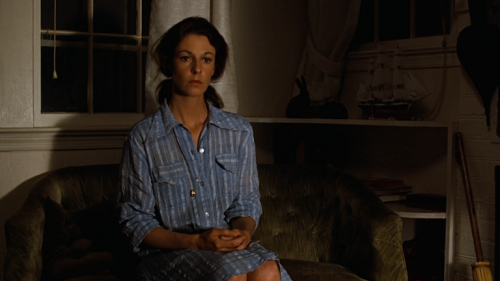
Everybody here is working at their absolute best and the hushed tones that linger keep things unsettled just enough Pakula knows how much emotion to let seep in with the quiet anguish felt in Jane Alexander’s “If you guys could get John Mitchell, that would be beautiful.” His view of each scene serves as counterpoint to the determination of these guys and there’s a calm in the air in the way through each scene with the single take Dahlberg phone call one of the most deservedly famous of them, Redford prominent in the frame as the camera slowly moves in on him away from the background where the newsroom is converged around a TV with the breaking news, McGovern dropping Eagleton from the ticket which the movie doesn’t make clear until a later headline is spotted but it doesn’t matter as far as Woodward is concerned and we zoom in, everything else becomes irrelevant as the real story becomes clear. It’s one of the most subtly bravura scenes in a film that doesn’t waste a single moment, every shot matters, as it presents Woodward and Bernstein as two small figures in these massive Washington establishments, the reality of the world combined with a stylization in the way it’s presented, familiar DC landmarks always nearby as they would be in real life, forcing them to do this work literally in the shadows of the men they’re investigating. The style transforms this from simple docudrama almost into a form of deceptive realism, the camera racing alongside them in the newsroom and the legendary dolly shot as Woodward exits the parking garage in the middle of the night, unaware of where Deep Throat has gone to, leading into him in an early morning parking lot which is some ways doesn’t make logical sense—after all, has Woodward just been wandering the streets all night—but places him existentially alone with what he knows in the middle of this city, almost too afraid to face the truth but remaining absolutely determined. For all the 70s realism it still feels like a jolt to remember that the Washington Post newsroom was recreated on the studio lot in Burbank (art direction that won an Oscar, over the likes of LOGAN’S RUN) and there’s nothing in the film that shouts backlot with the exception of the rearscreen projection in the driving scenes, not that I care, and that particular aesthetic of the decade is fairly soothing to look at now anyway.
The president’s men of the title are mostly unseen, phantoms always lingering nearby, occasionally spotted on television like Ron Ziegler slamming the post could be said by someone today, pretty much word for word, except maybe he displays better vocabulary skills. All powerful at the time but, as Deep Throat reminds Woodward, not very bright guys. And mostly terrified, even down to Ken Clauson worried about whatever happened in Sally’s apartment getting out and jeopardizing his wife and family and dog and cat. Woodward and Bernstein know that something is there, it just takes time to figure out what and ALL THE PRESIDENT’S MEN takes its time with those debates in Bradlee’s office about if they’ve gotten the story, not to mention what exactly the story really is or if it’s too thin. As well as trying to decide if they’ve knocked on enough of those doors. All these years later, the world may be considerably different and the crimes taking place at the moment may go far beyond anything that happens here. Separate from the Watergate crimes, there may also be a problem with any movie that happens to star Dustin Hoffman. The main story of the film ends on a fuck up, with the real ending coming via the teletype epilogue, but it feels right since in the 70s fucking up was the way things often went anyway. Considering everything that had already happened by the early 70s the eventual victory was almost irrelevant as the mention of settlement negotiations to end the Vietnam War in an editorial meeting reminds us. Seeing those two guys back at work to get the story is what matters. Because you’re going to fuck up. The trick, however, is not minding. You have to become what those guys on the other side already are. Only maybe, hopefully, the good version. And if it means acquiring a taste for the jugular, so be it.
Robert Redford and Dustin Hoffman become as one in playing Woodstein, as they’re dubbed, and it’s a couple of the best sheer movie star performances off all time as far as I’m concerned. It’s the best of each of their strengths, Redford’s innate laid back quality combined with the intensity the grows in Woodward making him click for me here more than any other film, zeroing in on the precise moments when Woodward finds the next piece of the puzzle while Hoffman’s jittery quality matches that perfectly, always looking for the next cigarette while walking ahead of his partner, calming down at just the right moments to get the answers that are needed and ready to fight but still willing to listen. They’re matched up against the all-powerful focus of Jason Robards in his Oscar winning performance as Ben Bradlee, always looking for the right answer to what he demands of people, never wanting anything but the right answer to what he asks, only wanting to be absolutely sure. Jack Warden, Martin Balsam and especially Hal Holbrook as Deep Throat are all phenomenal but there’s also the calm defiance of Jane Alexander (the film’s other acting nomination) as the bookkeeper, the smiling Robert Walden as Segretti, Lindsay Crouse, Stephen Collins, Ned Beatty, Polly Holliday, Valerie Curtin, Penny Fuller, John McMartin as the Post foreign editor calmly laying out the other way to look at things and the voice of John Randolph as John Mitchell.
The opening shot just after the 70s Warner logo fades away makes it clear—the typewriter is the weapon. The word is the bullet. And at the end, when Nixon is being sworn in, the typing continues, the only weapon they know. I miss working on a typewriter, without a doubt the most beautiful weapon that will ever be known to mankind, but that’s the way it goes. There’s anger out there right now. I feel it. It’s impossible to keep from thinking about it sometimes along with the simmering awareness over how certain people have tried to get away with such things. My sister, who once worked in the journalism world in D.C, lives in Bethesda and every time I visit I bring the disc of ALL THE PRESIDENT’S MEN to have with me, close enough to where it all takes place that I imagine it every time we pass a parking garage. I’m not sure how many times I’ve seen the film by now. And as I watch it now yet again I think about all the crimes that are happening right now that barely even need to take place behind closed doors anymore, practically out in the open and waiting for someone to do something about it. Anyway, a lot of the time lately I think we’re fucked. But I still hope not. Those newspapers matter even now and journalism matters, even if the journalists don’t always seem to realize that. The pulse of ALL THE PRESIDENT’S MEN is one that remains steady and calm as I watch it once again, trying to breathe through these awful days and remember that there’s always a hope, like an injection to somehow keep me going.
Monday, February 5, 2018
To Protect That Legacy
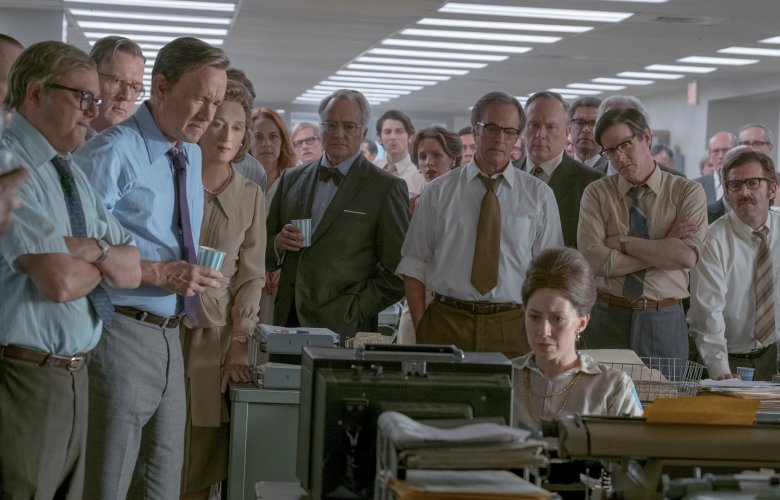
No matter how much time goes by, we still find ourselves trying to impress certain people. Even when they’re out of our lives, even when they’re already gone. Nora Ephron worked with both stars of THE POST over the years in addition to being friends with director Steven Spielberg, so the film’s dedication to her at the end can be easily explained, particularly since it involves a world she knew all too well. But I also wonder if among those other reasons Spielberg was paying tribute because he wanted to make a film Ephron would have approved of, not just shake her head condescendingly wondering why he was wasting his time with this or that, the sort of things that the New York literary elite would have brushed aside. I take some comfort in this possibility, the idea that even Steven Spielberg wants to be invited to the smart kids’ table. Or maybe he wants to do what he can to insure that other people will actually be sitting at that table in the future. After all, these days it’s looking a little iffy. THE POST is about this but it’s also about how the past matters, both in the big ways that shaped our lives which we need to remember as well as the little details that once made up pieces of the world but no longer exist. Those things meant something and were maybe more important than we ever paid attention to. And once we stop paying attention, that’s the ballgame. Of course, THE POST is also about moving beyond the past but more importantly it’s about saying Fuck You to certain people who want to do away with such ideals, which right now is an entirely warranted response as well. It could have even shouted that a little louder, as far as I’m concerned.
Just as Washington Post publisher Katharine Graham (Meryl Streep) is about to place her paper on the NYSE, classified documents that were part of a Pentagon Vietnam study smuggled out of the Rand Corporation by Defense Department analyst Daniel Ellsberg (Matthew Rhys) appear in The New York Times. Post editor Ben Bradlee (Tom Hanks) is immediately envious, always looking for something to get in the paper and when the Times comes under injunction the chance to run more findings in the Post is too good to be true. So when the documents are secured from Ellsberg thanks to Post assistant editor Ben Bagdikian (Bob Odenkirk), Bradlee is determined to go to press immediately but when board members try to argue against it out of fear of what this could mean for the paper legally in addition to jeopardizing the impending IPO, Kay Graham has to decide which side she’s really going to be on and what sort of newspaper she wants this to be.
Katharine Graham wakes up with a jolt at the beginning of THE POST as if from a bad dream, just like many of us have been doing for the past few years now. Going from a nightmare into a nightmare. Graham doesn’t appear at all in the film of ALL THE PRESIDENT’S MEN, of course, not counting the somewhat crass reference to her courtesy of John Mitchell and it’s a safe bet people viewing that film for the first time in recent years might not know the significance of this “Mrs. Graham” they’re talking about, the one Jason Robards’ Ben Bradlee doesn’t want a certain reference to in a family newspaper. William Goldman, interviewed in the book “The Craft of the Screenwriter”, confirmed that there was a scene featuring Graham in his screenplay at one point, with the role possibly to be played by Alexis Smith, but he was a little in the dark as to why it wasn’t used. Certainly the film was already long with a lot of dates and names to keep track of but it does sound like a good opportunity for a star cameo to put a spotlight on this particularly important figure who did play a role in the proceedings. So as it is ALL THE PRESIDENT’S MEN, which plays in the film as about as perfect a screenplay as you can imagine, will in some ways always be thought of through certain images—Woodward & Bernstein walking through the newsroom, Deep Throat in that empty parking garage in the middle of the night, watching TV in Ben Bradlee’s office—specifically, images that involve the men who were in the middle of the story. Watching it in 2018 is a reminder that the women in the film are there to either be flirted with or get answers from, none of them with the power to actually do anything about Nixon. And suddenly it’s hard not to think about the key figure missing from that perfect film.
Written by Liz Hannah and Josh Singer, and by now famously a spec script by Hannah that sold only days before the 2016 election, it’s very possible that over time THE POST will retreat to the shadow of that other film although if the worst thing you can say about something is “it’s not as good as ALL THE PRESIDENT’S MEN” then maybe that’s not so bad. It’s certainly much more of a character piece, focusing on Katharine Graham who as the film sees it is a woman who has always willingly been a mere observer being kept off to the side where the women in that world are supposed to remain but is now being forced into finally taking action. So while the importance of the Pentagon Papers is greater than simple McGuffin and the film doesn’t ignore the fault of previous administrations before Nixon came along, even if he is the big game, the focus of THE POST remains elsewhere, whether a reminder of the first amendment or the state of women’s liberation in 1971 as Katharine Graham’s awareness of what was around her finally began to take shape, always keeping the character beats up front.
The tight timeframe gives the story a focus and while Spielberg doesn’t direct this in the style of a 70s film, not like Fincher went full Pakula with ZODIAC, he uses his own camera-heavy approach to focus on the analog details that were everywhere at the time, down to the typewriters and rotary phones, the way Bob Odenkirk’s Ben Bagdikian begins to reach out to that pneumatic chute as the edited story is sent off to press or even when he fumbles for change at the pay phone when he leaves the office to make an important call (I like when he has to call back from another line and uses the pay phone furthest down in the row). It’s a film about the impulse of chasing the story just as ALL THE PRESIDENT’S MEN was about the cool, careful intellect of the process. In directing that film, Alan J. Pakula was always methodical in his framing even when things moved, whether those long dolly shots across the newsroom or the gradual zoom into Redford during the legendary Dahlberg phone call. Spielberg is a little more freewheeling, moving the camera everywhere at times, moving the actors into the shot together, following them as if he knows at certain times that they don’t want to be followed. Mixed in with the continually sharp dialogue there’s a looseness to even small moments of the sort that hasn’t been felt in any Spielberg film in decades, maybe not since one of the films he actually made in the 70s; there are a few beats where it almost feels like he decided not to go for another take with more precise timing, instead keeping in a little of the messiness that’s bound to happen against such a tight deadline. The details often feel tangible particularly in the Post newsroom even if there are times when the settings, both interior and exterior, almost have an overly shellacked feel (this also goes for Michael Stuhlbarg’s heavily made-up look as Abe Rosenthal) as if to give the appearance that the whole thing was shot on a studio lot, which it really wasn’t, with even the various newspapers handled by everyone throughout look a little too neatly pressed even if they are meant to be freshly printed.
Still, the speed helps even if Spielberg gets a little too broad with his staging at times such as the reporters peering into a box with the Pentagon Papers as if it contained the Sankara Stones. As seriously as he takes the issues he still can’t quite repress how much he responds to the boys’ adventure aspects of chasing the story so he clearly identifies with Bradlee and Bagdikian and Ellsberg and the interns from both the Times and the Post running through the streets; even when the Post intern arrives at the gates of the holy goddamn New York Times it’s hard not to think of the young Spielberg sneaking onto the Universal lot long ago. In comparison, the portrayal of Katharine Graham’s rarified world of parties and dinners at Art Buchwald’s house is kept at more of a distance even if her awakening is where the real conflict is, sprouting from the theoretical debate with Ben Bradlee over how they’re going to run the place which up until now has just been a casual series of debates, laughing over their own disagreements. That’s what the focus really is more than the subject of Vietnam and the papers (THE PAPERS was actually the title at one point; hard not to wish they could have come up with something that had a little more pizazz) which answers the question of why it’s not a film that focuses on The New York Times, which did after all publish them first. Some reports have the Times as not being too thrilled by all this, but I’m not so crazy about certain articles they’ve run lately so that doesn’t concern me. The point is to pay attention to the past as more than just photos hanging on a mantle, to remember the potential folly of playing it safe and ignoring what the real purpose of a place like this is. To make sure the people know.
When we’re in the offices of the Washington Post or going over the papers in Ben Bradlee’s townhouse with that rush of putting together the story in the air the film is at its best. Just as we saw at the start with Ellsberg beginning his report after witnessing combat up close, it’s the typewriter as weapon, even if some people type faster than others, and these scenes are good enough to overshadow the weaker points. As prologues without any of the main characters go at least the opening Vietnam sequence is short and to the point but (a) it’s a little extraneous, an attempt to shoehorn action into a talky piece (b) the use of “Green River” probably breaks some sort of cinematic law and (c) it was shot at the SUNY Purchase campus (not far from White Plains, where the Washington Post offices were filmed) and some things simply can’t be forgiven. And while Bradlee’s daughter selling lemonade to the other reporters gives us the exchange “What kind of lemonade?” “The one with the lemons in it.” as a reminder that sometimes the answer to what you’re searching for is pretty obvious, the cuteness still feels shoehorned in. Besides, Kay Graham’s granddaughter turns up in an earlier scene and it’s probably for the best to stop at only one cute kid in your Nixon movie. Graham’s big scene with her grown daughter Lally (Alison Brie, who for some reason I didn’t even recognize on my first viewing but she catches just the right east coast country club vibe) is also a little too obvious in its insistence of nobility but it’s still about a woman finally realizing the sort of person she’s supposed to be it’s also about the concept of grace and giving consideration to how we should approach such things in life. The willingness to being open to the challenge of what’s to come. To the very idea of thought.
So I get why some of these scenes are there even if it’s not how I would do it. There are still moments like the relaxed vibe of the early Bradlee-Graham breakfast and the way Spielberg holds this shot, making a few slight moves, for over three minutes which these days is the sort of directorial choice that deserves a medal. And not only does the second hour play beautifully at times as the debate of whether to go with the story escalates, all the activity showing in detail the actual physical process of putting together the paper and running it through the press is so lovingly shot that it almost qualifies as porn for anyone who cares about this tribute. And it is a tribute just as Graham asks Bradlee “What’s next?” at one point presumably as an Aaron Sorkin shoutout and though a TV is spotted playing Jules Dassin’s NIGHT AND THE CITY (Dassin was blacklisted, which seems mildly pertinent in a film involving Nixon) I can’t help but wish Spielberg had gone with a film directed by Sam Fuller, something he’s actually done before, and THE POST seems designed to run on a double bill with his great journalistic history lesson PARK ROW anyway. Or maybe SHOCK CORRIDOR would have been the correct parallel to draw for what it’s like covering Washington these days. There’s a lot to be cynical about when dealing in this world but it’s not in Spielberg’s wiring; he knows that the darkness in the world is there, he’s not that naïve, but actually presenting such things can force him to bend over backwards, going against the pureness of his cinematic nature. The score by the 85 year-old John Williams helps immeasurably with this balance, bringing to it a mixture of the sense of conspiracy from his Oliver Stone scores with the insistence of the deadline and the optimism that there might be some light to come out of all this. When the press run finally begins what he does there is glorious. Even a few of the source cues by Williams that can be heard on the soundtrack album feel like he’s inserted some amusing pastiche of easy listening tunes circa ’71 and more than that clumsy placement of Creedence Clearwater Revival at the start, he remembers what was in the air then which in itself provides an invaluable sense of texture to that part of history.
Because what is right is so clear to anyone watching it’s maybe not the most layered conflict Spielberg has ever dealt with but he has other fish to fry anyway and the film isn’t even looking to impugn anyone we don’t already know about—Bradley Whitford as Post board member “Arthur Parsons” is playing a composite, I imagine to protect the guilty and his overall condescension towards Graham is probably given one overly broad dismissive of women line of dialogue too many in this quasi-MAD MEN world but right now at a time when it seems to have been spiraling into outright hatred of women maybe it’s not really that much. The phrase “arguments on both sides” even turns up in one debate of whether or not to run the story, as if to remind us of just how repellent such a phrase sounds right now. I’m all for the message and because of the people involved this is the sort of film I was hoping might be my favorite of the year and, well, it’s pretty good. If anything, it’s a reminder of how Spielberg is one of the best at staging the simple art of people talking and how he stages them in relation to each other but it’s also a film meant to get us to cheer, a passion play designed for anyone who believes in what’s being stated so clearly, anyone appalled by what’s going on in the world now. We know that Kay Graham is going to do the right thing, we just need to hear her say it, we desperately need to hear those reasons and why this matters. And it’s not going to happen in the real world at the moment so at least it’ll happen here. The portrayal of Graham feels like a combination of elements of the real person, all the Streep tics that we can catalog and a little of Hillary for that matter which also feels right for the moment; a certain shot involving her near the end is probably a step too far but right now I’m willing to let it slide. Come to think of it, Katharine Graham is seen waking up twice in the film. The first time she’s uncertain of everything around her. The second time she’s ready. It’s a reminder that sleep isn’t always so easy these days but it’s also telling us that eventually we need to wake up.
It may be true these days that one of the things you're going to say about a Meryl Streep performance these days is how she gives what is very much a Meryl Streep performance but she still controls each scene here with the preciseness found in every moment as Graham navigates her world, considering the colleagues who may or may not be with her in this as her initial hesitation builds up into absolute certainty. Even down to the silent moments like when she quietly registers the news Abe Rosenthal is receiving about the injunction against the Times, she builds her performance as Graham into someone ready to make the decisions she does. Tom Hanks as Ben Bradlee slightly takes a backseat to her which is perfectly fine and he’s clearly enjoying himself playing a guy who’s enjoying himself loving nothing more than chasing the story and how much he lives for this while bouncing off Street in their scenes together. He seems to love playing out scenes with all the actors in the film as he commands the room, working off their own rhythms and relaxing into the portrayal with the confidence that he’s the one in charge. Sarah Paulson as Bradlee’s wife gets her one big speech about how brave Kay is which seems deliberately placed as if she’s the heir apparent to Streep herself while Bob Odenkirk plays each moment like his entire life has been building up to this story so that simple “Yeah…” when Ellsberg asks him if they’re publishing the papers speaks volumes. Damn, Odenkirk is good in this. It’s a very strong cast, no surprise, with each of the major supporting players getting their moments including Bruce Greenwood as Robert McNamara, David Cross, Carrie Coon, Tracy Letts, Matthew Rhys, Bradley Whitford, Zach Woods and Jesse Plemons.
The past matters. The ghosts of stay with us as we learn from them, realize what we did wrong and, by a certain point, try to understand how much we need to improve. And maybe some sort of acceptance can come out of those regrets so we can move on. Because you can’t stay in the past, after all, no matter how much you want to. THE POST tries to remember this in its insistence that the truth never gets buried but although the necessary message gets across it never really probes deeper beyond the page one headlines, to use the parlance of the subgenre. The final moments even offer the reminder of the real life sequel still to come, essentially going with the ROGUE ONE ending to send things out on an anticipatory beat as the end credits roll and it’s kind of cool but still gimmicky enough that it dilutes the message a little. Although it also works as a reminder that the next big thing is coming, it always is. And maybe when it does something good may come of it and you’ll wind up impressing the right person if you’re ready. It’s a long shot, one that these days seems to be getting longer all the time. But I guess you never know.
Sunday, January 28, 2018
Until People Stop Dying
In a lengthy profile on Robert Altman that ran in The New York Times on June 20, 1971, the director stated, “Nobody has ever made a good movie. Some day someone will make half a good one.” The following day I was born, emerging reluctantly into this world where no good movie had ever been made. A few days after that, Altman’s new film McCABE & MRS. MILLER opened in New York and he proved himself wrong. As far as I can tell, I was not taken to see it. Disappointments like that began early in life.
Regardless, every time I see McCABE & MRS. MILLER feels like the first time. I’m not sure if a Robert Altman film exists that doesn’t somehow transform as you get older and move further through the world but McCABE seems to do this more than the others. The world becomes richer, each shot becomes more layered, the characters become deeper as I cling to them, searching for them through all that hazy Vilmos Zsigmond photography and fuzzy audio that you might not hear all of at first. It took me 23 years until my actual first viewing, during a weeklong Warren Beatty series at the now closed Festival in Westwood leading up to the release of LOVE AFFAIR—this reminds me that LOVE AFFAIR, mostly forgotten these days, is roughly as old as McCABE was at the time which is all a little too depressing to contemplate. Already familiar then with some of Altman, I still wasn’t quite sure what to make of the film even as some of the imagery stayed with me long after, particularly from the ending, waiting for me to revisit and experience it again. Now all these years and however many viewings later, I still can’t get enough of McCABE & MRS. MILLER which seems to become something else every time through each new glimpse. However great it already was the film gets better, truer and more tragic as I try to fight through my own mist, forever becoming even more clueless about everything around me.
A mysterious gambler known as John McCabe (Warren Beatty) arrives in the tiny mining community of Presbyterian Church and soon asserts himself among the citizens, eventually acquiring several prostitutes that he brings to the town community begins to grow. After rejecting an offer of partnership from the local hotel owner Sheehan (René Auberjonois), McCabe is soon approached by Mrs. Constance Miller (Julie Christie), an experienced prostitute herself who has just arrived in town with an even better offer for partnership to bring in more, better girls and put together a high class establishment. The town continues to grow as their business booms and McCabe is soon approached by representatives of the powerful Harrison Shaughnessy mining company, looking to buy out their interests along with the mines to essentially take control of the town. But when McCabe acts a little too cavalier in the hopes of getting even more money out of them, Mrs. Miller warns him of what’s about to happen and McCabe soon realizes that his life may be in jeopardy with no chance to talk his way out of it.
Civilization evolves. Times change. People leave. And not only is there nothing we can do to stop this, it’s very likely the things we contribute to the world will be forgotten before anyone realizes it. The tiny northwest town of Presbyterian Church in McCABE & MRS. MILLER (screenplay by Altman and Brian McKay, based on the novel “McCabe” by Edmund Naughton) slightly resembles the MASH 4077th but it’s only partly about the community that emerges from the people who arrive there for whatever reason. Other Altman films keep the focus on the ensemble and how they relate to each other in whatever the distaff environment is but in this case the film is also about the title characters who for their own reasons remain separate, isolating themselves because that’s who they are. At the end of MASH everything cuts off when Hawkeye and Duke go home and it all just stops. In McCABE that loss is more complicated and much more painful, reaching for some kind of connection that never quite happens between the title characters.
It seeps into the look of the film courtesy DP Vilmos Zsigmond that was famously achieved through filters and a ‘flashing’ process during much of production which involved briefly exposing the negative to light in order to drain a certain amount of color out of the film. The riskiness in even attempting that has become part of the film’s legacy, the burnished look to give the impression it was somehow actually filmed way back then becoming at least as important as the star power of Warren Beatty which has led to various unwatchable video copies and problematic 35mm prints over the years--compared to the stunning Blu released by Criterion, the older Warner DVD really does look like mud and at an American Cinematheque screening a few years ago the theater announced they had to go through multiple prints before finding one good enough to show. The look of McCABE & MRS. MILLER makes more sense as the film goes on, as the town gets built up and we get used to it, we understand it even more and become attached to this place. It becomes part of the film and there’s nothing else quite like it.
It may not be the best Altman film (possibly NASHVILLE, but who’s to say) and I’m not sure I can call it my favorite (because, after all, THE LONG GOODBYE) but as much his directorial style was still forming at this early date it still feels like the most crystalized version we ever got of his approach to telling a story, to revealing who the people in front of his camera are and the world they inhabit. The Leonard Cohen songs used throughout as the score serve as the soul of it all, becoming as integral to the setting as the wind blowing through the air while transcending whatever they were first meant to be. Cohen’s “The Stranger Song” plays over the opening credits and serves as the only explanation of McCabe’s character that’s required and the haunting “Winter Lady” with those chimes heard off in the distance sounding like the entire summation of the regret of a life of experiences that was never fully allowed to happen. It all makes the film feel like a dream in a way, one where you’re never quite sure if you want to remain but you desperately hope you won’t wake up just yet. Altman himself called it an anti-western, a concept that I imagine meant more at the time when John Wayne was still making movies than it does now, but it almost plays as more of a non-western, merely a film set in the west of 1902 that trades off of certain familiar iconography while still becoming something else.
In its freeform way the film discards the clichés you expect from these archetypes in favor of who they really are when those personas are done away with whether the gunfighter that McCabe may or may not be, the whore (with a heart of gold), the comic relief, the hired killers, each of them never entirely what they’re supposed to be. In the end, Altman works with the genre on his own terms just as he always would. His version of the west starts off as one of the grimiest, muddiest environments ever seen onscreen with everyone gradually getting cleaned up as the town grows and the nature is taken away until a snowy climax where it overtakes that setting, becoming more bucolic as the violence gets more prevalent all in the middle of a nature that simply doesn’t care. Along with the music it’s also the silences that the movie fixes on where everything seems to stop, as if Altman realized while walking around those woods how absolutely quiet it could get and was determined to capture that allowing us to get a feel of what it’s like up there the rhythms are its own. Maybe more than any other Altman film this is one where he seems willing to expand its own pacing, to step outside of whatever is going on so this place and what it’s like to be there can be felt almost in ways that can’t be expressed.
Although not produced by Warren Beatty, making this one of the handful of post-BONNIE AND CLYDE titles he only acted in, it still feels of a piece with many of his iconic characters and the way they connect to each other as if in some sort of decades-long meta narrative. With McCabe muttering to himself while wearing his giant bearskin coat he seems to automatically assume the role of a leader in this hellhole that he helps turn into civilization, a star among bit players. It makes the film feel like it belongs equally to him as Altman, maybe more than any other top-billed star who worked with the director. Just as Beatty’s George Roundy in SHAMPOO would a few years later, John McCabe is able to talk a good game in a room and take charge at his own level even if he can never go beyond it due to his own foolhardiness. His ambition seems to stop at the belief that if he orders a round of drinks that alone will insure never ending loyalty and if he keeps talking they won’t realize how full of it he is. But McCabe doesn’t even know simple arithmetic, just as George Roundy had no idea about the specifics of getting a bank loan, and Mrs. Miller knows immediately how much he’s all talk and she wastes no time in calling him out on it. Possibly the only person he’ll listen to for more than a few seconds, she actually has an idea of how capitalism works and how to serve the market, while his first instinct when someone tries to reasonably negotiate with him is to repeat that damn “If a frog had wings joke…” for the hundredth time. The way he acts, the other people in the town are barely worth his attention so when he’s immediately assumed to be one ‘Pudgy’ McCabe who killed a man named Bill Roundtree in a card game through mysterious circumstances, he never confirms or denies those suspicions. Clearly, all that matters is they never know anything more about him, maybe even nothing more than he knows about himself.
If anything, he admits to himself that he’s got poetry but it’s only when he’s all along spitting out “Freezing my soul” to no one without even trying when thinking of her. And the more desperate he gets the more he tries to talk himself out of that desperation, as if all he’s got is what he can’t express like the poem Bonnie Parker read to Clyde Barrow or the poem that John Reed in Beatty’s REDS spent years obsessing over. Mrs. Miller keeps whatever her own poetry is to herself as if to emphasize the subtext of how much this film is also about Beatty and Christie as a couple, they go together. They’re the stars in this town but they’re a couple who are perfect but can never say the right thing to each other out of simple fear, simple stubbornness. Rene Auberjonois’ Sheehan tries to talk McCabe into being a partner before she shows up but he clearly doesn’t have the magnetism for him to care. Mrs. Miller does and is able to convince him through her own insistence but she’s still lost elsewhere in her own head, trapped in the opium daze that she doesn’t want to step out of and maybe that’s how it always will be for her. It’s never quite clear what their relationship is beyond at some point they start sleeping together and he’s paying her for it—it would be nice to think he’s the only one allowed such privilege but this is left ambiguous at best. It’s as if they want to be more than partners (‘comrades’ would have been the phrase in REDS), but it isn’t something they can ever say out loud. Of course, there’s only one ending any of these Beatty characters can come to, unless we’re talking about ISHTAR, and McCabe is sadly more foolish of any of them while still possessing the most determination in how he refuses to accept the inevitable. For a period of time he gets to drunkenly walk through the town like he owns it, which he sort of does, and what it becomes is largely due to his boastful nature anyway, just like the gangster he would later play who would one day get the idea to build up a town called Las Vegas in the middle of nowhere and that place would keep going after he disappeared from the world too.
It’s a wilderness that’s going to be destroyed just as the very idea of money and the lack of any real connection because of that is going to destroy the people, particularly these two people. Those that don’t care become part of the system. Those who try to somehow stay pure, whether it’s because they’re too stupid or not, pay the price. “He hasn’t got the brains,” one of the company men says about McCabe and we don’t want to admit how much we know he’s right. McCABE & MRS. MILLER may be about the impossibility of avoiding capitalism no matter how far you go or just avoiding what’s destined to happen to you, even out in the middle of nowhere, but it’s about the humanity hiding away from that world found there too, about how Mrs. Miller wolfs down that eggs & stew in an awe-inspiring way as McCabe, understandably mesmerized by her eating as well, sticks with the raw egg and whiskey he seems to entirely subsist on (eggs aside, the few mentions we get of what’s being served at Sheehan’s makes me glad I don’t have to try any of it) and outwardly she’s the most pragmatic of anyone in that town when it comes to how to survive but she eventually lets others see that humanity whether it’s McCabe or when she talks to Shelley Duvall’s widowed mail order bride even if she is only lost in her opium daze. It’s a town in the middle of nowhere that essentially turns into civilization, complete with segregated slums populated by the Chinese and a black barber who arrives with his wife and in the end have no problem with stepping away from the crowd while the church that shares the name of the town that is empty, unfinished, a shell like a façade on a backlot. In a west where the growing corporation does their business by sending out hired killers the faith is a shell anyway. In the end, there’s just the people who do their best not to notice.
Because this is Altman no scene feels like any other and there’s not a location in the town that feels used in the same way twice, each scene giving us this town from a different vantage point. It’s not always clear how much time the film spans, again just like a dream, and Altman’s habit of punctuating moments with zooms or other effects are at their very best here, always knowing just the right beat to end things on. He doesn’t go with the typical cinematic fantasy of old west prostitutes and everyone in the film, including Mrs. Miller referring to herself, calls them whores so I suppose we shouldn’t mince words but the men of the town never seem to have any complaints and every single one of them seems to know exactly who their character is even without an audible word of dialogue. When several of them join in on a chorus of “Asleep in Jesus” during a funeral scene and a pair of glances are exchanged between a pair of characters that almost becomes a fourth wall break about the inevitability of what's going to happen next, for a few moments this muddy masterpiece becomes one of the greatest works of art I’ve ever seen. It’s a film where all of the elements come together in a way that transcends merely thinking about genre even if it’s not always clear just how all those pieces are meant to fit.
There is the feel that you have to fight through that dialogue at times, the famous audio track that never becomes very clear but when William Devane gets one of the biggest chunks of dialogue of the entire film in his one scene as the lawyer (named “Clement Samuels” which presumably indicates how much he should be trusted) who McCabe goes to consult with it’s as if Altman is revealing all that dialogue for what it really is, just a lot of talk, so there was never any reason to listen to it. It’s the images and sounds that he’s interested in, the people who wander past while Warren Beatty is determined to take center stage that he’s interested in and he’s perfectly happy to let those images wash over so you can be devastated in the end. The one total innocent in the film, a cowboy played by Keith Carradine known only as “Cowboy”, has the most simple goal in the film so naturally he’s going to pay for it in the end, a reminder of the America that sprouted an extra head in summer 2015 and the one who confronts him even looks like a product of all that. Each time I see the film, when those outside forces enter and I know what it’s all leading to, my heart sinks a little. But that’s what the future is.
At one point it was called THE PRESBYTERIAN CHURCH WAGER then the rather dull JOHN McCABE before settling on the title it will always have, the one that makes the most sense. The title characters will only get together in a formal sense and unlike the myth presented in ONCE UPON A TIME IN THE WEST, another film where The Woman with the Past stays indoors as the final shootout takes place, there’s not even a goodbye. McCabe, always looking to keep things on his own terms finally realizes that it’s not up to him anymore and the middle men who come to negotiate (it’s an Altman film so the ineffectual guy in a suit has to be Michael Murphy, even in the old west) eventually becoming the killers led by the imposing Hugh Millais emerging in a giant coat just like McCabe so he looks just as absurd but also just as ready to take over this town. As McCabe finally takes some action the snow endlessly falls and McCabe becomes one with the nature but the town, never even noticing this, moves on. They don’t need him anymore. And the haze that Mrs. Miller looks at the world through as she keeps to herself, too often fixed on her opium, overwhelms any other dreams she has when she tries to get through to McCabe or reading one of her books or simply listening to her music box. She can’t stop what she knows is going to happen and she’s unwilling to fight against the pain so she simply drifts off, Julie Christie when she’s last seen serving as the old west Starchild in the Altman-Zsigmond version of the end of 2001: A SPACE ODYSSEY (this has to be one of the best shots ever in a film, I'm sure of it). A person becomes part of where they are. They transform. Sometimes they get swallowed. Sometimes it’s inevitable.
The way Robert Altman films these two leads catches what they bring to the characters precisely and no one ever used them the way they are here. Much of Warren Beatty’s performance seems to depend on how many other people he’s in the frame with to relate to, always looking for the next game of chance, always looking for the next person to impress so when he’s left alone the character is at sea, which is when Beatty displays a vulnerability that he rarely ever has. And Julie Christie as Mrs. Miller seems to make the most sense when she’s left alone in the frame. She’s not trying to win anyone else over so it makes her even more tragic, fighting with herself over how much she’s actually caring about this guy with her cockney accent and how little good any of her hard work really is. Every single supporting actor is memorable as well, particularly René Auberjonois but there’s still John Schuck, Michael Murphy, Keith Carradine with the greatest “Aw, shucks” demeanor anyone ever had and, goddamn, the arc of Shelley Duvall who first arrives in the town as the mail order bride of Bert Remsen. As well as the icy pragmatism of Hugh Millais as the hired gun named Butler who arrives in town to “hunt bear”, maybe not quite seven feet tall as he’s described but wearing a coat that outmatches McCabe’s and not budging for a second in how much he can intimidate him just by sitting there. There’s not a face on the screen that doesn’t burrow into us, even if we never learn their name. Joan Tewksbury, later the screenwriter of NASHVILLE, is onscreen for mere seconds as a Harrison Shaughnessy employee and gets across the coldness of ever trying to deal with such an organization with no intent of ever helping anyone at all.
There are nights when I watch some of this film again, getting caught up in the staggering richness of the world it presents, and it’s a reminder that we have to drift through events in life by ourselves and much as we want to hold on to certain people it never seems to work. If I listen to Leonard Cohen singing “Sisters of Mercy” again for a few seconds I might think otherwise. That feeling passes quickly. But maybe it’ll come around again. As for Robert Altman films that were still to come, the ramshackle nature of the setting and almost comical extravagance of the costumes at times anticipates Altman’s POPEYE a decade later, a film my mother actually did take me to, and it plays like the more hopeful mirror image of McCABE & MRS. MILLER. But this isn’t the time to go back to the past. Right now, I just know that even as we remember those people they remain an illusion, little more than a memory that if we’re lucky we can hold in our hand. There are nights when I can accept that but the inevitability of it all still hurts. And it’s still true, from the day I was born all the way to now, all the way to infinity. Freezing my soul.
Sunday, December 31, 2017
You Get To Live Forever
There were so many things wrong with this past year that I wouldn’t know where to begin. Some of them were out in the world and you know what those are, some of them were a little more personal. Part of the problem these days is that I’d rather spend as much time as possible with nothing but films on the brain but that’s more impossible than usual, not just because you have to deal with normal life stuff but because of how much of the real world right now is so fucking horrible and it may just be getting worse. In the framing device of Brian De Palma’s CASUALTIES OF WAR a few newspaper headlines are spotted that trumpet Nixon’s resignation, making clear not just the time frame but the specific context of the moment. It is, without a doubt, the end of a long and painful narrative. But the story that follows makes it clear that it will always be impossible to wipe away certain nightmares. It’s even worse when we’re in the middle of them. CASUALTIES OF WAR is a brave film from De Palma, one where out of necessity he strips away some of his tricks, pieces of the cinematic puzzle that he excels in putting together that I love in favor of telling a horrific story in the most pure, cinematic way possible. It contains echoes of some of his other work but in a way that forces one to reexamine his own preoccupations with the inability to save someone and make things right. It plays like a film he needed to make, not one that he wanted to make. Sometimes in life that’s the way it works, much as we’d rather not worry about anything at all for as long as we possibly can.
Soon after arriving for combat duty in Vietnam, Pvt 1st Class Eriksson (Michael J. Fox) is rescued during a nighttime patrol by his Sgt. Meserve (Sean Penn) after getting stuck in a tunnel hole. Soon after, Meserve’s best friend Brownie (Erik King) is killed in an ambush and when word comes in that he didn’t make it Meserve has changed. Leading his squad (also including Don Harvey, John C. Reilly and John Leguizamo) on an assignment, Meserve announces they are going to liven things up by ‘requisition’ a girl, kidnapping her, to do with as they please. No one believes it but Meserve does exactly that, kidnapping a girl named Than Thi Oanh (Thuy Thu Le) from her family home and leading her on a trek through the mountains, finally stopping at an abandoned hut with the intent of raping her. Eriksson balks at this order but no one else does and all Eriksson can do is remain nearby, listening to her screams. But once the time comes to fulfill their assignment Eriksson must wrestle with if he can help this girl and if there’s anything he can do about what he knows is going to happen.
Based on a New Yorker article by Daniel Lang about an actual event in 1969 with a screenplay by David Rabe, it’s hard to imagine CASUALTIES OF WAR ever being a sizable hit, even in the late 80s when the likes of PLATOON, FULL METAL JACKET and others were around, even when Michael J. Fox was one of the biggest stars in the world and even with one of the biggest raves that Pauline Kael ever wrote during her entire career. Already an admirer of the director, she calls it “the culmination of his best work” and De Palma was clearly taking advantage of the success that the all-holy THE UNTOUCHABLES brought him. It’s an admirable use of that power, one that was probably never going to result in widespread success and when the film opened in August 1989, the same weekend as UNCLE BUCK, it came in fourth. This was once a summer movie, a film that presents a Vietnam where you either embrace the death and hatred all around or you refuse to give into that darkness. But it’s impossible to get away totally unscathed. We barely know Meserve at first, only that he saves Eriksson’s life and he seems just like one of the guys, over there and trying not to get killed. When his friend Brownie is killed and Meserve simply states, “He’s dead,” to report on his progress he may as well be talking about himself. And when the local village is suddenly declared off limits which means no visit to the nearby brothel, that’s it for him. In a one-two punch Vietnam has taken away his friend then taken away his dick and none of it makes any sense. So what he does is not just fighting back against the locals but the military for their rules, for trying to impose some sort of order in this situation where his friend was killed. The moral code of CASUALTIES OF WAR is basically, things matter to you or they don’t. What Eriksson witnesses isn’t about war or anything resembling humanity, it’s about a hatred that has been born, a hatred that wants to do nothing more than burn down everything taking everyone else with them.
This isn’t one of the De Palma films I return to very often, for reasons that I imagine are obvious. Possibly because he’s aware of how this story has to be treated he seems to hold back his style at times, leaving the satire and archness we associate with his work in that quest for total cinema far behind. But each scene is never less than totally alive as if he’s always stripping it down to the necessary beats of who each of these guys are parts that come as close to De Palma letting the actors tell the story than ever before while at the same time his use of the Scope frame has never been quite as intimidating as it is here, making the horror even more in your face. Even the opening ambush just launches us into this nightmare before we can even orient ourselves and the first half hour is in some ways the most ‘normal’ war movie part with a few of the performances, particularly Penn and Don Harvey, almost feel too big for the room. It’s that giant close-up of Sean Penn shaving that becomes one of the first hints that something is going on and even isolated in the frame separate from the other guys he’s retreated into his own head, no real interest in their assignment anymore, the fact that he’s going home in the next 30 days totally unimportant. Presumably due to the influence of screenwriter Rabe (who, according to Vincent Canby in his New York Times review, “disassociated” himself from the finished film due to liberties he felt De Palma took) the middle section where the squad stops at an abandoned hut to do what they’re going to do to her feels almost completely like a one act play, one where the other soldiers are proudly playing the roles of the tough guys, and De Palma never tries to subvert this feeling either in the staging or the way the actors play it.
Or maybe I just can’t help but think of the real world right now and how for people like Meserve they’re all just nasty women deserving of that treatment. Meserve tries to tell him that counting on each other should be enough. Eriksson knows that it’s more than that. It has to be. Up against Michael J. Fox’s everyman, Penn revels in his power, Don Harvey is the brute (Kael compares his looks to Lee Marvin in her review and now I can’t see anything else), John C. Reilly asking for a beer over and over is the stupid one and John Leguizamo is a weakling, just wanting to go along with the guys. They’re the group of guys you’d encounter in the worst dive bar imaginable. And she isn’t anything to them, she’s just a bitch, a whore, simple collateral damage in this film made by a director who has certainly been accused of hostility towards women himself and could very well be making this film in order to show people who the real misogynists are. The way a few of the actors play it in the climactic trial, you’d think they were being accused of ignoring ‘Keep off the grass’ signs. Eriksson jerks awake after the ordeal hearing her screams in his head, shades of the end of BLOW OUT, the film that ended with that real scream retreating from the real world into the universe of bad movies and, truthfully, right now I don’t even find Sean Penn and Don Harvey overplaying it by a certain point. After the present world and all the hatred that’s been let loose, their behavior is perfectly believable in all their hatred. They’re people who don’t give a fuck, they just want to blow up the world and everyone around it. Nothing matters anymore for them, nothing but the pain they can inflict. In her final moments it’s very easy to view the girl they kidnapped and raped as being emblematic for what was done to that country but she’s also just a girl so to these guys that makes her even worse, maybe less than nothing.
It’s a film where even the biggest scene in the movie feels intimate in the way it’s shot since De Palma holds so tight to the point of view and what really matters, that it’s not about the fucked up battle but about the girl and Eriksson’s failure to save her so the giant APOCALYPSE NOW explosion barely even matters, not after what’s just happened. Quentin Tarantino has called it the greatest film about the war which doesn’t surprise me since I imagine the tight focus of the plot with just a few clearly defined setpieces would appeal to him. It’s not the epic phantasmagoria of Coppola, the this-is-the-way-it-was gestalt of Stone, the iconic coldness of Kubrick. For De Palma the reality isn’t as important, only the facts, only the moments. It’s not about asking those big questions about how pointless and futile the war was since what would be the point, anyway. In some ways it’s difficult to reconcile how deliberately dissatisfying it is since there’s never going to be any sort of catharsis, not even from Eriksson’s determination or the trial that results. But never fully breaks away from his own personal style, even finding a way to shoot the two dialogue scenes with the superiors—played, respectively by Ving Rhames and Dale Dye, each of whom would both be in De Palma’s MISSION: IMPOSSIBLE—in a way that adds to the intimidation Eriksson feels with one appealing to his emotion, one to the cold hard facts and shot in a way that seems to escalate the senseless nightmare of it all.
By the time we get to a key suspense sequence involving a long, unbroken take and an attempt on Eriksson’s life the way the shots are laid out beat by beat gives the impression that the director is enjoying himself and for once getting to do what he’s best at. He needs that relief and so do we, just as Michael J. Fox coming at Penn and the other actors plays like him letting loose some of the anguish he was really feeling. Due to the nature of the story it doesn’t build to a giant confrontation and by the time it gets to the trial the film is essentially over so it spends as little time as possible on this (it’s hard to imagine De Palma finding anything less visually interesting than a courtroom; naturally, some of his next film BONFIRE OF THE VANITIES was set in one too and we all know how that turned out). It’s the whisper Penn famously makes to Fox that’s going to haunt us, the worst thing imaginable that we’ll never know (as revealed in the documentary DE PALMA, in one take Penn whispered “television actor” at him which for him I guess would count). CASUALTIES OF WAR is not perfect and in some ways it can be difficult to reconcile its sheer unpleasantness with the bravura cinematic vocabulary that we want, that we crave, from Brian De Palma. That doesn’t make it any less essential or necessary. We need that whisper in our ear terrifying us. Maybe it’ll get us up again in the morning in 2018.
In “The Devil’s Candy,” the book on the making of THE BONFIRE OF THE VANITIES, De Palma expresses regret over making a few changes after an unsuccessful preview and felt that it didn’t make any difference in the end; I imagine that this might be what the “Extended Cut” of CASUALTIES that was released on DVD is which, full disclosure, I haven’t seen. Early on a few of the guys try to convince Eriksson that sometimes all you have to say to someone is, “Sorry about that,” whether you give a shit or not. But to De Palma, this is a world where “I’m sorry” might be the most useless thing you can ever say. Because there’s no real way to express the guilt you feel and there’s nothing different you ever could have ever done. The Morricone score always lingers above the characters, desperately searching for humanity, and even the brief track “Requiem for a Dead Cherry” as it’s called on the soundtrack album epitomizes the messiness of a dumb kid who was alive just a few seconds earlier, that he still deserves to be mourned. The big speech Fox gives about how it all maybe matters more than we ever know sounds like it belongs on a stage but it still matters. As the Morricone score tries to provide a benediction to the character in the final scene, his encounter with a girl who resembles her this time features her voice being dubbed by Amy Irving, a voice from De Palma past including starring in another film that ended with a bad dream, one that she was left having to find some way to move on from. Maybe that’s one way of trying to say it won’t be so easy. Because some bad dreams never end and this film’s version of a bad dream is the ultimate version of that. Brian De Palma’s films seemed to step back from such total darkness after this but the punishment that CASUALTIES OF WAR doles out for what’s been seen is harsh and deserved. And it may never be enough.
One of several excursions into drama that Michael J. Fox took in between FAMILY TIES seasons and before the BACK TO THE FUTURE sequels he doesn’t have the fierceness that Sean Penn has but he’s not supposed to. And his best moments are the wordless ones where his character looks totally lost, truly baffled by what’s happening. He’s going after someone who saved his life, after all, and you can feel him summoning all his courage to look some of these more powerful personalities in the eye, to not let them push him around. Sean Penn is the larger presence, after all, and I don’t know if he ever really looks like the twenty year-old that dialogue says he is but his ferocity comes full bore in the midst of all this madness as if this is the first time in his life that he’s found such clarity. In her only film Thuy Thu Le is as haunting as she needs to be, infusing someone we never get to know with the pure terror in her eyes that seems like nothing any human has ever experienced before. Don Harvey (also in THE UNTOUCHABLES, recognizable from DIE HARD 2 and even recently on THE DEUCE) as Clark is the most terrifying bully imaginable, John C. Reilly makes it seem like we’re witnessing the birth of Reed Rothchild as he keeps repeating how much he’d like a beer and John Leguizamo sells his quiet confusion and desperation with unexpected power in just a few short scenes.
There’s a friend of mine who earlier this year posted on Twitter about a screening of BLOW OUT she attended at Cinefamily, that place which is no more, and how enraged she became, “physically shaking with anger” as she put it, by people who were laughing at the end of the movie, a movie that ends with a scream as a woman is killed that the film’s main character is forever haunted by just like Pvt. 1st Class Erikksson is. She didn’t specify but I’m going to guess the people laughing were guys. And fuck ‘em. They don’t deserve De Palma. Hopefully if another movie theater ever opens in that place those people won’t show up but it feels like that laughter has grown over the past year throughout the real world, a world that CASUALTIES OF WAR wants to reflect as a reminder of the worst parts of humanity whether in war or elsewhere. With the Ennio Morricone score acting as a sort of benediction as the final lines of the film are spoken I don’t know if it really offers any closure beyond just saying, “It’s all going to be fine.” Which wasn’t exactly the takeaway of the nightmares at the end of films like DRESSED TO KILL or CARRIE. On the other hand, De Palma got to make the movie, so there is that. That may be the one real concession the film makes to the very concept of moving on, putting things in the past. I don’t know if that’s possible myself. The past happened and we’re haunted by it. It stays with us in our dreams as we wonder how things could have gone different. And there’s nothing that can ever be done, just as we never got that chance in the real world. But we still dream anyway. Right now as the New Year begins I guess we have to.
Subscribe to:
Posts (Atom)