Thursday, September 8, 2022
Other Ways Of Being Intimate
Let’s back up a little. Recently, thanks to a few of the streaming services out there I was able to watch FIVE EASY PIECES, THE LAST DETAIL and THE KING OF MARVIN GARDENS all close together. Two directed by Bob Rafelson, one by Hal Ashby, all starring Jack Nicholson, making me think about the creative forces behind these films and how they helped turn the actor into the icon he quickly became. But wait, that’s not the place to begin. Earlier in the summer, while visiting Santa Fe for a week, I sat outside each night to watch the sunset while reading Matthew Specktor’s excellent ALWAYS CRASHING IN THE SAME CAR, a series of personal essays which ties in his own life and history through the stories of various figures with their own L.A. connections. These names included Tuesday Weld, Frank and Eleanor Perry, Carole Eastman, Hal Ashby and others so for a short time each night looking out at that spectacular New Mexico view, the L.A. past got seared into my brain which meant for a few moments it was like I’d never really left. And with screenwriter Carole Eastman comes thinking of director Bob Rafelson leading back once again to that masterpiece FIVE EASY PIECES they made with Jack Nicholson.
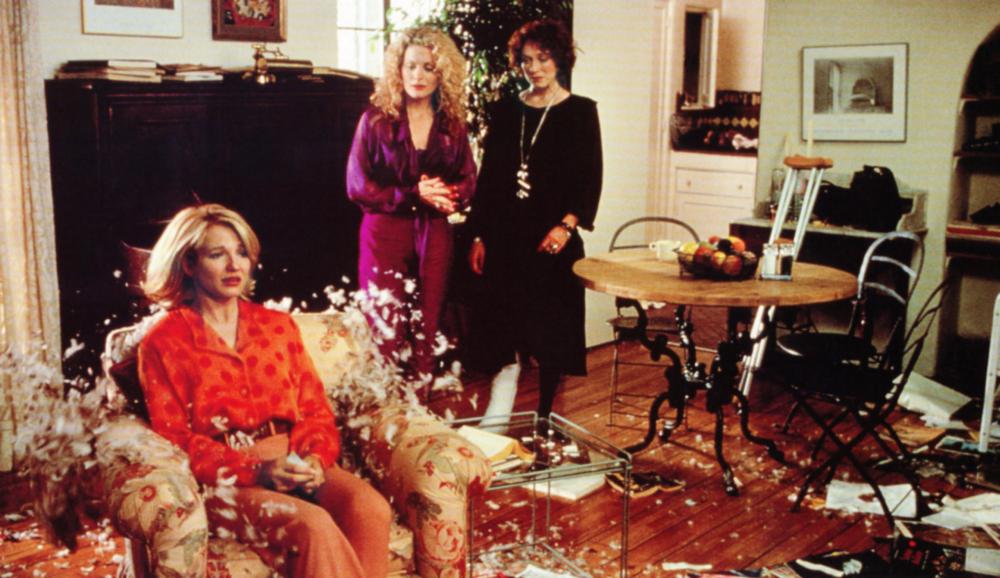
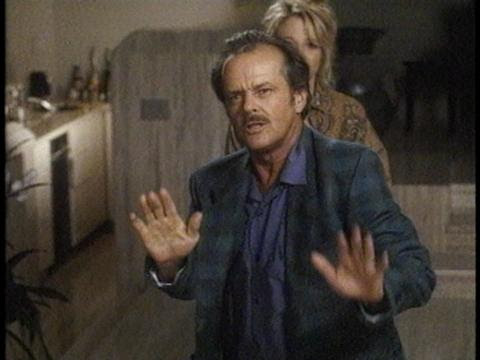
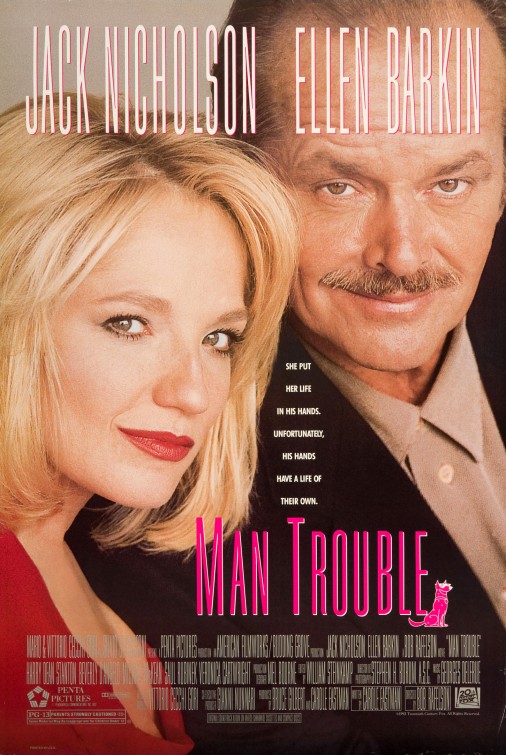
But to go back much further in my own history all this gets me thinking about MAN TROUBLE, a now forgotten comedy the three made together much later on but also one of the first films I ever saw in L.A. back then, my first time at the glorious Village Theater in Westwood. The theater was too good for that film. With over 1,300 seats, it was certainly too big at least for the amount of people who showed up that night. While this marked the end of the collaboration between these three key figures of ‘70s cinema it all came at the beginning of my own L.A. story so, as usual, I missed out on the cool stuff and was far too young to grasp the significance of this so had no real appreciation for how notable this reunion really was. As a film, MAN TROUBLE is, well, not very good. Maybe this is putting it mildly. The film contains promising elements, certainly starting with the people who made it along with a cast that should very well make it bulletproof but almost nothing about the movie clicks and it never develops any consistent tone or rhythm plus for an alleged comedy it contains very little in the way of actual laughs or even charm. There’s a kernel of an idea even in the title, of a woman dealing with all the men in her life and the realizations these conflicts lead her to, but the film never seems to do much of anything with that. Something about it stays with me and I’ll get to the reasons for that eventually but right now all we have is the film, one that does little else beyond serve as a misbegotten latter day collaboration between some very talented people and as a memory from a time in my life that also now feels very long ago.
Classical singer Joan Spruance (Ellen Barkin) has just split with her conductor husband when her apartment is burglarized. Understandably nervous that someone is stalking her, she takes advantage of her sister Andy (Beverly D’Angelo) going out of town to stay at her house and for protection hires a guard dog from a service run by Harry Bliss (Jack Nicholson), currently dealing with a bad marriage. Harry and Joan hit it off, helped by his not mentioning that he’s married, but during all this Joan still deals with threatening phone calls, the strange disappearance of her sister and the realization that a figure the papers have dubbed the Westside Slasher might now be after her as well.
Even looking at it now FIVE EASY PIECES is a remarkable film, a character study that digs deep into the persona that is Bobby Dupea as played by Jack Nicholson and his intense self-loathing, backed up by the phenomenal Karen Black as the girlfriend he treats so terribly. Rafelson provides an intense focus to it all with his direction and the script by Carole Eastman is so incisive in its portrayal of such alienation that its strongest moments, such as the legendary diner scene with the side order of toast being insisted on, never really leave you. Back in those days the writer often went by the pseudonym Adrien (or Adrian) Joyce, with other prominent credits during this period including the screenplay for Jerry Schatzberg’s PUZZLE OF A DOWNFALL CHILD as well as the ‘English dialogue’ for what remains one of my very favorite films, Jacques Demy’s MODEL SHOP. But it’s FIVE EASY PIECES that she’s known for which among other things plays now as one of the definitive portrayals of the onscreen Jack Nicholson persona and all the possibilities of what could really be done in a movie found in the glory days of ‘70s cinema. MAN TROUBLE doesn’t really have much to do with any of those things and even after several recent viewings part of me is still trying to clarify just what it is beyond an attempt at a light, goofy comedy that contains traces of what could be a more intricate character piece if you peer close enough, made by people who are probably more at home with much darker material. At the very least there’s a specificity to the dialogue at times that helps it seem like it’s coming from a personal place, at least on an observational level for the screenwriter, along with a certain low-concept vibe to the setup which at times approaches being charming in a zero stakes way.
This comes especially when the two leads are first sizing each other up while spending an evening out at Yamashiro getting drunk on sake so it’s tempting to say that a movie doesn’t need much more than Jack Nicholson and Ellen Barkin flirting with one another. For a brief stretch Jack feels dialed in to the moment, Barkin gives off that bashful smile of hers and for a few minutes all we have to do is watch them be charming so there’s nothing wrong with any of this. The dialogue allows them to circle each other, wondering if any of this is a good idea, while we know all too well the secrets hanging in the air so there’s a pleasure to them just hanging out and eventually hooking up. Somewhere in all this is a character piece which unfortunately has to give way to a plot that becomes sillier and more nonsensical as it goes on, or maybe it should be referred to as several plots since there’s a few, spending long, baffling stretches on things like blackmail and other secrets being kept to the point that it would be appropriate to ask what any of this is really about, particularly a lengthy hospital sequence in the second hour where some of all this comes together, but not really.
This was Eastman’s first screenplay credit since 1975’s THE FORTUNE which also starred Jack (and Warren too) and was directed by Mike Nichols, a screwball farce that to this day hasn’t been seen by many people and it’s a handsome, expensive looking production that never comes together, maybe notable now because of the production design along with an austerity that was a part of the Mike Nichols approach of the time but that’s about it. MAN TROUBLE is also in the screwball vein although never as ambitious but the pieces never click. Maybe Bob Rafelson wasn’t the right director for this sort of material and much of the time there’s a sense of flailing about a little too broadly, like an overly serious person trying extra hard to prove how funny they really are with an overall feeling to the performances that everyone needs to calm down a little. There are enough odd quirks that feel like if you squint you can make out the general tone it’s going for, like Veronica Cartwright as Joan’s best friend spending much of the movie on crutches with a cast on her leg, apparently due to a lawyer falling on her while sunbathing, and the actress doesn’t even do very much in the film but makes an impression solely by being Veronica Cartwright since this is the sort of movie where certain people are in the movie because, well, they just are. There’s also a certain nudnick nature to the dialogue which at times feels like it’s scrambling around in the dark searching for punchlines which it at least an attempt at approaching a certain irritating charm but while all this gives the script a unique flavor the film barely seems to catch any of it. In his book Matthew Specktor comments on Eastman’s proclivity for odd character names through her films and there is a certain pleasure to monikers like Harry Bliss, Joan Spruance, Redmond Layls and Helen Dextra but it makes me wish there was more to each of them beyond that. It’s an issue of tone and the film never seems to find it, feeling so low on tension that at times the looseness makes it feel like a bunch of friends getting together to make a movie on a whim, the way Jack’s old pal Harry Dean Stanton turns up playing the wealthy boyfriend of Joan’s sister in a role I’m not sure he’s totally right for but, in fairness, it’s not like we want to complain when Harry Dean Stanton turns up in any movie.
Jack is top billed and these days especially it’s hard to complain about a film starring Jack Nicholson but his presence does help diminish the idea of a film being about women’s problems with men, like in the title of the thing. Ellen Barkin makes sense as the lead, a woman who has always tried to use her own intellectualism to talk her way around the inevitable flirting and avoid what she refers to as ‘conflictual situations’ as if trying to rationalize everything in her life only to finally discover that it never made any difference, surrounded by men like the ex-husband played by David Clennon, the nice guy always getting the brush off played by Michael McKean (two more examples of how this should be a film made even better by its cast but that’s not the way it goes) and the new guy in her life who doesn’t even bother to mention that he’s married. It makes all the more sense that she wouldn’t want to be like her self-absorbed, man hungry sister played by Beverly D’Angelo, the sort of person ready to automatically act unimpressed by anyone who dares speak to her. Separate from all this is Harry’s wife Adele played by Lauren Tom who gets one of the big running gags of the film in how he insists on calling her ‘Iwo Jima’, a joke that might not go over so well these days but none of their scenes develop into anything beyond the hostility so any reason why they ever got married, even a comical one, is just left hanging there. Tom, who just a year later had one of the lead roles in THE JOY LUCK CLUB, does manage to give the performance some dignity but there’s still not much to it beyond wondering why any of these scenes felt like a good idea.
It's a comedy from the people who made FIVE EASY PIECES that opens with an animated title sequence which isn’t necessarily a bad sign in itself but it does say something about how maybe these were the wrong creative types to make this sort of movie. When Twentieth-Century Fox released it in July 1992 they didn’t even bother screening it for critics. It stands to reason that Nicholson was demonstrating loyalty to his old colleagues Rafelson and Eastman, and he presumably received whatever his fee was at the time, but the question was why this movie go made and not some of the other unproduced projects mentioned in Specktor’s book. Various stars and directors were attached to the project over the years and in some frank quotes to the Los Angeles Times shortly before release the normally reclusive Eastman insisted that this was never designed to be a reunion and seemed aware that maybe it shouldn’t have been saying, “Bob and I would kiss each other if we ran into each other on the street, but we probably shouldn’t make a movie again,” which suggests there were conflicts on this production that goes beyond anything she would give a quote on. So it’s a valid question why Rafelson chose to make this beyond commercial reasons or just an excuse to work with old pals since his earlier films never really demonstrate much in the way of broad comedy or farce. Time and again there are attempts at laughs which may not have been much on the page but even though you can tell what the joke is supposed to be it still gets fumbled in the timing, one more reminder that Rafelson just isn’t a director for this type of humor, even when it’s a joke that isn’t all that good to begin with. There’s never any real sense of flow to the pacing and with some abruptness at various points in the narrative the film ultimately feels sliced down to roughly 98 minutes to get it over with as fast as possible, which includes rolling the end credits before the final sequence has ended. Also not helping is a score by the legendary Georges Delerue, who died four months before the film’s release, which tries so hard to be ‘funny’ that it takes a tone which is already a little too broad and heightened to start with then pushes it up beyond any reasonable point.
Something like FIVE EASY PIECES or THE KING OF MARVIN GARDENS (not written by Eastman, but just go with it) felt like films that were made by people who had to make them. MAN TROUBLE feels like it was made by people who decided to make…something. And there’s nothing wrong with making a film that doesn’t want to be earth shattering. But it’s hard to find ideas here beyond the broad feminist strokes that would have allowed it to work. Harry shows Joan how to train her dog, she frets about while in the house alone late at night, they hit it off then they don’t but time and again while watching MAN TROUBLE you could ask, what is the point of a given scene? What is the conflict? What is any of this really about? Part of the movie can just be taken as a lark, looking at the way the two sexes deal with each other in a world where ads for slasher movies with women getting hacked up apparently play on TV all the time, but that’s not a good enough answer plus it also comes with a few straight suspense scenes like where Barkin gets terrorized by the stalker coming at her with an ax. Any thematic intents aside, in the middle of such a light tone it feels wildly out of place so once again just raises the question of what the overall tone is supposed to be, another indication that maybe this was a film being made by people who weren’t agreeing on things. It’s hard not to read more into what all this could have been—in addition to focusing more on the women it could have asked the question, what is the Jack Nicholson persona in the 90s? How does that relate to who women are at that point in time? Can he treat them any better than the way he treated Karen Black back in 1970? So help me, in the Me Too era this wouldn’t be a bad idea for a remake, not that there’s much value in the IP. Maybe at its heart is an old school, screwball ‘dog plays matchmaker’ sort of thing but even the dog, much as the characters gets attached to him, never has much presence either.
In my mind it’s like all through the career of Bob Rafelson, from his early Nicholson films (including EASY RIDER which he produced) all the way to the likes of BLACK WIDOW and MOUTAINS OF THE MOON that came later, he explores character through genre and are about people so lost they end up wandering, possibly going too far in the end. There’s no wandering in MAN TROUBLE. Everyone is already where they want to be, right Los Angeles, with one key location right in the heart of Hollywood down the block from Miceli’s (now I want to go over and get their chicken parm). At one point Jack Nicholson even references the main house as being up on Mulholland Drive, a reminder that for all I know he lives right around the corner from where the scene in question was being shot. A few years later, Rafelson reteamed with Nicholson one more time on BLOOD AND WINE which is an enjoyable nasty, if minor, neo-noir that didn’t do much business and didn’t get much of a release by Fox Searchlight even though you’d think the presence of Jack Nicholson would have gotten them to put in a little effort. MAN TROUBLE was a high-profile flop in the middle of summer while BLOOD AND WINE just sort of slipped out unnoticed but it’s definitely worth seeking out if you haven’t seen it. Carole Eastman didn’t write that one but the most interesting similarity is how it also features a Jack Nicholson character in a bitter, loveless marriage (Judy Davis in BLOOD AND WINE is portrayed as more sympathetic than Lauren Tom in MAN TROUBLE, whatever that’s worth) which makes me think of Bob Rafelson’s first wife, Toby Carr Rafelson, who worked behind the scenes with him in a way possibly similar to the Peter Bogdanovich-Polly Platt dynamic during what can really be called his strongest period, FIVE EASY PIECES, THE KING OF MARVIN GARDENS and STAY HUNGRY. Her other credits include working as production designer on Martin Scorsese’s ALICE DOESN’T LIVE HERE ANYMORE as well as Jack Nicholson’s directorial effort GOIN’ SOUTH. So the similarity between the films along with wondering about this history raises questions that MAN TROUBLE is not really substantial enough to answer, even as Joan comes to the conclusion that she doesn’t need to please any of the men in her life and never did. Or maybe these questions don’t even need to be asked. It’s just MAN TROUBLE, after all, which is just a reminder that we were robbed of the promise of what once sounded like a potentially delightful Jack Nicholson-Ellen Barkin romantic comedy, a movie that is, or should be, about finding ways of being intimate through trust and truth. At least, I think that’s what it wants to be.
If it’s a question of tone than part of it has to be the way the actors are directed and how they all go together. There’s an argument to be made that the films where Jack Nicholson sports a mustache (THE LAST DETAIL, THE BORDER, THE PLEDGE) have a little more edge to them, somehow preventing him from falling back on his usual tics but this film doesn’t do much to help that theory. Still, you watch him for a few isolated minutes here you might think it’s a better movie than it is, the way he always seems ready to dive in and look like a crazy person if need be with undeniable glimmers of that sharp coming timing when you least expect it. There are also such glimmers in Ellen Barkin, at her best here when she’s relaxed but at times feeling like she’s not getting the right direction. Revisiting THE BIG EASY recently was a reminder that Ellen Barkin in that film is one of the reasons the motion picture camera was invented in the first place and getting her in another romantic comedy should be flawless but the film around her doesn’t offer the support that she needs. Beverly D’Angelo, another personal favorite now and always, has moments but they seem isolated, never giving her enough of a chance to take over a scene the way her character seems to want to. Maybe the film just needed more of those moments and figure out how to use them, like the way everything stops to let Harry Dean Stanton’s lawyer played by Saul Rubinek compliment Barkin on the time her saw her perform the Battle Hymn of the Republic at the Hollywood Bowl and when he begins singing it himself it feels like the sort of effortless digression the movie could use more of. Paul Mazursky turns up too and, like a number of other actors in the film who maybe aren’t always seen at their best, at the very least it’s nice to have him around for a few minutes.
But to go all the way back to 1992 once again, MAN TROUBLE somehow managed to play for two whole weeks at the Village (23 years after EASY RIDER opened there, which likely interests no one but me). The theater is miraculously still open, although Westwood mostly feels like a ghost town these days when I get over there; the exclusive run of LICORICE PIZZA in 70mm late last year was a nice reminder of how cool it once was to go to the movies in the area. But, and here is where my own memory kicks into place, walking out of the theater that night long ago I fell into a brief conversation with a woman who said she was friends with Carole Eastman and felt so bad about how the film we’d just seen had turned out. I’m not sure any reply I made was that interesting but the very idea of chatting with someone at an L.A. theater who knew the screenwriter was then such a new concept to me and there’s no more to the story than that but to this day I can’t help but wonder, who was this woman? How well did she actually know Carole Eastman? She seemed interesting in our brief talk and for all I know is a name I would now recognize. It would be funny if it turned out to actually be her, going out incognito to see her own movie, but somehow I suspect this wasn’t the case. This is all a long time ago but enough time has passed that I feel bad for the people who made it too. So I’m left wondering about a lot of things, including the writer who is a key figure in the mythology of such an important period in Hollywood history but still remains such a figure of mystery. Matthew Specktor doesn’t spend much time on MAN TROUBLE in his book and it’s not like there’s any reason for him to but after reading it I was compelled to order a used DVD of the film for a long overdue revisit. The day the disc arrived, July 23rd of this year, Bob Rafelson died and may he RIP. It didn’t seem right to put that one on right away so I watched FIVE EASY PIECES first, then followed it with MAN TROUBLE which makes for one hell of a double bill, let me tell you. Does any of this matter? Does MAN TROUBLE matter? Does any of the past thirty years since I saw MAN TROUBLE matter? It feels like an important memory, in ways I can’t even explain, all attached to what is a totally forgettable movie. And yet, I’m forced to remember it. I’m forced to remember all of it. I’m not sure any of this matters at all but as long as I’m still thinking about it I suppose it does. Just like these movies still do. Just like my life.
Sunday, August 7, 2022
Probability and Outcome
Right now, I’m searching for signs of something good in the world. For one thing, there’s this friend of mine who always reports back whenever he sees Warren Beatty out having dinner at sushi places around town which always makes me happy to hear. It feels important to still have Warren Beatty somewhere in Hollywood, after all, even if he’s not going to make another movie at this point. Probably. I mean, you never know, right? Not knowing, after all, can be the definitive answer to what helps fuel an obsession and the feeling of obsession is a key part of certain Warren Beatty films, as well as a key part of his persona and our own attraction to those films. It becomes part of their power. This can even be felt in some of the films he didn’t direct, at least not officially, and helps connect them to one another whether thematically, politically or even emotionally. A line can certainly be drawn from his John McCabe of Robert Altman’s McCABE & MRS. MILLER to the hairdresser George Roundy he played in SHAMPOO, each man with big dreams but little follow through or awareness of how business (and, by extension, the world) really works. You could also go from McCabe building the town of Presbyterian Church to Bugsy Siegel intent on realizing his dream of Las Vegas and their ultimate fates. Even his John Reed and Diane Keaton’s Louise Bryant in REDS as seen in that early montage of creativity and expression during their early Greenwich Village days together is practically replicated in the flashback of Beatty’s Lyle Rogers and Dustin Hoffman’s Chuck Clarke beginning their collaboration in the early scenes of Elaine May’s ISHTAR, which itself leads to an encounter with world politics that attempts to destroy them. This is all for starters and the tone may be different in the films but there’s something about the feeling in them which stays the same, to pursue a dream to the point of obsession. What is life without a little obsession, after all? Beatty himself tends to be cagey about such things in the few interviews he’s given so, like many things in life, we’re forced to figure it out for ourselves.
As a matter of full disclosure, when it comes to one of Warren Beatty’s biggest hits I’ve always been somewhat of an agnostic. 1978’s HEAVEN CAN WAIT, which he co-directed with Buck Henry, has long seemed like something of an outlier to me as the rare Warren Beatty film that was ‘just’ a commercial romantic comedy, a big star vehicle meant to be a big star vehicle. It’s enjoyable, but that’s about all I took from it. Maybe this is a roundabout way of simply saying that except for the resonance of the final moments I felt less of a connection to this one and it didn’t seem to have much to do with any of the others. Simply put, I couldn’t locate the obsession. A remake of 1941’s HERE COMES MR. JORDAN (directed by Alexander Hall, starring Robert Montgomery, Evelyn Keyes and Claude Rains), it’s a slick fantasy-comedy which isn’t all that different plotwise from the film it’s based on beyond substituting football for boxing and while certainly entertaining, there didn’t seem to be much more to it than that. Maybe I just felt lost in all that ‘70s gauze of the cinematography and bounciness of the Dave Grusin score so it always felt like there was a distance. As it sometimes happens, things change. The film played at the TCL Chinese during the 2022 Turner Classic Movie Film Festival earlier this year with Beatty in attendance so I had to be there. And at a certain point during the screening that night the film started to finally click, even if it wasn’t in the expected way. This is a star vehicle, yes, and one that is very much a product of 1978 when it was one of the top grossing films of the year (opening in June, it took the place of STAR WARS at the Chinese and played for a not bad 14 weeks), along with the likes of GREASE, JAWS 2 and EVERY WHICH WAY BUT LOOSE. But it has something that almost none of the others in the top ten of that year have, an awareness of how little certain things matter in life which can lead to a realization of what really does. And when that occurs, an obsession can finally take hold so now when placed alongside those other films, suddenly it all begins to make sense.
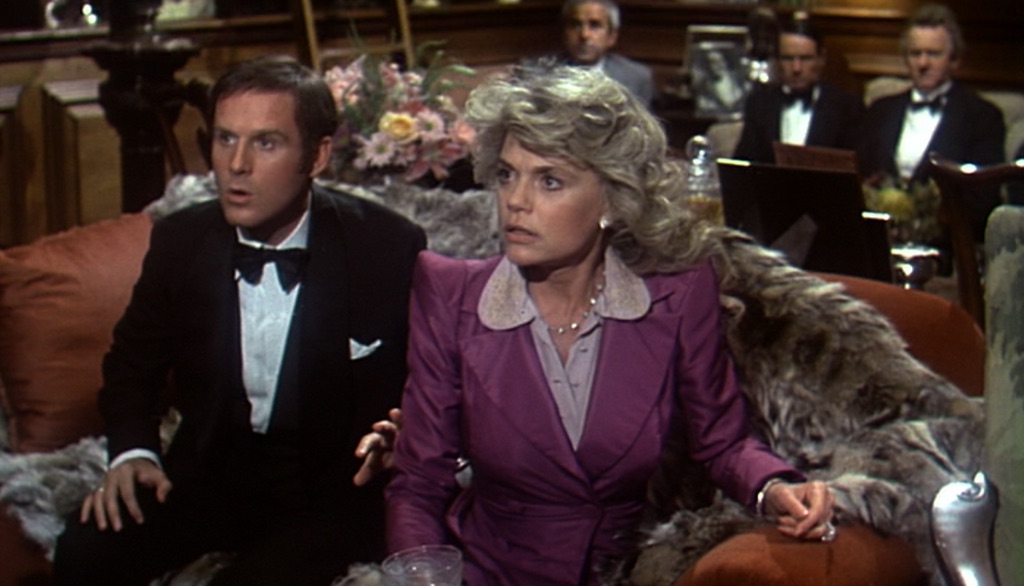
After working his way back from a knee injury, Los Angeles Rams quarterback Joe Pendleton (Warren Beatty) is poised to start again for the team looking ahead to a Super Bowl victory. But his hopes are dashed with an accident while he is out riding his bicycle kills him and sends him to a way station taking off for heaven. His refusal to get onboard forces his escort (Buck Henry) to bring in Mr. Jordan (James Mason), leading to the determination that the escort messed up by removing him from his body a few seconds earlier than he should have from an accident that he would have survived. Searching for a new body since the old one has been cremated, Pendleton and Mr. Jordan arrive at the home of billionaire Leo Farnsworth, an industrialist in the process of being murdered by his wife Julia (Dyan Cannon) and personal private executive secretary Tony Abbott (Charles Grodin) who are both having an affair. Joe shows no interest in Farnsworth until he encounters Betty Logan (Julie Christie), an activist there to protest a power plant Farnsworth’s company is about to build which will decimate her hometown. Agreeing that this is only temporary, Joe takes over Farnsworth’s body, determined to help Betty but he quickly falls in love with her, making him prepared to stick around in Farnsworth’s body which gets him to convince trusted Rams trainer Max Corkle (Jack Warden) that he has what it takes to join back up with the team and help them win the Super Bowl.
Forgetting for a moment my slight prejudice going into this screening, HEAVEN CAN WAIT is a breeze of a film. Every moment remains pure pleasure, a light fantasy-comedy with finely honed characterizations that carry it along seemingly effortlessly but always with a current underneath to add weight to this breezy story. The commitment everyone brings to the comedy gives things an added intensity, aided by dialogue that contains more intelligence, wit and in the long run more meaning than it would otherwise. The movie never transcends what this genre is at the center but it does let the emotion creep in until the end result suddenly resonates more than you would ever have expected and even when this feels restricted by the plot points that have to take place it feels ready to use it all to its full advantage. In a very simple sense, the film does so much right. On a surface level, all of this is true but it’s in the details where HEAVEN CAN WAIT feels most resonant, letting you sometimes dig for the extra layers.
But to also break part of the plot down even more succinctly: A wealthy man surrounded by employees forced to deal with his madness that has seemingly appeared out of nowhere. This could be HEAVEN CAN WAIT, this could be BULWORTH. Maybe some of it is even part of RULES DON’T APPLY. In the case of this particular film it’s almost a sidebar of the main storyline (screenplay by Elaine May and Warren Beatty, based on a play by Harry Segall) which, as far as we can tell for a long time, is primarily about Joe Pendleton’s determination to get to the Super Bowl. It’s all he really cares about at first and this is so important to Joe that he barely seems to think about the greater issue of, you know, his life having ended. Entering Farnsworth’s body does something about the way he sees things even if his motivation primarily comes from his very first look at Julie Christie. Who could blame him, of course, but what this does is set Joe on the right path to actually accomplishing something in this other body that would be good for the world. So while everything he’s saying and realizing makes perfect sense to us, the people around him are simply baffled, suddenly forced to deal with a Howard Hughes suddenly going full Bulworth, if you will.
We never meet Leo Farnsworth and never see what he looks like but everything about him is completely absurd. His oversized mansion, his clothes, the way his servants dote on him, the possibility that he has looked into purchasing Haiti. Of course, these days all this makes him even more believable. When Joe takes over Farnsworth’s body, this puts him in the unique position not to care about any of this so when he begins questioning all these business practices and speaks out about doing better the fact that he’s making sense leads the people close to him to only one conclusion, that he must be totally crazy. Maybe the world is forced to pay more attention to how awful wealthy people are these days but it’s hard not to think about the BULWORTH similarities, another movie about a powerful man going off the rails by speaking the truth which even shares a slightly similar murder plotline, but even if that’s not quite the main thrust of HEAVEN CAN WAIT the message still gets across. When Joe-as-Farnsworth publicly announces at a board meeting that he’s putting a stop to the plant that will destroy Julie Christie’s small English hometown, it becomes secondary to the real point of the scene which becomes the big speech he makes to the increasingly baffled board of directors about how they’re going to have to spend more money in the future to do things right. The money doesn’t matter and they’ll get it back anyway, what happens based on what they’re doing is what does. Thinking about the long game instead of the quick win that these businessmen only care about, Joe is about focus, his mind always on training as he drinks those health shakes, his body ready to take as much pain during that scrimmage as necessary to prove himself, and he’s been so focused on that he’s realizing what’s going on around him for the first time even though he isn’t himself anymore. That bouncy Dave Grusin music doesn’t even come in for the first few minutes as if to indicate how the determination in Joe’s head doesn’t have space for anything else. In doing all this he’s simply applying what he knows to all this just as he plays the one tune on that soprano saxophone repeatedly, not because he’s any good at it but as a Zen sort of centering thing.
The movie feels centered too and it has that seventies naturalism in the air to set it apart from the film blanc stylings of the original, right from the opening shot looking down on things that could be Mr. Jordan’s point of view as he waits for Joe to arrive and even the relatively simple visual layout of the way station where Joe is first brought has a simple elegance that goes perfect with the approach. The pleasures of HEAVEN CAN WAIT are numerous but come especially from the extra sharp wit in all that dialogue which presumably can be at least partly attributed to Elaine May, if not Beatty, but then again maybe Buck Henry, who knows? Every moment of Charles Grodin and Dyan Cannon bickering is priceless and Grodin’s “No, before. Outside. But she relives it,” about someone just having seen a mouse sounds like a line written by Elaine May if there ever was one but, whoever was responsible, this is a moment that belongs in the Smithsonian. And everyone is good in this movie, bringing to their parts an intensity that balances with the lighthearted nature to the storytelling. For that matter, so much of the comedy particularly the bedroom stuff may be nothing new but it’s still done so expertly thanks to the shrewd playing by the actors who know just what the timing needs to be for the laughs. It always feels like Beatty is fixated on the logic of it all as much as possible, whether the depiction of the way station Joe arrives in or to account for Joe still seeing himself in the mirror and not whatever Farnsworth looks like, always looking to talk things out so the plot makes as much sense as it needs to, along with using the idea of probability and outcome to break the plot down for Max in the same way.
Through it all is the issue of what the film has an interest in spending time on. The longest film that Beatty has ever made is REDS which, at 195 minutes, was always meant to be an epic anyway. Many of the other films he produced or directed don’t even hit the two-hour mark and HEAVEN CAN WAIT moves like a rocket at a trim 101 minutes, even if it is seven minutes longer than HERE COMES MR. JORDAN. And it doesn’t need to be longer than that, it always has a purpose so each moment counts, pacing that feels like the equivalent of Joe racing from one part of the giant mansion to another while still getting all the necessary plot points in. At a certain point it’s almost like the film becomes about the very act of watching Warren Beatty run. But it still finds a way to pause for moments of weight and lyricism like Joe emerging from that well, Mr. Jordan waiting to lead him on, so once again it’s the Dave Grusin score which makes this moment all the more resonant, providing the lyricism felt when these dreams appear to be snatched away from Joe. The speed picks up even more for the last twenty minutes where it’s as if the only things in the movie are either necessary story points or business by the actors that Beatty likes too much to cut so if Vincent Gardenia’s investigating police lieutenant had any long expository speeches they were dropped because, well, who cares? What it doesn’t do is spend more time on stuff than it needs to so the resolution of the murder investigation and the Super Bowl victory all go by so fast you could almost sneeze and miss them. It’s the emotion the film dwells on that becomes important, even as Joe in his new body as the quarterback apparently both throws the winning play and scores the touchdown which is a pretty neat trick, you have to admit. Just as it took its time earlier on for certain moments with Julie Christie and Jack Warden, the final moments pause to just hold on Jack Warden realizing that Joe is really gone, sitting there and holding his instrument. And the final scene with that way Julie Christie looks at him, that connection found in the eyes once and for all, knowing and not knowing all at once is all that we need to understand.
In spite of all this, for much of the time the inherently lightweight nature of the material can’t be avoided which maybe has something to do with my mental block to the film for such a long time, wondering why Beatty had been attracted to this sort of thing. But it knows how to find just the right moments that pop which shows that he found a way to connect with it and really say something about the transient nature of it all. In this film made by the Gulf & Western subsidiary Paramount, he saw the way such conglomerates were beginning to swallow things up, asking why such people exist in the world and what they really care about, anticipating his next film REDS or even the way Rogers & Clarke of ISHTAR deal with being marked for death by those in power and at times HEAVEN CAN WAIT is just as political, just as aware of what the ultra-wealthy are doing to the world during this present day we’re living through where an entire political party is about nothing more than hate and ugliness and attaining power, solely about making this world a worse place for people. The totem of that saxophone is the one thing Joe carries with him, a symbol of his spirit and in the end is left with the one person who will remember any of this. Football seems to be all about being the best to him but when it comes to that instrument it’s done just for the pure pleasure of doing it so it doesn’t matter how lousy he is. It only matters that he plays it. “I’ve got poetry in me,” John McCabe famously mutters to himself in his movie and through the soprano saxophone which turns into the totem of the film representing him (Beatty’s Howard Hughes in RULES DON’T APPLY plays an alto, which is close enough) is like Joe Pendleton’s poetry that he can’t express otherwise, even when alone with Julie Christie.
We think of Warren Beatty as this legendary movie star, hugely successful for decades and living at the top of the world somewhere up on Mulholland but every main character he plays in his films has only so much power in the long run just like any of us do. Sometimes they die, sometimes it’s a more spiritual death as they become irrelevant to the world around them. Sometimes the connection with a woman in his life gets made, sometimes it’s cut short. The ultimate question of this movie, or just about any Warren Beatty movie, seems to be asking how are you going to live your life? What do you want to achieve and leave behind in the end? Do you only care about money or really doing something to enrich yourself and others? This is the rare Warren Beatty film that isn’t about sex much at all even as a metaphor, so in that sense it really is an anomaly, and the main characters never even kiss which makes sense at the end since the two people in question have just met, or so they think. Instead it’s a connection, one that the characters played by Warren Beatty and Julie Christie in SHAMPOO couldn’t make in the end. “We’re not dead yet, that’s the only thing that’s too late,” he tells her on that hilltop in Beverly Hills, a few moments before watching her drive off with Jack Warden in the final shot. The ending of HEAVEN CAN WAIT seems to find a way around that idea, giving Joe Pendleton a rebirth he never knows about from a life he no longer remembers. “There’s nothing to be afraid of,” becomes a key phrase that gets repeated and becomes the lynchpin for the whole film, maybe for all of Beatty’s films, so the message is simply look someone in the eyes to see what’s in there and we get to see the two leads of this film go off together, not afraid. Which is all that really matters. The rest of the world is just a bunch of people worried about ‘profits’, to use the famous line in REDS. All this may be written, as Mr. Jordan infuriatingly keeps saying, but our own arrival date—like 2025, the date Joe was originally supposed to die—is closer than we think. So don’t be afraid, which is something I’ve been wishing lately that I’d remembered on a few occasions in my own life. HEAVEN CAN WAIT was nominated for nine Oscars, winning only for Art Direction, and it may never be the Beatty film I return to the most, not the way I’ve watched the likes of SHAMPOO almost compulsively at times, but right now along with a new appreciation of all that dialogue I’ve found the yearning in it. The drive of obsession becomes clear.
Coming midway between the releases of SHAMPOO and REDS, this is Warren Beatty at his movie star prime with all the confidence in the world and expert comic timing to every response he makes. The authority he brings to that tone lets the story build so when he fights with Mr. Jordan about Betty you can feel how this is all no longer clinical to him and it gives the film all that feeling. That emotion is felt every time he looks at Julie Christie and if you believe the various Peter Biskind books covering Beatty that say Christie had no interest in doing this but when you compare this to other roles she had played in the ten years leading up to this there’s not much to see since she’s basically The Girl. We’re meant to fall in love with her just as Joe does and that’s exactly what happens. But Christie brings such gravity and intelligence to every scene she’s in that it makes her role, and the entire film, work. She makes it all matter. That emotional feeling matches up nicely with the calm provided by James Mason, always smiling at Joe, always understanding towards him when he can’t anymore even if he can’t say why. What Mason does allows us to see what Mr. Jordan is doing, letting Joe make the decisions but still taking him along for what we know has to be. Buck Henry’s own coming timing with every ounce of his disbelief up against them is perfect but it’s the pairing of Charles Grodin and Dyan Cannon that provides some of the biggest laughs, Cannon appropriately a force of nature in every moment she's onscreen but the deadpan provided by Grodin is equally priceless as he tries to piece together what the hell is going on, offering some of the greatest pleasures to pick out in the corners of the frame. It’s the people around him as they react, even some in small roles, who also bring that weight to it, the likes of Joseph Maher and Hamilton Camp as a few of the servants backing up Beatty while getting laughs of their own and Beatty’s own double take at Camp’s servant stifling a laugh at one point is an awesome thing to see. But through all this it’s Jack Warden who becomes the real heart of the film right from the start, playing the only person who really knew Joe and knows what’s being lost. It leads to not just the joy coming from his expert coming timing but also the most truly emotional moments in the entire film all the way up to the last time we see him. As the years go by this becomes one of the actor’s most endearing performances of his long career.
Warren Beatty has made so relatively few films over his long career that it’s hard not to think of each of them as being part of some sort of strange overall narrative personal to him even if there are some where we have to dig to find the meaning. Whether I feel the need to look into DICK TRACY or LOVE AFFAIR next, who’s to say. In search of that meaning in HEAVEN CAN WAIT, the post-film discussion with Ben Mankiewicz that night in the Chinese at the TCM Classic Film Festival didn’t really shed light on very much but it makes me wish for the chance to talk with him where he wouldn’t have to be on the record about anything and simply hearing him refer to McCABE & MRS. MILLER as “an interesting movie…for several reasons” makes me wish for a lengthy elaboration of some kind. There was also talk of wanting the likes of Muhammad Ali and Cary Grant to star early on, probing how the football scenes where he gets knocked to the ground were shot, faking the Super Bowl during an actual Rams game as well as if he would ever write a memoir. When the subject of Julie Christie was brought up he simply answered, “Are you delving into my personal life?” You can watch the whole thing here and, I swear, I’m pretty sure I can be heard cheering in the crowd at the end although I’m not claiming that he answers all these questions. I didn’t expect him to. But there’s always the hope that I’ll see him at some tiny sushi place in a strip mall one of these days but even if this happens I promise I won’t bother him. As the two leads walk off into the darkness at the end of HEAVEN CAN WAIT we know that their story isn’t over, just like in our own lives we sometimes keep walking and if we say that one meaningful thing maybe a certain someone will walk with us. Maybe that idea is just a dream, but maybe it’s all we can do. One other question Ben Mankiewicz asked Warren Beatty was if he plans to make another movie. The answer, of course, was, “I don’t know.” Sometimes that’s the best response for anything in this world. Especially when deep down we already know what the answer is.
Thursday, June 16, 2022
More Important Than Power
Films of the ‘70s are often filled with so much darkness and cynicism that it can be almost impossible not to romanticize them out of proportion. Sometimes that’s just the sort of thing I need to watch late at night, maybe now more than ever. In that scrappy, old-school, shot-on-celluloid way those films put us right in there in the middle of what the mood was and the best of them can reflect those times in a way that feels like it would be impossible to do now. Even genre films of that time manage to face the uncertainty in the air head on and that’s why they remain potent today, whether classics like THE FRENCH CONNECTION, or less reputable titles along the lines of DEATH WISH as well as some that have achieved latter day appreciation such as the great NIGHT MOVES or THE FRIENDS OF EDDIE COYLE, but there are others that have continued to slip through the cracks. Maybe that’s also part of what I’m looking for late at night when I put these things on. Even the ones that have happy endings, and there aren’t many of them, can be upsetting. In a strange way that uncertainty helps get me to sleep, as a reminder that things haven’t changed very much.
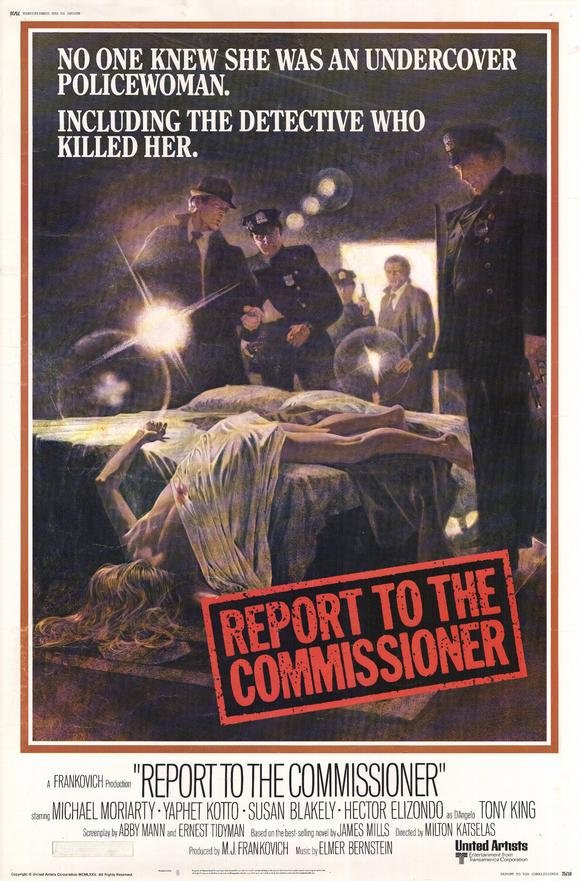
There’s also something about films released around 1974-75 that can feel like they reflect a society nearing the breaking point during the time of Watergate as if to see how far they could go in reflecting that cynicism in the air. Even JAWS, which turned up in the summer of ’75 and famously changed everything, offers the aura of conspiracy and cover-up to balance out the brilliance of its popcorn thrills. Released earlier that year, REPORT TO THE COMMISSIONER is all about conspiracy and cover-up leading to the individual damage that irrevocably causes, and even if it doesn’t live up to the best cop films of the era still has moments that contain a punch in its look at the intensity of city life in the mid ‘70s. This isn’t a very well-known film now and the file folder nature of the title could be the reason or maybe it didn’t make enough of an impression when it was new but maybe it’s also missing something that makes it stand out from the crowd, the way even something like the strictly so-so THE SEVEN-UPS still contains one of the best car chases ever smack in the middle. In fairness, REPORT TO THE COMMISSIONER has a few particularly memorable sequences but maybe the most interesting aspects are found after digging a little further into it, some of them documentary in nature even when the action kicks into gear along with some sharp character work throughout. Plus the film definitely offers the feel of what it was really like to stand on a Manhattan street corner back in the ‘70s, a reminder of how messed up things were in those days and maybe how messed up they are now too, more than I want to think about sometimes. It’s also interesting because of what it focuses on and what it doesn’t. The right decisions don’t always get made, after all. That’s the way it was then, that’s the way it is now.
The shooting death of a female NYPD undercover officer has the commissioner insist on an official investigation with a full report to be delivered to him without any cover-up. The case focuses on Detective Bo Lockley (Michael Moriarty) who as seen in flashbacks has recently begun his job at the NYPD as an undercover detective. The son of a former detective, it immediately becomes clear how wrong he is for the job while he is shown around the Times Square area by his partner, the much more seasoned Richard ‘Crunch’ Blackstone (Yaphet Kotto). What Lockley doesn’t know is that one of the young girls he spots out on the street is ambitious undercover cop Patty Butler (Susan Blakely) going by the name Chicklet out on the street, with a particular interest in a heroin dealer named Stick (Tony King) and looking to move in with him to get closer to his operation. But when the department has Bo look for Chicklet as a missing person to keep her cover going without being told who she really is, the two worlds collide, leading to the disaster we know is coming.
The flashback structure of REPORT TO THE COMMISSIONER that largely makes up the first half lends a complexity to the storytelling but even when things feel unclear or a little too familiar after so many other ‘70s cop movies there is often an energy and sense of seriousness to the approach. The film was directed by Milton Katselas whose other films include 1972’s BUTTERFLIES ARE FREE but he also worked on the stage, with credits that include the original off-Broadway production of Edward Albee’s THE ZOO STORY and later was a somewhat renowned acting teacher who founded the Beverly Hills Playhouse. Maybe appropriate for a theater director, here he often seems largely interested in both behavior and the physical presence of people in relation to each other, along with at times making a close study of people’s faces as they absorb information the very point of certain scenes. BUTTERFLIES ARE FREE was an adaptation of a Broadway play he also directed, largely set in a single apartment, and there’s a similarity felt to the blocking here during certain interiors like in crowded squad rooms that feels covered in a standard, if not restrictive, way as if some of these scenes would be played exactly the same on the stage but at times feels too constricted within the frame.
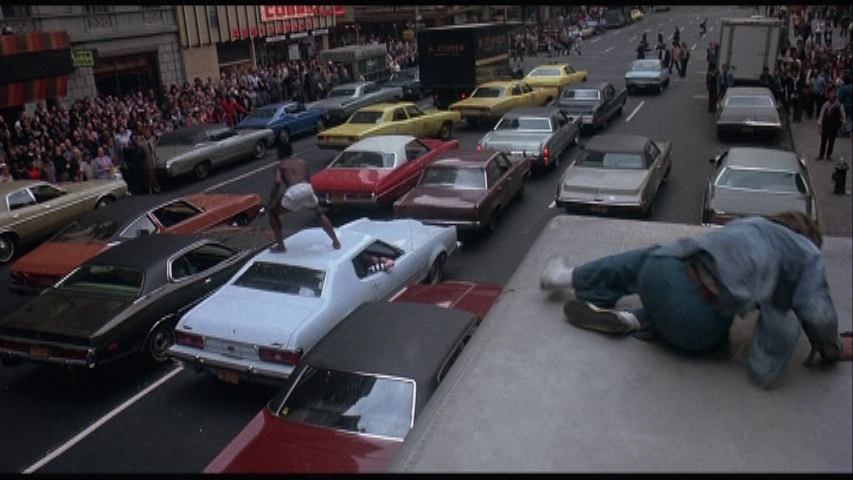
In comparison, some of the location shooting in the heart of Times Square features handheld camerawork that is downright aggressive at times (cinematography by Mario Tosi who also shot CARRIE and THE STUNT MAN, as well as the KOJAK pilot THE MARCUS-NELSON MURDERS), as if parts were ghost-directed on the run by Larry Cohen or somebody else who knew how to shoot in the middle of crowds and traffic without anyone realizing. Other scenes, particularly one foot chase that moves from the roof of the Winter Garden Theatre down into Broadway traffic, feature crowds of people in full view on both sides of the street presumably watching the filming since they couldn’t close off the street entirely, but it still helps add to the immediacy and verisimilitude of shots, giving the impression of a city so crowded that it’s practically about to burst. It may not be the point but the visual is so intense that it’s not even a bad thing. This comes a year before TAXI DRIVER which shot in some of the same locations but unlike that film which through its brilliance shows us all the depravity through Travis Bickle’s eyes this one puts us right down there in the middle of the sidewalk, not quite documentary style but still very intense in its more straightforward way, with handheld camerawork that gives it a much more frenetic feel as if someone might knock us over and take our wallet at any moment. It’s a look at a New York that appears to always be on the brink with enough great footage of Times Square that makes me dream of hanging out at the Howard Johnson’s for a while but there’s also glimpses at some of the movies that were playing—CLAUDINE and BLAZING SADDLES are prominently spotted on marquees in a number of shots along with THE GREAT GATSBY which also has two separate giant ads overhead; looking up release dates I’m guessing the location filming happened around April-May 1974. All of this is completely incidental to the actual film, of course, but it’s a good indication of how naturalistic parts of this film are yet still totally alien to what we think of as New York these days. It would be too dismissive to say that one of the most appealing things about this film is the look at the way Times Square was but it’s hard not to dwell on it a little.
With a screenplay by Abby Mann and Ernest Tidyman based on the novel by James Mills, the fairly complex flashback structure of the first half makes it a little difficult to keep track of things but maybe it’s the sense of familiarity how some of this feels like ‘just another cop movie’ that’s the bigger issue. The focus is more or less on Michael Moriarty’s new undercover detective Bo Lockley who enters the movie frazzled and never entirely settles down making it hard not to imagine the part played in more of a low-key Pacino mode. It’s tough to take at times but to his credit the actor never makes it about vanity or turning this into a star role, as if the body language coming from the performance is saying that even he’s not quite sure what he’s doing in this movie. His backstory comes with guilt over a brother who died in Vietnam and a father, never seen, who was once on the force but it never quite registers as much as it should and neither does talk of how he’s meant to be a modern cop placed out there on the streets by the department, contrasted with his older, wiser partner played by Yaphet Kotto who has no compunctions of smacking down a pimp right out there on the street. There’s just enough of the pairing to make me wish there was more, each talking around the other and not hearing what they’re saying but some sort of mutual admiration thing happening between the two regardless. In a way Moriarty’s performance comes off as so unhinged and out of place that it becomes the very point so Kotto looking at him in disbelief that response makes perfect sense.
All of this is well-played by the actors but just a little too familiar at times which means when the narrative moves over to the undercover cop Chicklet played by Susan Blakely, the switch hits the film like a shot of adrenaline. Right away there’s an additional energy and she’s a stronger, more compelling character. Blakely isn’t the lead of the film and the way the story plays out unfortunately she can’t be but it’s hard not to wish there could be more of her. She knows what she’s doing and why, a woman with clear-cut motivation as well as a cop who just wants to do her job and under the most dangerous circumstances imaginable if necessary. Maybe there isn’t much more to it beyond a sense of pure and total ambition but she has agency and is one of the few characters in the film who never seems conflicted. She wants to do the job no one else wants to do and she wants to do it better than anyone which means the men around her are all completely baffled by this independent woman. Even after everything has gone wrong though no fault of her own they still can’t think of portraying Butler as anything more than a girl who might have been caught between two guys, using her to cover their own ass. It’s a drawback of the film that in the end she feels more like a plot device than a character but Blakely brings enough to the performance to help overcome this, revealing multiple layers particularly in those moments when she’s suddenly forced to drop the act so we know she’s not kidding around. Even the way she’s framed at times with the color red lighting her face that signifies the danger she’s seeking out becomes one of the films most striking visual flourishes, setting her apart from all the other cops who are unwilling to take this sort of chance. It’s a character at once unknowable and more than anyone else in the film a figure of strength even if she has her own seemingly unfathomable reasons.
The skeezy, dirty vibe feels grounded in a way that sets it apart from the delirium of TAXI DRIVER and the the investigation plotline of the middle section offers tangents that pop up frequently including a sequence with Richard Gere, in what appears to be his first film role, playing a confident pimp that gets in Lockley’s way as well as a completely unrecognizable appearance by the great Bob (credited as “Robert”) Balaban as a homeless double amputee who wheels himself around, leading to an extended scene where he wheels himself out into traffic tailing someone in a cab that looks genuinely dangerous in a few shots; this is one of those places where the plot beats don’t quite add up but it’s still fascinating to watch. The nightclub scene where Lockley tracks down Chicklet also has a propulsive nature with the Vernon Birch’s “Changes (Messin’ with My Mind)” on the soundtrack that gives an ominous feel. It’s in some of these moments that helps REPORT TO THE COMMISSIONER stand out with a unique approach that always adds to the seriousness.
That feeling largely holds throughout but the film possibly needs more juice when the points are being made and some of the energy coming from that camerawork out on the streets could maybe have been applied to the interiors as well. At least some of this is grounded by the strength of Yaphet Kotto’s presence and though the script’s reason for why Crunch is so fond and protective of Lockley never feels fully developed beyond once knowing his father the actor sells it even if he disappears a little too long from the middle section. Between the close quarters interrogations probing the coverup plotline and all the Times Square footage it feels like the directorial approach wants to be the illegitimate child of a Lumet procedural (SERPICO is spotted on another marquee in Times Square) and Friedkin intensity but can’t find the middle ground so there’s a level of energy missing that doesn’t quite connect the two tones. The big foot chase through the streets with Moriarty pursuing Tony King clad in nothing but his underwear which finally ends in a Saks Fifth Avenue elevator is exciting, faulty geography aside, and, once again all the signs of New York life around them is definitely part of that. But the blaxploitation-type funk riffs in the Elmer Bernstein score feel like they’re in the wrong movie, ignoring the weight of the moment and another sign that the film is not quite hitting what the grounded mood should be.
Much of the final third is made up of the standoff between cop and drug dealer, trapped together in a Saks elevator which is effectively filmed to emphasize the close quarters aspect. The suspense is presented as soberly as possible with no TAKING OF PELHAM ONE TWO THREE wisecracks to be found, instead focusing on the big speech by Tony King as Stick which lays it all out. “It’s them and us,” is the big statement he makes, that the two of them trapped there together places them against all the cops on “their own side” who are really in charge. This is pretty much the only part of the film where this character so many people have been talking about gets any substantial dialogue and he’s given more strength to his actions than the nominal lead gets here, another reminder that this is a film without a typical hero which is both admirable and yet keeps the audience at a certain distance; to use our modern-day parlance it’s not really a movie with an identifiable lead for us to latch onto. Moriarty’s character is too unstable, Kotto is too cynical, Blakely too out on a limb for the men in charge to know what to do with. In the middle of all this it’s the drug dealer (along with indications that he’s some sort of black militant gun runner which are never made clear), who in other films would be portrayed as more of an outright bad guy, is the one who seems the most level-headed of anyone one of the most daring ideas in the entire film. Naturally, there’s only one thing the cops in charge know to do with someone like that.
The plot feels overly dense and a little undernourished all at once but still runs on too long in the second half with the department store standoff’s tension diffusing past a certain point. The flashback structure (presumably taken after the book which I haven’t read but apparently told its fictional story in the form of police reports and interview transcripts detailing the case) feels necessary in order to lay things out in a clear and concise fashion but it also causes what is likely the most dramatic event of the film to be brushed over quick so the tragedy is barely registered in the moment it occurs. All the men around Blakely’s Pat Butler seem to be intimidated by this woman, her commander talking more about her good looks than anything else, and even Lockley can’t quite explain why he was so determined to rescue her. But the film seems more intent on the overall nature of the Watergate-era cover-up which is at the heart of it, the cops in charge willing to give Bo up as a sacrificial lamb, even when he still has no idea what really happened, and when the right decision does get made near the end it’s too late. The way the plot is laid out forces the aftermath to wind down rather than build to a real dramatic conclusion so the last few scenes sputter out as the investigation fizzles. In a nutshell, stuff gets fucked up thanks to people who are trying to cover their own asses and there’s nothing anybody can do. There’s been no real point to any of it and nothing can even really come up the titular report since it would cause too much of a stir. When the end finally comes, the shock doesn’t register as much as it should and it feels like all we can do is shrug. It feels like the movie does too. That’s how defeated the final moment is. There aren’t any answers left for it to offer so maybe the somewhat sensationalistic credit in the end crawl (which seems to use the GODFATHER font, oddly enough) acknowledging “all the men and women of the New York City Police Department whose names cannot be revealed” says all that it needs to.
But through all that messaging are standout moments that stick in the brain afterwards. There’s a skill to the direction that lets the tension build in individual moments like Susan Blakely facing the camera/interviewer so sure in what she’s doing, Michael Moriarty tapping on the glass of the phone booth as she makes a call, Bob Balaban desperately holding onto the back of the taxicab, the close quarters feel of that elevator. These are the moments that tell the story in a way that hold the suspense together even if the larger details get somewhat lost in the moment. REPORT TO THE COMMISSIONER frustrates but it’s still fascinating in what it presents whether the character detail or the look at the city at that point in time and it has moments that are even better than that, a well-made film that has the courage of its convictions even when things get somewhat muddled. Frankly, anyone who is always looking for that other ‘70s movie would want to see this for the genre for the tone, for its look at dirty old fun city New York. It’s a cynical worldview that has aged in a way that makes sense. Those in power can do whatever they want which we knew all along. In the end, it’s not about making a difference or even being the one in charge. It’s just about filing the paperwork to move onto the next thing.
At times Michael Moriarty (do not, under any circumstances, take a drink every time he says “Chicklet”) seems genuinely unhinged and the very idea of underplaying a moment has never occurred to him but his strongest work comes near the end when his confusion becomes palpable during official questioning and he realizes that no one is going to help him, as if the actor has been in his own world the whole time and is just now realizing what movie he’s in with that jittery method thing feeling more like the actor responding to the more confident stylings of all the other actors he’s playing scenes with. This includes Yaphet Kotto who plays each moment totally confident with his body language which doesn’t ignore the cruelty he’s capable of but just the way he walks brings a lived-in feel to his every movement. Susan Blakely is particularly effective as the undercover cop so much of the plot swirls around, showing several sides of her character at once. Her performance is as fearless as her character, making me wish the plot could somehow revolve around her more, or at the least getting me to imagine the nonexistent movie where she gets to be the lead.
Playing The Stick, Tony King doesn’t have a long list of credits (formerly of the Buffalo Bills but also in films like SHAFT and SHARKY’S MACHINE; later he joined the Nation of Islam and changed his name to Malik Farrakhan) but he’s imposing in just the right ways particularly during his scenes with Moriarty. He is the one who gets the film's big speech, after all, and for these few minutes it all just about comes together. It’s particularly amazing to watch Bob Balaban as the legless Joey Egan, not just because he’s totally unlike any other performance by him but he seems downright possessed at times, a madness present in his eyes that for whatever reason makes helping Lockley the most important thing in the world when he’s asked. Richard Gere offers some nasty cockiness as the pimp who gets on Lockley’s bad side while even the middle management cops played by the likes of Hector Elizondo and Michael McGuire (lots of credits but maybe most recognizable as Sumner Sloan, the professor who abandons Shelley Long’s Diane Chambers in the pilot of CHEERS) are well drawn in their own levels of pettiness. The likes of William Devane (just like in McCABE & MRS. MILLER, he’s a lawyer who turns up for one scene during the last half hour), Stephen Elliott as the titular commissioner (he was later the police chief in BEVERLY HILLS COP but also played the commissioner in the previous year’s DEATH WISH) and Vic Tayback are in there as well. And, let’s face it, this is exactly the sort of movie that needs Vic Tayback’s sweaty combover.
At one point Bo Lockley recalls his father telling him that responsibility is more important than power but this is a film where almost no one takes responsibility, or at least not the people who need to. All of this seems very familiar in the world we live in right now. Maybe one of the more surprising things about REPORT TO THE COMMISSIONER is the PG rating complete with language that includes the n-word, plenty of violence and even some brief, if distant, nudity. But things were different in the ‘70s. And this is a film that’s worth seeing, so here’s a look at the trailer. There are echoes of neo-noir found in all this fatalism but it also feels like a natural part of the ‘70s weariness. And now, in 2022, the theme of cops fucking up, especially the ones in charge, seems more timely than ever. But this is just one of those things I’m looking for late at night. At least films like this don’t pretend things are better than they are. And that’s one way to get to sleep.
Subscribe to:
Posts (Atom)