Thursday, May 31, 2007

A Million Years


There’s something wonderful in the simplicity of seeing Ben Gazzara sit down for a conversation with Gena Rowlands. Or Bob Hoskins playing a scene with Fanny Ardant. Or the sadness in Catalina Sandino Moreno’s face. Or the confusion in Steve Buscemi’s.

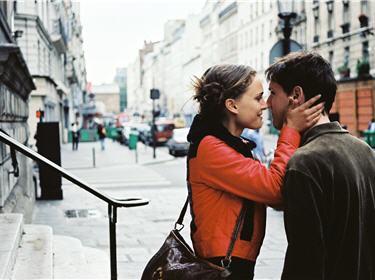
So are the pleasures of PARIS JE T’AIME, a collection of eighteen short films which focus on the concept of love, various kinds of love, in Paris. The directors include the Coen Brothers, Gus Van Sant, Alexander Payne, Olivier Assayas, Tom Tykwer, Wes Craven, Alfonso CuarĂ³n, Richard LaGravenese and other talents from around the world. Actors who turn up also include Natalie Portman, Elijah Wood, Miranda Richardson, Juliette Binoche, Willem Dafoe, Nick Nolte, Maggie Gyllenhaal and other talents from around the world.

Comprised of pieces that run about 5 minutes, many of them have a playful feel with very few pretensions involved. While many omnibus or anthology works are pretty hit and miss, much of PARIS JE T’AIME is surprisingly effective for a variety of reasons. Well, not the whole thing—for starters, there’s a piece about a mime. Fortunately, it’s not that long. There’s also one directed by Christopher Doyle and for the life of me I couldn’t tell you what it’s about. I bet very few others could. That one ends pretty quickly as well.


A man sits in his parked car, thinking about how he will forever be single, when a woman faints next to the car. A distraught woman tries to come to terms with the death of her young son. An immigrant leaves her baby behind as she goes to her job where she takes care of the baby of her rich employer. A man is about to tell his wife he is leaving her when she reveals she has been diagnosed with a terminal illness. A long-married couple meet for a drink the night before their divorce papers are going to be signed. A young man gets a call from his girlfriend which causes him to go over the entirety of their relationship in his head in rapid succession. A middle-aged single woman from America visits Paris for the first time and achieves a small but significant realization about herself.

That last one is directed by Alexander Payne and it’s a near-perfect encapsulation of some of the themes in his films. Feel free to consider this the new Alexander Payne film; the woman is played by familiar character actress Margo Martindale, who is quite amazing.


There are many other delights found here. The Coen entry, which stars Buscemi, is the one flat-out comedy of the bunch and it’s a riot. The sequence with Gazzara and Rowlands (she wrote it;Gerard Depardieu, who also appears, co-directed) is a pleasure just from watching the familiarity the pair have with each other combined with the awkwardness of what they’re clearly not saying. Cuaron’s, which stars Nick Nolte and ends with a tiny twist, is filmed entirely in one take. The best entries of PARIS JE T’AIME are simple, understated and ultimately elegant.

While a few of the pieces feel slightly under-nourished due to their brief running times, their cumulative effect resulted in my feeling a small bit of transcendence once PARIS JE T’AIME wound to its closing moments and I was sad that it was ending. The freedom some of these directors clearly felt by working under these tiny conditions is infectious and some of the entries, particularly Payne’s, deserve to be ranked among their best features. Here’s hoping that the future will bring us ROMA TI AMO.
Tuesday, May 29, 2007

Transformation

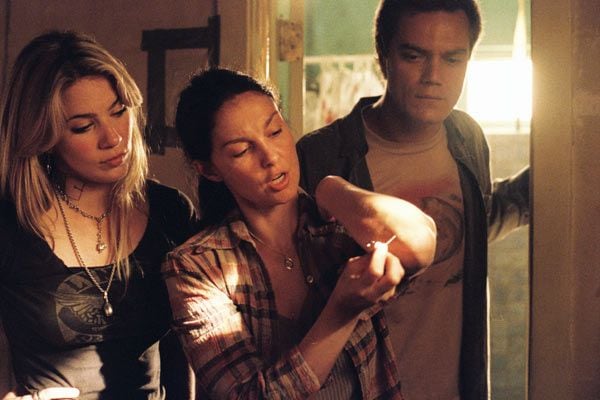
It’s nice to know that William Friedkin is still totally batshit. I give points to Lionsgate for releasing BUG in 1600 theaters and pushing it as a horror movie about people who get attacked by bugs. Ha! Nice one, Lionsgate. Way to tick off horror fans out for gore on a Saturday night. Ashley Judd plays a woman, several years out of an abusive marriage, living in a rundown motel and drinking too much cheap vodka as she waits tables at a local lesbian bar. A friend introduces her to a guy (WORLD TRADE CENTER’s Michael Shannon) seemingly drifting through town as her ex (Harry Connick, Jr.) reappears, freshly paroled. Judd and Shannon, two lonely people, begin to establish a connection, but he starts to notice what he believes to be a bug infestation in her motel room. It’s based on an Off-Broadway play, so maybe expecting massive bug attacks to occur shouldn’t be the way to go. Not a horror film, but in fact an increasingly claustrophobic tale of mental instability, BUG doesn’t entirely work but it has managed to linger in my mind the past few days, with sections of searing intensity that are tough to shake. For a film which takes place mostly in one room, it is never less than completely cinematic and there is a freedom in it that feels like the work of a much younger filmmaker. If that had been the case, I would suggest Cronenberg as a main influence, particularly the point-of-view aspect of VIDEODROME, the breakdown in the final section of DEAD RINGERS and the feeling of “ultimate transformation” that consumes some of his best work. But since this is Friedkin he manages to make things ambiguous and clear-cut at the same time, recalling elements of his films both good and bad from years past. It is confrontational in a way that is rarely seen in films these days but if I seem at all ambivalent about BUG it’s because I’m not quite sure what the point of it all is. Maybe the point is simply to be a descent into insanity, but it feels like what may have worked in a stage setting doesn’t necessarily translate completely. Still, Judd and Shannon are fearless in what they project here and the film has an overall sense of true paranoia which will stick around long past the point it gets kicked out of theaters. One final point: During one scene I realized that I was watching a William Friedkin film in which several people try to restrain someone flailing around on a bed. Something about that seemed strangely comforting.

Saturday, May 26, 2007

It Comes Back With The Buttons On It


Ah, the seventies, the one time in history where you could have a buddy-cop movie starring the team of James Caan and Alan Arkin. That’s 1974's FREEBIE AND THE BEAN and all I can say is, why have I never seen this movie before?

James Caan is Freebie. Alan Arkin is The Bean. They’re two San Francisco police detectives who’ve been working as partners for over a year and spend more time arguing with each other than trying to solve whatever case they’re working on. It’s pretty much ground zero for every buddy-cop movie out there. There are some chase scenes that are truly jaw-dropping in how fall on the floor hysterical they are. The characters, as well as the film, are racist, sexist and homophobic. The film is extremely violent. There are examples of massive public destruction. Rarely have I seen such a film from a major studio (Warner, in this case) that could be considered truly socially irresponsible. I think I kind of loved it.


There is a sort of plot in this film, where Caan and Arkin try to take down a local crime boss (played by THE APARTMENT’s Jack Kruschen), but the plot winds up as kind of incidental to simply following these two guys around as they get into fights with each other, chase down pointless leads, deal with the women in their lives and get into more fights with each other. Alex Rocco appears as the D.A. (Sonny Corleone meets Moe Greene!) and Valerie Harper plays Bean’s wife Consuelo. Harper is only in two scenes but manages to almost walk away with the film. The sequence where Bean interrogates his wife, convinced she’s having an affair, yet she has an airtight answer to everything he accuses her of, is kind of amazing to watch. But except for these diversions, it’s really a two-man show for Caan and Arkin and they’re absolutely fantastic.


There’s some neat San Francisco location work, with porno theaters seemingly everywhere—there’s a shot that shows one sharing a block with a Health Food store. Still, it can’t really be considered a great San Francisco movie—not like THE TAKING OF PELHAM ONE TWO THREE depended on New York or MOTHER JUGS AND SPEED depended on L.A. (random examples I know, but in some ways the seventies-ness of these movies seem to go together) Even with the multiple car chases, they surprisingly don’t depend on the locations every other chase in this city use as much as they focus on the wanton destruction that the characters cause. In some ways, the tastelessness in the film could have been set anywhere. It was the seventies. It was a different time. There’s also a scene here that strongly mirrors a similar one Caan plays in 1999’s MICKEY BLUE EYES—I’m truly embarrassed that I noticed this.


There’s one bit during a chase where Caan, at the wheel of the car, pulls off an outlandish stunt and when it happens he just quietly utters “Ta-Dah!” as if he’s surprised by it as well. After a beat, Arkin responds by trying to strangle him. That kind of sums up the movie. If I’m being light on the analysis here, it's because FREEBIE AND THE BEAN doesn’t really demand that, unless of course you’re going to take it more seriously than is at all necessary. It just asks that you laugh when Alan Arkin tries to strangle James Caan.

At the Egyptian last night, the movie played like gangbusters with the audience, myself included, in hysterics at times. Director Richard Rush was there for a Q&A after the film and started it off by thanking us for the joy we’d given him with our response. Since he gave us FREEBIE AND THE BEAN, no thanks were necessary.

Friday, May 25, 2007

He Has Too Much Of His Father In Him

For all the times I’ve seen it.

For all the joy it’s given me.

For all it showed me about what movies are.

Happy 30th.

Tuesday, May 22, 2007

Nobody Has Cream Soda In Their House

And now, a few words about the movie that inspired one-half the name of this blog.


When Alan Arkin was interviewed for L.A. Citybeat shortly before his recent Oscar win, writer Andy Klein asked the actor about BIG TROUBLE, a 1986 comedy that reteamed him with THE IN-LAWS co-star Peter Falk. The film was not a success and even though Klein mentioned his fondness for the film, Arkin wouldn’t say much about the troubled production and the final product beyond saying, “It’s a long, turgid story.” In fact, the one time I ever met Arkin and asked him about the very same film he simply replied, “I don’t know what the hell we did on BIG TROUBLE.” Over twenty years after its aborted release in theaters, the only thing anyone who ever saw it seems to remember is Arkin’s now-legendary response to a sip of sardine liqueur, a scene even Arkin admits to taking some pride in. But BIG TROUBLE has always had its own sort of strange charm.

The plot, for those who have never seen it: Arkin plays Leonard Hoffman, an insurance salesman with three musical prodigy sons who have all been accepted to Yale. No matter how much his wife (actress/screenwriter Valerie Curtin) tries to convince him how important Yale is to their education, he can’t come up with a way to make it work financially. After unsuccessfully asking his Yale Alum boss (Robert Stack) for help, he makes a sales call to one Blanche Rickey (Beverly D’Angelo) who informs him that her husband Steve (Falk) is near death and the two come up with a plan to sell him a policy with a double indemnity policy that will pay double if he dies by falling off a train. Any resemblance between this film and DOUBLE INDEMNITY is purely farcical.


The facts, as far as anyone can tell: IN LAWS screenwriter Andrew Bergman, who at this point had already helmed 1981’s SO FINE, was set to direct. Several weeks into production he left/got pushed off/asked to be relieved of his duties and was replaced by John Cassavetes, presumably due to his friendship with Falk. A Cassavetes bio I’ve skimmed contains some quotes from Bergman which indicate that he had certain personal issues going on at the time and, apparently feeling he wasn’t doing a good job, asked to be relieved from the picture. Some of what’s recounted here indicates that the script went into production without solving various third act problems, but this is contradicted by an Arkin quote in the LA Times from 1998 where he says, “Making films can be difficult for different reasons. With 'Big Trouble,' for instance, Peter Falk and I were given one of the funniest scripts I'd ever read, but as we were shooting, director John Cassavetes rewrote it on a daily basis…”


The Cassavetes book indicates that the new director was trying to get the actors to dig deeper with their characters, something that may not have been necessary with such a farce and Arkin didn’t exactly respond well to this method of working. As it is, Bergman took his name off the film, using the pseudonym ‘Warren Bogle’(presumably a relative of the oft-used W.C. Fields pseudonym ‘Charles Bogle’), and the credits list no producer or even production company beyond the Columbia Pictures logo. (For a bit of minutiae, the logo contains the Columbia-sunburst musical fanfare that seems to have stopped being used around 1980 or so.)

Filmed during the summer of 1984, TROUBLE bounced around the release schedule at various points during 1985. As far as I can tell it didn't get a release until May 30, 1986 when it opened at Cinema 1 in New York. Vincent Canby in The New York Times gave it a surprisingly positive review saying it “displays a level of comic intelligence that's very rare in any movies these days.” This was followed by an opening in L.A. about a month later, just days before the similarly-titled BIG TROUBLE IN LITTLE CHINA. This, in turn, was followed by the video release just a few weeks later.


Signs of a troubled production pop up throughout. Probably a result of Cassavetes’ involvement, the film has a loose, almost improvisatory feel. Arkin even acknowledges the camera at one point, which is kind of distracting. Paul Dooley, playing what is almost the Porter Hall role, gets prominent billing but appears for about as long as it took to type this sentence. Some settings, especially the exterior of a doctor's office (the doctor is played by IN-LAWS alum Richard Libertini), are pretty obviously shot on a backlot—I’m guessing it’s the Warner Ranch, or whatever it was called back in the 80s. Plus, without getting into spoilers, close to the hour mark the plot begins to go off the rails, like it doesn’t know where to go...then there’s a point where it really begins to go off the rails, spiraling down a cliff. What happens in the climax seems to come not from left field, but from left field of a stadium way across town. And in the final shot, which runs over the credits, it's tough to tell exactly to what degree the actors are bothering to stay in character.


While BIG TROUBLE never achieves the heights of insanity of THE IN-LAWS, there’s still a lot about it I like. The skewering of the DOUBLE INDEMNITY plotline is good for some laughs and both Falk and Arkin are extremely funny throughout. Charles Durning is very good in what is basically the Edward G. Robinson role, but the film is easily stolen by Beverly D’Angelo who is simultaneously extremely funny and sexy. I can’t think of anyone today who could play the role half as well. When the plot starts to spiral out of control and she has less to do, the film suffers for it. I’ve had a mad thing for Beverly D’Angelo for years and years—this film is the main reason why. Also, she plays “Blanche Rickey”, undoubtedly a spin on the old Brooklyn Dodgers owner Branch Rickey, which is probably my favorite character name of all time. All these years later I still remember maybe one guy in the back of the theater laughing hysterically when the name was first uttered. I can only assume it comes from the New York-born Bergman and would be the first thing I ever asked him about if I got the chance. Maybe it's the likable performances of the leads, maybe it's the unique comic tone it maintains throughout, BIG TROUBLE holds up pretty well. And it goes without saying that the film is way funnier than anything in the lousy remake of THE IN-LAWS.

"A Mrs. Rex All on the line..."

Monday, May 21, 2007

Quite the Babe


I may refer to her as my future wife or pretend girlfriend or just somebody I've seen walking her dogs in Silverlake, but the fact is that there are few actresses right now that I enjoy watching as much. She's been on SPORTS NIGHT and THE WEST WING, along with many shows that weren't written by Aaron Sorkin. I’m thrilled that she’s finally getting recognition for her role as Dr. Lisa Cuddy on HOUSE and the only thing about it I don’t like is that it isn't for a part I wrote for her. But still, a very Happy Birthday to Lisa Edelstein.

Sunday, May 20, 2007

One False, One True


A 60s heist movie starring Michael Caine sounds like a sure thing. GAMBIT, in which he stars with Shirley MacLaine, is a good example of this. DEADFALL, unfortunately, isn’t.

Directed by Bryan Forbes, best known for 1975’s THE STEPFORD WIVES, DEADFALL is a case of style not just over substance, but everything else too. It’s a very dour film and an early example of Caine seeming somewhat detached from the proceedings. Caine’s first Harry Palmer film THE IPCRESS FILE, which Sidney Furie directed, is also almost all style but it still has a plot that can keep our interest. Here, not so much. Caine plays a cat burglar drying out in a spa who is recruited by a man (Eric Portman) and his much younger wife (Giovanni Ralli) to pull off an elaborate heist. Of course, Caine and Ralli fall in love as certain secrets begin to come to light. (Random thought: So many movies in the 60s feature characters in spas that it almost seems to constitute its own subgenre. Caine also spends time in one in ALFIE.) The necessary heat from this triangle never really takes hold and all we’re left with are some unusual Majorcan locations to look at.

The centerpiece of DEADFALL, in some ways its entire reason for being, is the heist, an extended sequence where Caine and Portman break into an estate and attempt to crack a jewel-filled safe. The home-owners are out for the evening at a concert and for the duration of the heist we cut back and forth between the break-in and the concert, so to tie in the two events just about the only audio heard is a fourteen-minute piece by composer John Barry (who worked on this film during the period between YOU ONLY LIVE TWICE and ON HER MAJESTY’S SECRET SERVICE) specifically composed for the film entitled “Romance for Guitar and Orchestra.” Barry even appears as the orchestra’s conductor, much like Bernard Herrmann did in THE MAN WHO KNEW TOO MUCH. It’s a moody, intoxicating piece and in fact Barry’s entire score for the film is very good. But like almost everything in DEADFALL the heist turns out to sound more interesting than it ever becomes. For such an important sequence it comes surprisingly early in the film, before we’ve fully gotten to understand who and what everyone is and there’s still half the film to go once it’s over. There’s also that hard-to quantify feeling that a stronger editor (like, say, Peter Hunt, who cut the early Bonds) would have made the sequence more effective. Forbes also seems to emphasize the presence of Barry and guitarist Renata Tarrago to such an extent that someone could easily suspect that the two of them will actually figure into the plot somehow. It even scrimps on some of the details of the heist. Caine has to remove the entire safe from the wall, lugs it over to the second-story window…then the next time we see him he’s on the ground carrying it, with no indication ever given how he got it down.

But Barry’s work here manages to make break-in as suspenseful as it is and “Romance for Guitar and Orchestra” is so good that it would surely be better known today if the film had been a hit. His score also includes the theme “My Love Has Two Faces” which is sung by Shirley Bassey in full-on Shirley Bassey mode—imagine a slower, darker version of a Bassey-sung Bond theme. If you ever get a chance to hear John Barry’s music for DEADFALL, take it. The movie is another matter.

Saturday, May 19, 2007

The Names of Snakes

No way am I going to only talk about bad remakes happening, but just as Dario Argento’s SUSPIRIA is screening at Cannes in celebration of its 30th anniversary comes word that it’s in line for a remake. SUSPIRIA has always been, love it or hate it, a true original. It's such an example of a work that could only have come from its own creators that anyone who seriously attempts a remake can only be a person who has no respect for or understanding of the original in the first place. The tale of Suzy Banyon (Jessica Harper), a ballerina who has arrived in Germany to study at a famous dance academy only to discover that it is a front for a coven of witches, the film has never been my favorite Argento but is probably his most famous work. With vivid images that have been printed on old three-strip Technicolor and extreme gore that took years to be seen in this country unexpurgated, narrative coherence is not what the film’s after. More like the logic of a fairy tale is more accurate. The style is taken to the extreme here and has always seemed to me as a rare example of an ultra-gory horror movie that can also be taken as an art film. The tagline for the American poster is still famous: “The only thing more terrifying than the last 12 minutes of this film are the first 92.” It’s always struck me as somewhat ironic that the climax of SUSPIRIA is actually one of its least effective sections. After the impact of the sonic and aural imagery that has followed, particularly in its first fifteen minutes, it’s like Argento could never figure out the best way to get out of it. Fortunately, the expression on Jessica Harper’s face as she walks out of frame at the very end comes close to making up for this.

Those are some of the elements of SUSPIRIA that stick with me. The gore is there, the scares are there, but with them are also such hypnotic moments as the camera follows Harper as she tries to dance a simple routine. We follow her as she glides across the room going back and forth, getting weaker as she goes, almost unable to stop as much as she seems to want to, until she finally collapses on the ground. There’s the scene where Harper and Stefania Cassini silently swim late at night discussing the plot in an eerily silent pool. And, of course, the immortal line, “I once read that names that begin with the letter S are the names of snakes…” The wide-eyed Harper is a perfect choice to follow through this strange and unusual world. She’s the human presence here and helps bring that humanity to an otherwise increasingly illogical story. Joan Bennett and Alida Valli, all smiles and formalities, seem more and more evil with each viewing. What will probably happen is that everything that makes SUSPIRIA memorable—yes, even the maggots—will be jettisoned in favor of a pedestrian horror film with witches. The style that Dario Argento brought to SUSPIRIA is unlike anything else and any attempt to copy it will simply be a copy—a tenth generation one, at best.

But there’s no point in getting upset about this. All it means is that another bad movie will get made. It’s the weekend, I should just relax. I wonder what time Tiki Ti opens.

Tuesday, May 15, 2007

You'd Rather Have Nothing Than Settle For Less

“The way I see it, people would rather suffer with what they have than try the unknown.”
“Oh, is that true.”


Today marks the twentieth anniversary of the release of Elaine May’s ISHTAR and I couldn’t let the occasion go by without comment. A hugely overbudget production, its history has been a vast array of contradictions. It’s considered a box-office disaster (which it sort of was) but it was the number-one movie of its opening weekend. It’s considered a critical disaster but some of the reviews included the Los Angeles Times which called it “an entirely intelligent, drolly funny comedy with something on its mind” and a year-end piece in the New York Times by Vincent Canby where he called the film “crazily underrated”. It’s presumed by people everywhere to be unfunny…and it never fails to make me laugh. I’ve met other diehard fans of the film over the years and people have searched high and low for the soundtrack album promised in the end credits. Unfortunately, the joke’s on them since the album’s release was canceled when the movie bombed.


The legend of ISHTAR began even before it opened as articles, including a particularly damning one in New York magazine, began to appear focusing on the out-of-control nature of the shoot and its prolonged post-production which saw it delayed from a Christmas 1986 release to May. By the time it opened the word was out that the film was a mess. As for me, I thought it was funny on opening day and I still think it’s funny now.

ISHTAR tells the story of the terrible songwriting team of Lyle Rogers (Beatty) and Chuck Clarke (Hoffman). In flashbacks we learn how they met and what leads them to take a gig in Honduras when everything that has happened in their lives should be telling them they should just quit. Once overseas, the pair get caught up in intrigue involving a CIA agent (Charles Grodin), a beautiful suspected terrorist (Isabelle Adjani) and a blind camel.

“Look at the birds. Are those vultures?”
“Yeah. You fainted. They thought you were dead.”
“You mean they’re here on spec?”


Much of ISHTAR is funny to me, but what I’ve always preferred is the first half hour, a series of events detailing Rogers and Clarke’s partnership and their lives as songwriters. We see Warren Beatty work as a Good Humor man. We see Dustin Hoffman, the ladies’ man of the duo, try to teach Beatty the correct way to say the word “schmuck”. We see them work on songs. And more songs. And a few more. Most of them are credited to Paul Williams and they are all delightfully terrible. There’s something about the way the two of them work together that details the creative process in a way that to me is painfully true. That they’re terrible, and the two are so oblivious to this, makes it maybe even more true. But the movie loves them. Few other films have so glorified the art of being a loser as ISHTAR has.

When Chuck, in despair over being left by his girlfriend, steps out onto the ledge of his apartment threatening to jump, it’s Lyle who’s there for him. Chuck, despondent, tells him everything that has gone wrong with his life. “I’m not the kind of guy that you thought I was…I lived with my parents ‘til I was 32. I’ve just dribbled my life away” Lyle, whose own wife has recently left him, summons up everything he has, revealing what this movie is really about, maybe even what the handful of movies that Elaine May managed to ever direct are really about. “Hey,” he tells him, “It takes a lot of nerve to have nothing at your age, don’t you understand that? Most guys’d be ashamed, but you’ve got the guts to just say ‘to hell with it.’ You say that you’d rather have nothing than settle for less, understand?” “I never thought of it that way,” Chuck tells him and they go inside.

“Besides, I don’t think she’s that kind of girl.”
“She’s a suspected terrorist.”
“Granted, but that doesn’t mean she sleeps around.”


When the film heads to the middle east, getting involved with a sort of latter-day twist on Hope and Crosby, it becomes somehow less special (I’d like to see the alternate-universe version where the whole thing is set in New York) but I still enjoy it, particularly every scene with Charles Grodin (“We did NOT shoot at two Americans in the desert. We did NOT. Who told you that? The Secretary of State? Well, how would he know?”) and, of course, the performance of the blind camel.

Five days after ISHTAR opened BEVERLY HILLS COP II burst onto the scene and that was that. As I said, the soundtrack album was never released. I can recite most of the songs by heart anyway. There’s no DVD either. But ISHTAR deserves to be remembered as, at its very best, one of the most delightfully skewered looks at the creative process ever made.

“That’s because most men lead lives of quiet desperation.”
“Oh, is that right.”


Monday, May 14, 2007

Ex-Theater Becomes EX Theater


News got out last week that the National Theatre in Westwood, originally opened in 1970 and closed just a few weeks ago, was reopening. Mann is no longer involved so I think its current name is the National Westwood Theatre. THE EX is currently showing there. I made it a point to catch SHOOTER at the National on what was going to be its final night in business--I'm glad things have changed.

One point about THE EX is that the cast includes Charles Grodin and Mia Farrow as husband and wife, 39 years after they played doctor and patient in ROSEMARY'S BABY. I don't think that'll be enough to get me to see THE EX, but it's still interesting.