Wednesday, December 8, 2010

Drinking Wine And Eating Chicken


The recent passing of Leslie Nielsen seemed to bring out a huge range of memories from people all over the internet as they remembered every single time he made them laugh since the release of AIRPLANE! way back in 1980, an event that forever altered his career from serious journeyman actor to iconic comic figure—well, except for working with Barbra Streisand in NUTS, maybe, but I’ll leave that up to you. Just a few days after his death I was walking down the street when I flashed on his first appearance in AIRPLANE! where he is seen with a stethoscope around his neck while answering the question that was asked right before we cut to him (“Excuse me sir, I’m sorry to wake you, are you a doctor?” “That’s right.”) and I immediately started to laugh at remembering just how deadpan his response is. Over the following week I continued to laugh as I revisited some beloved episodes of POLICE SQUAD! but I also took another look at one film I have a fondness for though I’m well aware that not many others do. DRACULA DEAD AND LOVING IT remains the final film that Mel Brooks has directed and it’s a modest piece of work, in no way the hysterical gut buster that things like YOUNG FRANKENSTEIN or THE NAKED GUN still are today. You could even call Nielsen’s presence in the title role somewhat of a comedy violation, even if he was the ideal name to cast in the part at the time. The surprise of someone with such a grave persona playing Dr. Rumack and Frank Drebin was long in the past by this point and as a serious actor he certainly had no history in any kind of classic horror film, let alone the type of broad comedy that Mel Brooks always specialized in. So there’s nothing about him playing Dracula that constitutes a spoof—he’s just a comic actor in a Mel Brooks film. Nothing wrong with that, of course, especially considering he does a pretty good job and, besides, it’s not like we’re dealing with complex mathematical equations here in deciphering the meaning behind his playing the role. It just seemed worth pointing out.


The film didn’t do much business when released at Christmas 1995 and considering how quaint some of its humor seemed then, let alone how it plays now, I suppose that isn’t much of a surprise. But I have a pleasant memory of seeing it with some people at the Cinerama Dome—somewhere I have a photo of myself standing below the marquee that I’ve always liked—and even watching it now I find myself genuinely laughing so much of the time that I frankly don’t mind the movie one bit. It also displays a genuine affection for the type of film it’s skewering of the sort that even makes it a little endearing. Every now and then I’ve encountered someone in the world who knows the “We have Nosferatu today!” joke, so I hope there are a few people out there who feel the same way I do. It’s not great but it’s certainly boisterous in spirit and definitely isn’t the nadir for either Brooks or Nielsen that some have made it out to be.


The plot is basically the plot of DRACULA, or at least a close facsimile of what the world accepts as the plot of DRACULA: In 1893, solicitor Thomas Renfield (Peter MacNicol) travels to Transylvania where he is “shheduled” to meet with Count Dracula (Leslie Nielsen) to finalize his purchase of London’s Carfax Abbey. Renfield is of course totally unaware that Dracula is in fact a vampire and soon finds himself enslaved to do the Count’s bidding, beginning with his ocean voyage as he makes his way to England and continuing once they arrive. Once there, Dracula meets his neighbors from the local sanitarium run by Dr. Seward (Harvey Korman) whose daughter Mina (Amy Yasbeck) is engaged to his assistant Jonathan Harker (Steven Weber) but it really is ward Lucy Westenra (Lysette Anthony) who Dracula has his eye on. Once she begins to display the efets of Dracula feeding on her blood Dr. Seward calls in the famous Dr. Abraham Van Helsing (Mel Brooks) who may be the only one to uncover just who is behind this unspeakable evil once and for all.


Coming just a few years after the release of the Coppola-directed BRAM STOKER’S DRACULA, it’s clear that film’s success was a point of inspiration for director Brooks along with his colleagues and there are definite nods to it throughout, along with references to other versions of the tale. But in plot and approach much of DEAD AND LOVING IT feels like a deliberate cross between the legendary Bela Lugosi classic directed by Tod Browning and the Technicolor beauty of the famous Hammer approach, particularly in Terence Fisher’s classic HORROR OF DRACULA which began that series and it comes complete with a blatant aping of one of that version’s most famous shots. Even Hummie Mann’s fine score essentially blares “It’s DRAC-ULA!” throughout in just the right James Bernard-Hammer tradition. Almost all of DRACULA DEAD AND LOVING IT is shot on deliberately stylized soundstages and the sumptuousness (very nice effects work too) feels very much like Brooks is reveling in the chance to make this sort of old-style movie-movie as much as anything. When compared to the sequel plotline of YOUNG FRANKENSTEIN this film’s approach to what is commonly known as the classic Dracula tale (story by Rudy De Luca & Steve Haberman, screenplay by Mel Brooks & De Luca & Haberman) is surprisingly straightforward with a few plot points such as the massacre on the Demeter and the plight of Lucy being presented basically without any humor added to things at all.


Several years ago Tim Lucas in Video Watchdog pointed out that the number of such moments made him wonder if Brooks would have been perfectly happy to play the whole thing straight and I can’t help but imagine the director, once a suitable take was in the can, having his actors play versions of scenes without any jokes so he could cut together an alternate version just for his own pleasure. Some of this makes DRACULA DEAD AND LOVING IT feel a little spare as if it deliberately avoids ever moving too far away from the plot for the sake of a laugh but enough of the jokes that are there do work even on their own old fashioned level (“Shheduled?”). Mostly it’s the random asides or just bits of business done by its cast in the middle of shots that work best but it’s still able to pull off the occasional comic high point with the best probably being the staking of Lucy by Jonathan with Van Helsing cleverly standing off to the side (“We should have put newspapers down!”), a sequence which for me remains so flat-out hysterical, getting me to laugh no matter how many times I’ve seen it, that it alone pretty much justifies the whole movie being made.


Along with the laughs and affectionate feel for old movies, not to mention maybe more direct nods to Stoker than might have been expected, I’ll concede that it is maybe a little thin—Brooks doesn’t seem to be digging for any greater joke within the basic subtext of the story and there’s not much done with the idea of young women expressing sexual liberation in the face of the straight-laced older men outside of a few obvious gags. I won’t even make the claim that every joke at all works—one shadow gag spoofing what Coppola did is fine, we really don’t need more of them. But, particularly when compared to things like SPACEBALLS and ROBIN HOOD MEN IN TIGHTS, the humor here seems completely intrinsic to Brooks’ basic style of comedy and almost nothing feels added to make things more commercial or to appeal more to kids--the rap music in ROBIN HOOD comes to mind as well as just about anything in SPACEBALLS which pretty obviously was spoofing a genre that Brooks didn’t have the same sort of affinity for. Enough of it works that at times I felt like he could have gone even further with both the story as well as the overall comic approach—good as Nielsen is, it feels like he’s missing a big sequence for himself in the second half when things focus more on Renfield and Van Helsing. Also, the inclusion of two (count ‘em) dance numbers involving Dracula and Mina (as close to the requisite musical number as we get) makes it seem like Brooks was holding back from having the characters flat-out burst into song and it might not have been such a bad thing if they had—this just provides me with another daydream of a Dracula musical written by Mel Brooks hitting Broadway. But as it is the film contains numerous moments I look forward to throughout, whether during the escalating madness of the breakfast meeting between Korman’s Dr. Seward and MacNicol’s Renfield, Dracula succeeding a little too well in trying to hypnotize Renfield, the twisted YOUR SHOW OF SHOWS-type sketch feel to the autopsy presentation that introduces Van Helsing (wait, wasn’t this the opening of QUINCY?). For reasons I can’t even explain I have a particular fondness for the ‘daymare’ of Dracula stepping into what looks like some kind of recreation of a Renoir painting to sample ‘drinking wine and eating chicken’ which is one of the most bizarre, out of left field things I can imagine from a Dracula movie and exploring his basic character but I kind of love it. And, yes, I like the “We have Nosferatu today!” joke as well. Maybe the film just displays enough likable enthusiasm that I wind up laughing through every single one of its ridiculous pratfalls. It’s a Dracula movie where Jonathan Harker pokes Dracula in the eyes Three Stooges style. What’s not to like?


And even if his performance is spoofing Lugosi more than anything he ever did as a straight actor Nielsen is totally game as Dracula and on occasion displays timing as perfect as anything he’s ever done elsewhere in his best films (“Renfield…I don’t care.”), offering some terrific comic takes as whatever silliness going on is getting screwed up due to powers beyond the great Count’s control. Not appearing until a half-hour in, Brooks as Van Helsing is always enjoyable to watch, seemingly trying to literally spit out every single one of his lines in someone’s eye and never even going too crazy with the spoof element to his character, confident enough that going crazy with some of his otherwise straight explanatory dialogue will be funny anyway. Even matched up against actors like Nielsen and Korman in his scenes, Peter MacNicol pretty much steals the film out from everyone in a truly awesome performance as Renfield, combining a Stan Laurel/Jerry Lewis persona in the normal version of the character until he moves into a full on Dwight Frey impression, fully committed to what he’s doing whether leaping after insects or pausing to speak to Dracula upside down so he can get a good look at him, going beyond comic impersonation into something that feels truly unencumbered and fearless. Weber and Yasbeck (both on WINGS at the time) are both spirited but play things a little too much like a 70s variety show sketch, each probably assuming that they’re going to break up any second (that said, extra points to Weber for his immediate response the second time he stakes Lucy). Harvey Korman, who you’d expect to play it like a 70s variety show sketch instead fully commits to his Nigel Bruce impression and with every self-satisfied indecipherable sound he spits out turns the role into a full-fledged comic persona while Lysette Anthony, eagerly licking blood from her lips, displays a huge amount of intensity as Lucy, almost playing things straighter than anyone else and there are a few shots of her that could easily have come from a Hammer film—too bad she wasn’t around to appear in any at the time. The always welcome Mark Blankfield is an orderly at the sanitarium, Chuck McCann is an innkeeper and Anne Bancroft cameos early on as “Madame Ouspenskaya”.


It’s not something to make any great case for but I’ve always been able to get enough pleasure out of DRACULA DEAD AND LOVING IT to have a soft spot for it. Since it appears this will be Mel Brooks’ final work as a film director I’m glad that it somehow seems true to his own comic style and twisted love for these old movies that he often skewered, not to mention his willingness to let some of his cast members go to the absolute limit to try to get a laugh. And who knows, maybe someday a person looking for a Leslie Nielsen movie they haven’t seen yet will give it a try and be won over so I won’t have to be the only one out there defending it. Along with the number of genuine laughs that it produces is an enthusiasm for what it gets to do that is certainly there in the best Mel Brooks films and I suppose I respond to that feel as much as anything. Those high spirits go a long way.

“For the sake of her eternal soul we must destroy her. The only way is to drive a wooden stake through her heart.”

“Oh, that’s horrible. Is there no other way?”

“One other. We could cut off her head, stuff her mouth with garlic and tear off her ears.”

“Give me the stake.”


Tuesday, November 30, 2010

Virtually Unsupervised


Among the many titles of the late-70s & early-80s that had certain famous directors going more extravagant with productions, budgets, running times and the overall extremeness of their various approaches, Sidney Lumet’s two-hour-and-forty-seven-minute PRINCE OF THE CITY, released in August 1981, may be the most stripped down of any of them. This is little surprise since considering his dry, non-showy style Lumet doesn’t seem the type to ever go nutso in a Friedkin or Coppola kind of way. That said, while this film may have been an attempt to return to the success he achieved with SERPICO eight years earlier the stylistic approach taken to its length as well as sheer volume of information doled out feels like it was intended to be his most audacious attempt to examine, within his deceptively straightforward visual style, just how much information he could pack into one narrative, how much people could really process. Now, I’m no genius but I’d like to think that I’m not the biggest idiot either and even I couldn’t help but wish the movie had been maybe slightly more user friendly if only to allow a person seeing it for the first time—like me, I guess—a chance to get their bearings in the beginning, to figure this thing out. On the other hand, I can admire a staunch refusal to provide an introductory crawl or even an onscreen title card announcing a location at any given point. He’s asking if not forcing us to figure a few things out for ourselves, so I give him credit for that and maybe it’s just my own problem. I once read a quote where somebody referred to Fincher’s ZODIAC as ‘being locked in a filing cabinet for three hours’ and that was a film with suspense sequences and a fair amount of humor mixed in there. With an overwhelming avalanche of info in every scene that made me almost want to give up out of sheer intimidation, PRINCE OF THE CITY really is like being locked in a filing cabinet for three hours but the immense volume of what’s going on does begin to have an effect by a certain point and at its best the film does achieve a certain power through its density. Like many of his New York-set films, Lumet’s dry style can seem a little too much like the New York Times business section when it could use just a touch of the front page of the Post but ultimately it’s a film that offers considerable rewards for sticking with the increasing stakes that continually build over its lengthy running time.


Based on the true-life case of New York cop Robert Leuci, PRINCE OF THE CITY tells the story of New York Police Detective Daniel Ciello (Treat Williams) of the Special Investigative Unit, a team of narcotics investigators who answer to practically no one with the power they have, veritable “princes of the city” as far as everyone is concerned. After Danny is involved in what he feels are some questionable actions he begins discussions with an internal affairs group known as the Chase Commission and, saying that he has been directly involved with three separate incidents involving corruption over the years, agrees to assist them to expose what’s happening on the sole condition that he won’t have to rat out any of his partners, which they agree to. But as time goes on, some investigating officers drop out and others getting involved, with other interests coming into the mix Daniel begins to learn that having that promise kept may be next to impossible as he finds both himself and his family deep in a situation that will go on longer than he ever imagined and one he may never be able to find his way out of.


Definitely not a work of simple narrative, you could imagine notepads being handed out to people as they enter the theater to help keep track of it all. With sections of the story introduced by merely displaying I.D. cards of various officers involved with the case on both sides the screenplay by Jay Presson Allen and Lumet based on the book by Robert Daley never gives us a scene that spells out everything for us like we’re two year-olds, let alone a moment where Williams gets a simple anguished “That’s why I gotta do this” monologue and reveals exactly why. As if to prevent the protagonist from ever being fully let off the hook, such a speech never happens. The longer I stayed with it, the more I found PRINCE OF THE CITY to gain in power, particularly into the second half as I began to get a true sense of Ciello’s feelings of drowning in his life, of feeling lost at how guys he was depending on through his continuing ordeal get shuffled off to another department, at how the magnitude of what he promised to do becomes more clear, more terrifying. Since Treat Williams is onscreen about 95% of the time it shows almost everything from the point of view of Ciello, a cop who certainly isn’t pure but thinks he can get all this to work on his own terms maybe while dealing with some sort of guilt that he can’t even figure out how to admit to himself, let alone to anyone else. But it’s impossible for him to fully know the size of the machinery he gradually finds himself up against, his initial hopes to get all this over with quickly collapsing beneath him just like what happens to the chair he sits in during his very first visit to internal affairs. It’s based on a true story so it’s pretty clear going in that this isn’t going to be a simplistic action movie where his partners come after him for revenge. Where the conflict comes from instead is the full weight of the narrative, how Danny doesn’t know what the cost is going to be to him and his family, how he’ll never know who he can trust--certain individuals he deals with may be on the side of the law (like Bob Balaban’s immaculately tailored, utterly loathsome Washington official) but that doesn’t mean they’re on his side and the ones who would presumably be the stereotypical mobsters or corrupt cops are the ones who seem more willing to say what’s really going on to his face. After running into somebody who might turn out to be trouble, Danny says, “He’s not a doer he’s a talker. Which is probably worse” and in this film’s world that’s what is true. What Leonardo Di Caprio’s undercover cop in THE DEPARTED goes through looks like a cakewalk when compared with what Danny Ciello has to go through over the course of what turns out to be years.


At an early stage in its development PRINCE OF THE CITY was to be directed by Brian De Palma (it seems that De Niro and Travolta were both in the mix as possible leads) with one sequence from his version ultimately becoming a key flashback in BLOW OUT. It’s easy to imagine how that would have been a completely different film and Lumet of course goes more for a certain bookish naturalism through his straight-ahead style, as if exploring just how much pure information he can insert into a narrative before the viewer’s head explodes. The style is definitely locked into the 70s, moving quickly through sections past the sheer magnitude of what is being discussed or shown before one has a chance to process any number of things and even the courtroom scenes—a relatively small amount of the running time—come off as overwhelming in how they ellipse a huge amount of info into a montage that effectively shows how this process really works, certainly not how testimony is given in only five minutes like every other film. It takes a considerable amount of time for a viewer to adjust to this onslaught and one can only follow so many of the details of names, events, Ciello’s relationships with his partners, his decision making, interacting with his family, what has to happen to them, where he meets the prosecutors, what they say to him, how they respond to what he says to them and so on, with characters drifting in and out of the story in a way that adds to the believability. As a result it took me over an hour into this 167 minute film (and, yes, you feel that length, almost to give us an inkling of how overwhelming all this is for Ciello) before I felt like I could really get a hold of things. It’s not an ideal way to process a movie but it feels essential to what Lumet is going for. It also remains, by his own admission, deliberately ambivalent towards what its lead character has done to the very last shot and whether or not he’s at all someone to be admired. The film almost wants to pummel us with everything until we can totally understand what Ciello is going through whether we’re ever going to be on his side, leading to the question of what really is justice where the law is concerned and what really is corruption where the police are concerned. Hey, I’m only human and I guess I kind of wish that the film were easier to get a handle on to follow along with things but it does get its point across and the way Lumet gets it all to come together, to get those final few minutes to pay off as well as they do, is admirable. Of course, the director kept working at a steady clip through the coming decade with his final film (to date) released only a few years ago—his subsequent film DEATHTRAP followed only seven months later—but it’s hard to imagine he would have been allowed to make PRINCE OF THE CITY, at least with the same running time if not the same intensity of purpose, even just a few years later.


Not as instantly connectable as a few of his other films, like the escalating suspense of the much more compact DOG DAY AFTERNOON, it also doesn’t have the same sort of powerhouse lead. Pacino would have probably been too familiar a choice because of SERPICO, Travolta might not have been quite right and Alec Baldwin, who would have been brilliant playing this material, was still more than a half-decade away from making his first film (now in my mind I’m dwelling on how unfortunate it is that Lumet and Baldwin never worked together). Williams rightly plays this as the performance of a lifetime, sweating through every bit of anguish to an inch of his life but at times I can’t help but think that his lengthy speeches about his plight just have a few too many words in them that he has to fight through a little too hard but of course this movie has too many of a lot of things. He’s not as strong as certain other actors may have been in the part but his charisma as one of these princes is very evident, his desperation is palpable and his earnest belief that he can make it all work for himself carries what he’s doing throughout. Playing opposite him in the very large cast supporting cast with certain people doing excellent work are Lindsay Crouse as Danny’s wife, Jerry Orbach (playing one of Danny's partners, a rough draft for Lennie Briscoe if there ever was), Bob Balaban, Norman Parker, Carmine Caridi, James Tolkan (getting a chance to play some particularly strong moments in the second half), Lance Henriksen, Lane Smith and Lee Richardson playing an unctuous, well-tailored attorney whose demeanor anticipates James Mason in Lumet’s THE VERDICT. Most surprisingly, a very young Cynthia Nixon from SEX AND THE CITY appears briefly as a teenage junkie.


If anything, a film about a protagonist tortured down to his core, alienated from his friends and left staring at a veritable void wondering what his life has become is at least something I can identify with at this point in time. A film that demands you stay with it to appreciate the power of where it leads to, as well as every bit of fear and guilt its hero is going through, PRINCE OF THE CITY has never been one of the most popular Lumet titles and only received one Oscar nomination, for Best Adapted Screenplay. In his excellent book “Making Movies” Lumet doesn’t give the production any special emphasis (most impressive: it was shot in 135 locations over just 52 days) but it might be the most purely Lumet film, for both good and bad. It’s not his best work—what, you want me to choose between 12 ANGRY MEN, FAIL-SAFE, SERPICO, DOG DAY AFTERNOON, NETWORK and others? That’s a tall order. Like I’ve indicated, PRINCE OF THE CITY isn’t an easy viewing experience and even if Danny Ciello will be forever conflicted within himself about where he winds up seeing his journey to get to that point is ultimately a worthy one. No one ever said that films had to be easy anyway.

Sunday, November 28, 2010

Thinking About Doing Something Else


Brian De Palma’s gangster saga CARLITO’S WAY is an unrelentingly invigorating piece of work and I feel the same way about the film now as I did when I saw it on opening weekend way back in November 1993. I’m not saying that I think it’s a great movie or even necessarily in the top bracket of De Palma titles. Beats the hell out of me if it’s even better than SCARFACE though I guess I know deep down which one I’d choose if I had to decide but that’s not really what I’m talking about here. I’m just thinking about what I respond to personally in the film along with the power, the genuine feel of pure cinema dripping down off every frame, something about it that has always struck me as being extremely powerful. I admit, part of my excitement has to do with the big climax that it all builds up to, yes, but even if the momentum doesn’t continue at top-notch levels all the way through, with a romance plotline that it never all that affecting due to its pure familiarity but my feelings for it persist and arguments to the contrary don’t interest me very much. Made almost exactly ten years after the release of SCARFACE this reunion between De Palma and star Al Pacino with the two once again delving into a storyline focusing on the Latino underworld, the film arrived at an interesting juncture in De Palma’s career coming immediately after the fairly insane RAISING CAIN but also at the midway point between the total disaster of BONFIRE OF THE VANITIES and the enormous commercial success of MISSION: IMPOSSIBLE. Like that film, CARLITO’S WAY feels a little like the director trying to keep his stylistics and expected set-pieces maybe slightly secondary to the commercial needs of the material which, in fairness, was probably necessary. Considering how far he went to the brink with the madness of RAISING CAIN he probably needed to pull back just a little and CARLITO’S WAY could very possibly be one of his most ‘normal’ films, whatever that term may mean. That’s not to say that I wouldn’t be able to guess he was the director if it didn’t have any credits and while the final result isn’t always at a top-notch level, what’s there is pretty damn great. It’s the sort of film that I could criticize and what I might have to say would be valid but I’m not sure there’s much point because I don’t particularly care. It’s a film that I love and find absolutely thrilling in almost every possible way.


New York, 1975: Infamous gangster Carlito Brigante (Al Pacino) is released from prison 5 years into a 30-year stretch after his trusted lawyer David Kleinfeld (Sean Penn) uncovers evidence of illegal wire tapping led to his arrest. Visiting his old neighborhood, Carlito has little interest in falling back into old habits, merely intent on raising enough money so he can get out of this life and head for Puerto Rico to invest in a car rental agency. Old habits die hard, of course, even if one skirmish he wanders into and is directly involved in results in having enough to invest in a nightclub with Kleinfeld so he can make the money he needs. Once settled in, Carlito goes after old girlfriend Gail (Penelope Ann Miller) who he broke it off with once he went away and soon finds out that her dancing career isn’t going quite as well as she makes it sound but he continues as pursuit of her regardless while Kleinfeld, meanwhile, has his own problems. With an imprisoned mobster who believes he stole money from him making an impossible demand, Kleinfeld doesn’t hesitate to ask for Carlito’s help to pull off an impossible task which the reformed crook, against his better judgment, feels he has to do. He promises to help his attorney even if it threatens to jeopardize his future with Gail, not to mention any chance he has of getting out of the life once and for all.


At times hugely entertaining, CARLITO’S WAY succeeds not because of the very familiar tropes of its gangster story but in the noir-tinged elements of Carlito’s ultimate fate that we’re made well aware of as soon as the screen credit “AL PACINO” flashes onscreen at the film’s start, combined with the excitement of every frame delivered through De Palma’s patented visual mastery. OF course, it also has a lead actor fully confident to play things as every inch the star he is, taking a guy who in real life would no doubt be just a sleazy criminal and turning him into somebody with true magnetism but, hey, he’s Al Pacino so he’s really fucking cool. As a story, it certainly isn’t perfect and a few elements feel left kind of hanging there, sprinkled through the good-but-not-great screenplay by David Koepp (based on the novels “Carlito’s Way” and “After Hours” by Edwin Torres)—for one thing, there’s a big deal made about how a certain character in the pool hall scene is Carlito’s cousin but any fallout that might come from that relation is immediately dropped. The first half also contains what feels like a few extra threads for flavor that ultimately give the film a slight episodic feel, somewhat hurting the momentum as Carlito meets up with a few old associates (including Viggo Mortensen, in and out in one scene) to get a feel of what the streets are like after several years away.


And, yeah, the romance is just a little too familiar with the way it reunites the couple, provides conflict, then reunites them again just a brief time later, all feeling a little too much like plot pieces being moved as beats written on a chalkboard in the best Screenplay 101 fashion, causing the entire conflict in the love story to feel just a little too obligatory. It’s not even all that badly done, just overly familiar with nothing about it that can become very special no matter how well De Palma shoots it all. “He saved my life, Gail!” screams Pacino during one of their arguments and the star kind of sells it but it still feels like too much in the way of movie plotting. Do I care? Maybe not really. 70s period detail throughout is decent, with big collars and a few giant afros seen, but the feel isn’t quite there and the atmosphere is never quite as lived in as the sort of thing done in BOOGIE NIGHTS—in comparison, the CARLITO’S WAY look at the decade is just a little too shiny, never quite feeling as gritty as one might imagine mid-70s New York of the TAXI DRIVER-TAKING OF PELHAM ONE TWO THREE era (incidentally, we’re just a year away from this film being as old as the era it portrays was when it was released, which scares the hell out of me). A few pieces of how the era is shown seem not quite right, from the street signs to the spotless subways as well as the look of Grand Central in the famous climax—it’s certainly missing the famous Kodak Colorama and Westclox Clock that were there at the time and known to anyone who would remember but gone by the time this film was shot. Do I care? Again, not really, not much at all.


At its very best, the bigger-than-life style of CARLITO’S WAY ultimately achieves a kind of mythic feel similar to how the director approached THE UNTOUCHABLES, but here taken to even greater extremes. This approach goes through every scene as the story gains in power, with the various pieces coming together until it practically explodes in every pulsating close-up and tracking shot brought to the film by De Palma and cinematographer Stephen H. Burum, taking what in other hands would just be ordinary stuff and making it truly rich. The De Palma set-pieces are sprinkled in there like the pool hall shootout in the first half-hour (which is damn good), but momentum definitely picks up in the second half when we move away from the romance towards the inevitability the plot is building up to and the final 40 minutes play flat-out like gangbusters. Beginning with a expertly staged ambush near a certain elevator (no other director knows how to use a beautiful woman as a diversionary tactic in his framing like De Palma does) and the sly steadicam work moving along with Al Pacino’s Carlito as he makes a crucial hospital visit every single beat works just beautifully, the effect of everything the story has been building to finally coming together.


Good as some of this is, it still hasn’t quite broken out to the next level yet, so just when it feels as if the only thing De Palma can do to move this film into the pantheon is to create one of the great sequences of his career, well, that’s pretty much exactly what he does. As anyone who’s seen it knows, I’m referring to the extended climax as Carlito is pursued up through the subway by Italian gangsters seeking retribution as he desperately tries to get to the train that will whisk him and Gail to that new life he dreams of, culminating in a legendary final confrontation on the escalators at Grand Central—again, maybe a conscious attempt by De Palma to provide an equivalent to what he achieved at another train station in THE UNTOUCHABLES but, again, do I really care? Damn right I don’t, not when it’s this astoundingly well-executed. As soon as that chase begins (I’ve checked the DVD: this piece of bliss begins at exactly at 2:04:15) the whole effect it all gives off is like pure celluloid crack: moving to the subway at 125th Street as the camera incessantly follows the chase up the train from one car to the next, leading right to the famous station and climaxing with that all-holy phenomenal steadicam shot as Pacino tries to keep hidden and get down that damn escalator without the Italians chasing him ever noticing, all set to a truly remarkable score by Patrick Doyle (actually, the original location for the sequence was going to be the World Trade Center but the February ’93 bombing forced them to change things). I love this entire sequence, a near perfect fusion of De Palma’s expert way of putting this all together, Pacino playing it all just right and how Doyle compliments it all, his score matching up with what’s happening perfectly-- the combination of image and music at the precise moment where we see just how Pacino is moving down the escalator is pretty much like a goddamned complete cinematic orgasm for me, a feeling I can’t wait for every time I see this movie once again.


Some of CARLITO’S WAY might be a little too overly familiar in how some of this gangster movie stuff goes back to what was done in the 30s for the entire film to qualify as truly great but it does achieve greatness, from the way its star moves through the frame to the way De Palma tells this story. It achieves a power that almost seems beyond its grasp, taking the tale of what is essentially just a thug and making it genuinely greater than what is demanded. The more lyrical passages of Doyle’s score also stay with me making it almost more emotional than I ever really expect—something reaching, calling out from the past, desperate to tell its story, to get you to remember the tale of Carlito Brigante and his love for Gail. That feel of lyricism, along with the power of De Palma’s eye as it films every single gunshot, makes CARLITO’S WAY forever unforgettable. Yes, it’s not perfect. And I don’t really care. I still have an absolute and total love for it.


With this role coming right in the middle of a particularly strong period for the actor, Pacino is phenomenal as Carlito Brigante, a criminal who nevertheless believe in his “self-righteous code of the goddamn street” even if it may destroy him. He doesn’t quite inhabit the character as much as he did with Tony Montana— a stray line of dialogue saying how someone once thought he was Italian feels like someone covering their ass—but he seems more in tune with this film, more willing to play and work with what De Palma is doing with his camera. He also provides Carlito with a certain intelligence in every quizzical close-up he has of trying to figure things out as they happen around him—the canny voiceover narration makes him seem like a guy looking at several things at once, sort of like the famous De Palma split screen which never even occurs here, but it’s running through his head as he tries to suss out what’s really going on. And what the hell—he’s Pacino, screaming “YOU THINK YOU’RE BIG TIME? YOU’RE GONNA FUCKING DIE BIG TIME!” and it’s just so damn cool. Appearing in what at the time was his first role in several years, Sean Penn digs into his slimeball laywer character in unforgettable fashion, never trying to make him at all likable for an instant. He seems to do something surprising with every weasely moment he has on screen, coming off as completely nasty and bitingly funny at various points, not to mention pulling off a shit-eating grin in a way that no other human has ever achieved. It’s a fantastic piece of work by him.


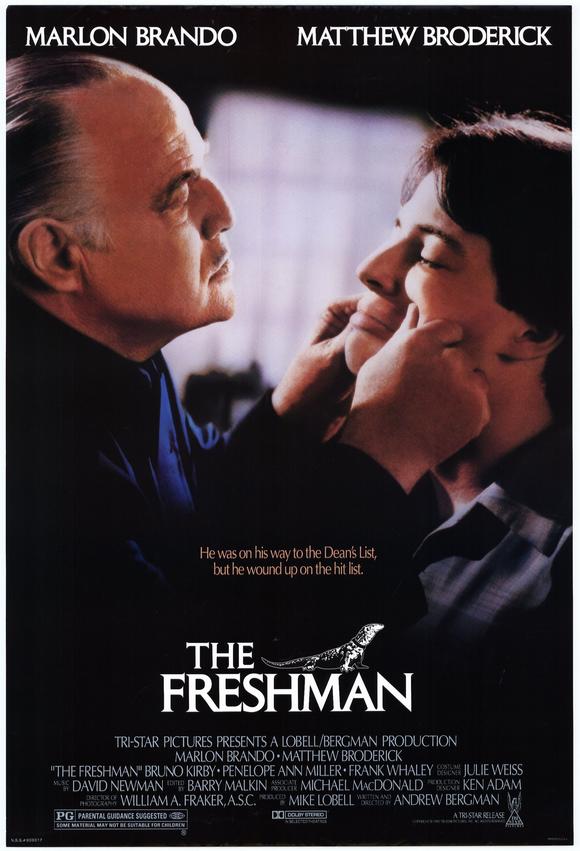
I suppose 1993 was during that period when it had apparently been decided by somebody that Penelope Ann Miller was going to be a big star so she kept getting shoved into big movies until it actually happened which it never really did although with a Golden Globe nomination this was probably as close as she ever got. This performance certainly isn’t award worthy but considering how down people are on her (which, considering a few other movies she did, I can understand) she’s not a trainwreck here at all—if anything, she just never comes off as world-weary as the character should really be presented but all things considered, with the exception of her sharp comic turn in THE FRESHMAN (she certainly worked with as many GODFATHER actors as possible) this is probably her best work. John Leguizamo is pretty damn great as the legendary Benny Blanco from the Bronx, the always dependable Luis Guzman is Pachanga (still, ask me some time what Guzman does in this movie that annoys me to this day), James Rebhorn is District Attorney Norwalk, playing his part as if he had someone literally shove a stick up his ass and the forever enjoyable Paul Mazursky cameos as Judge Feinstein.


Since De Palma was working with someone else’s material here there isn’t that much on a story level to connect to his other films outside of a definite feel of the inevitability of fate. But on a outward level the film feels absolutely like De Palma with its setpieces, feeling of extravagance along with that Patrick Doyle score that comes with a main theme that contains an undeniable feel of elegy that the director seemed to become fond of around this time (and, looking forward to SNAKE EYES, another De Palma/Koepp collaboration, Pacino yells out, “Here come the pain!” at a crucial point). I suppose it’s one of those movies where I just respond to it on a gut level and can even accept some elements that I might not be so receptive to other times—even the use of “You Are So Beautiful To Me” which one would imagine to be clichéd beyond belief, somehow works here and I don’t mind it one bit. CARLITO’S WAY is a big, juicy prime rib of a movie. Maybe it has some fat on the sides but in the center is a juicy, rich meal prepared by someone with absolute pride in the impeccable way that he’s preparing this grand feast and it’s something that I always look forward to returning to. Or maybe sometimes I just feel like watching that climax once again. Containing few if any of the usual preoccupations from his most personal work, this gangster movie may have been more of a job for Brian De Palma than some of his other films, true, but the end result is so expertly made that this doesn’t really matter and it manages to find a true passion within the material. It’s a beautiful piece of work.

Friday, November 26, 2010

Not Growing Up At All


A cluster of trumpets, as if the opening of John Barry’s main title to FROM RUSSIA WITH LOVE was somehow raised from the dead, herald Pierce Brosnan’s first on-camera appearance (not counting the gunbarrel) in TOMORROW NEVER DIES. The music sting sends a surge of electricity through the air, proclaiming JAMES BOND IS BACK in a way that the actor was never quite given in GOLDENEYE, his first stab at the character, and the unabashed charge of the moment seems to signal that this really will be the Bond film that we’ve been waiting to see. And at the time that’s exactly what it was but while TOMORROW NEVER DIES is one of those Bond films I may have liked a lot at the time, it really hasn’t aged very well. Released in December 1997 (same day as TITANIC, for those keeping track) it played just great then, a fun film to see in a theater with a big crowd, delivering non-stop excitement and serving as a solidification of Pierce Brosnan’s success in the role. But the years have laid bare just how uninteresting a movie it really is and even if the action is extremely well done at times too much of the story doesn’t have anything to offer other than that action. This sort of criticism was put forth when QUANTUM OF SOLACE (a problematic film for different reasons) came out a few years back and it raises the question: if a James Bond film pays so much attention to the action at the expense of anything else, should it automatically be considered a failure? It would be easy to delve into how the its villain resembles a real-life famous mogul with a powerful television network, only a year old at the time the film was made, and one which really has transformed the airwaves into its own force for evil. But, frankly, even I’m not sure if I can muster very much excitement in thinking about that too much since the film’s politics just aren’t interesting enough to go down that road.


Media mogul Elliot Carver (Jonathan Pryce) uses a special encoding technology via his own private stealth boat to send the USS Devonshire off course without its knowledge into Chinese waters in order to instigate tensions between England and China on the eve of the premiere of his new news network. The headlines of his newspaper Tomorrow blare reports of the conflict as he looks to reap the rewards when war breaks out. MI6 agent James Bond 007 (Pierce Brosnan) is of course sent in to investigate, posing as a banker at the gala premiere of the network in Hamburg, well aware that Carver is now married to his former love Paris (Teri Hatcher) and Bond has little choice but to seek her out with the intent of using their history to learn what Carver is really up to. He also encounters Wai Lin (Michelle Yeoh), a supposed Chinese journalist who has her own secret agenda with the magnate. Before they know it, the two must team up before Carver is able to use his technology and media savvy before the conflict between the two superpowers escalates and leads to World War III.


Maybe now we can all agree that Pierce Brosnan never quite got the Bond film he deserved. Looked at together, each of his four entries have a feel of one step forward two back in terms of progress towards achieving that goal and this particular film feels like a case of a production losing focus at a certain point while rushing to make a release date. GOLDENEYE, his first film in the role was very much a case of both actor and production trying to get its footing in terms of what that type of Bond he was going to be, so TOMORROW NEVER DIES (a title which, incidentally, doesn’t come from anything ever written by Ian Fleming) displays a certain degree of greater confidence in its approach but something still falters. The subsequent film THE WORLD IS NOT ENOUGH has a much improved story, utilizing the actor better—it’s not CHINATOWN or anything, but has some meat to it that helps in repeated viewings. Strangely, the action in that film is often too overblown for the story and is presented in a lackluster manner. In comparison, some of the action in TOMORROW NEVER DIES in expertly staged—at least, up to a point and I’ll get to that—but there’s not enough of a story to support it, with all actual conflict between Bond and the Carvers coming to a halt at a certain point so any element of actual drama, larger-than-life or otherwise, is lost. The way things are laid out in the screenplay (sole credit goes to Bruce Feirstein but other writers including Dan Petrie, Jr. and, interestingly, Nicholas Meyer also worked on it), some of it barely even has a chance to get started anyway. The character of Elliott Carver may be a media genius but, confident as he is, probably could have covered his tracks a little better in his master plan with everyone on Bond’s side seeming to correctly assume right from the start that he’s behind it all.


The entire storyline between Bond and old flame Paris Carver is a total non-starter as if rewrites quashed the entire point of it and, actually, quite a lot of the film feels like multiple rewrites bled out all sorts of elements until they were replaced with not much of anything as the story races from one setpiece to the next. Some of the first half focuses on a search for a half-hearted McGuffin so people like Ricky Jay are basically just stand around, not doing much of anything and by a certain point there’s nothing left to happen except for Bond to run and be shot at, then turn and do some shooting himself. By the halfway mark it feels like the film has featured more machine gun fire than any movie in history and it’s just getting warmed up. The plot is compacted into a very tight time frame of a few days—and, to be fair, unlike a few films like THUNDERBALL at least it pays some attention to its ticking clock—but in doing this it seems to sacrifice too many of the cool Bond elements. Damn it, if Bond’s going to be staying in a luxury hotel I want to see him check into that hotel and share a moment with the hot girl behind the desk as he asks for drinks to be sent to his suite. Or at least some kind of equivalent to give us that cool jet-set downtime and the movie never does that, turning way too much of what goes on into one giant setpiece after another until nothing that happens really matters anymore. One might notice future Oscar winning screenwriter Julian Fellowes playing the Secretary of Defense and he has the sort of look that would have made him ideal to play opposite Roger Moore’s Bond as a stuffed shirt who gets put in his place or whatever but here he’s just another authority figure with a few lines of exposition as the scene barrels through to get to the end. I’m not saying that the film needed more goofy Moore-era humor but it feels like the overall approach has disposed of some of the needed elements—character, mood, story—to keep the pace going and by a certain point it doesn’t feel enough like a Bond film. An action film, yes, but they shouldn’t be the same thing.


For a variety of reasons, it’s one of those Bond films that hasn’t dated all that well, with some of the technology and media skewering in its storyline feeling very much like an artifact of the 90s. In a similar vein, THE MAN WITH THE GOLDEN GUN had that whole Solex Agitator plot, always a little too locked into the energy crisis of the 70s, and interestingly, that film also crammed martial arts into things. This film’s focus on Michelle Yeoh feels like a massive reminder of that stretch when hastily redubbed Jackie Chan movies were being tossed into thousands of theaters maybe twice a year by Miramax and New Line (including SUPERCOP, co-starring Yeoh), with this film trying to capitalize on the popularity of Hong Kong action cinema. Hey, I like Michelle Yeoh—scratch that, I love Michelle Yeoh, I think she’s amazing—but watching this film now, I couldn’t help but think once or twice, what the hell is Michelle Yeoh doing in this movie, anyway? It’s at least partly because the movie suddenly decides she’s one of the leads when the plot has collapsed but also because it almost seems like the wrong personality for this film.


To be fair, some of the action is very well done, with the escape from Carver’s Hamburg plant and the parking garage chase particularly good, not to mention how the martial arts stuff is at least staged in a way that lets us follow what’s going on (I’m not crazy about this stuff being in there, but it’s not badly done). Director Roger Spotiswoode keeps the non-stop going through much of the running time—again, he succeeds more in making an action movie than a Bond movie—but by a certain point the action is all it is and the film has one of those half-hour climaxes, set on Carver’s stealth ship, of the sort where I just zone out by a certain point since the ‘plot’ is finished and I’m just waiting for it all to be over with already. Even the look of the film, photographed by Robert Elswit, is the sort of thing I like on its own and Elswit is a master, making the film look more expensive than the (sometimes reused) sets ever do but it feels like it has too much lens flare, smoke and atmosphere of the sort that doesn’t seem right for what I guess is my own idea for the Bond approach. The location work feels a little skimped on as well—Hamburg seems like a picturesque place from the little we get to see but it still feels like they decided on setting it there just by throwing a dart at a board and while I would hardly have expected the production to go to Vietnam when the story moves there with the exception of some second unit stuff as they go out to sea much of the footage shot in Thailand (some of which looks like where they also filmed THE MAN WITH THE GOLDEN GUN) almost feels like they may as well have done it all on the backlot.


Revisiting it the film for the first time in a few years it played considerably better than I expected through the first half and I was almost surprised at how much I was with the film. But after the peak of the parking garage chase, which really works in all the ways it’s supposed to, my patience began to wear thin during the second half as all the mayhem became more and more repetitive, with practically all Bondian elements getting bled out by a certain point with the exception of a few one liners. Sure, Jonathan Pryce keeps on spitting out witty rejoinders as the bad guy to the bitter end but really, so what? The character of Elliot Carver (interestingly, the only Brosnan entry where he deals with one clearly defined bad guy from start to finish) is played so big that he kind of cancels himself out by the climax—and as much as I may like to, I can’t bring myself to have much interest in trying to draw a link between the headline-engineering tactics of the Carver Media Group and certain real-life equivalents, maybe since what’s here is sketched in such a broad manner. TOMORROW NEVER DIES plays a little like a Bond film that they made while someone else in another room was still working out the story for the really good Bond film they wanted to make next and it’s too bad, really, because as it turned out Brosnan only did four of these and it just feels like there should have been more to this one. The big love scene between Bond and Paris comes close to what it should be in illuminating something about the character but it feels not quite there, as if it went through one too many rewrites and has been made just a little too spare, never becoming the Brosnan version of a great lost love for Bond in a way that it feels like the movie was going for. Since it’s a James Bond film I can still enjoy it just like I can watch any of them, good or bad, at any time but too much of what I enjoy about these movies feels lost in favor of a lot of noise.


I wonder how bored Pierce Brosnan is with talking about Bond by now. With this film, it feels like it’s the script that strands him with ultimately nothing left to do but act cool and use his expert comic timing that even then he was probably able to do without getting too worked up over things. Brosnan can often be self-critical in his frank discussions of his own frustrations with the series but in this case that seems unwarranted. He displays a great deal of confidence here and inhabits the part just fine, making it seem like the actor deserves to be playing the part in a cool, stripped down film that he never got to appear in. Jonathan Pryce goes way over the top in his portrayal of the villain but something still feels weirdly mis-calibrated as if the actor thinks he’s about to burst into song or something—he plays it as if he’s about to star in the first James Bond Broadway musical. I think my favorite part of his performance is the way he types on his portable keyboard with one hand. And if there’s anything wrong with the film’s Bond girls it’s that they don’t really seem like Bond girls—Michelle Yeoh is awesome, seriously, she’s just in the wrong movie and as great as she is when the movie stops to let her do her thing it still feels shoehorned in. Her best moment is when she turns up wearing a quasi-Emma Peel garb in Hamburg and displays herself literally walking down the side of the wall but it all goes by too quickly. Teri Hatcher seems a touch too immature for her role and I’m not sure she had any real idea how to play the thin material. The actress was also several months pregnant at the time and it makes me wonder if she just had her mind on other things. Actresses up for the Paris Carver role but not cast include Sela Ward and Monica Bellucci. Seriously, they turned down Monica Bellucci!! That she never played a Bond girl feels like one of the more unfortunate tragedies of pop culture from recent decades.


Almost walking away with the film in just a few minutes of screentime is the late, great Vincent Schiavelli as the sadistic assassin Dr. Kaufman who brings the right sort of menace and arch humor to his part in one of the very best scenes of the film, even if the Auto Club line is pretty dumb. Gotz Otto is the big, blond henchman and Ricky Jay doesn’t get to do much at all as his computer hacker bad guy—his odd style of speaking makes me wonder if he really only should act in films directed by David Mamet or Paul Thomas Anderson. Judi Dench as M, Joe Don Baker as Jack Wade, Desmond Llewelyn as Q and Samantha Bond as Moneypenny are all in there, however briefly, while Colin Salmon makes his series debut as Chief of Staff Charles Robinson. Gerard Butler makes an early appearance on the USS Devonshire, Al Matthews from ALIENS is a U.S. Master Sergeant and Hong Kong film veteran Philip Kwok appears for a few seconds as General Chang (presumably no relation to the character of the same name played by Christopher Plummer in STAR TREK VI), one of those characters who seem to play a large role in the plot but almost entirely off camera.


Coming after the train wreck of what Eric Serra unfortunately provided for GOLDENEYE, David Arnold received a great deal of praise for his score at the time and for at least the first half of the film it’s deserved so it’s not surprise that he’s stayed with the franchise up to now. The score for the pre-credit sequence “White Knight” on the album, is a genuine triumph, a endearing tribute to John Barry and sounding like Arnold is living out his ultimate fantasy of scoring a Bond film, making an ok sequence into something truly special. Much of the time his score lines up just right with the movie, making it thrilling and fun in all the right ways, tossing in gentle electronic stings in there, but by a certain point it feels like Arnold runs out of ideas so he blares things as loud as possible either in generic ‘action movie music’ style or just playing the Bond theme over and over and over again as often as we hear all that machine gun fire. As for the songs, Sheryl Crow’s main title has never done much for me and I like Crow most of the time but k.d. lang’s “Surrender”, written by Arnold and Don Black, is much more like it. The sound is genuinely Bondian and it even utilizes one of the melodies from the film itself, particularly in the track “Backseat Driver” which underscores the parking garage chase. Larger than life in the way any true Bond theme should be, “Surrender” really is kind of awesome and a song that deserves to be better known than it is.


The movie isn’t in any way a total loss—there is lots of enjoyment in there and more serious touches like Bond doing shots of Smirnoff (ignoring the blatant product placement) while waiting to see who’s going to turn up at his hotel room door might not strictly be Fleming but it is character detail of the sort which I like that the film doesn’t have enough of. I can’t remember who it was that complained how Bond’s line about “not growing up at all,” when he comments on how well he handled that BMW motorcycle, protesting that James Bond isn’t an overgrown kid who goes out and does lots of cool stuff but a full-grown adult who lives the way he does because he’s convinced that it may very well end at any time (“Enjoy it…while it lasts.” “The very words I live by,” went the exchange between Brosnan and Famke Janssen in GOLDENEYE). That may be what’s wrong with TOMORROW NEVER DIES, as much as some of it does work pretty well—it gets all the action in but misses the character too much of the time. Of course, everyone has their own idea of what makes the ideal Bond film and you can’t please them all but this one tries to bland the formula down in a way that thinks if it’s noisy enough we won’t notice what isn’t there. I honestly don’t mind TOMORROW NEVER DIES—I don’t mind any James Bond movie, really. But, as loud as the familiar theme blares some of the time, I can’t help but wish that it could take as much pleasure in how cool it is to be a James Bond movie in a way that the very best of the series is sometimes able to achieve.

Tuesday, November 23, 2010

You End Up Here


It was the Saturday after Thanksgiving, 2002. I was flying back to L.A. from D.C. where I had spent the holiday with family. On this particular trip I was flying first class, the only time I’ve ever done that, but as I was waiting at Reagan National for my connection to Chicago word came down that the flight had suddenly been cancelled. Fast as I could, I scrambled to get another way back home as soon as possible which resulted in my being put on a tiny American Eagle up to New York, from where I would get a flight that night back home. And it worked out just fine, though it was a little frustrating to land in New York but not get to spend any time there. Anyway, I was sitting in first class of the American Airlines flight out of JFK acting like Frankie Valli or some kind of big shot as all the other passengers walked through the cabin back towards coach, just as I’ve also done every other time that I’ve flown. I was on the aisle with an empty seat next to me and I wondered who might sit there, hoping it wouldn’t be an old guy with a cough to kill the cool vibe but down to ten minutes before takeoff it was still empty and I wondered if anyone would be sitting there are all. And that’s when Diana Ross walked onto the plane. Instantly recognizable, she definitely made her presence known as an assistant fussed around having her stuff put away, talking up a storm about how she was going to get some sleep on the flight. She then headed over in my direction to sit in the seat next to mine, looked at me and said, “You, you’re sleeping with me tonight.” “Um, ok,” I think I sort of muttered, not a little stunned at what was suddenly going on. I glanced around and it felt like everyone was staring in my direction. Her assistant soon disappeared, never to be seen again and the music legend with all that hair sat down next to me, shutting her eyes immediately so I figured she was serious, that she really would be sleeping through the whole trip. Then, as the plane began to taxi out for takeoff and we picked up speed, without saying a word or opening her eyes, Diana Ross suddenly grabbed my hand as if for support at this moment. Of course, there’s a rule in life—when Diana Ross grabs your hand, you let her grab your hand.


Soon when we were in the air, she opened her eyes and as drinks were served she began to ask me about myself, probably because since I was in first class she figured I couldn’t be just some schmuck. Little did she know. Now, let me cut in here—of course, I know who Diana Ross is but I’m hardly an expert when it comes to the subject. When she first sat down I began going through the filing cabinet in my head of what I knew about her—the music everyone loves, the Supremes all hate her, that infamous Central Park concert in the early 80s, some movies I’ve never seen…and not much beyond that. So as she began to talk to me I made the decision that except for any follow-up questions that arose naturally from our conversation I wasn’t going to ask her anything that might possibly upset her or make things awkward. No ‘What is the deal with Michael Jackson?’ no ‘So how did you really get along with the other Supremes?’ no nothing, because I was enjoying this and I didn’t want to say something stupid that would cause this experience to end sooner than it had to. So our conversations continued on and off throughout the flight, along with the drinking and the dinner while the flight attendants (who I could very easily tell were treated as ‘the help’ by Ms. Ross) were always quizzing me about what she was like whenever I got up to use the facilities. She got up herself at one point to walk around and returned to first class carrying another passenger’s baby. I guess the rule is if Diana Ross suddenly appears to you on an airplane, you give her your baby. She talked to me about herself and how she wasn’t sure what she wanted to do at that point, she showed off a photo of her daughter, actress Tracee Ellis Ross—for about five minutes I thought she was going to try to set us up—and she asked me various things about myself and my life. And I can say that sitting as close to her as I am to my computer screen right now that she was absolutely beautiful. I jotted down a lot of the specifics of what we talked about soon after which I naturally can’t find right now but packed into the glamour and flirting of those six hours in first class with this music legend was probably one of the best relationships I’ve ever had with a woman. Relatively speaking it was just a brief amount of time spent in the fantasy world of first class but that’s part of the strangeness of flying, finding yourself in a sort of limbo where you can feel free to talk about anything with a total stranger, even one that just happens to be a legendary icon. The following month she was arrested for a DUI in Tucson which made headlines worldwide. I really don’t think I can be blamed.


None of this story about a cross-country flight really builds to anything—I think the last thing she said to me was, “We’ll meet each other again,” but I didn’t see that happening any time soon and I haven’t been proven wrong. I have actually seen her daughter Tracee a few times over the years, but never went up to say something. Still, I’ve maintained a fondness for Diana Ross through the years anyway although it wasn’t until recently that I decided to finally watch one of those films I had never seen, namely her 1975 star vehicle MAHOGANY. If you’ve seen the film, you probably remember it as the one where they play that “Do You Know Where You’re Going To?” song over and over until you can never manage to forget the damn thing. But really, at this point in my life, do I have any idea where I’m going to? I think it’s pretty clear that I don’t. And in all seriousness, speaking as a straight white male, having seen it now I’m not sure exactly what I’m supposed to say about this film. Do I approach it as a camp artifact of the 70s, an early attempt by African-American filmmakers to move stars of color into the mainstream, as an unabashed vehicle for the famous diva, an update of a Joan Crawford-Douglas Sirk kind of formula? All of the above? Since I wasn’t watching it in a theater with a bunch of people cackling over how it’s-so-bad-it’s-good it is, which is something I hate to do anyway, all I could do was just take it sort of at face value while still being vaguely aware of the sort of response it would probably get. For all I know people think of it as a crazy VALLEY OF THE DOLLS-level campfest but it never quite goes all that nuts, staying firmly in the PG realm and it’s hardly as hysterical as something like THE OSCAR is either. In spite of what I suspect is its reputation out there (One and a half stars in Maltin, which calls it a “silly, contrived affair”) I didn’t think it was even a particularly badly made film, even if all it seems to be about is how wonderful the great Diana Ross is (even I don’t have much of an argument for that) and how much the whole world has learned to love her but she should never turn her back on the most important man in her life, no matter what she’s tried to accomplish. How much all this is actually about Diana Ross’s own travails while pursuing success is a subject I know nothing about but I don’t really feel like seeing DREAMGIRLS again to learn more. Now would somebody please get that damn song out of my head?


Tracy Chambers (Diana Ross) is an aspiring designer living in the Chicago projects and working a secretary job at a ritzy department store as she takes classes at night. While trying to get ahead she begins a relationship with an activist Brian Walker (Billy Dee Williams, “looking uncannily like Jesse Jackson” per Roger Ebert at the time) trying to keep the slums from being torn down and running for alderman but things change when she catches the eye of a famous photographer Sean McAvoy (Anthony Perkins) who soon whisks her off to Rome, he renaming her Mahogany and before she knows it she becomes a famous model, living the high-life among the rich and powerful though she still has thoughts of using her fame to be a designer. But when Brian turns up in her life again she must make a choice in where she wants to go in life. Does Mahogany know where she’s going to? Does she know the things that life is showing her?


MAHOGANY was directed by Motown founder Berry Gordy after kicking the esteemed Tony Richardson off the project (Gordy said in a statement at the time that Richardson “didn’t understand the Black experience”) and, look, this is one of those times where I have to admit that a certain film just wasn’t really made for me or my sensibilities. I have very little awareness of inner city politics in the mid-70s and I certainly don’t have much of an interest on any level in the world of fashion so there’s not going to be much of a response coming from me at the sight of all those wacko fashions designed by Tracy which even I think are pretty garish, even for the 70s. While watching a few of the endless montages set over and over to that one piece of music (interestingly, the title song reached number one on both the Hot 100 and easy listening charts) that chronicle her road to success I could imagine the cackles of laughter that probably erupt at screenings from those bizarre outfits, designed by Ross herself according to the credits, but that’s just not my sort of thing. I suppose that while watching it I looked at MAHOGANY as a sort of intentionally old school Hollywood melodrama updated to the blaxploitation-era 70s (Screenplay by John Byrum, based on a story by Toni Amber) but more than anything it’s a movie star vehicle meant to proclaim as loud as possible to the world the absolute greatness of DIANA ROSS.


More than once the film seems determined to just stop and let her do her thing, like laugh for thirty seconds at something going on or dance around her apartment as she makes up a little campaign song for Billy Dee as he stands there in awe of her, flashing that grand piano of his he calls a smile to quote a line of dialogue she has to describe him. And of course, it’s Diana Ross dancing in front of him—what else is he supposed to do? The film also lets her be as dramatic as possible at various points as well as being totally idealized, an inspiration to every downtrodden woman seeing this film in 1975. Tracy is someone who can succeed as a model, design new innovative outfits, who knows how to handle potential muggers in Chicago just as well as she deals with cab drivers in Rome, not to mention how she can let loose on a bunch of Italian-gibbering fashion sleazes who dare to critique her with all the sass in the world like she’s an updated Lana Turner in IMITATION OF LIFE until the one other woman in the room, the only one of power of course, is instantly impressed by her moxie and asks, “When can you start?” leading to a high class lifestyle in Rome of parties, expensive restaurants and various bottles of J&B scattered around. And, ultimately, I guess that’s what the film is really supposed to be.


As ridiculous and soapy as it all is MAHOGANY is actually weirdly entertaining, more than things like VALLEY OF THE DOLLS and THE LOVE MACHINE are for me anyway. It’s the sort of film where I’m not even sure why I’m watching it but then suddenly I’m surprised at how long I’ve been sitting there, actually involved in this nonsense in spite of itself. Maybe it’s the beauty of the star, the suaveness of Billy Dee, the over the top glamour of Rome or maybe that the story just sort of weirdly works even though it shouldn’t. There’s not much credibility to any number of things that happen as Tracy becomes the world-famous Mahogany—for one thing, it’s one of those movies with a narrative that presumably spans several years but it all seems to be set during the winter months of 1975, with some trees in Rome looking just as bare as the ones in Chicago. Considering this is Berry Gordy’s only directing effort the movie actually has quite a bit of elegance to its visual style and much of the credit for that must go to master cinematographer David Watkin (CATCH-22, THE DEVILS, OUT OF AFRICA) who makes MAHOGANY quite a rich, beautiful film to look at with a true sense of scope to the anamorphic framing and even an impeccable sense of place in a way that films don’t really posses anymore. Along with Watkin, mention should be made of editor Peter Zinner, also a cutter on THE GODFATHER and THE DEER HUNTER, and who maybe more than anyone here is responsible for making some of this flow as well as it does.


There’s a genuinely lived-in feel to the Chicago portion of the story with a great deal of texture in that urban environment compared with the Rome half which feels a little touristy but even that approach makes sense for what the film needs to do, whether it was intended or not. The Italy half certainly contains the craziest stuff, from the wacko vibe of the fashion shows as the sophisticated Europeans are first shocked, then elated by what Mahogany creates, leading to sinuous parties where she literally allows candle wax to drip down on her. And there’s the photographer that becomes obsessed with her who is presumably--well, they never actually say what he is but he’s played by Anthony Perkins, it’s made clear that he can’t get it up for Diana Ross and it doesn’t seem to be because of simple impotence so I can guess what we’re supposed to think. The character is written to behave more and more as a genuine sociopath as the movie goes on, first in a passive-aggressive way than culminating in two separate showdowns with the noble leads, one a bizarre scene involving fighting over a gun with Billy Dee with all the symbolism you can imagine and finally a scene involving an out-of-control car where he crazily insists on taking Mahogany’s picture, a point of hysteria that is probably as much of a reason for the film’s notoriety as anything (and, yeah, I could hear those cackles from that nonexistent audience when we later actually see the photos that were taken). But even the nightmare end of anything that happens in the story never goes too far and MAHOGANY, along with being a pure star vehicle, is also obviously a piece of wish-fulfillment for any of her fans, representing the dreams they may have to go off and do whatever they may want to do but the film seems to say that the dream has to end sometime and the place you really belong in is right where you started in the first place.


The film brings a certain amount of realism to the Chicago sections which grounds it sort of in the real world but the political stuff feels a little too sketched in and keeps some of the approach to racial issues more implied than anything--even a few white faces are inserted among the crowds as if someone was hesitant to make this too much of a story specifically about African-Americans—Tracy’s success as both model and designer happens without comment on her race but maybe all those wackos over in Europe, where Billy Dee can’t tell some of the men from the women, are just more enlightened. At times, the film feels a little like some of the down and dirty success of the blaxploitation genre being co-opted for a big, slick studio production (and it makes me wonder about how that cycle began to rapidly fizzle out around this time though that’s getting a little off topic) and MAHOGANY is almost progressive but is kept from being too much so by making it about how if the romance is a failure than Mahogany is a failure as Billy Dee screams as loud as possible, “Success means nothing unless you have someone to share it with!” leading to her finally, irrevocably realizing the apparent truth of this statement. But is this what it should really build to? Is the conflict really as clear-cut as the jet-set glamour of Rome versus the downtrodden projects of Chicago, a city where we’re told that, “You don’t make it here, you end up here,” as if to say that if Tracy stays in that town she’ll be giving up on her dreams. This is all pre-Oprah, of course. But really, if she could possibly make so much money in the world couldn’t she use some of that to help out back home or would that be seen as wrong? Isn’t there a viable middle ground? Maybe not, since the movie wants to keep things cut and dried. At the very least the final shot, with credits shoved onscreen as fast as possible before anyone can really think about the ramifications of what just happened, displays a political rally that isn’t even all that well attended but the ultimate goal seems to be noble and one worth fighting for (Brian Walker pledges to “stop the power merchants from trotting over the little people.” Yeah, that worked out real well). It almost makes me imagine how maybe in a few years after these two people get together they’ll encounter a young man who’s just hit town then, having been inspired by this great-looking couple gets directly involved in the Chicago community for himself, meets the woman which will become his own wife, and sets down a road that will lead to becoming President, making good on what was begun in the story told here. All right, that’s probably looking a little too hard for optimism in this ending but I’m really trying and as the downbeat on the theme song (like the part where she sings “Now, looking back at all we planned…”) is played at the end the whole thing just stays with me, a big piece of cheese that is weirdly affecting in its earnestness or at least what I perceive to be its earnestness. So if anything it has that.


Diana Ross and Billy Dee Williams both play this as charismatic as the stars they were at the time. They’re not great and they certainly don’t always make the problematic dialogue work. But whatever else you want to say about them, she’s energetic, he’s cool, they’ve got chemistry, they’ve got presence and they both look great, each given numerous terrific close-ups by Watkin. Anthony Perkins, who must have been cast with his most famous role in mind, becomes less of an actual person and more of a prissy monster as the film goes on until he zooms right towards becoming the queeniest version of Norman Bates to the nth degree, almost made to look purely eeeevil in some shots. For all I know this sort of behavior still runs rampant in the fashion world but it still comes off as pretty homophobic (and, for all I know, not taken seriously in the least by some of the film’s fans) as these things go. DANGER: DIABOLIK’s Marisa Mell is Italian fashion big wig Carlotta Gavina—is this film her only U.S. production? Mell doesn’t get to do very much beyond say supportive things to the film’s lead but it’s still nice to have her around. DAY FOR NIGHT’s Jean-Pierre Aumont is Mahogany’s European benefactor with an obvious eye towards getting more out of the relationship, Beah Richards and Nina Foch have supporting roles and Bruce Villanch, of all people, plays a dress manufacturer in Chicago. When he turned up I honestly thought it was Severn Darden.


I guess you could say that it’s glossy star vehicle of the sort that really only got made in the 70s and I can appreciate that. Or at the very least, that song has gotten locked into my brain and there’s really nothing I can do about that anymore. And it’s a pure old-fashioned vehicle for the great Diana Ross, in ways that are both good and bad. Maybe if I’d seen this at the time I would have summoned up the courage to ask her a few questions about it. I’d probably at least have brought up David Watkin and Marisa Mell. Maybe. As it is, I kind of doubt that Diana Ross has any recollection of sitting next to me that night but I know that I’ll never forget it. A ridiculous movie like this is a reminder of what an icon she has always been and how lucky I was for a few hours on an airplane back in ’02 to get to know her just a little bit. Now, as I look back at all I planned and wonder how I let so many dreams just slip through my hands I know that I’ll certainly have that to remember.