Thursday, February 27, 2014

Nothing But A Cheap Crook

Al Pacino wanted to play Johnny Handsome. In Lawrence Grobel’s book of interviews with the actor he talks about how he was going to do the film with director Harold Becker and he loved it, loved the part, that it was his favorite role ever, but as the script was worked on he felt they never got the right third act so it didn’t happen, finally saying, “Mickey Rourke did a great job on it but that didn’t matter; the movie didn’t have the finish.” On the film’s imdb page it states that Pacino dropped out because he “felt, despite numerous revisions, they had never been able to transcend the script’s B-movie qualities.” Which of course isn’t quite what he says to Grobel so maybe there’s another quote from him on it out there but, regardless, there is an interesting point to be made of what a film should be, what it can be turned into and if transcending the roots of a concept is actually a good idea. As it was finally made, JOHNNY HANDSOME which starred Rourke in the title role was directed by Walter Hill who I doubt ever had a problem with B-movie qualities and was certainly able to bring out the undeniable essence of character within a pulp framework in addition to making a full-on action film with all the energy imaginable. Hill’s JOHNNY HANDSOME didn’t do much business when it was released on September 29, 1989 but I’ve always admired its noirish stripped-down qualities and no-nonsense approach to the story, things which can certainly be said about any number of Walter Hill films. It fully embraces its roots in a way that this director seems to know how to do like few others. It still feels that way now. And you know what? The third act actually is kind of problematic. But let’s put that aside for the time being.
Deformed crook John Sedley (Mickey Rourke), known as ‘Johnny Handsome’ because of his appearance, is talked into pulling a job by his only friend Mikey (Scott Wilson) who is desperately in need of money. But things go wrong when they are double crossed in the middle of the job by accomplices Sunny Boyd (Ellen Barkin) and Rafe Garrett (Lance Henriksen) who kill Mikey and leave John for dead. After an attempt on his life in prison he winds up in a hospital where plastic surgeon Dr. Steven Fisher (Forest Whitaker) is looking for someone to test his new procedure on, giving John a new face and new identity but in spite of the skepticism of needling cop Lt. A.Z. Drones (Morgan Freeman) who knows what Johnny is deep down, things seem to be going well with a new job and nice new girl Donna McCarty (Elizabeth McGovern). But Johnny still has his eye on revenge and seeks out his old accomplices who don’t recognize him, with a plan for a new robbery and a ways to get back at them.
If you averaged out the running times of Walter Hill’s films you would probably come somewhere between 90 and 100 minutes (1993’s GERONIMO at 115 minutes is the exception to this). JOHNNY HANDSOME, coming in at about 93 minutes falls in the lower end of that spectrum and that lean feel of narrative economy is apparent right from the start, wasting no time with introducing us to the characters and who they are, moving quickly to the all-out assault of the initial heist. Ultimately this approach is what JOHNNY HANDSOME (screenplay by Ken Friedman, based on the novel “The Three Worlds of Johnny Handsome” by John Godey) really is, a walk down a short, dark alley where there might be some momentary respite from the nastiness of this world but ultimately it just leads to a brick wall. Everything is a given, everything is inevitable and the way Hill tells the story he sees no reason to waste time—early on once the initial heist is finished we go from Johnny’s sentencing to the prison then finally to the hospital after the attempt on his life in the space of about two minutes. The film keeps moving, placing the emphasis on the noir-soaked nature of the story and this world instead of the action although since this is Walter Hill he never holds back on the gunplay, not at all, as well as forever juicy details in the dialogue like how the guys hired to kill Johnny in prison were paid “a grand each and cigarettes”.
And each of these characters are perfect in this world—Barkin’s Sunny and Henriksen’s Rafe are soaked in their own nastiness but are really just a bickering couple dependent on each other more than they want to admit, Whitaker’s doctor and his straightforward earnestness, Freeman’s cop who’s one step of every person he’s having a conversation with and Rourke as the title character, the calm center to the film as if in his earlier life Johnny was never fully formed because the world never allowed him to be. “Johnny don’t need no mask” is the childhood taunt he remembers and now that he’s finally given a mask he’s determined to use it while the white-hatted Lt. Drones taunts him, knowing what’s coming, knowing the truth that the ultimately decent doctor can never see since he can never understand the limitations of the mask he’s giving Johnny, that this is nothing more than a ‘genetic abnormality’ that needs to be fixed. He doesn’t even understand that, ultimately, a mask is all it is with Johnny staring at the photos of his old self, wondering who he really is, nothing to be afraid of anymore since in some ways he’s already died. Freeman, with a moment I love where he bursts out into a surprised smile at seeing the new Johnny where he states, “That is fucking amazing”, thinks that Whitaker is naïve and he’s not wrong but the doctor is just as someone who wants to bring the good out and he sees no reason why that can’t happen. Much as Al Pacino didn’t want it to be, the heart of JOHNNY HANDSOME isn’t its potential as character study as much as a simple demonstration of noir allowing the characters to emerge from that whiskey soaked atmosphere, so much that if you told me it was a faithful remake of a 75 minute film made in 1948 for the bottom half of a double bill I wouldn’t be surprised (Pauline Kael in her review speculates that film would be the 1941 Joan Crawford vehicle A WOMAN’S FACE but JOHNNY HANDSOME is much more down and dirty). And I wish it was so I could watch the two versions back to back.
The opening third detailing Johnny’s path to his new face offers some of the best work of Hill’s career without a wasted frame, giving us a feel of each of the characters. The three acts of the film are more or less broken down into the path to getting the new face, living with the new face and then using the new face to disguise the old face. The approach maybe isn’t perfect—the effect of the more experimental first third is broken slightly when it moves to the next section, opening with a montage of Johnny at his new job that is scored a little like a beer commercial and while there’s no way for such a spell not to be broken but it still feels like a misstep, taking us away from his head and a little too much into the outside world. You can feel Hill letting the actors dig into their characters and there’s a certain joy in that—just looking at their faces, whatever their real faces are, becomes the movie more than anything else—with the visual style like the following year’s ANOTHER 48 HRS. directed by Hill on which Matthew F. Leonetti also served as director of photography relies more on close-ups than Hill had done earlier in his career. When Sunny and Rafe reenter the story in the second half it’s frankly a joy to watch them and I certainly wouldn’t mind a few more scenes of just the two actors playing them snarling at each other but in keeping the pace going the film doesn’t waste time moving towards the second big heist either. More than anything it’s hurt by how the final section post-heist feels like a process of moving chess pieces into place more than telling the story of the title character since while things should barrel forward at this point there are the issues of laundering the money and certain people learning Johnny’s true identity and getting everyone to the same place for the climax. If it could have accomplished all this sooner while paying attention to the arc of the title character and run only 75 minutes, like the mythical black & white verison I mentioned, it might have been better than just another cool Walter Hill film. It might have been a minor classic.
But even in the final third here there are memorable moments, such as a phenomenal scene where Henriksen’s Rafe pulls a gun on Barkin’s Sunny and she, not caring, just walks past him. He holds his gun on her, wanting to pull the trigger on her and not bringing himself to doing it. Hill holds on the shot, letting the actors play out the moment as if it’s on stage and it couldn’t be more electrifying. The director isn’t trying to find these characters through speeches that they make so everything doesn’t stop while Johnny explains more than we ever need to know to Elizabeth McGovern’s Donna. Instead much of it is about the behavior in what these fantastic actors make out of these moments. Maybe the story needed an extra beat or two so things didn’t seem quite so clinical in the inevitability of what happens, where Johnny realizes that he has no choice but to do what he’s going to do since that’s the way the world is going to be no matter what. The story doesn’t always live up to the best moments, maybe that finish the film never found that Pacino alluded to, and I haven’t spent any time trying to come up with a better third act myself but at its best JOHNNY HANDSOME feels bracingly alive in a way that maybe only Walter Hill can deliver.
What does the story of this film inadvertently say about what has happened to Mickey Rourke’s face in the years since? Since this comes at the very end of the 80s it almost seems like the very end of classic-era Rourke (DESPERATE HOURS and HARLEY DAVIDSON AND THE MARLBORO MAN came after, followed by oblivion for a few years). It’s an unusual close to that period if that’s the case considering how much the character is supposed to be a blank, with his most emotional moments coming before his face changes. At first speechless at the sight of his new face, afterwards it’s as if he allows the blank of his new face to work for him, to play off of the much bigger performances around him and it’s continually fascinating to watch. Ellen Barkin (in one of two films released in September ’89—the other was SEA OF LOVE which also starred, what do you know, Al Pacino and was directed by Harold Becker) is phenomenal here, ferociously and terrifyingly sexy, fearless, grabbing hold of every scene she’s in and biting off every last ounce of meat she can find. The name Sunny couldn’t possibly seem less appropriate for her character and Barkin plays it as if she thought Marie Windsor in THE KILLING was too nice and sweet—when she tells Rourke, her old DINER co-star, that he’s giving her bad thoughts one can’t help but wonder what sort of thoughts she’d been having beforehand. She’s absolutely fearless here, taunting Johnny with a cry of “geek” like the kids who teased him when he was a kid, and the way her voice goes down on the word ‘gave’ when she says, “Either that or I gave it away” to Henriksen makes me think statues should be erected in her honor.
Really, all of these performances nail it—Lance Henriksen’s shitkicker glare, pounding down the whiskey is one of the best characters of his career, Morgan Freeman’s cockiness, Forest Whitaker’s kind nature. Looking at the film for the first time for a while I was also struck by how good Elizabeth McGovern is here. It’s not at all a showy role like the others and the good girl nature of the part is probably the weakest on the page but the actress imbues her scenes with a genuine sense of humanity without making a big thing out of it. In my imaginary 40s version I kept picturing Joan Bennett playing this part. Scott Wilson as Johnny’s one friend has a nice speech about his own desperation early on that helps make him a fully fleshed out character in just a few scenes and Peter Jason, familiar from both Walter Hill and John Carpenter films (his big screen debut was in Howard Hawks’ last, RIO LOBO) plays a boss at the shipyard where Johnny gets a job. In 48 HRS he’s the bartender at Torchy’s getting harassed by Eddie Murphy. Here, he gets full on pistol-whipped by Ellen Barkin. It’s a certain kind of filmic immortality, that’s for sure.
The issue isn’t whether or not Pacino was wrong, that doesn’t matter. And, yeah, he would have been amazing playing this role. The final version of JOHNNY HANDSOME is flawed and as much as I love just watching these actors embody these rolls in a way that is near exhilarating as a full story maybe it doesn’t entirely connect on an emotional level in the end. I don’t know if that connects so the last image we see before the end credits roll doesn’t register. The film isn’t about a lost friendship so much as booze-soaked tour of a New Orleans drenched world courtesy of a sometimes master director enacted by actors I love in which people don’t change no matter what, just frozen in themselves like a photographed carried in our back pocket until it’s falling apart. That’s a part of our dreams of the better person we’d like to be, the one we know we never will. And if that’s not noir, or at least a small slice of what it should be in the dead of night, I don’t know what is.

Monday, February 10, 2014

In A Couple Of Seconds

No way that I’ll ever forget being jolted awake in the early morning hours of January 17, 1994 when the Northridge quake hit. Even though I was living in North Hollywood at the time, not that far from the epicenter, I was lucky as far as things went so just about the most interesting part of my own experience is that I had returned from an extremely cold and snowy visit back in New York, arriving to something considerably more treacherous as it turned out. Much of that week is a blur to me now and as these things go, because I’m very strange, one of my most vivid recollections is of what came about a few days later when I went to the movies in Westwood at the National Theater (I really miss that place—demolished in ’08 and maybe now destined to be remembered as ‘the theater in ZODIAC’) for opening night of the Richard Gere-Sharon Stone drama INTERSECTION. Actually, my recollections aren’t really that strong. I’m pretty sure I must have worked at my job in Brentwood (the Brown-Goldman murders less than five months away at that point) and then driven over to Westwood that evening. I don’t remember specifics. I don’t remember what I might have had for dinner or even if I got popcorn. I wish I did, just like I wish I’d kept other pieces of time in the brain to remember what I actually did on certain days back then but those things leave you as time goes on.
I do recall that the theater was surprisingly crowded and there was an unmistakable feel in the air of relaxation as if everyone was relieved and thinking, “We made it through the week, now let’s go see a movie.” And it probably didn’t even matter what that movie was, which considering the movie in question may have been just as well. Maybe some people there even expected as much—directed by Mark Rydell and originally scheduled for a Christmas release INTERSECTION had been pushed back to the dead of January, never a very good sign, and what we got to see that night pretty much confirmed those suspicions. Ultimately it didn’t do very well, coming in third that weekend, behind the long running MRS. DOUBTFIRE and PHILADELPHIA, winding up with a gross of $21 million. Revisiting the film now my reaction hasn’t changed all that much from what it was then and it’s not so much an outright bad film as simply one that doesn’t really connect. It ends with more of a shrug than any real emotional response but it is interesting to look at again as not only a reminder of what I went to see that night long ago as well but also as being a relic of the nineties when major studios were still making star vehicles like this. I suppose lots of films from the nineties are going to look like relics sooner or later. Maybe they are already.
Speeding along on a country road, successful architect Vincent Eastman (Richard Gere) is suddenly about to be involved in a multi-car collision. Seconds before impact, portions of his life flash before his eyes, much of it having to do with wife Sally (Sharon Stone) who he’s on the outs with and journalist Olivia Marshak (Lolita Davidovich) who he’s leaving her for. As he’s faced with the two woman coming together at the opening of one of his new buildings he’s faced with the choice between the two of them that he ultimately has to make so his life can move forward.
There are a few notable points about INTERSECTION but even those aren’t really all that interesting. One might be that it’s the rare Hollywood film shot in Vancouver that actually says it’s Vancouver, not Seattle or elsewhere, and I’ll give it points for utilizing quite a bit of scenery in the areas surrounding the city. Additionally, the film is director Mark Rydell’s fourth collaboration with cinematographer Vilmos Zsigmond, presumably after they met when Rydell acted in THE LONG GOODBYE (and if you haven’t seen their first, CINDERELLA LIBERTY, go and take care of that) and also features Sharon Stone right in the middle of her post-BASIC INSTINCT hot streak, presumably trying to play against type by taking the role of the unhappy wife instead of the flashier part of the other woman. But ultimately INTERSECTION (screenplay by David Rayfiel and Marshall Brickman based on the 1970 French film LES CHOSES DE LA VIE) is a movie where not very much happens, as indicated by the synopsis above, and even what does occur onscreen never has the metaphorical significance that the film clearly is going for.
There’s not much about it that I believe at all beyond being a movie where people have flashy movie jobs like architect and magazine columnist while wearing nice clothes and living in nice houses—the sort of people who wear expensive sweaters, although I’ll admit to being fond of the suit Richard Gere wears through the ‘present day’ portion of the flashback. It promises to be a high-powered drama about choices and fate as time moves forward and cherishing every moment but in spite of all the flash and promises it just turns out to be not much of anything, a 52 pick-up game of flashbacks divided between the present (mostly over the course of a single day before the accident) and various key events in the main character’s relationships with the two women, waffling about fully committing to Olivia, still somewhat attached to his wife, all meant to detail the path this man has taken but not much really connects. More than anything Gere’s architect seems like a guy who’s bored, unhappy because his wife chooses to answer the phone when they’re alone together, caught in a structure that is both annoying and ineffectual—a few flashbacks come past the point when they still seem necessary, so they come off as marking time while waiting for the accident to occur, and if you arranged everything in chronological order it wouldn’t be much more compelling either. None of these people do much of interest as they agonize through this drama, none of them warranting the film they’re the main characters of.
The blanks that get filled in aren’t enough, at least not enough to be satisfying. Stone’s Sally presumably turned him from the art student he once was into a successful architect who can make money in the business world she occupies, turning art into a commodity for rich people as part of their ‘corporation with a kid’ that their perfect marriage really is. There’s never much of a pulse, not even during the moments when characters are laughing about something so when Davidovich’s co-workers jokingly bow to her when she walks into a staff meeting it all just seems phony. Maybe the French version works better—maybe this is the sort of thing that works best in that language. The script seems to indicate that the other woman, the free spirit of the two, is supposed to be younger but the two women look roughly the same age anyway (Stone, who is presumably playing older, has only three years on Davidovich) so that element is lost. There are hints, intentionally or not, that things aren’t going to go much better with her and that her immaturity means he’s just going to wind up in the same place he started, like when she suggests going upstairs at a party to privately make love like he did once upon a time with his wife, but not enough is done with this and she’s too inconsistently written anyway. Much as the film is almost about its own flashback structure more than anything the story is still pretty thin and already feels like it’s reaching the climax at the hour mark but there are still more flashbacks to go (including a ridiculously ‘cute’ charades scene with Gere and Davidovich that has to be some sort of low point) as well as the business involving the accident and the visions of fantasy afterwards leading to the twist conclusion. The story wants to feel incomplete the way life is sometimes but instead just drifts off so when the credits roll there’s not a feel of the tragedy of it all so much as a shrug where you think, well, I guess that’s the whole thing. “That’s it?” Davidovich asks Gere when he describes his life, waiting for the horrible story that isn’t coming. “I must have missed something.” That’s all fine and everything. It’s perfectly believable, actually, but it doesn’t do us much good.
Nothing about INTERSECTION is really all that wrong but it just kind of drifts away in the end, not having very much impact at all. A few scenes connect briefly—Martin Landau talking about his dead wife, a post-separation Stone shooting down Gere immediately when he tries to say something nice to her. A waitress played by Suki Kaiser who serves Gere at a café asks aloud why they don’t all move to Arizona to get away from the Vancouver rain and I wonder what her story is since there’s not much else of interest to focus on. For that matter, since some of the scenes almost seem overly dramatic like a film being shot in a film a more compelling story might be a DAY FOR NIGHT style film about the making of this sort of film and what happens between the three leads. Now that’s a film I’d like to see. The big flashback scene where Gere breaks it off with Stone is pretty good all things considered, maybe even the best moment in the film and it all drifts off in a way that feels somewhat believable but the stifling feel of what leads to the eventual eruption here is emblematic of the film as well. Not enough is spoken, not enough is there. Not enough is anything, although the score by James Newton Howard features a fair amount of harmonica which is rather soothing in a 70s sort of way. Even Gere’s encounter with a little girl late in the film that’s meant to give him his ‘answer’ still doesn’t feel as emotional as it should although the way she says “Bye” to him when she leaves is awfully cute. The film means well and I can feel director Rydell trying to bring emotion to the agony the characters are all going through. Gere’s character buys an antique clock at an auction and repeated shots of a ball bearing moving through the specialized mechanisms indicating the passage of time and fate as if it’s somehow watching over everyone while waiting for him to make his big decision clearly are supposed to mean everything. But it doesn’t. You can’t stop what’s coming, went the line in NO COUNTRY FOR OLD MEN and that would seem to be part of the theme of INTERSECTION as well. But, really, the clod shouldn’t have been driving his vintage Mercedes so fast in the first place.
Some of that Vancouver area scenery is awfully nice, especially when Richard Gere endlessly drives around during the last half hour, I’ll give it that much. The age of Richard Gere’s character is my age so make me even more depressed than I already am, why don’t you. As for the performances, everyone somehow seems a little uneasy together in the frame too much of the time. Gere is playing the script so since the script is dreary, his character is dreary, spouting off things like “Norman, I loved the elevation!” to remind us that he’s a high-powered architect (based on some dialogue he’s apparently a famous architect, which is probably George Costanza’s dream) and constantly trying to remind us that he’s torn between these two women down to his very soul. Sharon Stone, trying to go full on Grace Kelly, maybe comes off best and her performance becomes more interesting the more I watch it, noticing elements she’s adding that allow her to bring shadings to this thinly written character. Lolita Davidovich has the right sort of energy but the erratic nature of her part means that there isn’t a full sense of life from the character almost as if she’s getting contradictory suggestions from either the script or the director so, again, it’s as if something is missing. Martin Landau has a nice scene early on but then disappears for most of the running time while Jennifer Morrison (billed here as Jenny Morrison) of the hit ABC series ONCE UPON A TIME plays the Eastman’s daughter. Incidentally, go and watch ONCE UPON A TIME.
If I told you that just as I was writing that last sentence Jennifer Morrison happened to walk by would you believe me? Probably not. But life is funny that way, causing your view of the world to sometimes be altered in just a couple of seconds, which is something I’ve realized many times in the past twenty years. To be honest, I’m trying to remember more details of that night at the National in Westwood but not much is coming to me, just like some of those days following the Northridge quake are now hazy to me as well. So much has changed since then. As for INTERSECTION, it’s a case of a film that only means something to me because of those distant memories that surround it. Which I suppose is what the film is about as well and while that film may not mean much of anything in the end I’m not sure if all that stuff surrounding it means anything either. But I do have those memories, cloudy as a few of them are. So they must mean something.

Friday, January 31, 2014

Another Man's Poetry

And so HOUSE CALLS starring Walter Matthau & Glenda Jackson begat HOPSCOTCH directed by Ronald Neame and starring Walter Matthau & Glenda Jackson which begat FIRST MONDAY IN OCTOBER directed by Ronald Neame and starring Walter Matthau & Jill Clayburgh. Well, I guess Glenda Jackson wouldn’t have been ideal casting to play a Supreme Court justice. Released in August 1981 (same day as AN AMERICAN WEREWOLF IN LONDON, speaking of films you’d think I would have written about by now), FIRST MONDAY IN OCTOBER had its release apparently pushed up several months when the selection of Sandra Day O’Connor as the first ever female Supreme Court justice rendered its storyline somewhat out of date or at the very least fortuitously timely. Based on a stage play which was first produced at the Cleveland Play House in 1975 starring Melvyn Douglas and Jean Arthur (“Within the province of dramatic jurisprudence it is a draggy, flaccid unconvincing brief” so said the Time Magazine review) the film followed a mere six years later yet it feels like a case of an adaptation that was already a little behind the times. The result is 98 minutes that feel sporadically engaging yet I wish it were sharper, I wish that its characters had more interesting and clever things to say during their bickering when the points being made should have all the fire imaginable. When the play premiered on Broadway in 1978 it starred Henry Fonda and Jane Alexander but didn’t run more than a couple of months and hasn’t been revived very much since. It’s not exactly a dinner theater-ready evergreen like a few of the Neil Simon adaptations Matthau starred in during this period and it’s also very much a product of its era, just barely anyway—this film could be the answer to a trivia question, ‘Name another Paramount release that opened the summer of RAIDERS OF THE LOST ARK’ and that right there is maybe an indication of how this sort of thing was quickly going out of style as the 80s progressed. Like HOPSCOTCH, which came out less than a year earlier, it manages to be pleasant but is also somewhat strained, never as much of a smoothly enjoyable easy listening piece of music the way that earlier Matthau-Neame collaboration is.
When the sudden death of a Supreme Court justice causes a vacancy on the bench, Associate Justice Daniel Snow (Walter Matthau) is thrilled to learn that a woman will finally be appointed to the court. His enthusiasm is tempered, however, when the longtime liberal learns that the woman in question is the Honorable Ruth Loomis (Jill Clayburgh) a staunch conservative who he dubs ‘the Mother Superior of Orange County’. Though the two find a way to clash on every possible issue almost instantly on both their methods and their ideals circumstances cause them to soon find some common ground and develop a certain fondness for each other.
I suppose that any movie in which we get to watch Walter Matthau struggle with using chopsticks can’t be all bad and one can appreciate the Tracy-Hepburn approach taken to the relationship between the two leads, skirting the edge of possible attraction yet wisely leaving the matter hanging with only the hint of possibility. But there’s not much that catches fire in FIRST MONDAY IN OCTOBER (screenplay by Jerome Lawrence & Robert E. Lee based on the play by Jerome Lawrence and Robert E. Lee) and the things that do get my attention are almost accidental, byproducts of watching this thirty-plus years on. Walter Matthau certainly doesn’t have a dull moment, playing an intellectual who seems to like nothing more than getting his hands dirty while arguing over the future of the country and the movie convinces me that his Justice Snow would be an engaging person to have a conversation with which makes the fireworks we anticipate all the more promising. Let’s say he’s ‘crusty but benign’ to quote the oft-used character description in NETWORK. Jill Clayburgh doesn’t have quite the same kind of flair for this material—she comes off as more of a puzzled wet blanket rather than annoyed in a persnickety way (which brings how Glenda Jackson approached their sparring to mind) that would add to the humor although the words she’s given don’t really help. Sure, I’m going to agree with what a liberal judge has to say over the conservative one but the specifics of what she argues doesn’t help to bring me around to her side and there’s an edge missing from her portrayal which would help make her case more persuasive. Because of the side she’s on I don’t agree with a lot of what she has to say but that still doesn’t mean the film should make it so easy. But more than that there’s no real spark to their debates, not enough real chemistry between the leads.
What they’re arguing over is never as interesting as it should be anyway and a subplot about exhibition of a porno film (called THE NAUGHTY NYMPHOMANIAC, described as “an educational film” so when we finally get a look at the movie in question it’s supposed to be a joke) feels at least several years out of date for ’81 becoming all the more annoying that the film spends about twenty minutes on a first amendment argument related to it never develops into anything more than platitudes so when Justice Loomis delivers her final comment on the matter the moment doesn’t land like it should. The other major case that figures in is more interesting, again almost unintentionally, since it seems to anticipate the growth of multi-conglomerates of the following decades involving a company named Omnitech buying up patents only to bury the products and even has the arch-conservative judge played by Clayburgh plead its case by arguing “Aren’t corporations people?” in a way that would surely please the likes of Mitt Romney but too much of this plotline feels muddled and the revelations of Loomis’ own possible connection to it are humdrum with a twist that strains credibility, never feeling appropriately explained or clarified.
There are all sorts of interesting possibilities with FIRST MONDAY IN OCTOBER, like the comical awkwardness of the other justices in dealing with this woman as well as Snow’s obsession with mountain climbing and how that relates to his job. This feels like it should mean something, a metaphor for this self-proclaimed king of his own mountain but it really doesn’t and ultimately just feels like a way to open things up for the start of the film. It would be interesting if the appointment of Loomis brought out Snow’s own inadvertent misogyny going beyond his disagreement with her political beliefs and I guess that’s sort of in there, with runners about women noticing wallpaper and the benefits of a messy desk but it’s not enough. One of the best examples of this sort of thing in the movie doesn’t even feature Clayburgh but rather when Matthau’s Justice Snow and his wife played by Jan Sterling seemingly have two separate conversations at once and the moment plays as totally natural—when she finally asks him a question in response to what he’s actually talking about he doesn’t even get what she’s referring to. But all too often it becomes way too pat, too easy.
The direction by Ronald Neame (whose lengthy filmography also includes THE PRIME OF MISS JEAN BRODIE and THE POSEIDON ADVENTURE as well as personal favorite GAMBIT) is polite and workmanlike but aside from knowing how to frame all this for 2.35 in a way that makes what comes from the stage as visually active as possible (points to veteran cinematographer Fred J. Koenekamp as well) there’s really not much to be done to make it a movie since it really is ultimately a play. It’s the sort of film where with little else to think about I find myself paying attention to what a bad job Clayburgh does parking a car in one scene, shades of Janet Maslin’s negative review in The New York Times in which for some reason she complains about a film that opens in August being set in the winter. It’s like the film rubbed her the wrong way but since it’s not quite a ‘bad’ movie per se she couldn’t quite pinpoint exactly why (going along with their review of the original stage production, Time Magazine didn’t like the movie much either). Featuring a moment where Matthau high-fives the sole African-American judge on the court, the film doesn’t seem to have much of an opinion about anything that gets discussed beyond the pomp & circumstance of the traditions of the Supreme Court along with playing variations of “Stars & Stripes Forever” over establishing shots which feels like a way to somehow try to open things up.
Maybe portraying the two political sides fighting for the glory of democracy while finding a way to work together even with their differences just feels too out of date. Things just aren’t this way anymore and maybe I doubt if it ever really was. The dialogue needs to make both their arguments stronger beyond just the boilerplate and the way Matthau’s character is portrayed sounds like he would want it that way too (in one of my favorite moments he muses, “I don’t agree with a word with it, but it’s well written,” upon reading one of Loomis’ opinions) but the movie doesn’t live up to that. And some of what Clayburgh discovers late in the film relating to the Omnitech scandal which is never very clear anyway and the conclusions she draws from that realization weakens her character as a result, leaving Matthau to talk some sense into her. It’s patriarchal and rather dull but hey, she can help him with his dumplings when he fumbles with those chopsticks. It makes this battle of the sexes unequal even if I know I’m never going to agree with her to begin with. I found myself imagining what a better version of this might be and at one point the fantasy began to coalesce—bring it back to Broadway, have Aaron Sorkin do a complete top-to-bottom dialogue polish and set it in period. Sure, some of his sexual politics are sometimes problematic as well but at least the dialogue would sing and placed in the proper context might allow us to think about how far we’ve come and how far we haven’t. This would no doubt be disrespectful to the original playwrights (who were, incidentally, also the writers of INHERIT THE WIND so who the hell am I to talk?) but now that I’ve seen FIRST MONDAY IN OCTOBER, I honestly think it’s a good idea.
At the very least, Walter Matthau making a Hitler joke is always going to get a laugh out of me. He’s a pleasure to watch even though it may not be one of his best performances, possibly due to how he sometimes doesn’t seem entirely comfortable with the words on the page, particularly during some more serious moments. But most importantly he seems to enjoy digging into playing this guy and making him as much of a curmudgeon as possible while still demanding that the person he’s arguing with make their feelings known. In contrast, Jill Clayburgh was an excellent actress and though this came during her post-AN UNMARRIED WOMAN hot streak (one film I really do need to get around to writing about is STARTING OVER) but she still doesn’t seem quite right here. As an actress Clayburgh gets you to believe what she’s saying but not enough of it sticks to the wall, maybe because she doesn’t always have faith in the words, or maybe the arguments, either so the character just isn’t as strong as it needs to be. Incidentally, Clayburgh is introduced playing tennis making me wonder if when Joan Allen does so in Rod Lurie’s THE CONTENDER if it’s an homage and that gets me to wonder how Joan Allen would been in the role if made at another time. It also occurs to me that if it had been made a few years this would have been a Meryl Streep role but she was just too young back then and not as much of a name. In 1981 Marsha Mason might have been an interesting choice as well though I wonder if she would have come off quite so regally the way Clayburgh seems to naturally carry herself. As the Chief Justice Bernard Hughes is always good for some enjoyable moments throughout and Jan Sterling from Billy Wilder’s ACE IN THE HOLE appears as Matthau’s wife in her last film.
There are certainly multiple reasons why I was curious to finally see FIRST MONDAY IN OCTOBER. Walter Matthau is probably the best of them. But more than that is because it’s yet another one of those films that I remember existing when I was a kid (here’s the trailer which I vaguely remember from way back then) and never saw because they were rated R or simply not for kids in general so for reasons that I could never possibly explain I’ve always been curious about them. More often than not they’re the sort of films that aren’t made by major studios anymore but I get to finally seek them out. On principle, I’m fine with something like FIRST MONDAY IN OCTOBER (available now from the Warner Archive if you're so inclined) and I don’t mind at all that I saw it, not one bit. But even if its premise is dated it still doesn’t have the snap that the best possible version of the storyline might have had. As a movie it’s pleasant but unmemorable and that’s really about it. So I just need to move onto the next film I’ve always wondered about, whatever that is. And it may be better, but most likely it won’t have the glorious sight of Walter Matthau fumbling with chopsticks and if nothing else at least FIRST MONDAY IN OCTOBER has that.

Monday, January 27, 2014

That's A Fact

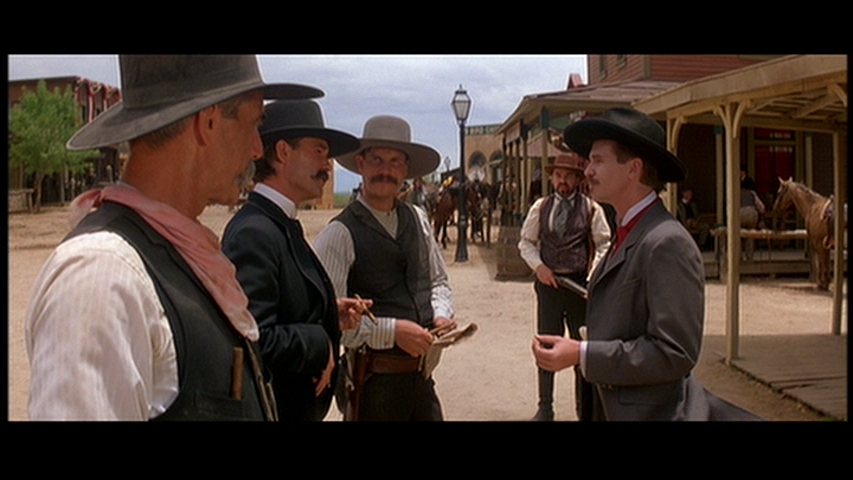
Twenty years on since TOMBSTONE, released December 25, 1993 and the film has survived as one of the most fondly remembered westerns of the past few decades. No one really saw that coming—a chaotic production which was rushed into theaters (presumably to beat the following summer’s WYATT EARP) the studio barely put any effort into selling the film beyond the formality of letting people know it was there only to find surprisingly good reviews, healthy business and talk that Val Kilmer might have gotten an Oscar nomination if they had bothered to push him for one. I enjoyed the film too when I caught up with it on New Year’s Day of that holiday season and actually have a recollection of feeling a sudden sense of ease during an early scene as I found myself realizing that this film was going to work. And it does, for the most part anyway. It kinda sorta falters at a certain point in the last stretch but enough of TOMBSTONE holds together that it’s still a rewarding one to return to. It’s a flat out western with a capital W and it’s become such a rarity to find one willing to revel in the sheer pleasure of that quite so much. In that celebration of the genre is a portrayal of family, of friendships, of myth as well as an acknowledgement that this in telling this story again on film it’s part of that myth, right from how the black & white footage in the opening prologue narrated by the legendary Robert Mitchum is capped by the famous final shot from THE GREAT TRAIN ROBBERY. In that sense, TOMBSTONE is saying, little has changed. We still need those legends and every now and then it’s good to find one which embraces that idea the way this film does.
In 1879 former lawman Wyatt Earp (Kurt Russell) has decided to settle down with wife Mattie (Dana Wheeler-Nicholson) in the growing mining town of Tombstone, Arizona along with brothers Virgil (Sam Elliott), Morgan (Bill Paxton) and their wives. The Earps are soon joined by Wyatt’s old friend Doc Holliday (Val Kilmer) with his girl Big Nose Kate (Joanna Pacula) and the group begins to take charge of a local saloon as Wyatt turns down any and all offers to wear a badge again. But with troubles in his marriage even as Wyatt’s attention is distracted by traveling performer Josephine Marcus (Dana Delany) matters are soon complicated by the presence of The Cowboys, a gang that includes the likes of Curly Bill Brocius (Powers Boothe), Johnny Ringo (Michael Biehn) and Ike Clanton (Stephen Lang) with their eye on taking charge of Tombstone. Unwilling to stand by and watch this happen to the town the Earps soon take charge, imposing a weapons ban within the city limits but even as Wyatt resists getting involved the tensions between the two sides grow leading to the legendary showdown at the O.K. Corral.
It’s that early scene when the newly arrived Wyatt Earp lines up himself and wife Mattie along with his brothers and their wives in the reflection of a nearby window, just to let them gaze upon that moment of the reunion. And as the music swells a certain sense of comfort is felt, a realization of what this film is going to care about and it all begins to click from there, whether or not these feelings have anything to do with the real Wyatt Earp and his kin. Written by Kevin Jarre and directed by George P. Cosmatos (and more on those credits in a bit), TOMBSTONE isn’t a great film but it is an extremely enjoyable one, more endearing than anything else, which counts for a lot and as a result it remains a rousing example of the genre, an unabashed piece of unpretentious entertainment. Much as there might be a tinge of updated revisionism it quickly becomes clear that it’s flat-out in love with the idea of being an old-fashioned western and is the sort of film that wants to celebrate moments like riding through the range towards the next frontier, the next town, more than any such film in the immediate post-UNFORGIVEN period. It depicts the setting of the title in a way that feels lived-in and movieish all at once as well as featuring an expansive look and feel thanks to cinematographer William Fraker with historical touches on the edges of the frame all set to Bruce Broughton’s triumphantly full-bodied score. Going along with that is group of actors who seem perfectly cast for a movie where you would just want to hang out with the people who are up onscreen and that just adds to the sense of pleasure felt right off.
Even if some of the narrative is a little too choppy at times the story holds together to an almost surprising degree with a great deal of momentum building as the tension ratchets up towards the confrontation we’re all waiting for and it’s fun to just sit back with it, to enjoy the brothers and Doc Holliday bantering, to take in the wide expanses of Wyatt and Josie getting to know each other as they ride their horses during their first real meeting. It clicks along, there’s a real energy to it. Maybe it’s not the old west of classic Hollywood old west but it gets the spirit right and feels like the right sort of update for the 90s and also beyond. Plus the O.K. Corral sequence with its Leone-like close-ups (I assume that some of the violence wants to ape Peckinpah but it doesn’t mix in quite as successfully) building to a wink from Doc Holliday that really sets off the fireworks is a nifty piece of action filmmaking that pays off what’s been built up. As much as certain elements may have been added for this telling, like the red sashes of The Cowboys which feel like they’re meant to blatantly resemble gang colors, the straight-forward nature of the story being told feels flat-out refreshing looking at it again now, maybe even more than it was then. If the same script were made today I’d imagine the whole thing would be grunged up—the primary colors of the red sashes and certain costumes wouldn’t be quite so prominent, the period appropriate moustaches would probably be done away with in favor of a more grimey unshaven look (Sam Elliott’s moustache here has to be the Sam Elliott Moustache to end all Sam Elliott Moustaches), Tombstone probably wouldn’t appear as welcoming. Plus I’d imagine that it wouldn’t be allowed to be nearly as much fun. And that pure enjoyment is so much of what causes TOMBSTONE to work. In some ways it feels like a movie about fun actors playing cowboy as much as anything and those good feelings bring an epic feel to this retelling of the famous story almost more than anything else about it.
Keeping in mind the troubled shoot, the pacing is at times a touch haphazard with some scenes that could remain just as easily as being left out, which makes it easy to believe that there are also such moments missing. With some of the actors on the edges of those crowd shots seemingly doing their business whether the camera takes notice or not there seems to be enough lurking on the outskirts of the plot to make us wonder what we’re missing, like whatever’s going on between Billy Zane and Jason Priestly (even though he’s fourth billed in at least one trailer Priestly doesn’t have much presence at all in the final film) or how Dana Delaney’s relationship with Jon Tenney’s County Sheriff Johnny Behan seems to both start and end out of nowhere. Dialogue refers to the town being terrorized by the Cowboys but outside of one crucial murder it feels like we don’t see enough of that. But to its credit the movie does know how to compensate by keeping characters alive within scenes when they don’t even have dialogue like a tight close-up on Joanna Pacula’s Big Nose Kate while Doc Holliday receives news from a doctor and it keeps certain minor players active in the narrative even when they’re not doing anything so they aren’t forgotten about—that it knows how to juggle so many faces feels like a triumph in itself. It’s not perfect and as much as certain scenes feel like they’re given a chance to play out in a relaxed way between the chararcters, like when Morgan Earp talks about a book he read on spiritualism, just as many feel like they’re slamming through to the basic expository plot points as fast as possible, giving the impression that lots was cut down to get the film to a reasonable length—Cecil Hoffman, recognizable from L.A. LAW around this period, gets decent billing (and even a name for her character) for what appears to be a single reaction shot while an important court hearing is only discussed after the fact making me wonder if the scene was cut during shooting.
The post-Tombstone section of the last half hour is the weakest section containing a few fast montages of rapid action and not a lot of plot since much of the interesting stuff has happened already--I saw the film once when it played theaters but not again for years afterward and I remember that I checked out of the film for a few minutes at the exact same time on both viewings. Maybe it’s because when Wyatt & friends set off on a roaring rampage of revenge it feels like a new movie is starting—it’s like we’re getting to see cool stuff that it didn’t know how to fit in otherwise but the style seems all wrong and even though this is just a few minutes of the running time it still causes the movie to stumble at this point with way too much repetition. The story strands do come together near the very end with two scenes that resolve both Wyatt’s relationship with Doc and with Josephine in ways that feel appropriate for what the film is so even the final narration by Robert Mitchum (who was set to play Old Man Clanton before sidelined by an injury suffered on set; the part was simply omitted) which races through multiple important events that we never got to see has the right spirit.
Ultimately TOMBSTONE pays off in a way that feels satisfying, like a meal at a roadside diner which you never imagined could be so good. And it’s all anchored by Kurt Russell, bringing all his onscreen confidence to the role with every bit of likeability and power associated with him, turning this version of Wyatt Earp into an earthbound legend that deserves to be followed. Ultimately, the film is about Wyatt Earp embracing the destiny of the lawman that he is and leading a charge into hell against the evil of The Cowboys while at the same time looking for his own idea of heaven in the form of Josie, the woman he winds up dancing in the snow with right before ordering room service. Whether that’s really legend or fact, it seems correct for this particular film.
Production began with screenwriter Kevin Jarre making his directorial debut but after falling behind and apparent dissatisfaction with his footage he was replaced several weeks into shooting by George P. Cosmatos (some of what Jarre shot, including Charlton Heston’s entire role, remains in the film). While reports of the troubled production made it out there at the time—including an Entertainment Weekly article which is surprisingly frank—it wasn’t until a 2006 interview in True West magazine that Kurt Russell basically admitted to essentially ghost-directing the movie himself when Cosmatos was brought in after Jarre was fired. Many scenes were lost in the rush to keep the shoot on schedule and Russell, who claims he made substantial cuts to his own role to get the other actors to trust him, says just enough in the interview to leave me with even more questions—I also wonder about a claim in the Entertainment Weekly article that those revenge montages were a Cosmatos addition, considering they’re my least favorite stuff in the film. Not to mention what Kevin Jarre, let alone anyone else on set, would say about it all.
Sadly both the credited writer and director have since passed away—Jarre in 2011, Cosmatos in 2005—so there are some answers we’re never going to get but it’s still hard not to hope for some sort of expanded version featuring scenes that are only glimpsed in the trailers and that didn’t even turn up in the 2002 “director’s cut” released on DVD (In 2006 Russell answered, “Because I got a life. Someday I may do it,” when asked why he hadn’t reconstructed the film). Whatever is the truth about Russell’s involvement, and I can believe that it’s a complicated truth, it’s sometimes a miracle that a film is ever made, let alone good, so however good this one is has to be this confluence of events where several people just determined to get something done and they pulled it off. Or maybe it was just in the stars, although I don't know if something that becomes remembered as fondly as TOMBSTONE ultimately is happens without some work getting done. Maybe that’s partly what the film is about as well.
The cast, filled with people who I imagine in ’93 often weren’t even the third or fourth choices for big movies, is a large part of what makes the movie work and you can feel their excitement for playing these characters—Kurt Russell is the sturdy rock that holds much of it together, while Val Kilmer who clearly has the best roll (and best dialogue of anyone) feels almost like he’s doing Captain Jack Sparrow ten years before Johnny Depp yet never feels like he’s in a different movie than everyone else. He’s always adding to his character by playing off those around him and when he chastises Wyatt for insisting that this isn’t Doc’s fight the feelings in his voice are genuine even through the flamboyance. Sam Elliott’s serious determination and Bill Paxton’s youthful enthusiasm play well off of Russell as well. The movie is willing to give the actors the chance to do things with their moments, like the Latin-off between Kilmer and Michael Biehn as Johnny Ringo. Biehn with his nasty intelligence is particularly good but Powers Boothe and his slimy canniness, Stephen Lang’s filthy cowardice, Thomas Haden Church’s slow-witted callowness and Billy Bob Thornton’s hollow bluster in a small role all stick out in their own ways. As Mattie, Dana-Wheeler Nicholson does something with what might come off as a one-note role in lesser hands, while though Dana Delaney doesn’t quite seem period appropriate she still manages to be completely disarming making you believe that Wyatt is totally stopped in his tracks by this modern woman and Joanna Pacula as Big Nose Kate has such an effective, smoldering presence that it makes me wonder why there aren’t whole tumblr pages devoted to her in this film. Harry Carey, Jr., veteran of Ford and Hawks plays Marshal Fred White while Charlton Heston turns up in the final section as real-life rancher Henry Hooker--I particularly like the way the full breadth of his character seems to be revealed in the way he offers his hand to Wyatt right before he rides off. Maybe the scenes don’t really add up to very much beyond giving Heston a chance to make an appearance but it still has resonance as if he’s reprising a role he played in a western long ago and is helping out the leads in this film because, well, that’s what heroes do.
Twenty years on TOMBSTONE is now its own legend, a film with an old fashioned approach that still succeeds in being something new. Six months later it was clear that WYATT EARP wanted to be the David Lean western. This one wants to be a good time, one that still has the shadings needed in the story of Wyatt Earp, while still respecting that legend. I’m not saying one automatically makes it better than the other, they’re just two approaches, but somehow it succeeded. Maybe TOMBSTONE is a case where part of the intent makes me overlook certain flaws and overblown elements but its best moments work so well that they get me to dream of a world where westerns like this still get made. Thinking about this, when the end circles back to Robert Mitchum’s narration the very last line that details what Tom Mix did at Wyatt Earp’s funeral feels absolutely correct. I could imagine that most people seeing TOMBSTONE don’t even know who Tom Mix is, but the point is clear. Those legends matter. It’s why we love westerns to begin with.

Wednesday, January 15, 2014

Not Even A Song

“Let’s face the music and dance,” as Fred once sang to Ginger. Sooner or later you need to, even if things don’t always work out so well in the real world when you try. Long ago when Quentin Tarantino appeared on Charlie Rose to discuss PULP FICTION (the interview can be found on the DVD and Blu-ray--it’s a good one) he brought up the concept of the evolution of director’s careers, specifically during the period of the 70s through the 80s, examining where certain directors seemed to pivot away from the interesting stuff—often, Tarantino says, there would be one big film from a director which would be then dismissed if not the biggest flop of their careers, after which they would begin to repeat themselves or just do star vehicles. Tarantino declined to mention anyone specifically, only saying he had a few in mind, but I’ve always felt he was onto something interesting about tracking certain careers that doesn’t get discussed very much and while I have no idea who he was actually thinking of one who has always come to mind for me in terms of this, probably not the most expected name, was Herbert Ross. With a background that began on the stage, particularly working as a choreographer, Ross has a genuinely interesting run of films in the 70s with titles like THE LAST OF SHEILA and THE SEVEN PERCENT SOLUTION along with acclaimed hits like THE TURNING POINT, THE GOODBYE GIRL (which were nominated for Best Picture at the Oscars in the same year) and CALIFORNIA SUITE. His ambitious, expensive adaptation of PENNIES FROM HEAVEN came in 1981 after which there were more Neil Simon adaptations (I OUGHT TO BE IN PICTURES followed in theaters a mere three months later), a huge hit in FOOTLOOSE as well as a number of, well, star vehicles like the very 80s THE SECRET OF MY SUCCESS and MY BLUE HEAVEN which reunited Ross with PENNIES star Steve Martin.
So I wonder if PENNIES FROM HEAVEN was the sort of artistic summation Tarantino might have been thinking of. It’s just a theory, that Ross in assembling the material from Dennis Potter adapting his own teleplay, along with bringing in genuinely brilliant technical craftsman like director of photography Gordon Willis and production designer Ken Adam as well as a star in Steve Martin who at that point was looking to try something different was able to achieve more than he ever had in a film, to put up on the screen everything about the medium that he wanted to express. And what happened, happened. PENNIES FROM HEAVEN was a commercial disaster when released in December 1981 (that’s one hell of a Christmas gift from MGM) but it did receive considerable acclaim from some circles including an Oscar nomination for Best Adapted Screenplay as well as a win at the Golden Globes for star Bernadette Peters. Plus Pauline Kael, in one of those rapturous reviews that she occasionally turned out, declared it “The most emotional movie musical I’ve ever seen.” It also wouldn’t be a bad guess to make that Lars Von Trier has probably seen it a few times. On a historical level, you could even point out that the film is for all intents and purposes the last MGM musical that was ever filmed on that famous lot even if some people might take issue with the term ‘musical’ here. PENNIES FROM HEAVEN isn’t an easy film. I’m ok with that. Some of it is also transcendent in a way that few films ever even attempt, let alone achieve.
In 1934 Chicago, smack during the middle of the Depression, sheet-music salesman Arthur Parker (Steve Martin) is unhappy in his life and in his marriage to equally unhappy wife Joan (Jessica Harper). The only respite he has from his daily life and unsuccessful business is his frequent journeys into his own dreamworld where he fantasizes a world where the songs he peddles come true just like they do in Hollywood musicals. He thinks things might change when he meets schoolteacher Eileen (Bernadette Peters) although while she lets him take advantage he doesn’t tell her the truth about his marriage. But as bad as things soon get for Eileen who finds herself in her own predicament and unable to find Arthur, an unfortunate twist of fate is about to make things much, much worse for him and even the songs in his head are unable to do anything about it.
Considering they both come from the same late 70s-early 80s filmic period (although actually released four and a half years apart) on the surface PENNIES FROM HEAVEN seems somewhat of a piece with Scorsese’s NEW YORK, NEW YORK in terms of how they’re both over-stylized look at a clash of the film world and real world, between dreams and reality, between what we wish would be and how it’s going to turn out no matter what. As I’ve written about before NEW YORK, NEW YORK, fascinating as it is, kind of makes me want to jump out the nearest window whereas PENNIES FROM HEAVEN hits something deep down, more than I want to confront, more than I want to admit. Even after many viewings I’m still taken aback by how nasty certain moments in its real-world half are, how utterly despondent and vulgar. But they have to be there. The conceit, for anyone who doesn’t know, is that all of the ‘musical numbers’ actually and intentionally consist of lip-synched performances of vintage recordings in fantasy sequences which is what makes it partly a musical and partly not. But what the hell, let’s call it a musical, just about the most blissful musical imaginable, and looking at a few of the numbers on Youtube by themselves always provides a momentary hit of joy but when properly framed against what surrounds them makes that joy presented in them all the more palpable. Why can’t life be that simple, that glorious? Whoever said you could stop a dream? Aside from the whole world, that is, and it’s the world that PENNIES FROM HEAVEN is set in.
Taking on this film so soon after his run as the most successful stand-up comedian around as well as the smash hit of THE JERK two years earlier was about as brave as it could have gotten for Steve Martin and while there have been comic actors in the years since who have made similar stretches I can’t think of another example where it came so soon and attempted to move so far from where that person previously had been. Coupled with how jarring the film intentionally is, how utterly despairing the story being told really is deep down, is how the star is playing a role not only miles away from what he was famous for at the time but also someone who is, much as he talks about wanting to live in a place where the songs come true and are real, a total shit. Not at all the nice, kind and gentle person Eileen thinks he is, just a cowardly shit with a secret desire of where he wants his wife to put some lipstick on, who can’t comprehend a life that might have to come after those songs. How far the movie takes this is just about the most surprising thing about it now. But there’s a palpable desperation in Martin’s voice as Arthur that I recognize, what he’s dreaming of seems more eerily familiar to me than I want to admit. Both utterly joyous and beyond sorrowful at once, it’s a near miraculous piece of work as a film.
Part of that miracle has to be every single one of those musical numbers beginning with the simplicity of the first yearning moment as he ‘sings’ to his wife in the bathroom as she brushes her teeth to the exhilaration of the bank scene, Eileen's schoolhouse fantasy to the tune of “Love is Good for Anything That Ails You”, Christopher Walken coming out of nowhere for his one scene performance of “Let’s Misbehave”, Martin and Peters taking the place of Astaire and Rogers in a recreation of “Let’s Face the Music and Dance” from FOLLOW THE FLEET and maybe most memorably of all, the absolutely otherworldly dance performed by Vernel Bagneris as the Accordion Man during the title song. Every single one of the musical numbers cuts deep more than expected, the film clearly wanting to believe what’s in the musical numbers and the dreams of happiness, joy, laughter, wealth, as much as Arthur wants to, but it knows that it can’t and at times the songs don’t seem to end as much as either drifting off into the mind of the person imagining it or otherwise rudely interrupted by reality. The entire production has such an otherworldly aura somehow placed onto its celluloid it seems unreal that this was ever really accomplished and along with Ross’s direction the look provided by Gordon Willis could make him the auteur of the project as much as anyone, pitting the two worlds against each other—the GODFATHER-like shadows seen in the darkness framed against the unspeakable beauty of the musical numbers. In addition, the recreation of Edward Hopper paintings and Walker Evans photography being an integral part of the overall design which combined only adds to the heightened reality of a world that we may never come close to achieving.
As harsh as the story surrounding those musical numbers can be, almost brutally harsh, the moments of grace in the real world scenes make a mark, the moment of silence on the street with Arthur and the Accordion Man, John McMartin’s outwardly stern principal quietly remembering when he taught in Eileen’s classroom years before, all deliberately thrown against scenes where characters are not connecting with each other for different reasons, the ability of human connection rarely ever able to be as ideal as they are in those songs. Even with those beats of unbearable emotion, the 108 minutes of PENNIES FROM HEAVEN feels almost surprisingly tight with editor Richard Marks keeps the pacing impeccable—during a 20th Anniversary panel at the Motion Picture Academy back in 2001 (an edited version of which can be found on the DVD) several deleted scenes were mentioned including a final scene for Bagneris’ character and, more surprising, what was described as a scene showing the full murder of someone who in the final film is only found dead later on. I can recall Steve Martin commenting that ‘you can feel the movie running out of money’ at a certain point, possibly referring to how the same location is oddly used multiple times. Or maybe he was referring to how the ending feels like it’s missing a beat, a reminder of just how much of a fantasy it is, beyond just showing us that fantasy. These are minor points. And yet when one character calls after another near the very end, the sound echoing as if to accentuate the fakery of the scene simply being shot on a soundstage, the effect is about as haunting as I could possibly imagine.
I’m also reminded about how the character of Arthur is pretty much a prick who can’t give someone a quarter without being an ass about it, even as he’s looking for his own form of grace. When he calls out a declaration to a blind girl he meets played by Eliska Krupka he means it with all his heart, as clumsily melodramatic as the words sound. Late in the film he breaks down as if pleading for mercy declaring, “I’ve always known something terrible was going to happen to me.” I don’t even want to say what I think when I hear that line, only that it reminds me of how the recurring use of the song “Somewhere the Sun is Shining” causes it to sound like the inevitability of fate, a reminder that as much as you want it there’s nothing turning back from the road you’re on. I’ve disappeared into my own dreams more than a few times as well. I’m not sure if PENNIES is the single most emotional musical I’ve ever seen, to borrow the line from Kael, but it seems to understand the unreachable gap between the two halves like few others ever made. It’s not just emotional, it’s soulful. It’s gorgeous. It’s despairing. It’s haunting. It’s not a film I want to live without. If anything, I’m just worried that it’s only going to get sadder as time goes on, as I keep on returning to it in search of that joy.
On initial viewings years ago Steve Martin seemed not quite right to me as if as an actor wasn’t up to the challenges of this part just yet (certainly following up THE JERK with this was commercial madness; now, it doesn’t matter). But looking at it now he seems perfect, every ounce of bitterness feeling truly genuine as those songs play in his head, every piece of bullshit that Arthur slings in wooing Eileen showing off just how much he’s trying to keep the truth from slipping out. Plus his innate sense of timing serves him perfectly when he dances. Bernadette Peters is astonishing, going right from her timidity when she first appears before Arthur in a music store to when she gives that one final ‘yes’ to Christopher Walken to make it clear she understands him and through all that makes it clear how much stronger she is than Arthur as well. Good as the two leads are, it’s very possible that Jessica Harper does the strongest work here, playing a character who is nowhere close to the vision of wonder of something like PHANTOM OF THE PARADISE but someone who the anger and fear that clearly lies within her is absolutely palpable. Either written as shrewish or just perceived that way through how Arthur sees her (which makes me think of how astonishing it is to just look at Jessica Harper’s eyes at certain points), she’s never comes off as friendly at all yet there’s clearly a human being under there, one who’s hurting as much as anyone. It’s just been smothered by life and a husband who she may know better than he wishes but she still has no idea how to communicate with. Christopher Walken is a total powerhouse in his one scene as the pimp encountered by Eileen, Vernel Bagneris is truly haunting as The Accordion Man, while among the many actors who make an impression even in small roles John Karlen is particularly effective as the twitchy police detective who questions Joan about Arthur and as the blind girl Eliska Krupka (per imdb only one other screen credit, in 1988’s DANCE ACADEMY) is beyond ethereal. When he meets her Arthur’s reaction makes sense. I’m pretty sure I’ve wanted to say what he says to girls I’ve never seen again. Some of them haunt me in the dead of night the way this film does.
Oh yes, it all originated as a miniseries, didn’t it? It aired in 1978 on the BBC and starred Bob Hoskins. Feel free to put it on my tombstone, ‘He never saw the original production of Pennies From Heaven’. All right, maybe that’s a little harsh since I’m sure the original is pretty great—I can imagine it has considerably more breathing room with the plot allowing it co clarify certain details that feel a little rushed over—but I’ve reached the point of being fed up with people who, whenever the film version is mentioned no matter what the context, have to pipe in with declaring that the only real Pennies From Heaven is the original and anyone who says otherwise is a philistine. It’s like arguing with the people who insist that Tony Soprano died when that final episode went to black. Actually, it’s worse. I’m done engaging with those people, on Facebook or otherwise. The PENNIES FROM HEAVEN that I’ve always known flopped but it exists now and it certainly has enough admirers to allow for that packed house at the Academy to celebrate its 20th anniversary back in 2001. During the discussion that followed the screening one of panelists onstage mentioned that it was possibly the greatest screening the film ever had. Having been there and seen how well the audience responded to it, I can believe that. It was glorious. The audience loved it. It’s a sort of joy that films rarely have, the kind that understand you can only really appreciate that joy when things are at their absolute worst. And it’s the sort of film that knows both feelings often remain with you forever.