Saturday, November 30, 2019

One At A Time


With Martin Scorsese’s THE IRISHMAN fresh on the brain, it’s impossible not to think of certain other late films by great directors which feel like summations of everything they’ve ever said and done. Something like THE MAN WHO SHOT LIBERTY VALANCE wasn’t really John Ford’s last film but it very much represents the last word of everything he was saying, just as THE IRISHMAN feels like the last statement on every Scorsese protagonist who was by himself at the end, isolated from everyone and everything he ever knew. Of course, there will likely be more Scorsese films to come, hopefully for years, but as is forever inevitable, sometimes the end is the end. And final films are usually not meant to be final films. For John Huston, THE DEAD can certainly be read as a coda to his long career but with John Cassavetes it was BIG TROUBLE, a favorite of mine but not at all one of his personal projects and one he reportedly disowned, unhappy it would be thought of as his final film. Plus there’s Alfred Hitchcock and FAMILY PLOT, Howard Hawks and RIO LOBO, Tony Scott and UNSTOPPABLE, Blake Edwards and SON OF THE PINK PANTHER just to name a few and it’s easy to read finality into any of these to look for some sense of completion. It’s what we do. In reality, these were likely directors still hoping to make more for as long as humanly possible which is how it should be.


Of course, BUDDY BUDDY will always be known as the final film directed by the great Billy Wilder so it’s hard not to look at it as the end of something significant. A comedy so cynical that there’s nowhere really to go once it’s over, it practically qualifies as a final, definitive statement of a world view. How much it succeeds as comedy is open to debate. An instant box office failure when released in December 1981, Wilder himself was never that kind towards it in later interviews and by now the very use of the title has become a short hand for an unfortunate late film, the sort of thing Quentin Tarantino says he wants to avoid by quitting after ten movies. BUDDY BUDDY has the potential elements for classic Wilder and even contains a few surface similarities to his 1974 remake of THE FRONT PAGE—a reunion with Jack Lemmon & Walter Matthau, a story based on previously filmed material, much of the film taking place in a single location and the two were even both released at Christmas. THE FRONT PAGE, likely no one’s favorite Wilder film either, did a little better but between the two of them it’s clear that by this point even Wilder was at the mercy of projects that could be easily packaged by an interested studio. Nobody seems to like BUDDY BUDDY. I sort of do, maybe because I really want to. That doesn’t mean I don’t see problems but there are still a few laughs and I could even look at its finality as a stripped down view of the world and humanity done by a director using two of his favorite actors as vehicles to deliver that verdict. And besides, since this is the end it matters that much more. As Rene Belloq would state with confidence, this is history.


A hitman named Trabucco (Walter Matthau), hired to eliminate witnesses in a massive land fraud scandal, arrives in Riverside, Califonia, where the final witness, a mob stool pigeon, is about to testify that day. As Trabucco arrives at the Ramona Hotel where he has a nice view of the courthouse steps waiting for him, television censor Victor Clooney (Jack Lemmon) checks in to the room next door hoping to reconcile with his wife Celia (Paula Prentiss) who has run off with Dr. Hugo Zuckerbrot (Klaus Kinski) head of the nearby sex institute the Zuckerbrot Clinic (“Ecstasy is Our Business”). When Celia refuses to meet with him Victor quickly and unsuccessfully tries to kill himself, leaving Trabucco forced to deal with his disruptive neighbor as he desperately tries to prevent anything which will bring attention to the job that has to get done.


A remake of the Francis Veber-scripted French farce L’EMMERDEUR (released in the U.S. as A PAIN IN THE A--), BUDDY BUDDY is short and slight plus not as funny as it should be but there is a certain degree of integrity to its cynicism. Written with longtime collaborator I.A.L. Diamond, this was Wilder’s first association with MGM since co-writing the masterpiece NINOTCHKA back in 1939 and it would be nice to think the comedy is in that tradition but there’s not much trace of the Golden Age that Wilder became a legend in. The plotting doesn’t exactly stand up to close scrutiny even for a farce and it’s a sour film, with thinly drawn, unlikable characters living in a world that the director doesn’t seem to have much use for anymore, fed up with whatever it’s become with a dead body followed by the sight of Walter Matthau driving a milk delivery truck reading “FEEL BETTER LIVE LONGER” one of the better jokes. Jack Lemmon’s television censor Victor Clooney is an uptight prig apparently known as the ‘Iron Duke’ at CBS, a nickname I’ll bet he gave himself, who apparently left his wife and family years earlier only to now be dumped by the second wife with nothing to show for that marriage, happy to tell a total stranger he’s been throwing up because his wife left him. The implication to it all is that he hasn’t spent a second of his life actually living which suggests a more intriguing characterization than we ever get. Much of his backstory is revealed in one short driving scene and it’s about all we get of the character, just that and his suicide attempts and all the pleading for his wife to come see him. The way the film is laid out plays as if he’s the sort of putz who Wilder can’t stand while the Matthau hitman is more his speed. All we ever know about his past is a vague reference to being married, as he puts it, “Once. But I got rid of her. Now I just lease,” and everything about him is revealed by his habit of only buying one cigar at a time, never planning anything too far ahead, never letting a sliver of emotion slip through.


The humor in BUDDY BUDDY is not always as sharp as it should be, looking for some sort of middle ground between dark comedy and sex farce that all feels slightly outdated for ’81, with what I imagine was the unique sound at the time of Walter Matthau calling Jack Lemmon ‘shithead’ with Paula Prentiss musing on how the sex doctor she’s sleeping with will help her achieve ‘the ultimate orgasm’. The bulk of the plot is all contained within just a few hours, almost in real time and it’s so tight that there isn’t much chance for enough plot to actually happen but it still never moves all that fast and if the pace were picked up to a certain extent it might barely reach feature length. More than just the hitman plotline it’s really about the two leads, Matthau all stoic and Lemmon taking things to the nightmare end of his flopsweat persona, but the characterizations never get too deep and the way Trabucco acts annoyed towards Clooney you can barely believe that these guys actually just met. Incidentally, the film opened a week apart from the John Belushi-Dan Ackroyd NEIGHBORS, another darkly comic teaming mostly set in one location, but while a Lemmon-Matthau version of that film doesn’t sound very intriguing, the daydream of putting those other two stars into BUDDY BUDDY seems to offer a number of possibilities either way you’d go with that casting and feels like it would have lots of ways to expand on the characterizations.


It’s all set in a bland looking southern California where everyone is already slightly skeptical of whatever they’re being told with a flat, stop-start feel to the rhythm of scenes and the closest thing to any real visual consistency is the way the film seems to place as many palm trees into the frame as possible as though looking for some sort of respite from the stifling nature of it all. Many of the side details are more weird than funny whether the hippie celebrating the birth of his son named ‘Elvis Jr.’ as he gives celebratory joints to cops, the Sitar music that accompanies the scenes at the sex institute (which seems mostly populated by senior citizens, whatever we’re supposed to make of that) and Klaus Kinski dialogue about how “premature ejaculation means always having to say you are sorry”. The extensive rearscreen projection during driving scenes is one of those indicators that make it feel Wilder chose the project because of how logistically simple the production would be along with a Lalo Schifin score which is energetic but still feels like it would be more at home in a mid-70s ABC movie of the week. But even that doesn’t mean I don’t gladly sit through the end credits each time I watch the film and the pure feel of nasty defiance found in BUDDY BUDDY gives the film a certain integrity, even if not enough of the dialogue has the old Wilder-Diamond zing like the orderly at the sex clinic who protests when a woman about to have a baby arrives saying, “We don’t deal with the finished product here!” But the mere sight of Walter Matthau’s annoyance carries it far and the ninety-ish minutes go by in a flash, the work of someone maybe not at their best but always aware of how this should go together.


At one point Jack Lemmon buys a bunch of lighter fluid with the plan to light himself on fire and yells out, “Apocalypse now!” which is actually one of the better lines so there are scattered laughs and bits of business among the ones that don’t work but, in the end, BUDDY BUDDY feels like nothing more than a view of the world by men of a certain age looking back on what’s been accomplished in a life to think when all is said and done the answer is to say, well, fuck it. Why not just shoot somebody, what does anything really matter? The sex wasn’t worth it, you were probably bad at it anyway, the second wife didn’t solve all your problems and now there’s nowhere else to go with the wedding ring that’s been melted down into a charm necklace in the shape of her new man’s giant cock serving as a symbol for it all. There’s still more potential in the various plot elements like the Clooney marriage that the film doesn’t have time for so it feels like a waste to strand the great Paula Prentiss in such a one-note bitch role which I wonder if she took simply because it was Wilder. The end of BUDDY BUDDY is a message that you can’t fully escape the annoyances of the world no matter how far you run so why the fuck not just be your true self. And somewhere in this revelation is a kind of optimism. Billy Wilder lived just over twenty years after BUDDY BUDDY was released so for him it wasn’t really the end. Just the end of all we were ever going to learn from him through his films.


Probably the most consistent pleasure found in the entire film is the incisiveness of Walter Matthau who gets laughs from lines that don’t deserve it, continually showing what he can do with just a few words or no words at all, if necessary. The hitman is probably a better part but Jack Lemmon is simply a little too much in comparison, no subtlety or shading and can’t quite get the laughs out of a character who is a little too pathetic a little too much of the time. He’s apparently playing 48 for some reason, looking not a day younger than the 56 he was but as much as I love and miss Lemmon he just never gets the right moments here for his performance to fully come together. Incidentally, this was the last film Lemmon and Matthau appeared in together until they both turned up separately in Oliver Stone’s JFK followed by their final run of films together in the 90s. Klaus Kinski, who hated this movie, feels more robotic than comedic in almost every line delivery but it’s still enjoyable bizarre to watch him here anyway, making me wish there were more scenes with him and Paula Prentiss who is energetic all through her scenes but she’s still isn’t very much for her to do and it’s too bad. The familiar faces that turn up include Dana Elcar as the police captain, Miles Chapin from Allan Arkush’s GET CRAZY as the hotel bellhop, Ed Begley, Jr. as one of the cops guarding the courthouse plus Joan Shawlee from SOME LIKE IT HOT and THE APARTMENT who plays the receptionist at the Zuckerbrot Clinic.


And since I mentioned him here I may as well recount the story of the time at a party where I met Ed Begley, Jr. and while standing around in conversation for some reason the name Billy Wilder came up. “I worked with Billy Wilder,” he offered to which I piped in with, “Yeah! You were in BUDDY BUDDY!” At which point Begley looked astonished, hopped back a step and said, “How did you know that?” I think my answer was something like, “Because you’re Ed Begley, Jr. And you were in BUDDY BUDDY.” What I’m saying is, in this life we take our immortality where we can get it. L’EMMERDEUR was remade in France yet again in 2008 followed by a Bollywood version in 2012 and it’s a good question why this particular storyline needs to be revisited by anyone this many times. Maybe the recent remakes account for what may be certain rights issues since BUDDY BUDDY isn’t easy to see at all right now except through, um, certain disreputable means; maybe this is why the good people at Warner Archive haven’t released it on disc since MGM titles usually fall under their domain. But regardless BUDDY BUDDY, through the laughs it does have along with getting to see Lemmon and Matthau bicker together is at least one more Billy Wilder film. And with a hitman protagonist who, at the end, is isolated from everyone and everything he ever knew, it’s as much about death as THE IRISHMAN and, just as that film does, the last image of BUDDY BUDDY offers one final, definitive statement about that glimpse of death from the specific point of view of the great director who made it. None of which is a question of whether these films are good or bad but simply what they are. And if that’s not cinema, nothing is.

Some Men Have Strange Desires

If we had more time right now I’d get into it. Things have just been a little crazy lately. What’s good seems to remain just out of reach and I can’t tell which way things are going or what may be coming. That’s the sort of year it’s been, maybe the sort of future it’s going to be. So for now, it’s time for a western. Those usually help. And even when the New Hollywood emerged as the 60s turned into the following decade the western still wasn’t gone just yet. John Wayne, freshly an Oscar winner for one of those, still had a few years to go at that point and his final film for the great Howard Hawks, RIO LOBO, came out in December of 1970. LITTLE BIG MAN, even if it qualifies as a revisionist western, was one of the top grossing films of that year. The genre of course also helped turn Clint Eastwood into a star and at this point no one knew DIRTY HARRY was going to overtake all that so the run of starring vehicles which landed between his Leone films and the introduction of Inspector Callahan is an intriguing batch, as if they’re all part of a top spinning to determine exactly which way his stardom was going to go. HANG ‘EM HIGH turns up on TV more than it probably deserves and PAINT YOUR WAGON is infamous as a prime example of Hollywood waste but there’s also his directorial debut PLAY MISTY FOR ME as well as the pre-Harry films he made with that film’s director Don Siegel: COOGAN’S BLUFF, THE BEGUILED and TWO MULES FOR SISTER SARA, the last of which is also a western and, released in June 1970, in some ways it’s not anything but a western but pairing him with someone like Shirley MacLaine takes the film to a different place in the genre which helps it stand out. It may not be the sort of classic HIGH PLAINS DRIFTER would later become and it definitely isn’t Leone but the enjoyable TWO MULES FOR SISTER SARA is just unique enough to make it a fun discovery. If anything, it’s a reminder to keep an open mind towards the next thing that might be coming which is pretty much what I need right now.


Riding through Mexico, a former Civil War solider named Hogan (Clint Eastwood) comes across a woman being terrorized by several bandits ready to kill her. Hogan dispatches them quickly enough but is soon surprised to learn that the woman is in fact a nun named Sara (Shirley MacLaine) who has been helping Mexican revolutionaries in fighting the French that she claims are after her. Since Hogan has already made a deal to help out the revolutionaries in exchange for half the French’s treasury if they are successful, he agrees to escort Sister Sara to them. But her unexpected behavior reveals her to be a somewhat unusual nun and it soon becomes clear that their journey will not be as easy as Hogan first anticipated.


TWO MULES FOR SISTER SARA is the sort of star vehicle where by a certain point you realize you’re paying more attention to what the leads are doing than the plot which I honestly always glaze over on. Eastwood and MacLaine are definitely fun to watch together even if the two of them feel like they’re bouncing off each other during their scenes more than developing any real chemistry, the banter keeping things going until whatever’s being argued over is dropped and they just move on to the next scene. But even if no real fireworks develop between them it always feels assured as a film and photographed by Gabriel Figueroa (credits include THE EXTERMINATING ANGEL as well as KELLY’S HEROES, also with Clint, which came out the same year) it contains some of the most elegant camerawork found in anything ever directed by Don Siegel, giving the two stars some wonderful close-ups and making full use of the Mexican locations. There’s always a complexity to the shots which visually takes it far beyond some of the director’s other films from the period which can have too much of a ‘Filmed in Universal City’ feel even when they’re shot on location—these are likely distant memories of MADIGAN poking around in my head. DIRTY HARRY would be shot by Bruce Surtees (camera operator on TWO MULES) and in some ways it’s deliberately one of the ugliest looking films ever but in the case of TWO MULES FOR SISTER SARA there’s a beauty to the way it places its two leads against the landscape, offering its own assistance to the growing relationship between them, as if the film itself is looking for ways to keep them in the frame together.


The visual beauty of the Mexican landscape glimpsed in the opening credits is combined with the pure heavenliness that is the Ennio Morricone score which of course is a slight extension of what that composer did for the spaghetti westerns a few years earlier. With a few cues utilized by Tarantino later on for DJANGO UNCHAINED, it provides the expected arch commentary but also takes the threadbare story to a different level, allowing us to accept the heavenly intervention at work even if no one onscreen can, providing this film with its own tapestry of searching for deliverance, however that may come. If I’m being totally honest the power of that music makes me want to like TWO MULES FOR SISTER SARA even more than I already do but from the very first notes heard during the Universal logo that’s where much of the serenity comes from. The film seems willing a surprising number of times to just sit back and let some cues play out during transitions, looking beyond the fairly simple plot towards something else. It’s just what you want from Morricone, the right amount of quirk and beauty combined into something totally unique which makes the film more than it would have been otherwise.


Maybe it’s best described as the sort of movie where the sounds and images are among the best things about it so as a result the most notable aspects of the film may be what it might have been. The screenplay was by Albert Maltz, one of the Hollywood Ten and also a writer on films like THIS GUN FOR HIRE and THE NAKED CITY, from a story by the great Budd Boetticher who had hoped to direct for himself (and reportedly no fan of the film that was eventually made). Elizabeth Taylor was also intended to co-star with Clint but the deal apparently fell apart when she insisted on the film being shot in Spain where Richard Burton was working so Universal cast Shirley MacLaine who unlike Taylor wouldn’t pass as a Mexican (hey, it was a different time) but she was the star the studio wanted. It certainly changes whatever the film was originally going to be but MacLaine’s off-center screen presence finds the balance between the comic grouchiness of Clint and the more serious revolutionary elements the film really only has passing interest in. She brings needed gravity to what is otherwise a lark while playing off of the film’s wry amusement towards the increasingly perplexing way this nun acts and how much sense it makes when revealed why. “The lord grants dispensations in such circumstances” is what she says a number of times to allow for their transgressions while the phrase “Everybody’s got a right to be a sucker once” also gets repeated and the film is ultimately about finding the middle ground between the two to keep going, to give into the fear of losing yourself while with another person, which sort of makes sense for a movie where the two stars don’t totally click in a romantic sense.


It’s a sort of western AFRICAN QUEEN in a way but for long stretches the plot barely seems to matter much at all, veering between the two of them bickering and the genuinely serious glimpse at the revolution in Mexico against the French that it brushes past, putting off actual movement in the main plot until after the hour mark. Even the title barely matters since Sister Sara trades her mule for a burro fairly early, making nonsense of the phrase unless Hogan himself is supposed to be the second mule being dragged along. All this maybe makes it more of a buddy movie than a love story in the closeness that develops even though roughly half of the film is just Eastwood and MacLaine, no one else to share the screen with. But it rarely drags, with the most drive coming during a prolonged sequence in the middle section involving Hogan being hit with an arrow by an Indian attack that Sister Sara has to remove followed by the matter of blowing up a bridge to keep a train with supplies from getting through. It all culminates in some very impressive miniature work and putting aside that it’s hard for me to dislike any film with a spectacular train crash done this way the film still always remembers to be about the two of them so it becomes maybe even something deeper than just a love story, but about two people who respect each other in spite of everything and, ultimately, need each other no matter what plans they otherwise made. But spending so much time with just the two leads still doesn’t allow for very much variety; one expects them to run into an old friend of Hogan’s played by some familiar character actor to liven things up which wouldn’t have been a bad idea and, as it is, there are barely any significant supporting characters at all, with most of the other actors in and out in one scene, either adversaries to be gunned down or cohorts ready with information. The third billed actor in the entire film is Manolo Fabregas playing the Colonel in charge of the Mexican revolutionaries that Hogan is looking to rendezvous with and he has a fair amount of screen time in the second half but even his character is entirely in service to the two leads, everyone else pretty much forgotten by the end.


Which still makes sense since Clint’s Hogan is a loner, sort of a Bogart in CASABLANCA-type more interested in the profit than the cause and surprisingly the film, set in Mexico with two white leads that apparently matter more than anyone who actually lives in the country, never asks him to change his mind. Hogan’s dream is to go to San Francisco, where UNFORGIVEN’s William Munny supposedly wound up after the end of that film, but his desire to stay on his own is upended by Sister Sara and a few of the most unexpected moments in the film gives us a rare look at a Clint Eastwood character who’s at a genuine loss for words thanks to her. In comparison, Shirley MacLaine is, well, the Shirley MacLaine-type much of the time but when she finally takes action the actress finds the needed gravity to the moments which help remind us that there actually is a plot going on and they’re some of the best moments in the entire film. TWO MULES FOR SISTER SARA is a good popcorn movie and I’m not sure it’s anything more than that but there’s nothing wrong with being that either. Even when Hogan and Sara hatch a plan near the end against the French to break into their fortress, the climax has a little too much of a second unit feel when the battle breaks out, losing the stars in the mayhem for much of it except for when Clint gets in some Gatling gun action but at least some of the explosions are pretty cool. TWO MULES FOR SISTER SARA has that but also remembers to find the grace notes to pause among the landscape and the music with a final shot that serves as a reminder of what it means to stay with another person against your better judgement while still never entirely losing yourself and who you really are.


Because of all this it comes down to the two leads and how they work off each other to make them evenly matched so instead of sparks that come it’s an easygoing camaraderie which pays off whatever’s been growing between them throughout the film. Clint Eastwood combines the coolness of his spaghetti western persona with the patience of having to deal with this nun he can’t quite understand and considering it would be several decades before he would again co-star with an actress of equal stature (all respect to the likes of Jessica Walter, Tyne Daly, Sondra Locke and Patricia Clarkson) he seems totally comfortable sharing the screen, always aware that just his presence in the frame can be what’s needed. Meanwhile, Shirley MacLaine and her physicality are always engaged with the setting, displaying expert comic timing when needed and holding back her true self until just the right moment so when the façade is ripped away she plays the scenes as barely moving a muscle to underline the gravity of the moment and how there will be no arguing with her.


In his autobiography “A Siegel Film” the director seems pleased with how TWO MULES FOR SISTER SARA turned out even though producer Martin Rackin took control for the final edit but mentions with some confidence that he had shot the film to be cut a certain way regardless. Shirley MacLaine, meanwhile, later on said that she loved Clint even though he was a republican and, yes, this is a struggle many of us have had through the years. But maybe this film is really about looking beyond that surface to what can develop in spite of everything, the way Hogan and Sister Sara discuss whether certain things that happened were in fact miracles or just simple accidents. Which is often a good question to ask as you move through life, to understand what led to those domino effects that changed things for you irrevocably, with no way to turn back. Maybe there was a reason. Or maybe there is no answer and the decision of whether you’re going to be alone through all this is up to you. Even westerns can ask these questions, even if that turns out to be only a minor element of the film in the end. Maybe I respond to the beauty of music by Ennio Morricone so much because it sounds like fate, the sounds of what you can potentially discover as you ride through life, trying to find the answers to the life you really desire and if it’s really possible to ever find that without giving up your greatest dreams.

Saturday, September 21, 2019

Captive On The Carousel Of Time


The following contains extensive spoilers about ONCE UPON A TIME…IN HOLLYWOOD.

Sharon Tate did die. We already know this. She died and so did Jay Sebring and the others who were at the house up on Cielo Drive with them and then the LaBiancas across town the next night. We know all this. And when I look at certain films that came from Hollywood over the next few years it’s hard not to see the darkness that has fallen over things because of that horrible event, because of the 60s ending then as the narrative became. Whether it’s the climax of BEYOND THE VALLEY OF THE DOLLS and how it was very much exploiting the events of that night, when Mark Rydell as gangster Marty Augustine in THE LONG GOODBYE takes a Coke bottle to the face of his angelic redhead girlfriend (played by Jo Ann Brody in her only screen appearance) it’s always Sharon Tate that I think of, Goldie Hawn sitting in her house up in the hills in the ’68-set SHAMPOO who has “this terrible feeling that something awful is going to happen” or, maybe most obviously, the way Roman Polanski chose to end CHINATOWN. All this becomes a part of these films just as much as it becomes a part of the town itself and whatever else ONCE UPON A TIME…IN HOLLYWOOD shows us, we can never forget that.


Sharon Tate also lived. She lived and she married Roman Polanski and she made THE FEARLESS VAMPIRE KILLERS with him and she also made movies like DON’T MAKE WAVES and THE WRECKING CREW, quickly becoming one of the most stunning examples of Hollywood beauty ever seen, while also displaying a comic potential that would have been truly wonderful to see develop in a life that is too often forgotten except for how it ended and nothing else. “Why don’t you stand over by the poster? So people will know who you are,” the ticket seller at the Bruin says to Margot Robbie as Sharon Tate, never even thinking that one day people might know her for anything else. I probably shouldn’t mention the girl I knew some years back who once went as Sharon Tate for Halloween and what that costume entailed.


This was a Los Angeles that I never knew since I wasn’t around yet but at least in ’69 my parents lived on Wilshire in a building that Sharon Tate would have driven past shortly after picking up that hitchhiker on her way to Westwood Village. The past stays with us and like it or not in Los Angeles some of those memories are going to be about all that driving, all those times on the freeway when we have to make our way back to the valley, the goddamn valley, so far up it feels like the end of the earth. Brad Pitt driving in this film is a wonderful thing to see as the day turns into night, with him speeding down Hollywood Boulevard, speeding down the freeway towards the exit with that Van de Kamp’s windmill waiting at the end of the Panorama City off-ramp as he heads for his trailer behind the Van Nuys Drive-In. All that driving in this film feels like it’s at least partly taken from Jacques Demy’s all-holy MODEL SHOP, a film actually released in ‘69 which also understood the rhythm those long days can fall into when you’re doing almost nothing but that driving, in no hurry to get anywhere. Cliff Booth is never in much of a hurry either. It’s just the way he drives.


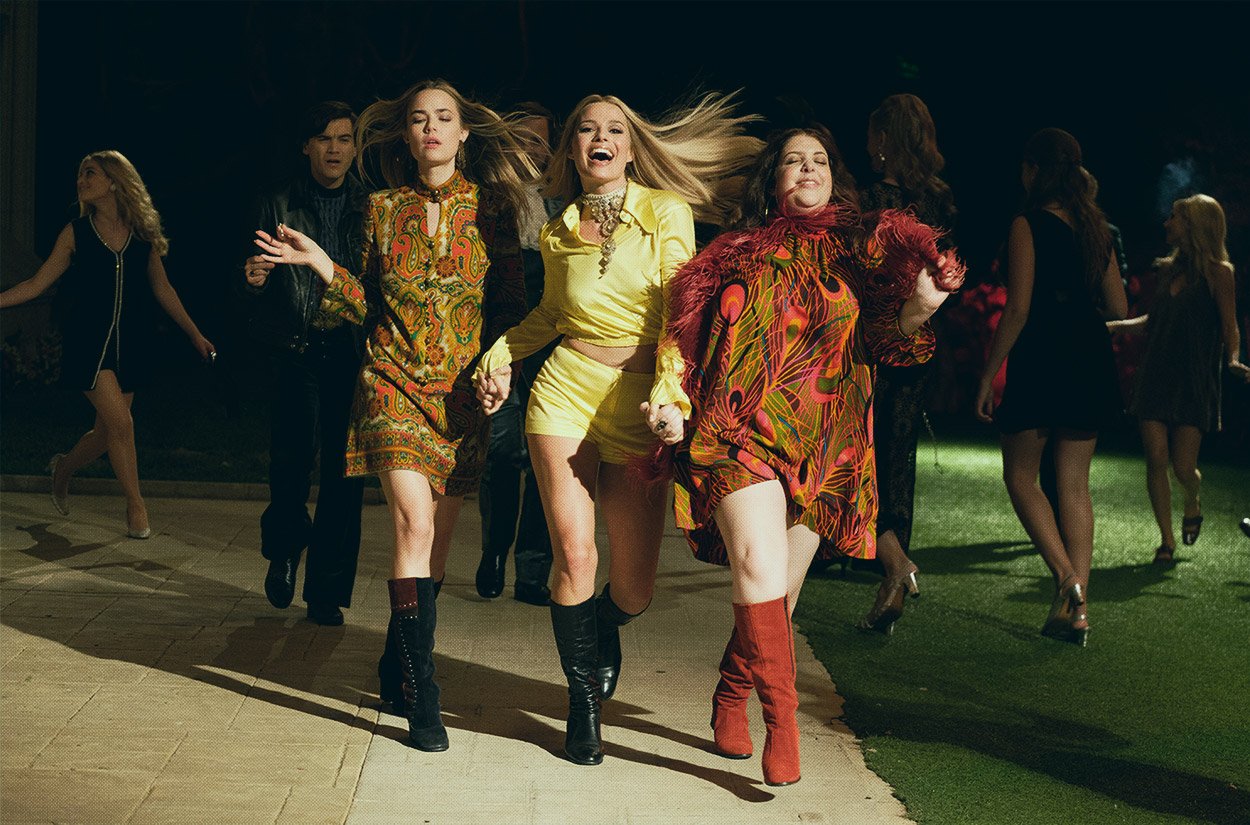
ONCE UPON A TIME…IN HOLLYWOOD is a memory piece, the Tarantino version of Fellini’s AMARCORD, with its own history of what life was whether it’s what really happened or not, filtered through all those movies, TV shows and half remembered daydreams of billboards never seen again. Filtered through memories that never happened or maybe were never allowed to happen, which in this town can sometimes get mixed up. It takes its time like no other Tarantino film, the story of Hollywood cowboy actor Rick Dalton (Leonardo DiCaprio), stuntman buddy/driver Cliff Booth (Brad Pitt) as well as Sharon Tate (Margot Robbie), the rising star living next door to Rick on Cielo Drive and the long day each of them spend in February ’69 before the film jumps ahead to August 8th of that year when the only thing anyone on that street seems to know for certain is that it’s going to be another hot summer night. There are many things that make ONCE UPON A TIME…IN HOLLYWOOD as glorious as it is, vibrant through every moment yet elegiac in its recreation of this time with a tinge of sadness always hanging around the edge of the fame and is maybe more about love than any other film Quentin Tarantino has ever made, even if it’s a love you always worry might fade away like the end of a movie. In that sense, it’s about loss as well. It’s as close to pure joy as any film I’ve seen in a long time.


Whether or not I wind up calling it Tarantino’s best film is something I’m willing to wait on but right now at the very least it feels the most confident, the most fearless, the one most willing to pause and take in the air in a way films never do anymore, yearning to remember what things were like as it tries to turn those memories into something more. And through every heightened, fanciful moment it feels the most human. There’s a carefree vibe all along the way, never in a rush to get anywhere and along with how much the film loves its three main characters there’s a non-stop affection for the ephemera of its world and pop culture that years later you only sort of remember whether it’s the rush of gazing at certain movie posters as a kid or even down to the sound of the Screen Gems logo briefly heard. The astonishing detail of Barbara Ling’s production design transforms those Hollywood streets filled with signs and marquees of what was around then with camerawork by Robert Richardson that always becomes a part of the moment, capturing the middle ground of a past receding further into memory and how much it always stays with us. Of the sprawl sometimes found in Tarantino’s films and scripts, this is the one most unencumbered by the rigidness of plot and any impulse to toss unexpected twists into the narrative, freeing the film up in its exploration of character, behavior and sense of place. The only thing close to a ticking clock, after all, is August 1969 with that whoosh heard as the end of each day cuts to black, propelling us closer to that night whether we like it or not. But along with all those movie posters, and you know every single one of them is there for a reason, it also catches what it can be like to feel stranded in this town when things have changed so you no longer know for sure if you’re still living here or just waiting for something else to happen.


Already each new viewing offers moments that I keep looking forward to seeing again whether the natural camaraderie of the two leads, the way former Spider-Man Nicholas Hammond as Sam Wanamaker directing the LANCER pilot comes in full throttle at the hungover Rick Dalton, Cliff Booth’s realization that Margaret Qualley’s Pussycat might be more than he can handle even before she gets in the car, the way Al Pacino’s agent says the name of his wife “Mary Alice Schwarrrrrzs”, the guy who says, "Rick. It's a flamethrower." or, to go darker, how The Mamas and the Papas’ “Twelve Thirty” rises on the soundtrack as a certain car appears, ready to fill us with dread for all time. Not to mention the specificity of the Kurt Russell narration when describing Rick’s six month stay in Rome, giving us all the footnotes that anyone who wants to know about these films is going to care about. The sounds of the day coming from the radio that everyone always has on AMERICAN GRAFFITI-style veers away from what are by now the expected late 60s sounds from every movie, instead giving us Paul Revere and the Raiders, Neil Diamond, Buffy Sainte-Marie, not to mention all that easy listening music drifting out of episodes of MANNIX and the like, offering an innocence still found then in pop culture as a reminder how even as the world outside was falling apart that naïve charm was still barely hanging on for a few seconds longer. The amount of time spent on the set of the LANCER pilot that Rick Dalton is appearing in feels a little like an excuse by Tarantino to quietly make another western without anyone knowing ahead of time but he uses that fantasy to make this show look better than any of those shows ever did back then. But just as how Rick Dalton’s hit NBC show BOUNTY LAW and his B-grade WWII epic THE FOURTEEN FISTS OF McCLUSKY, which apparently uses a piece from Bernard Herrmann’s rejected TORN CURTAIN score, echo Tarantino’s own films it’s also like he’s reveling in the chance to make a fantasy version of what he’s done before only removing any post-modern irony from it, to show off where those films and ideas were really born to make clear how much he wants them to stay alive, how much he loves and misses them more than anything.


When agent Marvin Schwarzs offers an assessment of Rick Dalton’s prospects over that Musso & Frank lunch it clearly strikes a nerve and though maybe his career isn’t looking as bad as he seems to think but it’s still in a precarious state. That TV-to-film transition, which apparently included one with Suzanne Pleshette called JIGSAW JANE that I want to hear more about, didn’t go so well but doing guest shots alongside people like Norman Fell doesn’t really sound that bad (plus TANNER co-stars Ralph Meeker so I’d really like to see that one). Even if a director wants him to look like a hippie cowboy it seems to bring something out in him making me think Rick is a better actor than he’s ever allowed himself to be but as a perennial guest star he’s never at home on the these sets, as if always renting instead of buying to recall the advice Edmund O’Brien once gave him, always asking for directions to find his way and I suspect falling back on an acting tick of tossing trash down on those western streets whenever he can. He’s got the talent as well as determination but has maybe burned a few of the wrong bridges and, besides, even if he stays alive another 28 years, questionable with that cough and all those whiskey sours, he’ll be too old for Tarantino to use him in the Max Cherry role when JACKIE BROWN comes along.


Rick is as set in his ways as anyone resentful of the counterculture would be, happy to stick with his booze that don’t need no buddy while everyone else is trying something considerably stronger and the only thing that really throws him off is his encounter with the future in the form of the child actress played by the remarkable Julia Butters and in describing the book he’s reading, the tale of cowboy Easy Breezy, he gives a fairly heady summary that just like the movie we’re watching sounds strangely more character oriented than the slim piece of pulp fiction we’d expect (one small bit here that’s gone without comment involves the dispute over Rick Dalton’s character name on LANCER which plays like a reference to the way ‘Domergue’ is pronounced in THE HATEFUL EIGHT versus how DiCaprio’s Howard Hughes says the same name in THE AVIATOR). Rick’s answer to his problems always seems to be how much he’s in a war that he has to fight with himself whether acting in a scene opposite an eight year-old girl who baffles him at first or being surprised when lounging around in his pool. And he has to win. When he remembers that, when that eight year-old gives him that compliment after he pulls things together for his LANCER guest shot, it seems like he might be ok.


Cliff Booth doesn’t have these problems. He doesn’t have much of anything at all beyond a questionable past involving the death of his late wife and the trailer where he lives among the oil derricks, the MODEL SHOP influence sneaking into frame again, and even the TV left on for his loyal dog Brandy while he’s gone recalls Kim Novak’s equally broke Polly the Pistol and her parrot in Billy Wilder’s KISS ME, STUPID. But compared to the jitteriness of Rick, Cliff is always in his Zen state, always knowing where he’s going on the road even though he has no idea what lies far ahead. The unexpected glory of watching Brad Pitt make macaroni & cheese for dinner while watching MANNIX in another of those moments in the film I can’t stop thinking of, at the very least getting me to make some for myself some and as he pours out Brandy’s food before sitting down to talk back at the TV it makes me wonder what secrets he’s holding onto. After all, you know that he and Rick have never talked about what happened with his wife. Brad Pitt’s weathered face almost cracks a few times through the chill demeanor during his time out at Spahn Ranch when pushed to the breaking point and he’s a Tarantino character unlike any other, definitely not one who can be explained in a pulp novel since there’s no one else to compare him to. Cliff is a guy who doesn’t have any idea where he’s going anymore but he’s always up for watching Rick’s network guest shot with a six pack nearby ready and waiting, just like any good friend would.


Sharon Tate, meanwhile, doesn’t have a care in the world except for maybe people not being sure who she was in VALLEY OF THE DOLLS but she loves her husband Roman who may or may not be cheating and has Jay Sebring nearby, whatever the state of their relationship is. And Tarantino has held back on his legendary dialogue to simply let her exist and looks at her with nothing but affection, especially when she decides on impulse to go see her co-starring role with Dean Martin in the Matt Helm spy spoof THE WRECKING CREW, which I always say is the best of the four Matt Helm films partly because of the spark the actress brings to it although your mileage on these things may vary. The theater is the Bruin (where 23 years later I would attend the premiere of UNFORGIVEN, starring an actor curiously unmentioned here), a reminder that, not counting the Chinese and the Cinerama Dome, Westwood Village really was once the greatest place to go to the movies but it also turns into what is for me the most purely joyous scene in the film partly because of the way it highlights this stupid movie I’ve always secretly kind of liked but also in the way it gives us a glimpse at the real Sharon Tate so that along with the way Robbie responds to the film and everyone around her watching it, the moment is played as if sneaking off for the afternoon to see THE WRECKING CREW represents all that is Good in the world. It’s pure cinema, no dialogue necessary at all and the look on her face as she leaves the theater while the Jose Feliciano cover of “California Dreamin’” plays is a person who is totally at home, the image saying more than words ever could and, at last, the right way for this actress to be remembered.


The film offers that moment to Sharon and pretty much no one else, certainly none of the other real people portrayed get the chance. Steve McQueen, The King of Cool himself, feels like one of the least likely movie stars to ever be saddled with giving exposition so naturally the way Tarantino does that here itself feels like a joke, lamenting that he never had a chance with her in words echoed by Rick Dalton about his near miss of getting the McQueen role in THE GREAT ESCAPE even as he plays himself in the part in his mind. Bruce Lee is worried about saving face after his run in with Cliff Booth but no one listens and he never gets a chance. LANCER star James Stacy as played by Timothy Olyphant is last seen riding off on his motorcycle in what feels like Tarantino’s requiem for all those actors he was too late to give a shot at a comeback to. Just a few years later he’d lose an arm and a leg after being hit by a drunk driver while on his motorcycle so he never had a chance either. They’re all out of time, none of them knowing the full extent of the New Hollywood that was already well on its way.


It also comes up with a solution of what to do with that third rail of anything involving Sharon Tate at all and having her be the loving, beating heart of the film means it’s not about Manson who turns out to be close to a total non-entity, appearing in one brief scene before being summarily dismissed and only referred to as “Charlie” otherwise. Tarantino correctly shows no interest in any of that or what he was doing, not even deserving of a thirty-second scene ranting about Helter Skelter or whatever and particularly surprising coming from the man who wrote the original screenplay for NATURAL BORN KILLERS, the film has no interest in glorifying the Family or even in making them ironically interesting. It’s another reminder that I’d rather read a book about the making of THE WRECKING CREW than anything Manson related and in some ways that’s what the movie’s about too. Whatever he represents is irrelevant as far as the movie is concerned and the visit to Spahn Ranch where he’s not even around plays out as a PSYCHO/TEXAS CHAINSAW MASSACRE slow burn mashup without the expected payoff, dragging out the suspense only to give us monsters in the form of these hippie girls who have emerged from the bones of Hollywood’s western past that Rick so reveres. Both Rick and Cliff spend this afternoon on old west sets encountering young people who behave in totally unexpected ways but it’s the more relaxed and open Cliff who turns out to have zero connection with what he finds. It’s one of the best extended sequences by Tarantino ever and along with editor Fred Raskin it nails the tempo of how certain shots and beats are allowed to play out, stretching the tension as far as it can go between the VILLAGE OF THE DAMNED stares of the Family and the sounds coming from the TV, including more Bernard Herrmann music not used in TORN CURTAIN as it turns out, locking into the nightmare fantasy of finding yourself in this place in early ’69. Even the tension between Cliff and the Dakota Fanning version of Squeaky Fromme offers no way to tell the true horror of what’s coming but there’s clearly something very wrong with the dazed George Spahn as played phenomenally by Bruce Dern who after several agonizing minutes of Cliff trying to get in there to for a look turns out to be not a Mrs. Bates in control over these kids from a back room at all but a zoned-out old cowboy with western themed wallpaper in his bedroom, not unlike all those western tchotchkes Rick Dalton has, only his version of the past is already lost and he’s given in to the power these children of the future have over him without a single thought, the future coming faster than anyone possibly realizes.


With INGLOURIOUS BASTERDS, the director presented an alternate WWII where knowledge of film theory made someone qualified for a top secret mission, a comic strip fantasy where cinema literally killed Hitler and won the war. But the way this film alters what happened late that night feels like it’s coming from somewhere more personal for Tarantino, as if even as a kid he sensed that something very wrong happened here which allowed itself to permeate the world he grew up in. And while Tarantino may or may not share Rick Dalton’s feelings on the youth culture of the time (“Who, the dirty hippie?” Sydney Poitier asks about Rose McGowan in DEATH PROOF) he finds the beauty of the carefree hope in the air as Sharon Tate picks up that hitchhiker on Wilshire heading to Westwood Village, the two of them instant best friends with only good things seemingly in front for both of their lives and all the possibilities in the world. Even Rick’s new wife Fancesca Capucci played by Lorenza Izzo, who you can easily picture turning up in an Italian James Bond knockoff, is mostly a comical figure but the way she snores just like Sharon shows there’s some endearment towards her and by getting in a punch at one of the most notorious murderers of the twentieth century she more than earns her stripes.


But then there are those young hippie girls marching away from that mural of James Dean and everything he represents, even if there is a vague awareness of who he was along with all the other cowboys they had on their lunchboxes but they still don’t care, as if the film is anticipating a future of people who have no idea who these hippie girls were or what they did or who Sharon Tate was or what it all meant, a reminder that in Hollywood the past doesn’t matter whether it’s 1969 or 2019. But it matters to Rick Dalton just as it matters to Tarantino and as for the Manson family, in their rantings about Hollywood and in their hatred of who they’re determined to wipe out it sounds like the seeds of the way people years later would choose to follow a racist reality TV star and be part of a much more dangerous cult. Their hatred of Hollywood in their rationale of who to kill and what it did to the town, what it did to the world, becomes Hollywood itself fighting back against that which is what Cliff with his brute strength and Rick with his flame thrower that he’s been keeping out back do in their moment of triumph that they’re not even completely aware of while on booze or acid-dipped cigarettes. It’s to finally laugh in the faces of these detestable people while providing a form of catharsis for all the fear, sadness and terror begun on that night and continued over the decades by these people which means the film marks the fiftieth anniversary of this event by stripping them of their power and Tarantino treats them the way they deserve right up to the end. When we finally hear the voice of Sharon coming from that intercom and the Polanski home gate opens up at the end as Maurice Jarre’s score from THE LIFE AND TIMES OF JUDGE ROY BEAN (another film where an actress is revered from afar and which contains a title card reading, “Maybe this isn’t the way it was…it’s the way it should have been.”) comes up on the soundtrack to reveal the final moment it’s as if everything is suddenly reborn in an alternate reality, even while none of them have even the slightest idea of what’s just happened. The world is different now and there’s hope for the future. It’s a nice dream but the sadness in that music makes it clear the movie knows what really happened. It happened, after all. It always did.


Leonardo DiCaprio at least equals his career high in THE WOLF OF WALL STREET, balancing the comedy and Rick Dalton’s arrogance with his insecure desperation over where he’s suddenly found himself and it’s tremendous work right down to the way he walks from moment to moment, leading to the spectacular ferociousness of his trailer breakdown where every ounce of his anger and desperation comes pouring out. Brad Pitt is essentially a god here as Cliff Booth, delivering what might be the best performance of his career as well as very likely the best part he’s ever had to play with his charm always in control of the moment and more than anyone else here a display of star power in a way we just don’t get anymore. Margot Robbie isn’t quite a dead ringer for Sharon Tate but she captures the carefree and blithe charm just right, with the unknowing goodness found in the way Sharon politely waves at Manson as he walks away. Plus the joy in Robbie’s face watching the real Sharon Tate is magic itself, not to mention the one key moment when all we hear is the sound of her voice, essentially what the entire film has been leading to and the result is otherworldly. Of the others in the cast, maybe too many to mention and praise, there’s Julia Butters as child actress Trudi Fraser whose intellectual approach to the work leads to its own rewards, the awesome physicality of Margaret Qualley as Pussycat and how she prepares to finally get in the car as Cliff drives up, Mike Moh as Bruce Lee, Bruce Dern as George Spahn, Emile Hirsch as Jay Sebring, Dakota Fanning as Squeaky Fromme, Lena Dunham as Gypsy, Luke Perry in his final role, Kate Berlant as the box office girl at the Bruin and the great Clu Gulager helping Sharon Tate out in the bookstore. Plus the no-bullshit directness of Kurt Russell’s stunt coordinator Randy on THE GREEN HORNET and the way he tells Rick about Cliff, “I don’t dig him,” along with how perfect the actor is for the narration with the tone of someone who’s been there and remembers.


The past becomes little more than half-remembered names as time goes on, the way Bruce Dern’s half-awake George Spahn can only mutter ‘John Wilkes’ as Cliff Booth introduces himself. Generally, the past doesn’t matter to people. If only Sharon Tate could have lived. If only the movies were still larger than life. If only a lot of things but who knows what would have changed. Of course, the 70s would still have happened. The western would have continued to fade away. Nixon was still president, Reagan was still governor. DIRTY HARRY would likely have been at least somewhat different but Joan Didion was still going to have to find something to write about. There are too many what ifs and LA was going to change as well just as it always will, whether you’re having dinner at El Coyote or Casa Vega. Maybe because of this, the neon beauty of the glorious sights of the Cinerama Dome, Musso & Frank and Taco Bell in the “Out of Time” montage devastates me more each time I see it, the lights coming on as the world is ending. Like the best films do, ONCE UPON A TIME…IN HOLLYWOOD reminds us of the things we love in this life and somehow makes them even better than we ever could have dreamed even as there are parts of my own life that echoed through my head at certain moments in the dialogue. But it’s also about what friendship can actually mean in this town, not just what other people say it means, and the hope found in that idea, so maybe for just a few moments late at night you feel like you’re no longer just passing through but in the place where you belong and were always meant to be. Maybe this film means so much I don’t want to say all the reasons. I just look forward to future viewings and what it will mean for me as time goes on as I continue to dream of living in this movie, the inevitable dread of the first viewing replaced by a joy at revisiting it until, finally, the sadness that I always feel at the end of this masterwork. That haunting final shot has Margot Robbie as this version of Sharon Tate emerging from her home just as her DON’T MAKE WAVES co-star Claudia Cardinale does at the end of Sergio Leone’s ONCE UPON A TIME IN THE WEST, each sent to offer a form of cinematic benediction, each in their own way a symbol of all that is good in the world, one the promise of the coming civilization and growing west, one the totally pure love of the movies and all their possibilities coming out to greet her neighbor Rick at last. It’s that feeling of what we wish we could change but never can. But even if it may be too late we still hope for what our lives could be, so the best parts of our past will be allowed to become part of our future. We live the lives we were meant to and dreamed of long ago.

Sunday, August 25, 2019

To Hook Up The Doll


Whatever crush I had on Molly Ringwald back in the day ended long ago but I follow her on Twitter for old times’ sake and was very pleased to see her 2018 New Yorker piece where she looked back at the films she made with John Hughes to confront certain plot points in them which, to be blunt, have aged about as well as Mickey Rooney’s Mr. Yunioshi in BREAKFAST AT TIFFANY’S. Acknowledging such things are necessary, particularly since people out there are presumably showing these films to their kids but as for the films themselves I’m not sure how passionate I am about them. To be honest, I lost interest in high school about 48 hours after graduating from high school so revisiting THE BREAKFAST CLUB or FERRIS BUELLER’S DAY OFF never holds much interest for me. The freewheeling all-in-one-night aspect to SIXTEEN CANDLES can still be fun although I can’t ignore that film’s problematic aspects nor do I want to. I still have a fondness for the Howard Deutch-directed PRETTY IN PINK and SOME KIND OF WONDERFUL in theory even considering how they mirror each other but, in truth, I haven’t seen either one of those in years.


Coming in the middle of all this, WEIRD SCIENCE is just about the silliest of this group and the one most detached from any sort of reality, so much so that it almost overrides whatever issues there might be with the plot of inventing a gorgeous woman as plaything. Not that it makes any difference now but it’s the only one of these films that I’ve never seen in a theater; released by Universal in early August ’85, I was trapped in summer camp up in Maine at the time and it must have already left the local multiplexes by the time I got back. Looking at it now, WEIRD SCIENCE seems to represent a moment when Hughes let his attention wander away from Ringwald and PRETTY IN PINK notwithstanding never seems to have entirely gone back. Maybe instead of a muse he wanted an alter ego and that’s where his interests led him. WEIRD SCIENCE is maybe too slight to be offended by but as a full movie maybe there’s just not enough there. It does present the idea of a teenage weekend where everything goes right thanks to a fantasy woman who shows you the way and even now I can kind of relate to that as a daydream while still being very aware that maybe there’s nothing wrong with leaving this movie back in the 80s.


Teenage outcasts Gary (Anthony Michael Hall) and Wyatt (Ilan Mitchell-Smith), whose parents are out of town for the weekend, are doing nothing on Friday night when Gary gets an idea to use Wyatt’s computer to make a girl, an actual girl. Miraculously this somehow works and the beautiful Lisa (Kelly LeBrock) appears in his doorway, ready to do whatever they want. And she wastes no time upending their lives but soon Lisa’s real agenda to makes their lives better, to give these boys a shot at becoming men, becomes clear and even as Wyatt has to deal with bullying older brother Chet (Bill Paxton) the two of them see a chance to win over the girls of their dreams and throw the greatest party the town has ever seen.


The key image of the film, not counting any shot which contains Kelly LeBrock, might be the two guys with bras on their heads which could be seen as a metaphor for the teenage male trying to find a way into the female psyche but on the other hand it could just be typical John Hughes immaturity. Looking at WEIRD SCIENCE now is a reminder that what John Hughes could do was write scripts that might have actually come from real high school students (most likely male) if they really knew how to write them. They’re slight, they’re goofy, they’re immature even as they reach for deeper themes and in many ways they’re fearless which allows them to capture something about the feeling of being a suburban teen in an affluent suburb that many other such films haven’t. For a film set over the course of a weekend—36 hours, really—it feels a little like WEIRD SCIENCE took just as long to write, which considering some of the stories about how Hughes cranked out things during this period may not be far from the truth. It’s a weekend movie that feels like it was written over a weekend but I don’t mean that in a bad way. It doesn’t even have the briefest time span of these Hughes films but it does feel like the slightest of any of them with even the big party, which you couldn’t be blamed for remembering as the climax, kicking off before the film is even half over. In broad strokes, it’s a story about two guys maturing due to the guidance of a woman but also how clueless you can be when fantasy unexpectedly becomes reality and only you can decide what’s going to happen next.


Coming out during the same summer as other teens-and-science movies like REAL GENIUS and MY SCIENCE PROJECT (Joe Dante’s EXPLORERS sort of counts, to say nothing of BACK TO THE FUTURE), more than anything WEIRD SCIENCE plays right from the start as a much goofier RISKY BUSINESS, maybe the closest Hughes came to that other Chicago teen film, combined with the wish fulfillment aspect of this woman willing to do anything with powers that are never clarified but so what, but is really there to turn the boys into men just not the way you’re thinking. All of this works as well as it does thanks partly to the sheer energy of the leads but the slapdash nature of it all means that it doesn’t have too many plot ideas beyond the big party. The way the high school kids are paired up from the leads to the girls they’re going after as well as the bullies played by Robert Downey (Jr.) and Robert Rusler all against the singular force that is Lisa feel like a set of parallels that a more fleshed out concept could have done something with, particularly since Downey and Rusler basically disappear by a certain point. When Lisa takes Gary and Wyatt to a sketchy bar downtown it’s actually not a bad idea as a comment on how sheltered kids are up in the suburbs but the whole sequence feels a little random coming so soon in the film and the racial element plays like leftover ANIMAL HOUSE material combined with some half-baked improv. John Kapelos, who gets the immortal line “What’s a beautiful broad like you doing with a malaka like this?”, is always welcome in these movies and if Hughes had written ADVENTURES IN BABYSITTING (he didn’t, you just think he did) I’d call this a very rough draft of the club scene in that film. But as usual this is very much set in the affluent white Chicago suburban Hughes world of Shermer, Illinois, with less screen time in the actual high school than the other films but we can get a taste of what it’s like. It feels just as segregated as ever with the brief glimpse of the one tough-looking, somewhat androgynous girl at the end of a line of guys ogling Lisa about as progressive as this world ever gets.


It feels like the future according to this film is computers and a colorized version of FRANKENSTEIN although it seems a little curious that they’re not watching BRIDE OF FRANKENSTEIN, but never mind. “I want her to live, I want her to breathe. I want her to aerobicize,” Gary tells Wyatt as Lisa is created and it’s a film where all logic is sent spiraling into outer space but as much as Hughes has no interest in rationality here, LeBrock somehow grounds it. From Lisa’s very first line she gets the tone and even finds an emotional logic to every scene, possessing no inner life—hell, nobody in this movie has an inner life—but she also never hesitates for a moment in what she does, pushing the guys into taking command of their situation as they bounce off her in scenes displaying disbelief although oddly, even though Hall was the star at the time he doesn’t get the big kissing scene with her. Parents are more irrelevant than usual in Hughes’ films this time out and Gary’s are a joke but one bit near the very end where Wyatt’s returning dad declines a hug has a surprisingly plausible edge in the middle of all this, another of those fathers trying to turn their sons into men in the most toxic way. The stuff with the grandparents showing up works pretty well, especially the line about “the Rex Harrison hat” even though the movie totally forgets about them too and when the film goes vaguely near T&A material with the girl at the party who gets her clothes ripped off when things go haywire and hurled out of the chimney I wonder how much of the slightly skeezy vibe can be attributed to producer Joel Silver (this was the only time Hughes and Silver worked together; a Silver-produced remake announced in 2013 has yet to happen). But even the girlfriends, mostly presented as insecure and confused in wondering why they’re with any of these guys to begin with, are still kind of playthings to be bartered over as well as rescued which turns out to mean more than simply having the courage to talk to them ever would.


There’s still a definite conservative streak to the whole thing and maybe another film might have tried to play games over whether or not anything ever really happened between Lisa and the two guys. Even back in 1955 it was only the production code that kept Tom Ewell from sleeping with Marilyn Monroe in Billy Wilder’s THE SEVEN YEAR ITCH, after all. It maybe feels more finely honed production-wise than SIXTEEN CANDLES but that film had better jokes as well as Molly Ringwald at the center and there are maybe a few too many shots here of the guys standing, staring incredulously at whatever’s happening. It moves so fast at the start, jumping into things as quickly as possible with the whole creation montage that makes no sense but who cares helped by that incessantly bouncy Ira Newborn music but it’s still pretty thin and when the movie hits the hour mark even though I know what’s coming I still wonder how there’s actually 30 minutes left to go. Broader than the other Hughes-directed films during this period it’s loaded with throwaway gags tossed into the frame like Hall drinking Coke from a brandy snifter but just as many of those jokes fall flat, another thing that makes it all feel a little tossed together so the mayhem doesn’t quite hit a peak.


A few Frank Tashlin-style sight gags as the party spirals out of control along with the missile that emerges from the floor to stick out of the chimney makes it seem like the movie could have gone crazier and even the blocking in the big confrontation with the bikers who invade the party is pretty dull as if they had no real time to shoot it. But more often than not the film maintains a sense of looseness through its rush to have almost nothing of actual consequence happen and some actors even visibly break character in one scene, smiling during some Bill Paxton antics near the end but it’s the sort of film where this isn’t a big deal. Mainly, it’s a movie about overcoming fear and trying to find the real person in an illusion, a lonely Friday night fantasy of what you wish could happen over a weekend before going back to school. Plus the title song by Oingo Boingo is pretty great. The film was released in August and even though I didn’t see it then, it’s a dog days of summer movie that’s a product of a more innocent time. Nothing wrong with revisiting, of course, I just never want to stay there.


It’s so broad that if it was a movie with more naturalistic performances it wouldn’t work and unlike his character Anthony Michael Hall seems up for trying anything; no reaction is too big and his acting style becomes the equivalent of the fearlessness in Hughes’ writing. With Ilan Mitchell-Smith (who starred in the Cameron Crowe-scripted THE WILD LIFE the previous year) as Wyatt, the charm is in always looking like he might start cracking up at his friend even when he’s supposed to be upset so the relaxed vibe bounces off him nicely and he even gets a sly fourth wall break. Kelly LeBrock is confident, loose and seemingly up for anything as Lisa, always working the frame that she’s in so no one pays attention to anyone else and using the commanding tone of her voice to full advantage, as if always daring the younger guys to take command of a scene they’re in together.


The forever awesome Bill Paxton almost steals the movie as Wyatt’s brother Chet, going even bigger than Anthony Michael Hall if that’s possible and doing things to contort his face that are still mesmerizing and finding the joy in this prick that Robert Downey and Robert Rusler never do as their bullies who aren’t as much fun in their assholishness. Boy, I miss Bill Paxton. Suzanne Snyder, who went on to play two separate roles on SEINFELD and Judie Aronson, who appeared again with Robert Downey, Jr. as “Gift Bag Girl” in KISS KISS BANG BANG, have a sincerity to their scenes which comes off as genuinely likable and their bits together have a genuine chemistry that makes the friendship seem totally real in the middle of all this. Vernon Wells of THE ROAD WARRIOR and Michael Berryman of THE HILLS HAVE EYES are a few of the mutant bikers who invade the party while the perfume salesgirl is played by Jill Whitlow who one year later starred in NIGHT OF THE CREEPS, a film Suzanne Snyder had a small part in which always gave the impression the two had switched places for some reason.


WEIRD SCIENCE was released only six months after THE BREAKFAST CLUB and maybe it makes perfect sense to follow that one with a movie which is pretty much its total opposite in tone but it does feel like the genuine sensitivity that people have always responded to in John Hughes’ films, for better and also for worse, is a little absent this time out. It wasn’t the hit that some of his other films of the period were although it actually did slightly better than SIXTEEN CANDLES just over a year earlier. Go figure, but of course it has the expected cult following these days. WEIRD SCIENCE was also the last Hughes film to feature Anthony Michael Hall, which is still surprising maybe since we just assumed at the time there would be lots more and feels like what we remember about the 80s was already starting to fall apart halfway through the decade. Maybe the filmmaker’s biggest hits were still to come but it’s as if the things people responded to in them as well as the looseness they had which feels so rare these days (SUPERBAD comes to mind) was lost along the way. There’s never any reason to think all that much about WEIRD SCIENCE, a film that doesn’t really ask you to anyway. It has its charms but strains a little too much to get there and maybe isn’t really worth defending all these years later. Guess I still have to think about it anyway, whether it’s because I missed it at the time or because I never had a weekend like this one in my own suburb. Of course, eventually you have to move on.