Thursday, September 5, 2013
Into An Untroubled World
Some nights I cook for myself. I don’t claim to be any good but it’s something I like doing especially when I make pasta, probably more often than I should. I chop up onions and garlic and other things to put in the sauce while listening to music that you’d probably hate but particularly on Sunday nights it’s a ritual that I’ve developed a weird attachment to by now. It’s something that I look forward to doing and that’s just the way it is. So, anyway, the remake. Commonly known these days as the reboot. Which, I suppose is one way to avoid actually saying that it’s a remake and is also a way to avoid having to come up with an idea for something. Beats working for a living, after all. There are actually many points to make in favor of the remake—hey, it wasn’t until the third version of THE MALTESE FALCON when they got that one right and something like HIS GIRL FRIDAY was of course a remake of THE FRONT PAGE, only with an arguably better spin on it. But unlike back then the very concept in this day and age behind any given remake is to not offer anything new beyond making the overall approach more ‘grounded’ and ‘real’—the skeleton of whatever the structure might have been made of is still visible and the story may make sense but the way it ultimately plays out is lifeless, a movie going through the motions of its own self. The title has as much to do with it as anything else and the days when the classic noir OUT OF THE PAST was updated to the 80s and titled AGAINST ALL ODDS to bring an updated spin to the story are long since gone. These days the point is to remind people of the original in the most hollow way, bringing very new little to the table, to streamline the story, removing things like irony and satire while maybe tossing in a cameo from someone who was in the original while they’re at it, maybe to give the impression that the whole thing is authorized. There have been good remakes. It’s just tough to remember what they are sometimes.
Edgar Wright’s new film THE WORLD’S END which you’ve hopefully seen by now is about many things one of which is the danger of nostalgia, the folly of one person attempting to remake what he remembers as the greatest night of his life and what happens next from that return to one’s hometown. As I’ve written about before I may remain haunted in the dead of night by images of where I grew up, a place I don’t have much of a desire to go back to—members of my family have all moved elsewhere so it’s really not a concern for the time being. To mangle a line from MAGNOLIA, I may be through with the past but that past doesn’t seem to have very much interest in me either. In addition to being hugely entertaining, THE WORLD’S END struck a nerve in me down to the bone and Edgar Wright is one of the few directors of this generation who displays a love of films, as well as being someone who has some of the best story sense around but you can also tell how personal some of this is for him and with this new film you can tell that he’s setting the bar for himself higher than before and I’m looking forward to many repeat viewings. It gets a lot of things right, not the least of which is to point out that eventually you have to say Fuck Nostalgia. Fuck where you came from. Sure, there’s going to be some love mixed in all that way deep down but you can’t live there. You shouldn’t live there. You need to do something new, to keep moving forward and face what the future might conceivably hold. Something remakes don’t do. New things in life are good. That’s forgotten way too often these days.
Which makes this the perfect opportunity to talk about a remake that actually is excellent, one that is willing to expand on the original, turning it into its own thing while keeping the spirit of where the story came from very much alive. After all, the metaphorical possibilities in science fiction and horror do lend themselves to updating a concept to another time in order to take advantage of the new era. Martin Scorsese’s 1991 remake of CAPE FEAR became a giant swirling mass of cinematic imagery combined with how the south of the original had changed in the thirty years since it was made. Even if Cronenberg’s THE FLY and Carpeneter’s THE THING had nothing to do with the AIDS crisis as the world responded to it in the 80s in terms of intent it’s hard not to think about the subject while watching those films. In comparison you could make the argument that since the 2011 prequel/remake of THE THING was also set in 1982 it isn’t really about anything at all. The 1978 version of INVASION OF THE BODY SNATCHERS directed by Philip Kaufman was very much about something that was in the air at the time the film was made, just as any version of that particular story needs to be, has to be. There’s always going to be the fear of losing ourselves, losing our individuality, becoming lifeless and going through the motions of its own self. Of course, exactly what that loss means, what we are in the greater context of society, means something a little different in each decade. As part of the lead-up to the release of his new film, the ‘78 BODY SNATCHERS was programmed as part of Edgar Wright’s two-week “The World’s End is Nigh” series at the New Beverly and it was a great thrill to see it in 35mm for the first time, even if the print was slightly faded, since it’s one of those 70s films that even if it was a hit at the time has maybe fallen through the cable TV crack a little more than it’s deserved to. It stays in the brain and maybe haunts me now more than it ever has.
Almost as pure cinema, the first remake of INVASION OF THE BODY SNATCHERS essentially tells us what’s happening right away, beginning with an opening credit sequence that details the process of these lifeforms departing their own world to eventually arrive on Earth in San Francisco. Matthew Bennell (Donald Sutherland) works for the Health Department whose co-worker Elizabeth Driscoll (Brooke Adams) has discovered a strange new flower and the day after bringing it home her live in boyfriend Geoffrey (Art Hindle) is suddenly acting strange to the point that she genuinely believes that he’s not Geoffrey. Matthew has Elizabeth talk to his friend Dr. David Kibner (Leonard Nimoy), a well-known psychiatrist, for advice, but even he speaks of a strange hallucinatory flu that seems to be going around. As Matthew’s married friends Jack (Jeff Goldblum) and Nancy Bellicec (Veronica Cartwright) get involved he genuinely begins to believe that there’s something going on around him, that people really aren’t who they seem to be anymore.
Shortly after the opening credits as the webs make their way down into the Bay Area we get a now infamous Robert Duvall cameo, with the actor briefly seen dressed as a priest on a swing set as one of the lead characters pass the playground nearby. And that’s it. It’s unexplained. We never see him again. And yet the recognition of the moment sets us perfectly on edge. Almost unnoticed as everyone is paying attention to how this really is Robert Duvall are two things: the teacher who has just been suspiciously glaring at the passing Brooke Adams is encouraging the kids to take the flowers home to their parents so she is obviously already a pod person, just as the priest Duvall probably is as well, and the kid on the swing next to him is behaving particularly goofy, something that probably won’t be happening for very much longer. These elements in each shot are laid into things all the way through, continually keeping us on edge while maintaining a sly wit in just about every scene. Almost as if contradicting itself it’s one of the best San Francisco films ever while at the same time somehow making the charming city seem totally cold and hostile. With a screenplay by W.D. Richter (SLITHER and BIG TROUBLE IN LITTLE CHINA, along with directing BUCKAROO BANZAI) based on the original novel “The Body Snatchers” by Jack Finney, this version of the story has been greatly discussed in the past as taking advantage of what the 70s were just as much as the small town original version had lent itself to the McCarthy 50s whether about communism or people simply staying at home to do nothing but watch television from then on. The San Francisco of the Me Decade seen here containing book readings filled with people looking to pour their hearts out to the latest big name in pop psychology and live-in boyfriends more focused on the game he’s watching with his headphones don’t seem that different from certain equivalents that would be around today. The context of post-counter culture sixties is there even if it remains under the surface and it’s not a reach to look at the film 35 years on and see it as being about the ultimate nightmare of the sixties generation in that city as everyone just sits back and lets Reagan take over—it’s not for nothing that one of the possibilities suggested of what may have happened to Geoffrey that he’s become a Republican, which before the truth is learned may seem like the most horrifying possibility of all.
There’s continuous snap to the dialogue whether discussion over whether anyone expected ‘metal ships’ or a decidedly ominous “I’ll see you soon…I hope” one woman who has turned says to Adams at one point. Every beat of the narrative is laid out expertly and even the relationships between the characters are vividly mapped out through shorthand without overexplaining why certain people are friends or how they know each other, particularly in the unspoken flirtation that’s been going on between Sutherland and Adams as well as whatever he’s told his friends about her (“This is THE Elizabeth?” is heard when one of them meets her). There’s also Nimoy’s teasing of Goldblum, a successful psychiatrist and author who seems to be pulling the appropriate advice from the filing cabinet in his head instead of listening versus the jealous poet who takes six months to think of a single line, the hack who’s a success placed against the artist with his principles jealous of that success. Scenes like these offer a consistent immediacy to the film’s tension and humor making it stand out all the more—maybe since Kaufman was never a horror director along the lines of John Carpenter the tone he’s going for here feels that much more jaggedy, distorted like through those funhouse mirrors in the bookstore. It’s as if his uncertainty of what would play correctly for the genre works for the uncertainty of the narrative, dangling on the precipice between suspense and satire as people about to be forcibly turned are earnestly told to not ‘be trapped by old concepts’, between the blank stares of Art Hindle’s Geoffrey and the insistent humanity brought forth by Sutherland’s lead performance, playing a person who seems relaxed in his daily life as he cooks for himself yet seeming to enjoy the exacting nature of his power over fancy French restaurants.
Maybe best known now for directing THE RIGHT STUFF (as well as his co-story credit on RAIDERS OF THE LOST ARK), Kaufman’s work here is some of the best of his career containing metronome-like pacing to every single scene with those ominous garbage trucks everywhere. It propels itself forward through the enshrouding dread of the second half and a certain pop feel to the social commentary while being always serious about the threat as the utter blackness of the sequences where the characters are being pursued feel like the worst possible nightmare yet still very real. Right from the start Kaufman is planting suspicious-looking extras around the edges of the frame which seems almost too obvious and yet you could imagine in real life people wouldn’t pay much attention to that sort of thing. It’s to the film’s credit that many of those strange glances could be just about anything. It’s also to the film’s credit that every single one of them are probably exactly what we suspect they are in the end, an encroaching threat that seems like a shroud of darkness literally making its way over the film. The logic of the film seems to be that everything has already happened before the characters in the film have had a chance to even begin to realize it and the result is almost unnerving in its normality at times—when it becomes clear that one character has turned he doesn’t come off as a monster so much as someone simply annoyed that it wasn’t allowed to happen sooner.
There is some middle-of-the-movie juggling in the narrative when all it can do is stand in place for a few minutes while the threat intensifies, so a meeting with a city official is barely seen and doesn’t result in anything afterwards. But the best things stand out, like the genuinely eerie depiction of exactly how the change takes place when the pods are nearby as well as the score by Danny Zeitlin which maybe could better be described as a full-on soundscape (I could write a whole piece on my favorite uses of sound in the movie—Ben Burtt of STAR WARS legend is credited with the sound effects) along with the tiny touches like the strip club barker promising that what’s inside is “Guaranteed to make you feel like a new man!”, a genuinely memorable use of “Amazing Grace” or just the basic paranoia of the big city, the people who won’t stop staring, the cab driver (played by Don Siegel, director of BODY SNATCHERS ’56) repeatedly asking where you’re going. Like the San Francisco-set FREEBIE AND THE BEAN from a few years earlier barely a sequence goes by without a glimpse of the Transamerica building—on Kaufman’s DVD audio commentary he speaks of wanting it to appear to be pod central, a notion that certainly comes off in a few shots and considering how this is film was released by United Artists when they were owned by Transamerica the concept comes off as meta in several ways.
The question of what exactly remains of the former person inside is intriguingly not completely answered, all the way up to the famous final image and a moment near the end where we get to see people at their job, take over, zombified, changed, having already slept, doesn’t seem that far off from the real world these days. In spite of its placement in the series at the New Bev and however much these themes tie into the plot of THE WORLD’S END it feels a little like the film was at least as much of an influence on Wright’s earlier SHAUN OF THE DEAD, particularly the growing tension of the first half and a similarly unexplained shot of a man running in terror down the street—the constant attention paid to the angling of the houses on these San Francisco slopes makes me wonder if this film was also a large inspiration for how Steven Soderbergh photographed the city in CONTAGION. But the more I think about THE WORLD’S END and how bitterly its characters display their regretful feelings towards the past it at times makes me wonder if there really is more to the comparisons under the surface. The genuine enjoyment of this BODY SNATCHERS stands out and makes the film continually engaging on repeat viewings, yet the emotion that comes to the surface near the end makes me think about similar thoughts of regret and waiting around, not doing anything about what you deep down want to change. Matthew tells Elizabeth that he loves her, something that only happens because of the situation they’re in. And then suddenly it’s too late. Before then he was doing his thing, enjoying his casual flirting with her, cooking his food, doing his job, trying to be casual about it all. But he couldn’t say it. Not until then, when there was nothing more that could be done about it. Since she was living with a guy anyway, there probably wasn’t anything that could have been done earlier. Life isn’t fair. Which I suppose is an emotion that the pods want to rid us of. They want to make it so that doesn’t matter anymore. Either way, there are no happy endings.
Donald Sutherland is outstanding, using his height to intimidate when necessary but allowing his confidence to shrink down as he becomes more unsure about everything and the chase grinds on—I can’t think of many other examples of a hero begging for his life as nakedly as he does late in the film. Everyone is excellent and add to the flavor of each of these people mattering—the down to earth goofiness of Brooke Adams, the nebbish insecurity of Jeff Goldblum (seen in three films throughout the ‘World’s End is Nigh’ festival—INTO THE NIGHT and THE BIG CHILL were the others), Veronica Cartwright who is particularly good at balancing her exposition with the growing freak-out of her character and Leonard Nimoy in a sly use of the baggage that comes with his most famous role which he plays as if overjoyed at the chance to balance himself between the two halves, making every statement seem like he’s processing a quantum equation. Of course, Kevin McCarthy of the 1956 original 1956 makes a cameo appearance early on essentially reprising his most famous scene from that film, one of the first times this sort of cameo appearance ever happened and probably still the best—not at all shoehorned in, the moment plays perfectly well if you don’t know the original and if you have makes it all the more unnerving. As directed, McCarthy seems to go through the reprise of his most famous dialogue faster than we’d expect as if he doesn’t have the energy to shout it anymore. He knows what’s coming. He already knows.
On its release Pauline Kael went gaga for the film proclaiming, “For undiluted pleasure and excitement, it is, I think, the American movie of the year—a new classic.” The shrieking of the pod people has since become iconic and I suppose that a few lines of dialogue have as well, particularly, “How do you know my name? I didn’t tell you my name,” additions that have become as familiar to the BODY SNATCHERS lore as anything in the original. And it’s been officially remade two more times to date, by Abel Ferrara as BODY SNATCHERS in the early 90s and by Oliver Hirschbiegel as THE INVASION in 2007. Both productions had their problems—Warner Brothers barely released the Ferrara version to theaters (I’ve always liked that film) and the latter film, which even featured Veronica Cartwright in a supporting role, underwent extensive reshoots with another director. It’s a safe bet that it’ll be remade again eventually. The fear of losing someone you love, losing yourself, while you ‘sleep’, is too good a concept to not explore as our world continues to change. To be optimistic about this inevitability I’ll say that at least it’ll be another chance to prove my belief about the worth of remakes wrong. And I’ll be happy to let that happen. In the meantime I’ll return to my kitchen on Sunday nights making my pasta, listening to “Sinatra at the Sands” or whatever weird Italian lounge music I’m in the mood for and dream of being myself, thinking about the certain women I’m avoiding declaring my real feelings to. After all, it’s not too late yet. And if it is, I’ll try not to think about that for a little while.
Wednesday, August 21, 2013
It Happened That Way
The issue of commercial viability regarding the western in today’s marketplace has only gotten worse through the years. For one thing, we’re even further away from when the genre actually meant something to a large portion of the audience. For another thing, the foreign market matters more now than it did at one time and they’ve never been all that crazy about the western overseas anyway—even the few that are domestic hits these days like TRUE GRIT 2010 earn much of their money in the U.S. and, well, that’s just not how things are supposed to be done anymore. THE LONE RANGER was several years in development and budgeting and scripting and directing by Gore Verbinski and producing by Jerry Bruckheimer to fashion it into the sort of extravaganza those men know how to make and the response hasn’t been so swell. I’ve never been all that crazy about any of the PIRATES OF THE CARIBBEAN films which have been embraced all through the world, not even the first one, so it’s a touch ironic that I didn’t really mind THE LONE RANGER much at all, messy as it kind of is. It’s not great but it’s not all that bad either, at least somewhat bizarre, energetic and with a climax that is as rousing as I’d want it to be. If only more of the film lived up to that but it’s still not the biggest calamity I had to deal with in Summer 2013. Although one thing I think it has in common with other would be blockbusters like WILD WILD WEST and JONAH HEX is the nagging feeling that within all the action and a certain steampunk-type approach is a film that is hesitant to be ‘just’ a western, to express love for the genre and simply enjoy that aspect of itself.
Truthfully, I don’t know if I entirely minded the bomb that was JONAH HEX all that much either but minus credits the thing only lasted about 73 minutes anyway so maybe I just felt sorry for that movie. On the opposite end of the spectrum in the past several decades is Lawrence Kasdan’s bio-pic WYATT EARP which embraces the idea of being a western full throttle, running over three hours even in its shortest cut (longer than the theatrical edit of DANCES WITH WOLVES) and didn’t do very well at all when it was released at the end of June 1994. I saw it opening day in Westwood, after what seemed like six months of the trailer playing before every single movie that came out, scored with Ennio Morricone music from A TIME OF DESTINY presented with all the pomp and circumstance to indicate that this was going to be the biggest, most important historical epic of modern times (there were actually two separate trailers but only one is on the DVD). That’s not how things worked out as everyone seemingly waited a few weeks until FORREST GUMP was released for that particular look at American history. I admit to being a little underwhelmed at the time by WYATT EARP like most everyone who actually saw it was and it sure didn’t help that TOMBSTONE, rushed into theaters six months earlier, was a good deal more fun. Looking at it now when the movie isn’t doing anyone any harm and we’re all kind of wishing that maybe we’d been a little nicer to Kevin Costner when we had the chance, WYATT EARP is still an extremely flawed film that seems to lose its own footing more than a few times but I can’t bring myself to have that much animosity towards it. Maybe because it’s a western. We need westerns. We always will.
The epic-length WYATT EARP tells the story of Wyatt Earp (Kevin Costner) and his life, from growing up on a farm being watched over by his stern by loving father (Gene Hackman) to his first marriage that ends in tragedy and causing him to hit rock bottom. Almost by chance he eventually finds himself working in law enforcement leading to his eventual life as a legendary marshal in Dodge City and later on in Tombstone where his legend is solidified along with his good friend Doc Holliday (Dennis Quaid). As an actress new to town named Josie Marcus (Joanna Going) enters his life to possibly give him the love he’s long been without the growing tensions between the Earp family and the lawless Clantons eventually lead to the legendary Gunfight at the O.K. Corral, an event which seals the legend of Wyatt Earp forever.
Almost twenty years after it was released the box office failure of WYATT EARP, a pretty big deal at the time, feels mostly forgotten now so all we’re left with is the film, a giant swirling ode to the western as lived through a main character who believes in the tragedy that is the world, depending on no one and perfectly content to have no one but family depend on him either. What is WYATT EARP? Is it, ultimately, an epic telling of an important life that took place during the evolution of the American West? Or is it an epic tale about epic tales about the American West as filtered down through both mythos and, ultimately, Hollywood films? Maybe it’s an epic tale of a star and director who want nothing more than to make the biggest, grandest western in the form of myth they ever imagined and had the power to attempt. That might be the answer. Whatever it is, WYATT EARP is definitely ambitious in its goals as well as earnest in its approach. It’s clear that director Lawrence Kasdan and producer/star Kevin Costner mean the passion that runs through every scene in their bones as they attempt to go beyond the simple old-fashioned thrills of their previous collaboration SILVERADO back in ’85. And I may as well be honest—for sentimental reasons and because I like westerns anyway there is something I enjoy about revisiting this one all these years later, even as I’m aware in the back of my head that it doesn’t entirely connect, that I’m not having the emotional response it’s trying to get out of me.
The scale evident in scene after scene with magnificent vistas and production value all over the place makes it look kind of sweet now as if trying to fashion itself into an automatic masterwork, not knowing that the world wouldn’t really care about this sort of thing anymore. The craftsmanship is always evident. The film is genuinely trying. More than the overriding nobility and inherent squareness to the approach which seems too much at times, one problem with WYATT EARP is that it feels so determined to craft itself into an epic come hell or high water, striving to be John Ford through a David Lean filter whether the spine of the story warrants it or not only it doesn’t contain the profundity to pull that off. There are many qualities to WYATT EARP. Is it self-important? Maybe, kinda. Is it also genuinely impressive at times? Yes, it really is. Scene after scene is exquisitely staged but whether or not any number of them really need to be there is another matter entirely and as a result the problems go beyond simple length, beyond ambition, to a point where the ultimate emotional effect feels muted or just not quite there, maybe because of choices that were made somewhere along the way in what they wanted the film to be, wanting it to span the full life of the man instead of spending more time on the really interesting stuff.
Written by Kasdan and Dan Gordon, part of the issue may simply be one of structure. With the exception of an in media res opening the approach is basically linear, beginning with a first hour that builds up Wyatt Earp’s character and the man he becomes, how his father’s outlook on things shaped him, how losing his young bride scarred him, learning the lesson that if you’re not willing to be harsh to harsh people in this harsh world that’ll catch up to you. It turns Wyatt into the cold person he is, unwilling to debate or argue, unwilling to let anyone close until his friendship with Doc Holliday and eventually his romance with Josie Marcus, the two people who will look him in the eye and he’ll look back. It all makes sense, I’m just not convinced we need everything in that first hour or at least not as much of it as we get, possibly robbing him as a character of any mystery or ambiguity from that point on. In bio-pic tradition it’s the sort of film where an early marriage goes from wedded bliss to heartbreak in a cemetery within about five minutes but that aside the first hour or so actually has the best flow of the entire film in the way it’s paced.
The conundrum is that it’s hard to avoid the feeling that almost none of it is needed and when we enter Dodge City at the 70-minute mark this is where the movie we came to see is really beginning which maybe wouldn’t be such a bad thing if it were really the case. This isn’t because I’d rather see a fun, good old-fashioned western instead of a brooding, moping character study (or is it?) but I can’t help but think that all the backstory didn’t need to be stretched out so much. Oddly, it feels like less is missing from the tapestry of the film in the early section as if when someone was making a pass through the entire picture looking for things to remove late in the game they wound up cutting more as they went along simply out of impatience. As a result it feels like chunks of the drama that we actually want to see are missing whether that’s the case or not, resulting in some occasional clumsiness like when a bartender asks Wyatt questions about why he’s left Dodge City and the scene plays out in the most Basil Exposition-way imaginable. If cuts were made maybe they were the wrong ones and as it goes on more pieces feel like they’re missing—Tom Sizemore’s Bat Masterson, a major character in the Dodge City section, is asked if he wants to go to Tombstone but doesn’t respond and then we never see him again. Isabella Rossellini gets a big introduction as Doc Holliday’s girl Big Nose Kate (I like her defensiveness when she says, “All kinds of reasons a person gets a name”), is seen once more and then that’s it. Dennis Quaid does solid work but because of his late entry doesn’t make the dramatic impact it feels like he’s designed to provide.
The Tombstone section of the film doesn’t even feel like it has a proper beginning—we’re just there at one point instead of the movie fully acknowledging the arrival and for what we would imagine is the meat of things the plot mechanics involving the buildup to the O.K. Corral sequence feel more sketched in than properly clarified so what follows never means as much as it should. The conflict between the Earps and the Clantons is merely taken as a given so it doesn’t have the necessary power, just feeling inevitable since, after all, this is what’s supposed to happen in a movie about Wyatt Earp. The problem with the entire film isn’t just the long running time but that it’s a case of a long film where the length is felt more as it goes on. Actually, while watching it this time I suddenly began to have the daydream of not cutting things down but instead making the material even more expansive to allow for two separate movies so it could all flow better, maybe called WYATT EARP: DODGE CITY and WYATT EARP: TOMBSTONE. Flashbacks could have been interspersed, details could have been dwelled on and maybe the desired effect could have been reached. For obvious commercial reasons it never would have happened, but I still think it’s a valid idea.
Comparisons to 1993’s TOMBSTONE (not to mention things like MY DARLING CLEMENTINE, which I really should have seen more times by now) are probably inevitable but still unfair—not just to the film but to people like Dennis Quaid who delivers a solid performance, one of his best, but TOMBSTONE’s Val Kilmer not only got more to work with he just seemed to become Doc Holliday. And in that film’s very title it knew where to focus on everything while ultimately WYATT EARP, even if I genuinely enjoy some of it—Kasdan does do a pretty snazzy job with the entire O.K. Corral sequence making it messier and of smaller scale than would be expected—feels like it’s so focused on the stoicism of its lead character along with making noble proclamations that the tone becomes stifling and ultimately I’m not sure what it’s really about. Family? Loss? Perseverance in the face of an uncaring world? It reaches for myth through big statements in dialogue and imagery borrowed from other places, like when Wyatt is first made Sheriff and the moment plays as an inversion of HIGH NOON’s most famous shot, as opposed to letting these themes play out naturally through the material. The score by James Newton Howard seems intent on providing the epic sweep and it’s beautiful (not Morricone but still pretty good--I’ve always liked the album) but maybe is given too much responsibility in terms of making the emotional connection.
The famous last line of THE MAN WHO SHOT LIBERTY VALANCE which gives the film its title is spoken by a minor character unaware of the irony in the statement which makes it all the more devastating. WYATT EARP feels like it’s constantly reaching for myth through its own poetry spoken much more deliberately by the characters. “Nothing counts so much as blood. The rest are just strangers” has weight to it particularly when spoken by Gene Hackman but the line doesn’t account for how the two people who Wyatt ultimately depends on the most aren’t that nor does it refute the idea in the end either. The statement doesn’t matter as much as how noble it sounds. It has the appearance of weight but not the gravity. By a certain point I’m gazing at the film, lost in the western imagery thanks to Owen Roizman’s Oscar-nominated cinematography more than the post-Corral section of the story or Wyatt focused on his own obsession. WYATT EARP has been compared to HEAVEN’S GATE at times not just because of how much of a flop the two epic westerns were but also because of a portrayal the loss of youth amidst Americana that goes bad, to a similar endings in a completely different locale that wonders what it was all for. There is that ending, mixed in with a flashback that strives to offer its own version of “When the legend becomes fact…” from LIBERTY VALANCE that doesn’t offer a twist or different perspective but simply a recapitulation of what we’ve already heard verbalized. What to make of the life of Wyatt Earp based on this film? Or maybe the question should be what to make of this film about the myth of his life. All we ultimately know is he did what he thought he needed to do and it somehow became myth, whatever the truth really was. It happened that way, the film states, which I suppose is what could be said about the film as well.
Kevin Costner in occupying the center of the screen with this role gradually strips away the SILVERADO persona that Wyatt seems to embody early on entirely taking him beyond the nobility of Eliot Ness to something else much darker. It’s a color that blends in with the western scenery but in some ways it’s not enough. Even with what we’d expect of the title there’s not enough of an ensemble, always making sure that’s it’s a star vehicle without enough shadings to go with his stoicism. The occasional group composition of the Earps and Holliday imply more of an ensemble piece than it ever actually is. Dennis Quaid, who lost 44 pounds to portray the sickly Holliday, is quite good and I particularly like one scene where he talks about death but there needs to be more--it’s a film about Wyatt, not Wyatt and Doc, which may be to its detriment. As the Earp brothers Michael Madsen, David Andrews, Linden Ashby and Jim Caviezel never get enough of a chance to make an impact--Madsen lost out on the chance to play Vincent Vega in PULP FICTION because of this and he doesn’t get much out of it beyond recognition that Michael Madsen is playing the part. Gene Hackman brings all the strength of his presence in his few scenes that you would expect and I wish there was a place for him to reappear later on. There are lots of familiar faces—when a door opens to reveal Karen Grassle at one point I feel like we’re in an old episode of LITTLE HOUSE ON THE PRAIRIE for a second. Some in the large supporting cast do manage to make strong impressions, particularly Catherine O’Hara, Annabeth Gish, Tom Sizemore, Mare Winningham, Isabella Rossellini and Jeff Fahey as Ike Clanton who more than anyone is the sort of character actor who you’d think would have actually been in TOMBSTONE. Not appearing until past the halfway point, Joanna Going is very striking as Josie Marcus, a sort of Old West Morose Pixie Dream Girl who knows how to talk to Wyatt directly almost instantly, and she does give the movie a certain kind of soul that it doesn’t otherwise have and an emotional level that it badly needs.
Sometimes you can give into a movie in spite of its problems, sometimes things nag at you even if you’re not looking for them. Sometimes a movie just loses its way in terms of what its core should be and I wonder if that’s part of what happened here. An extended version running about twenty minutes longer was released on laserdisc but the DVD is the theatrical cut, the one I saw in Westwood way back which I suppose marked the point when Kevin Costner was no longer the golden boy of DANCES WITH WOLVES not to mention ROBIN HOOD: PRINCE OF THIEVES one of the big hits of three summers earlier and which always was a lousy movie. Search your feelings, you know it to be true. But it was crowd pleasing on a level that was never at all on the mind of WYATT EARP, a film with nobility but it falters. There is something to be said for getting lost in the film’s grandeur for a little while—I imagine that walking around some of production designer Ida Random’s sets was pretty cool—and I feel all of Kasdan’s ambition but ultimately it never really stirs me. I don’t feel anything beyond the weight of its nobility, its desire to be an epic without achieving the label. But it is a western so I do feel admiration for what it’s attempting, for what it’s trying to say about the yearning within the lost dreams of its title character and for all the possibilities that are there just in trying to make such a film. As I was writing this piece we had hit the tenth anniversary of the Costner-directed OPEN RANGE, a film that I thought was just swell and one that even did solid business at the box office at the time but, maybe skewing older, was one of those hits that don’t really matter very much to those in charge. There hasn’t been another western starring Costner since then—to get the HATFIELDS & MCCOYS miniseries made, which like WYATT EARP he starred in and was a producer on, it had to be for the History Channel. Times change. I doubt we’ll get another three-hour western again in movie theaters anytime soon. THE LONE RANGER was two-and-a-half and, well, we all know what happened. But I still think there’s potential for another western to come out and be a hit. Maybe Kevin Costner could be the one to get it made to once again express a love for the genre and the unlimited potential of those wide open vistas. Something that would be remembered. Maybe I need to believe in that, to believe it’ll happen that way.
Thursday, August 1, 2013
Back Where I Started
One day in early 1993 I spent a few hours in the vicinity of Times Square near the production of John McTiernan’s LAST ACTION HERO which was using the location as part of the film’s setting, both in the climax centered around the star-studded premiere of the movie within the movie and over near the grindhouses of 42nd Street, then in its final death throes before the neighborhood was prettied up. The rows on each side of the block contained various exploitation titles on the marquees and whatever you can see of it in the finished film is nowhere near as cool as it looked in real life. In the middle of it all watching over everything was a giant 75-foot Arnold Schwarzenegger balloon holding a gun in one hand and a badge in the other, changed from dynamite after the February ’93 World Trade Center bombing. Several months later I had moved to L.A. and was in Westwood Village seeing the very first show of LAST ACTION HERO the night before it officially opened. Twenty years later a lot has changed. Times Square certainly has, for one thing, and I haven’t been back there for a long time. Westwood isn’t the hot place to go to the movies on opening night anymore, for another. By now we also have even less of an opinion of Arnold Schwarzenegger than we ever did and, particularly sad, director McTiernan is currently serving a year in prison for making a false statement to an FBI agent in relation to the Anthony Pellicano wiretapping case. Time keeps moving forward, always merciless. You can’t get away from it, no matter what movie you try to escape into.
Released one week after JURASSIC PARK changed the world forever LAST ACTION HERO opened to a negative response from critics, mediocre box office and was generally seen as an overblown misfire by all involved. The first film to feature the presumed state of the art SDDS sound process, near the very end of that first Westwood screening one of the main speakers blew so no dialogue at all was heard for several minutes. Kind of amusing since, because of the nature of the film, it wasn’t immediately apparent that a screw-up had happened but it still probably served as some kind of metaphor for the whole enterprise. Free passes were handed out to everyone after the film so my friend and I used them a few days later to see the movie again. Why not, right? All the extravagance makes it tempting to try for an ‘it’s not that bad’ argument in the movie’s favor and, in all honesty, it really isn’t. But it’s still all kinds of a mess for a number of reasons and feels like a case where the very concept of the film was never fully thought out by the people making it, maybe the result of the mad rush to completion in order to get it in theaters for summer ’93 come hell or high water. There are a number of fun things in LAST ACTION HERO. There’s lots of other stuff too. Like messes tend to be, it remains fascinating as well as sometimes enjoyable.
Pre-teen Danny Madigan (Austin O’Brien) lives in Manhattan with his single mom (Mercedes Ruehl) but more often than not skips school to go to the movies especially at his favorite theater, the rundown Pandora on 42nd Street where he pals around with old-timer projectionist Nick (Robert Prosky). Danny is especially excited when Nick gives him a chance to see the new action extravaganza JACK SLATER IV before it opens but a special ticket Nick gives him which he once got from Houdini does the unexpected and transports Danny into the film where he meets maverick L.A. cop Jack Slater (Arnold Schwarzenegger) himself and sets off to take part in the actual movie. But assisting in Jack’s investigation arouses the suspicion of the movie’s chief henchman Benedict (Charles Dance) who begins to wonder who Danny really is and where he comes from.
Tone is a tough thing. It can be even tougher when the concept of tone is as automatically precarious as it’s going to be in a movie like this, how much should be comedy, how much should be action, how much should be parody, what should even be parodied. Earlier incarnations of the basic concept of movies and real life intermingling whether SHERLOCK JR. or THE PURPLE ROSE OF CAIRO seem more comfortable with the fanciful nature of what happens without worrying so much about ‘rules’ but even this issue is merely one single point when it comes to discussing LAST ACTION HERO, one of many problems that can be found. With a screenplay credited to Shane Black & David Arnott (story by Zak Penn & Adam Leff), the first word I think of when I think of LAST ACTION HERO is big. And then huge. And then gargantuan. Revisiting it all these years later the film still plays as if it not only wants to be the biggest movie ever made, it wants that very concept to be part of the gag. And it becomes all the more strange that this massively expensive film feels like a very elaborate in-joke of self-parody coming from both Schwarzenegger and McTiernan, not to mention co-writer Shane Black (other writers worked on it too, including William Goldman) who in some ways launched this run of action movies with his spec sale of LETHAL WEAPON. Even composer Michael Kamen brings in all sorts of jokey riffs that he had already specialized in while doing the DIE HARD and LETHAL WEAPON movies and one can easily imagine him sitting off to the side, amusing himself with classical music jokes that he tosses into the score while the rest of the production is dissolving into chaos. The range of humor is pretty inconsistent although I guess with all those awful one-liners that’s part of the point—the best and most extremely dead-on jokes are the ones we hadn’t realized were jokes until just then like how the very first line is “This is one hell of a way to spend Christmas” which I’m guessing came from Shane Black. Some are a little too obvious in comparison and others like the animated cat voiced by Danny DeVito makes you wonder just what the hell they were thinking. At times what seems like might be a joke is obscured to the point of confusion--I assume that placing the La Brea Tar Pits down in Long Beach is a comment on how movie geography never makes sense but I doubt most people would notice (some are buried even deeper--apparently there are a number of deliberate continuity errors like how in one scene Benedict is reading the Wall Street Journal and then the Financial Times just a few seconds later). And when there are split-second cameos by the likes of Sharon Stone as Catherine Trammel and Robert Patrick as T-1000 it becomes even murkier what the ‘rules’ of the film are or even what this ‘movie world’ is supposed to be. After all, why would characters from other movies show up in this one? Is it saying that all movies take place in one big universe? Part of the problem of LAST ACTION HERO feels like these things were never worked out so instead lots of stuff was thrown at the wall hoping that a laugh would somehow come.
Maybe it was parody being attempted by the wrong people as if Irwin Allen, after producing THE POSEIDON ADVENTURE and THE TOWERING INFERNO, decided to make AIRPLANE! to satirize himself, unable to step back and see what the joke really was. The concept of making the film Danny goes into the fourth in a series almost indicates a commentary on the nature of diminishing returns in these sequels but aside from the joke about Slater avenging his favorite second cousin, which is a pretty great one actually, the movie isn’t really that self-aware, instead reveling in the glory of the over-the-top stylistics of late 80s-early 90s action movies. Penn & Leff’s original spec script was titled EXTREMELY VIOLENT and it feels like any satirical element making fun of the massive gunplay in those films fell away during rewrites as the PG-13 was aimed for. Producer Joel Silver, who was not involved with this film, knew where to go for the laughs in his action movies during that era and in some ways the arch satire McTiernan achieved in the original DIE HARD is the greatest example of that but maybe that’s where his sense of humor really excelled as opposed to what he goes for with the broader approach in this film. I do enjoy how much he always seems to be cramming stuff into the Panavision frame and the larger-than-life kineticism of the police station is funny but it’s tough to say exactly what the overall joke is since it’s not directly based on anything in particular. Some of the skewering of over-the-top action movie mechanics does work, like Slater realizing that the numbered cards he’s turning over are actually counting down a bomb, but when it goes for a more direct reference like a joke about 555 prefixes not only had FORD FAIRLANE done this a few years earlier the way it’s written here pretty much kills the laugh. What the film needed was someone to definitively state what the concept was, what the rules were and what the jokes could be based off that. It seems strange to say that such a wild, over the top movie needed this kind of clarification but maybe it did not just to make sense but to also work as comedy.
Lots of money is up onscreen, that’s for sure, so the movie certainly succeeds in coming off as extravagant as possible and occasionally a joke absolutely nails it—the eruption in the Westwood Village Theater at the line “No, this is California” to answer Danny’s protest when he points out that there are no normal looking women so this has to be a movie is still one of the loudest laughs I’ve ever heard in a theater. And having him call out that F. Murray Abraham showing up in SLATER IV is a sure sign he’ll turn out to be a bad guy (since why else would he be in the movie?) nails that sort of casting beautifully. But having the kid spend so much time trying to convince everyone that they’re in a movie feels like some sort of mistake on a very basic level, making him out to be a killjoy unwilling to enjoy his own experience and it’s almost puzzling why they spend so much time on it as if it was one of many things the production lost track of during rewrites. All the stuff about Houdini’s ticket also feels like empty Hollywood feel-good flash to somehow make the McGuffin pay off. Too many things bug me—the presumed ending of SLATER III that we never get to see would be way too downbeat to ever actually occur in one of those films not to mention how it seems to set up an ending that never happens, maybe one that reunites Slater with his son in the celluloid world. And too much seems to be not completely thought out so even the pacing feels off before we enter the movie, down to the protracted sequence of Danny waiting to leave his New York apartment. Charles Dance as Benedict wandering around Times Square is impressive in how depressing it gets for a few moments but the tonal shifts don’t really work so the real-life scuzzy New York clashing with the glitzy SLATER world never feels satisfying—it’s just a lot of rain. There’s lots of potential all over the place but maybe they needed more time to explore the concept in the writing to really bring out what was intriguing about the concept, like the blankness of Slater’s apartment which I always wondered if that meant it was a set we were never supposed to see. And one joke it always felt like was missing was addressing the intended plot of JACK SLATER IV, maybe even featuring a running appearance by some new partner or comic relief that gets left behind. Really, what was the actual plot of JACK SLATER IV supposed to be?
At the very least some of the movie does have a certain flair like the kinetic nature of the rooftop funeral at the Hyatt Regency down in Long Beach, a pleasure to watch now not only because of how this was all clearly filmed up there in the actual location but in how the larger than life dreamlike logic of this movie world suddenly seems to come together in an odd, baffling sort of way. Or maybe I just enjoy the ridiculousness of Arnold Schwarzenegger shouting “Elephant!” to distract a crowd of people. John McTiernan brings every ounce of his visual prowess to this sequence and all the action throughout the film so even though I don’t know if he’s necessarily satirizing his fondness for elaborate camera movements and lens flares it at least feels of a messy piece. I also can’t stress enough how much all this is stylistically unified, as much as it ever could be, by Michael Kamen’s score which not only balances out the action with whatever emotion there is, he’s also the only person involved with the film who seems to understand the concept of ‘nimble’. The movie-in-a-movie nature of it all means it’s not that big a deal when the bad guy essentially turns to the camera and explains his plot to us—on the other hand, that he does so still seems kind of weird, as if the film was desperately searching for a place to insert all this exposition to clarify things and never came up with another way. The climactic mayhem centered around the premiere and its celebrity cameos never really comes together beyond the size of it all--an appearance by the real Tom Noonan who plays The Ripper, bad guy of SLATER III, is one of those jokes that might have gotten more of a laugh if Noonan was more known to the general public. One cameo that unfortunately didn’t happen was an appearance by Sam Neill (who had starred in McTiernan’s THE HUNT FOR RED OCTOBER) in JURASSIC PARK garb wandering around the dinosaurs in the La Brea Tar Pits which in June ’93 might have played as the most HELLZAPOPPIN!-style joke in the entire film. Maybe part of the problem was that the concept never got clarified enough so it could overtake the in-joke nature of the whole thing. Or maybe it needed to be more committed to something for that concept to be clarified, I don’t know. LAST ACTION HERO is never bad at all, it’s just a case of a movie being too overblown while at the same time forgetting to focus on its own story, even if that story is meant to be a joke about never knowing whether to care more about movies or real life. Which, as Jack Slater himself might say, is a big mistake.
The teaser trailer which played in theaters months before the release called it “the big ticket for ‘93” which turned out not to be the case although Gene Siskel’s comment in his review that “it may be more significant than it is entertaining” is interesting. Calling him the last action hero in a film that opened right at a point where CGI started its domination headed towards where it is today seems somewhat prophetic not to mention that the concept of a movie which completely exhausts you as the endless climax keeps going was still relatively new in ’93. And much as I may genuinely not say very much good about Schwarzenegger I genuinely liked his recent action movie THE LAST STAND which did zero business when released in January of ’13. It’s a good movie, pretty much a modern day western and one that knows what it is. That’s never a bad thing. In LAST ACTION HERO Schwarzenegger plays it as Schwarzenegger parodying Schwarzenegger which I guess means that he plays it as Schwarzenegger and the parody element works best when he’s willing to play things for straight comedy more than parodying himself so when he talks about how great Stallone is in TERMINATOR 2 or playing ‘himself’ during the climax it comes off as a little too cute. Still, maybe there’s more truth in Jack Slater telling his doppelganger that he’s brought him ‘nothing but pain’ than we know. There’s energy provided by a lot of the people who turn up, way too many to mention here, with strong, knowing bits by the likes of Anthony Quinn, F. Murray Abraham, Frank McRae, Robert Prosky and Mercedes Ruehl. Bridgette Wilson is Slater’s daughter in her first film appearance—was she going to have the co-lead before Danny showed up? Among the many cameo appearances by familiar faces playing themselves, Maria Shriver of all people seems the most willing to bring a little edge to her brief portrayal. Particularly good is Charles Dance as Benedict, the one wild card in how he doesn’t have to play his role as parody but as someone genuinely curious about what’s going on and by a certain point deciding to take deadly advantage of it. I’m hardly the first person to say it, but Dance really is a terrific actor. Austin O’Brien as Danny, is, well, a kid. The way he’s written doesn’t help. Maybe someone younger would have worked better, I don’t know. Extremely random trivia: this was the first film to feature the new Columbia logo, still in use today, although the previous logo opens SLATER IV. The last film to use that one was LOST IN YONKERS, also featuring Mercedes Ruehl, which opened the previous month.
If it’s going to be a wildly overblown summer action movie with huge shifts in tone at least it’s one that contains a sequence centered around an Ingmar Bergman film (that’s where the speaker blew, incidentally, so we didn’t hear a word of Ian McKellan’s dialogue as Death). There’s lots of things I could say about LAST ACTION HERO and a surprising amount of them are weirdly personal, like my memories of going down to Long Beach a number of times years ago and always taking note of the Hyatt Regency as I drove by or passing the Village Theater again the night after I saw it seeing Sylvester Stallone and Joel Silver, then presumably filming DEMOLITION MAN, going in to see it which is a memory that remains so vivid in my head even now I wonder if I’m making it up. Back to that first screening in Westwood the previous evening, another friend of mine was there as well and even though I didn’t speak to him that night spotting him from a distance now feels like a key element of my own personal narrative in this town for reasons I won’t even get into. Ten years after the film was released (which, come to think of it, means ten years ago now) there was a 70MM screening at the Arclight Hollywood which featured a Q&A with Zak Penn and Adam Leff, there to talk about the spec sale that launched their careers and in the process were fairly merciless in making known all the things about the movie that they felt didn’t work, saving their biggest disdain for McTiernan and Black. Of course, they didn’t claim to have all the solutions either. The mix was off in a few of the reels of the 70MM print causing the dialogue to be too low which was even commented on during the discussion afterwards. I guess I’m fated to never get a problem-free screening of this film. One thing they stated was their belief that part of the reason the movie turned out the way it did was that McTiernan and Black actually hated the action genre. Whether this may have been overstating the case is open to debate but you can make the argument that some of the most successful examples of parody ever, like Mel Brooks’ YOUNG FRANKENSTEIN, are clearly steeped in an absolute love of the genre that is being tweaked. LAST ACTION HERO, instead, makes a mantra out of stating that the hero can’t die until the grosses go down. Which doesn’t say much about art. Which also doesn’t say much about love for these movies. Twenty years after it was made even the concept of LAST ACTION HERO has been rendered obsolete considering film prints are about to die. And I’m still in this town. Wondering just how far I’ve really come.
Friday, July 19, 2013
Half The Time We Part That Way
The other day I was walking down the street when I passed a guy. In one arm he was carrying several books. Around his other arm was the girl he was walking with. Naturally, I immediately felt extreme pangs of envy for whoever this bearded Silverlake doofus was, a guy presumably living a life that I can only dream of right now, filled with knowledge and conversation and all the wonderful possibilities those words imply. I probably felt even lonelier after that than I’d already been feeling that day. But I’ve been in a weird mood lately, alternating between wanting to go to a bar looking for a girl to strike up a conversation with and just wanting to stay home so I don’t have to deal with anyone. Which is pretty much what I’ve been doing. I’ve got my reasons. Maybe I’m just thinking about certain people in my life, trying to figure out the meaning of certain relationships, wondering about the dead end I’ve reached, knowing the answers but not wanting to face the reality full-on. I’m in the middle of one of those periods where I find myself awake into the late hours wondering about a lot of things. And how they could ever possibly be different than the way they are.
I’m still holding out hope that before the show ends its run the American Cinematheque or someone will do some sort of ‘Road to MAD MEN’ series spotlighting films of the 60s that either mirror parts of the series or explore similar terrain of middle-age malaise along with what was happening between men and women as it was felt over the course of that decade. Of course, it would also be an interesting look at how that portrayal changed as the 60s moved forward—Gene Kelly’s A GUIDE FOR THE MARRIED MAN, Richard Lester’s PETULIA, Irvin Kershner’s LOVING, Frank Perry’s THE SWIMMER, John Frankenheimer’s all-holy SECONDS, but one I would be very interested in seeing screened is Richard Quine’s underappreciated STRANGERS WHEN WE MEET from 1960, the year when MAD MEN’s first season was set. Beginning his career as an actor, Quine went on to be one of those intriguing journeymen from the era who seems mostly forgotten now despite making successful star vehicles featuring the likes of Jack Lemmon, Audrey Hepburn and Kim Novak who he directed in four films. He was based at Columbia for a while and his career interests me for a variety of reasons, partly because of his association with Blake Edwards who had early screenplay credits on a few of his films and together they even created the short-lived THE MICKEY ROONEY SHOW: HEY, MULLIGAN in 1954. There seems to be an intriguing commonality in their approaches and thematic sensibilities—Quine’s pleasant Jack Lemmon service comedy OPERATION MAD BALL which Edwards was a writer on almost feels like a warmup for his considerably crazier WHAT DID YOU DO IN THE WAR DADDY? that he directed later on. In 1963 Andrew Sarris even wrote, “As Blake Edwards’s stock has risen, Richard Quine’s has fallen” and his book “The American Cinema” is rather dismissive of Quine, dumping him in the ‘miscellany’ section but in pointing out that his more successful films aim for ‘lower key seriousness’ as opposed to their comic goals much as I might enjoy something like HOW TO MURDER YOUR WIFE—and why don’t I own that one on DVD?—maybe Sarris isn’t entirely incorrect in this viewpoint.
Quine’s best-known film now might be 1958’s BELL, BOOK AND CANDLE which seems to be a confirmed classic in the mainstream and of which I’m probably risking some sort of harm by admitting that it’s really not a favorite of mine, maybe always playing a little stodgier than I’d like. Yes, the bouncy main theme is pretty much stuck in my brain, there’s a nice Christmasy feel of old New York to the thing and, well, Kim Novak after all, so I’ll watch it on TCM but still wish it were just a little bouncier, a little more madcap but maybe that wasn’t what Quine was ever going for. There’s something in his smooth directorial style that reminds me of the screen presence of Ernie Kovacs who appeared in three of his films— at home in the 50s (or maybe what we think of as ‘the 50s’), laid back, sly demeanor, well-groomed, with an air of hipness that feels as if it’s straddling the line between the coffee houses of Greenwich Village and the cocktail lounges the ad men of Madison Avenue inhabit. Quine’s comedies are likable if a touch serene never hitting the manic highs that Edwards would achieve as director which is maybe why he seems so much more at home for something like STRANGERS WHEN WE MEET, a devastatingly heartfelt look at suburban alienation and adultery in Los Angeles during a time when the town probably seemed much emptier than it does now, when what was going on inside certain homes felt much more constricted even if the doors were unlocked and when a secluded hideaway up in Malibu really was secluded. The film hasn’t been forgotten so much as overshadowed by other films the various leads starred in around this time but either way the low profile is a shame. It’s a film that presents a concept of yearning which crystalizes in the Cinemascope-Eastman color time that it was made in and yet does so in a way that I’ve rarely ever seen.
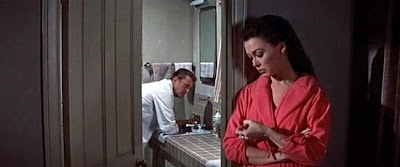
After architect Larry Coe (Kirk Douglas) meets up with rising novelist Roger Altar (Ernie Kovacs) to discuss building a house for him, one that Larry hopes will be an original, he encounters neighbor Margaret Gault (Kim Novak) who like Larry has a son about the same age as well as a homelife that is somewhat lacking. Almost immediately their mutual attraction begins to take effect and as Larry begins construction on Roger’s house in Bel Air their affair begins. As it coincides with pressures Larry encounters at home with wife Eve (Barbara Rush) the affair brings to light both a key event in Margaret’s past and the curiosity of neighbor Felix Anders (Walter Matthau), the local grocer who can tell pretty easily what’s going on between the two lovers and decides to use that knowledge to his own particular advantage.
The quiet of the film’s very first moments as the two leads first notice each other indicates a tranquil quality to STRANGERS WHEN WE MEET that permeates every scene even as the genuine intensity and despair between the characters becomes more and more clear. With a screenplay by Evan Hunter adapted from his own novel it’s one of those films I feel oddly drawn to even if I have no experience in matters like adultery. Maybe it’s because of a certain honesty that comes through in the movie’s portrayal of absolute yearning. It touches a chord somehow, over fifty years after it was made. Suburbia, friendship, longing, women, individuality, creativity, what it means to be an artist, if one even is an artist. Because of the suburban backdrop it’s tempting to tie the film into the more famous Douglas Sirk soapers from the period but unlike the openly dramatic portrayals of societal taboos in those films the conflicts of STRANGERS WHEN WE MEET feel more internal somehow, not delving into the hysteria of Sirk so much as focusing on what needs to be kept behind closed doors regardless and what rises to the surface as a result revealing what’s really going on when the cocktails aren’t being downed. It’s felt in Larry’s architect, desperate to prove his earlier promise, Margaret’s loneliness poking its way through her veneer or the deceptively friendly Felix, making sure all his customers are happy as he smokes his pipe but keeping a closer eye on what’s going on than anyone realizes.
Beautifully photographed by Charles Lang the glossy surface is almost as intriguing as what lies underneath and STRANGERS is a film from that period which makes a somewhat unique use of how it presents Los Angeles that sets it apart from a simple generic backdrop, with even certain establishing shots like Roger Altar’s apartment over on Rossmore offering the right flavor. Much of the film is set on suburban streets where the main characters live over in Brentwood, even if the area is never specified as such -- websites have even catalogued where certain scenes were filmed and I was surprised to discover how often I drove down a few of these streets when I spent time in that part of town. There’s also the site of the house construction off in Bel Air, presented as a sort of untouchable Eden that Larry is adding his genius too. The architect as played by Kirk Douglas is someone who wants to express himself through his designs, not by erecting some grand city that he never even visits but a single thing that he really cares about that he can work over while walking through it, feeling the land, feeling the layout, feeling what it could be. He wants this without being smothered by his suburban existence of friendly neighbors asking advice about crabgrass during dinner parties in a way that only Kim Novak can provide and he brings out something in her as well, a lonely housewife resigned to people being the same everywhere. And they’re more similar than they ever realize, down to each spending time getting their sons to drink up their milk.
Worrying about how it’s been eight years since he won a prestigious award, held back in his passions by his much more pragmatic, if still loving, wife and confronting the drifting nature of insecurity the film looks ahead in an intriguing way to the later TWO WEEKS IN ANOTHER TOWN featuring Douglas, a film with different goals but also both a portrait of its time and place as well as a ‘what the hell do I do now?’ storyline that the lead finds himself in the middle of. Kim Novak’s Margaret, or Maggie as Larry begins calling her, with her deepest secrets revealing the crack beneath the perfection of her own surface, brings to mind VERTIGO but practically all of Novak’s films bring that to mind anyway. It’s the two halves that we associate with Novak—the cool detached Madeline Elster that everyone seems to think Margaret is and in the pleading way she asks her husband, “Don’t you think I’m pretty?” the more lost Judy Barton of that film’s second half. Played by John Bryant, her all-business husband barely seems to be a person in how he doesn’t seem to notice it’s Kim Novak that he’s married to, living in his very own house, treating her desire for an evening at home as if he’s been taken over by the pod people in INVASION OF THE BODY SNATCHERS and he doesn’t seem to think that she would have any kind of desires at all which has its own weight to it—every line in the screenplay by Hunter, every moment as staged by Quine seems to comprise both text and subtext at once. A key scene involving Walter Matthau late in the film plays as if his character simply decides to drop the pretense of what he’s avoiding saying midway through, turning it into gradually more imposing text making what’s still left unspoken all the more unnerving. More often than not the film is focused on the continuing battle between everyone being the same and the individual wanting to deny this. And what is more desirable deep down.
Just as Kirk Douglas uses his own determined anguish to prod Ernie Kovacs’ novelist into writing a book the way he wants to while using the argument to build the house he wants (one which will also help him see the world more clearly, thanks to Maggie’s suggestion that it needs lots of windows) it’s one of those films where it feels like the production of it seeped into the story being told... or maybe the other way around. As discussed in a 2008 LA Weekly article by Philippe Garnier the making of STRANGERS WHEN WE MEET could have been a film itself—for one set in 1960, it probably would have been a hell of a lot better than HITCHCOCK. The Bel Air house that Larry Coe is so passionate about was actually being built during production. Very much involved at the time, Quine and Novak were engaged and the studio was going to give it as a present upon wrapping--“Home For Kim Novak Movie May Be Honeymoon House” read one headline. The marriage never happened—Novak was the one who ended the affair—but Quine apparently kept the house. The degree that the film goes beyond his earlier, pleasant comedies like OPERATION MAD BALL as if genuinely trying to make a grand statement about existence, about the need to stand out and make the art that matters to you more than anyone, makes it seem as if the film was as important to Quine as the house being built is to Larry Coe, a chance to express everything he has with this particular woman there to guide him. The director actually worked one more time with Novak after this and although some of his later films in the 60s like SEX AND THE SINGLE GIRL and HOTEL have their qualities they feel more like the work of a director-for-hire than someone looking to make a personal statement. His work in the 70s included three episodes of COLUMBO. The final film he worked on, leaving partway through production and not receiving credit, was 1980’s THE FIENDISH PLOT OF DR. FU MANCHU which also turned out to be Peter Sellers’ last. After a period of illness and depression, Quine shot himself in June 1989. Blake Edwards was quoted as speculating that he was just tired of waiting for the phone to ring.
But STRANGERS WHEN WE MEET, made almost thirty years before this event, feels like it’s about the possibility of connection, even a temporary one, how that can jumpstart our creativity, our desire to actually feel alive and just for a brief period what’s connected to that can seem absolutely the way we want things to be. That’s what happens when strangers meet and eventually, “half the time we part that way” as Ernie Kovacs’ novelist says, enriched by having known someone a little but of course never entirely. But sometimes, if we’re lucky, there’s a connection, where everything comes together out of nowhere. The moments of clarity, of discovery, are handled differently in a way that feels more internal than Sirk in moments like the Cinemascope framing of Douglas’ face as he takes in what Novak tells him about her greatest secret or the low angle of Walter Matthau’s Felix near the end as he realizes the depths to which he’s sank and in the very same moment how it becomes clear that he doesn’t feel the least bit ashamed of himself. As much is revealed in dialogue coming from the main characters much is still left unspoken but the film seems to know that there’s much that doesn’t need to be said. There’s not really a final exchange in a few scenes near the end once it’s made clear where things are going to go, where they have to go. Things simply are going to be the way they are even after all that’s happened and the brief moment of accidental recognition that occurs in the film’s last moments is what they’ll have to live with, leaving behind the house that represents the accomplishment of what they briefly had. STRANGERS WHEN WE MEET offers a sense of connection coming from what feels like Quine’s own connection to the material that is genuine and gives it a unique power, almost to the point that I can’t think of many other films like it. Do I know that Quine was intending it to be his great dramatic statement? Not at all. But maybe that’s how it turned out. It strikes a chord, almost more than I fully want to understand. It insists on these themes while quietly pointing out that as much as people may desperately try to be different they’ll still all be the same. Maybe there’s no choice. Maybe the differences are only noticed by the ones who matter.
In his autobiography “The Ragman’s Son” Kirk Douglas doesn’t say much at all about STRANGERS WHEN WE MEET outside of an anecdote detailing the pitfalls of working with a director and lead actress who were involved. SPARTACUS was happening around the same time so that’s probably where his memories are focused on but even if he doesn’t think much of the film he gives an excellent performance and if there was any sort of frustration felt during production that not only comes though onscreen in all the best ways that possible response almost becomes another subtext in itself. Kim Novak is also wonderful—not only does she do some of her best work here her very presence is enriched by Quine’s direction, even down to how he situates her mouth at the top of the frame in her big scene as Douglas listens to her confession, an effect which is almost hypnotic. Barbara Rush (as in, “I do Barbara Rush” for all you SHAMPOO fans) is particularly strong as Larry’s wife always keeping the balance of her understandable pragmatism and the ultimatums she sets down just right. As the smiling cobra of a friendly neighborhood grocer who ushers his wife out of the room at the first sign of a dirty joke, Walter Matthau does some of the best work of his early career with his side character slithering his way into the primary drama before anyone seems to realize it while the relaxed nature of Ernie Kovacs always feels totally genuine and fascinating. Watching the way he and Douglas play off of each other remains one of my favorite things to look forward to on repeat viewings--for a good time check out Kovacs’ narration of the OPERATION MAD BALL trailer from several years earlier.
You meet somebody, you want them to be a certain way. Desperately. Often it doesn’t happen that way but sometimes, every now and then, there’s a moment where everything feels in synch and such crazy thoughts almost seem possible. STRANGERS WHEN WE MEET is one of those cases where what sets it apart from the rest of the director’s career makes it all the more fascinating since there isn’t much else to compare it to. The DVD is now out of print, going for high prices on Amazon. Thanks to the friend who loaned it to me. It is a product of its time, of 1960, of what people seemed to believe then about all sorts of things, and though it occasionally becomes evident that it isn’t a perfect product (the bridge in Charles Dunning’s syrupy main theme always sound a little too much like “Volare” for my taste) there really shouldn’t be anything wrong with that. Some of it does seem to be a story that comes from another place and some of it seems so much of now that it hurts. I almost can’t help imagine Larry Coe sticking around in Hawaii longer than he says he will, maybe even years down the road bumping into Don Draper at some point during a scene in the MAD MEN 6th season premiere that we didn’t get to see. They’d look at each other and understand everything without saying a word. What this all meant for Richard Quine, I don’t know but Blake Edwards’ 1986 film THAT’S LIFE! was also about an architect. Played by Jack Lemmon, a star who worked with both filmmakers, this architect was considerably older and yet also worried that he hadn’t lived up to his potential. No matter how hard you try, no matter how old you get, it’s impossible to not care about what other people think. It’s even harder when all the people around you don’t care anyway. And as you wonder about the serenity of having books in one arm and a girl in the other, it’s the person who you want to care most of all that never seems to hear what it is you say, at least not the way you want them to. That’s just the way it is. Time doesn’t stand still. And eventually you stand there alone. Still a stranger.
Subscribe to:
Posts (Atom)