Monday, May 11, 2015
Ideal But For The Writing
If I could I would just sit here and write. Write a script, then another script, then several ridiculously long blog posts, I’d go back and forth doing all that without a care in the world. If only I didn’t have all that other stuff on my mind. I watch a film about a writer it makes me want to write more. It makes me want to be a writer more. And when I say ‘writer’ I don’t mean I want to go to bars and get into fights, although that sounds pretty cool. I mean the dream of a life where I can be in the most relaxing environment possible and do nothing but write, to let whatever’s in my head explode out on to the page (or the computer screen, but you get the idea) and just keep doing that. The times that I can’t write, when I feel absolutely strangled by whatever’s consuming my brain, where nothing comes to me no matter how hard I try to pound it out of me, can be the worst. But those times pass, or at least I hope they always will. I’ve even still got my old typewriter around here on the off chance I ever need it. Somewhere at the bottom of a drawer I even have some extra ribbon that I picked up once, you know, just in case. I don’t expect that to happen any time soon since it’s of course more practical to do it this way on the laptop but maybe that dream is just part of being a writer, the dream of feeling that much more like one.
Whether it’s the lingering shots of typewriters in Cronenberg’s NAKED LUNCH or Jack Nicholson working on his ‘new writing project’ in THE SHINING I’ll take any film about a writer which is probably why I’ve returned to Mike Hodges’ PULP on occasion through the years. I do this even if it has a lead character who states at the start that he doesn’t go for the romance of those typewriters, instead dictating his hackwork out loud so someone else can type it for him. I also do it even though the very odd PULP, released in 1972, is a movie that I still can’t entirely wrap my brain around. A followup for Hodges and star Michael Caine to their previous collaboration, the all-holy GET CARTER, it’s about as far away in tone from that film as you can imagine which could very well have been part of the idea but the 95 minutes of PULP are almost too disarming, the film slips away from cohesion just a little too quickly. But even if it doesn’t entirely connect the oddball tone is genuinely unique and there’s something about the film that makes me want to poke further into whatever the hell it is. Deemed a ‘minor masterpiece’ by Time Magazine (I don’t think I can go that far) the film has enough of an off-kilter slant that gets me to want to keep giving it a try and I haven’t yet ruled out that in five or six more viewings it might totally click for me. I guess that’s the foolish optimism of a writer, the sort that makes you think for a few minutes that what you’re working on might actually be good.
Mickey King (Michael Caine), having long since abandoned his wife and kids back in England, is living the life of a writer “somewhere in the Mediterranean”, churning out pulp novels under various pen names without a care in the world. One day after finishing his latest tome, “The Organ Grinder”, he is approached by a mysterious gentleman named Ben Dinuccio (Lionel Stander) with an offer to ghostwrite the memoirs of an unnamed famous person. Not knowing anything more than this, King is sent on a trip where he will be contacted with further instructions. After the first person who King suspects of being that contact turns up dead under mysterious circumstances, King is finally approached by the beautiful Liz (Nadia Cassini) who reveals that King’s assignment will be to write the memoirs of retired movie star Preston Gilbert (Mickey Rooney). The actor is famous for playing gangsters but be had actual mob ties as well, including certain people who may be concerned about just what Gilbert, and King as well, plans to put into the book.
Each time I see PULP I feel a rush during the first few minutes set in a typing pool as various women react to Mickey King’s overbaked prose, the way the the pounding of the keys going in and out of the soundtrack displaying such filmic confidence that it grabs the attention immediately. It always makes me think that the whole thing is going to click this time around, the way a film about a writer should, but what follows seems to go against such expectations almost immediately. “She was wearing nothing underneath,” is the very first thing we hear in PULP, one of those lines in Mickey King’s book getting dictated by him, but what we soon learn is in the world of PULP no one has anything genuine underneath, including its lead character. Mickey King has created this identity of various nom-de-plumes as he lives his life after leaving his family and previous career, working as a funeral director, long behind only to now find himself right back in pretty much the same game as the bodies begin to fall around him. His dream isn’t to write well as much as to write pulp as fast as possible anyway, at least as fast as world record holder Earl Stanley Gardner, no interest in the romanticism of working on a typewriter and whether this means he’s an actual writer at all feels open to question. He knows the plots but he doesn’t have the ability to probe any deeper than that and figure out what’s really going on in the mystery he’s investigating. Maybe a code that’s a little too tough for me to crack, PULP is an extremely odd heffalump of a movie with sly asides and unexplained occurrences in almost every scene scattered throughout a plot that almost seems deliberately obscure in its story points that aren’t always audible in dialogue (even the New York Times review mentions an issue with the soundtrack). What’s being said often gets drowned out by a Michael Caine voiceover narration intending to explain it all better but of course it never really does, resulting in my spacing out for a few minutes and suddenly wondering what exposition I’ve missed, followed by my attention being grabbed by yet another digression.
Very slight and almost more of a short story than a full narrative, it’s a film about a writer who wants nothing more to dash off stories that move fast and get to the point stuck in a narrative that meanders, wanders around, introduces characters who never quite pay off and doesn’t arrive at a conclusion so much as a dead end. With the likes of Rooney, Stander and Lizabeth Scott around it’s like we’re viewing the ghosts of pulp past, or at least of Hollywood past. Everything feels offhand—a few comical car crashes early on feel like they could have been assembled with more Blake Edwards-finesse but the film is so loose that it makes sense they don’t have such precision. Even a time jump about midway through that makes it feel like the film has just jumped over a portion of the plot but there’s not that much of a plot anyway, with whole sections seeming to go by without very much of importance happening at all. It almost seems designed to frustrate any fan of GET CARTER, looking for more of that cool style and nastiness. Caine is cool, of course, drifting through every scene as he sizes up whoever he’s up against. He always wears the same white corduroy suit, thinking he’s one step ahead of everyone when it’s actually the opposite, unaware of whatever’s going on, just assuming that he’s floating above everyone with his own brand of aloofness, wondering when the plot is going to kick in. And it really doesn’t, not when the first dead body turns up and not when a key death takes place about an hour in—finally it seems like the story is moving into high gear but it doesn’t really happen even then. Maybe in a film that features a police lineup of priests during the hunt for a killer that’s the wrong thing to look for anyway. After multiple viewings I’m still a little hazy on a few points but it’s in the asides that PULP offers pleasure, sometimes quite a bit of it, if you’re into that sort of thing.
It’s a film that is maybe best viewed during the day while you’re already on your third vodka & tonic, waiting for 5:00 so the real drinking can begin. Complimenting that vibe, Hodges’ direction always seems to be looking for the most off-kilter way to film a scene giving more import to what’s in the background than the plot points, stopping for a few minutes so we can intercut between the vain Rooney primping while getting ready and the bored Caine waiting for him. The visual style somehow seems extremely offhand while calculated all at once, seeming to revel in shooting dinner table scenes as the actors peer at each other with their own agendas and spout off the acidic dialogue from his script. Even the narration (which, for the record, includes a few homophobic asides about a possible bad guy he encounters) that often goes against what we see reveals that Mickey King may be a hack a few steps behind everyone but he has a certain way with the words on occasion. “I flipped on the light and showed her the door. I had my pride,” as he does the exact opposite when finding a beautiful woman in his bed, as I imagine any writer would actually do. The filming in Malta helps to give the production a distinct vacation vibe as if Hodges and Caine decided to take a few weekends in an exotic locale to make a quickie before moving on to their next big project, giving the whole thing a genuinely offhand flavor but stays maybe a little too much at a remove, with characters that never seem to serve much purpose beyond being mysteriously ornamental and the shadowy figures pulling the strings of the plot never becoming characters at all. Maybe that’s part of the point too—the writer in question never seems to get that he barely ranks as a character in the story from their point of view.
Maybe the plot loses me a little too often but certain moments keep me going all the way to the end, individual shots grab attention on their own, even certain extras who don’t do more than pass by the frame feel like they deserve praise. Much of the shell game of the first half doesn’t really lead anywhere but then again much of the shell game of the second half doesn’t lead anywhere either aside from the end credits. Even the tone is a little too inconsistent ranging from amusingly sly to maybe a little too comically broad but there’s a conviction to all that casualness that makes it feel like a genuine world view. The washed out look of the cinematography, even on the DVD, seems appropriate. It’s not really a spoof but it’s…well, at least PULP is its own thing. In some ways it’s the deliberate opposite of GET CARTER while also serving as a response to that film—both films are extremely dry in their approach too all that violence only PULP doesn’t see much reason to get upset about any of it. GET CARTER is about the title character played by Caine returning home and the nastiness that results from that. PULP is about its lead character staying as far away from where he’s come from as possible which leads to a more pleasant sort of oblivion, but it’s an oblivion nevertheless.
Many of the characters in PULP seem happy to be trapped in this purgatory while others desperately wander through it, wondering what happened to their lives while George Martin’s lite AM score plays on without a care in the world. As King realizes, sometimes in life when you’re looking for a story all you wind up with is just enough to get you lost in the fog. Caine punches a face on a poster at the start which proves to be a nice bit of foreshadowing but makes just about as much of a difference that he could even make to the real thing. The film could make for an appropriate double bill with John Frankenheimer’s similarly screwy 99 AND 44/100% DEAD starring Richard Harris, a film also from the early 70s with a tone that doesn’t quite come together and with lead actors that look exactly alike. Either way, PULP causes a question mark to form over my head while at the same time I appreciate its gallows humor and its belief that just because you think you know all the plots doesn’t mean you know how they’re going to turn out. The life of being a writer, I suppose.
Just like GET CARTER, the climax of PULP features a showdown on a desolate stretch of beach—the end of the world, nowhere else to go, the perfect place to keep the most horrible secrets of the past buried. The film is set in a kind of paradise disguised as purgatory where there’s no way to have any effect over the bigwigs pulling the strings. Like INHERENT VICE, the shadowy villains barely seem to care since they know they’re going to get away with it. Like Roman Polanski’s own film about a ghost writer the plot was set in motion before the lead character ever got involved. “Cheers,” the final image seems to be saying as the figure behind it all (apparently a comment on a prominent Italian figure at the time; to me, he looks like Charlie Bluhdorn) raises his glass at the end, having just lured an animal to his doom. “We don’t have to give a fuck about you.” All part of the life of pulp.
The name Mickey King almost promises that it’s going to be a quintessential Michael Caine role which doesn’t quite happen as he continually gets the rug pulled out from under him but he goes along with the gag totally. And he does look pretty damn cool in that suit, it has to be said. Mickey Rooney is so dynamic as the ultra-crass movie star in the George Raft vein that it’s a shame he isn’t around for longer. He knows who this son of a bitch is and plays him just right with enough secrets simmering under the surface that he makes us want to hear them in that book. Lionel Stander is enjoyable as always as Dinuccio while Lizabeth Scott as Princess Betty Cippola in her final film basically glides through every one of her scenes without a care in the world knowing that she has at least as many secrets as Preston Gilbert but no one is thinking to ask her. Nadia Cassini as Gilbert’s kept woman Liz makes enough of an impression that I wish she didn’t just fade into the woodwork near the end while the enjoyable familiar characters actors who turn up throughout include Al Letteri (of THE GODFATHER and Peckinpah’s THE GETAWAY) as Miller, Amerigo Tot and Leopoldo Trieste (each from THE GODFATHER PART II) as well as Luciano Pigozzi of Mario Bava’s BLOOD AND BLACK LACE who I imagine was cast for his resemblance to Peter Lorre.
Even if Hodges and Caine made an ideal pairing unfortunately the two have never worked together again after the flop of PULP. Among Caine’s similarly forgotten titles from a few years later is Peter Hyams’ PEEPER, another noir homage which is more of a spoof but also pretty forgettable unlike the unexplained tone of PULP which at least sticks to the ribs. Hodges, in the meantime, is probably best known for directing 1980’s FLASH GORDON but that’s another story entirely. Still, thinking about the disarming nature of PULP does make me curious to revisit the director’s odd, slow I’LL SLEEP WHEN I’M DEAD which reunited him with his CROUPIER star Clive Owen and in a similar vein refused to follow up the earlier film with the same kind of bang. That’s the funny thing with storytelling. Sometimes you can’t help but do the exact opposite of what’s expected of you. Sometimes the best things come out of that. Of course, sometimes you just wind up thinking, “What the hell were they going for here?” Funny thing is, when all is said and done I’ll probably wind up seeing PULP as many times as I’ll see GET CARTER. Where the film ends up makes a certain amount of sense, at least as being a writer goes; after all the unrewarding nonsense you’re left sitting there, ignored, stealing from real life, lifting from what you’ve already written before (maybe Mickey King is a real writer after all), all in a desperate attempt to make yourself seem cooler than you really are. And it’s all kind of muddled anyway. Somebody may politely ask, “Where do you get your ideas from?” but, really, nobody cares. All that’s left to do at that point is just start again, hoping for the best. As always.
Wednesday, April 29, 2015
Long Enough To Be Anything Else
Norman Lloyd gave away the end of LIMELIGHT and I didn’t care. Not that I should care, since when you’re Norman Lloyd you can pretty much do anything you want. Plus if, like me, you’ve waited this long to see LIMELIGHT then any risks you take are on you. Besides, a film is more than how it ends, at least that’s how it should be. This event happened partway through the second day of the 2015 TCM Classic Film Festival which by that point was already a whirlwind and there I was, about to see Charlie Chaplin’s LIMELIGHT for the very first time, preceded by a discussion featuring the legendary Norman Lloyd who appears in the film. One story he told required revealing how it ends and, yes, when he started I was taken aback that Lloyd would actually do this but let me go back a little first. It’s impossible to cover the entire TCM Festival since it’s impossible to experience the entire TCM Festival. There are always going to be films that you don’t see, appearances you don’t make it to, people who you know that you barely get to see. The blogger meet-up at the Formosa the night before it all starts organized by my friend @oldfilmsflicker takes care of that last part since once it all begins you just have to hit the ground running and not look back. This sort of marathon viewing used to be something I did much more of but you can’t keep that insanity up forever. Patton Oswalt, in his recent book “Silver Screen Fiend”, writes about attending a massive Hammer Films festival put on by the American Cinematheque (in the years before they took over the Egyptian and Aero) that took place over two consecutive weekends way back in ’95. Probably not much of a surprise but just as Patton Oswalt was I was there for every single film they played. As far as I remember, he and I never met but I look back on something like that with a combination of amazement at how I actually did that and wondering just what the hell I was thinking. I could never do something like that again now otherwise I’d go stir crazy but for whatever reason the TCM Classic Film Festival is an exception I’ll gladly make. To be honest, it was a glorious weekend.
The theme for this year’s festival which ran from March 26-29 was “History According to Hollywood”, a subject broad enough that you and I could easily program our own series filled with completely different selections. Certainly the inclusion of several John Ford films throughout was a worthy choice as were things like the recently discovered 1919 Harry Houdini film THE GRIM GAME. One point of controversy about this year’s selections were certain newer titles— in particular, Steven Soderbergh’s OUT OF SIGHT (shown with editor Anne V. Coates in attendance which is a good enough reason for me) and APOLLO 13 for its 20th anniversary with a Jim Lovell appearance. The year was also made notable by the unfortunate absence of TCM host Robert Osborne for health reasons. These subjects came up during the “Ask TCM” panel on Thursday afternoon in the Club TCM area of the Roosevelt Hotel where attendees got to ask questions of various bigwigs from the channel. It was very clear how much TCM really means to people and I guess it means something to me too since I’ve got it playing on the TV behind me right this second. As the opening night party kicked off, the big red carpet event for THE SOUND OF MUSIC was happening right across the street at the Chinese—I wasn’t there for that and that’s ok but since it’s my mom’s favorite movie I have nothing bad to say about it. I was introduced to the Bogart’s Gin sponsoring the festival so I had the first of quite a few gin & tonics over the weekend and the fun began. One obvious way my TCM Festival experience differs from others is that since I live in L.A. I already get a pretty good selection of films to see every week anyway so the chances are better that there are going to be films I’ve seen before, prints I’ve seen before. And I’d rather see 35mm prints, always. Yes, you can’t avoid the awful spectre that is digital projection no matter how much I wish things were otherwise. But my own desire to see these 35mm prints, the way the films were meant to be seen, combined with the chance to see films I’ve never seen before at all sometimes sends me away from the massive main theater at the Chinese where many of the popular choices play and upstairs to the smaller multiplex area where the funkier titles often turn up. That approach began right off with the double of the 1949 noir TOO LATE FOR TEARS (which in fairness I had already seen, but it’s so much fun) starring Lizabeth Scott who was shamefully ignored during the In Memorium segment at this year’s Oscars followed by a first viewing of the powerful BREAKER MORANT which was introduced by director Bruce Beresford.
By the time LIMELIGHT came up on Friday in theater #6 at the Chinese multiplex it was well into the day which for me started with the special presentation “The Dawn of Technicolor” at the Egyptian, an eye-popping examination of the early history of the Technicolor process and business with jaw-dropping clips of now-unknown movie musicals from the early sound era. I moved down the street to the Chinese 6 for a digital restoration of the excellent Michael Curtiz western THE PROUD REBEL starring Alan Ladd and Olivia de Havilland. LIMELIGHT came immediately after and it happened during one of the most packed blocks of the festival--Ann-Margret appearing with THE CINCINNATI KID, a digital restoration of Orson Welles’ CHIMES AT MIDNIGHT, YOUNG MR. LINCOLN with Peter Fonda appearing to talk about his father Henry, among others. I went with LIMELIGHT, not only because I’d never seen it and it was about time I had but because I didn’t want to go this entire festival without seeing Norman Lloyd, who has recently celebrated his 100th birthday, speak at least once. Norman Lloyd who at one point during a story about his early days paused to mention about someone who appeared briefly in the telling, “And that woman was Katharine Hepburn…who had yet to make a picture.” In most stories that would be the climax but here the young Katherine Hepburn was merely an aside. Such is the life of Norman Lloyd. There was no real reason why I should have picked LIMELIGHT but for whatever reason it seemed to make sense.
Much as he should be represented at something like the TCM Festival I’ve never had much to say about Chaplin before. It’s safe to say that many people of my generation have never had much to say about Chaplin before. At this point in time much of his work seems to act as little more than part of a Film History 101 syllabus—THE KID, CITY LIGHTS, MODERN TIMES, various shorts, you deal with the political fallout surrounding THE GREAT DICTATOR and then you move on, maybe back to Buster Keaton since you’d rather be watching THE GENERAL anyway. My favorite Chaplin is MONSIEUR VERDOUX, the first viewing of which is one of those memories I need to write about sometime, and since it doesn’t feature his Little Tramp character barely seems to qualify as what we think of as a ‘Chaplin’ movie. Chaplin’s LIMELIGHT, originally released in 1952, also isn’t a Little Tramp film and yet unlike MONSIEUR VERDOUX it may be impossible to consider it at all without taking his voluminous history into account. Whatever someone knows about Chaplin is likely going to inform their response to this particular film which makes it all the more fascinating in itself. Or maybe part of why I found it so fascinating was how sincere it was, how unconcerned with how old-fashioned, even for 1952, that it might be. Did part of my response how to do with my own indifference towards Chaplin? Was I confronting whatever that legend really is today or did it somehow go beyond that?
The plot is simple: It is London, 1914. Legendary music hall comic Calvero known as “The Tramp Comedian” (Charlie Chaplin) is nearing the end of his time, often drunk and with very little demand for his talents anymore when he happens upon a depressed young dancer named Terry (Claire Bloom) who has just tried to kill herself. Nursing her back to health Calvero helps restore Terry’s self-confidence and resume her dancing career. But her attempts at doing the same for him don’t prove as successful and as much as she falls in love with the much older Calvero even her attempts at featuring him in the ballet she’s been chosen to star in isn’t enough no matter how great the love between them grows. Along with that plot which mostly focuses on its two leads, the visual presentation is just as simple—the film opens with the camera moving into the setting and the final shots have the camera pulling back from the last moments which is maybe about as visually flashy as it ever gets. Chaplin once famously said, “I don’t need interesting camera angles, I am interesting.” Which is consistent with his approach to LIMELIGHT, a film which presents its story in plain, clear fashion but is a complex portrayal, as piercing as staring down into Chaplin’s own soul. A title card at the beginning tells us the film is “a story of a ballerina and a clown…” but even more than that it’s about Chaplin himself, his iconic persona, his career, his life, his own past and the way he looks at the world--I imagine it’s not at all coincidence that it’s set in 1914, the year he made his first film.
Much of the dialogue is so blunt in its statements about the glories and pain of living that the film can’t even really be said to contain subtext since it’s all spoken out loud so plainly by the characters already. Even with a few brief ornamental passages showing off the theater scene of London as well as several extended ballet sequences just about any cinematic trickery is entirely limited to Chaplin’s own comic antics. And of course Chaplin is right--he is interesting; his physicality is always fascinating to watch throughout the film and not even just during Calvero’s routines. It shows us who Calvero is through just his movements as much as anything even with all the lofty statements about life that he makes and this helps, possibly because on occasion the tone of Chaplin’s voice almost seems a bit too harsh for the moment. Aside from the two leads everyone is very much a supporting player, including the great Norman Lloyd as the sympathetic ballet director (my favorite moment of his is a silent beat when he pops a piece of candy in his mouth). Even the famous appearance by the great Buster Keaton for a sequence which teams the two legends up together for the first and only time is totally in support of Chaplin—he’s not even given a character name, just “Calvero’s Partner” but I suppose it’s not really needed since of course we know who he really is anyway. And Keaton himself seems totally aware of this in his performance which makes his visible onscreen feelings towards his co-star all the more touching.
As Calvero states near the end, “We’re all amateurs. We never have time to become anything else.” It’s one of any number of lines in the film that could be considered an authorial statement if not his own feelings about everything surrounding what he’s observed in life—the phrase “the melancholy of twilight” is heard at one point which could easily have been an alternate title of the film. So nakedly sentimental that it almost seems redundant to even point that out, the film is the work of someone who has accepted things while continually on the verge of tears over how beautiful life is. It’s a film about looking back made by someone aware that the world is very much moving forward beyond him. Calvero is worried that his is a type of performing that no one wants anymore, exactly what Chaplin is clearly worried about as well, and I suppose that means even more now that the world really has moved away from whatever he represented. At one point a character, not him, offers the observation, “What is more eloquent than silence?” as if he’s remembering what has really been lost in the type of filmmaking he knew best. To give a reason for disregarding charity Calvero offers, “It’s the tramp in me,” which is a clear reference to his famous character but also can be used to explain his own stubbornness, why he can’t make this film anything other than what it is. Calvero’s stage persona is clearly an alternate version of that, as if it’s the one Chaplin would have taken on if he had lived during that era instead—even the plot point involving Calvero changing his name so no one will know it’s him onstage is an interesting choice for this Chaplin film where he is basically playing another version of Chaplin. What we see of his act is never particularly funny, or at least isn’t in this day and age, and these scenes go on way too long but maybe that’s beside the point—it’s a depiction of Chaplin playing Calvero basically playing Chaplin.
Seemingly unencumbered by what a 1952 film is supposed to be and with much of the running time set in Calvero's tiny apartment, the deceptively simple visual style is a reminder that Chaplin as director hadn’t changed his ways at all in 30 years. A few moments that can almost be called clumsy on a basic filmmaking level, maybe a reminder that his style didn’t always translate to the modern era, almost make me more supportive for it because it reminds me the film always totally means what it’s saying about, well, everything. To both Chaplin and Calvero, the young, unsullied Terry is clearly meant to represent all that is good in the world, as well as how dangerously close an artist can come to losing their way through despair and hopelessness. He has to stop her from hating herself because of her past—it’s a film set in his own past that’s partly about the fear of being held back by that past, held back by some horrible form of regret that sometimes in life we can’t do anything to shake and it paralyzes us—in Terry’s case, literally. Totally angelic in every single one of her actions towards Calvero, it makes her more of a symbol that a person although Bloom makes her fully human in her performance. Ultimately, the film rages against her initial sorrow over “the utter futility of everything”, getting her to want to fight for happiness. The film seems to say that the search for meaning is a waste since the answer is right there in front of us all the time already--art has meaning, love has meaning. In the end, what matters more than anything is that we’ve gotten to experience just a little of this.
Reading up on how the production was relatively straightforward for Chaplin, who in earlier years didn’t hesitate shooting scenes hundreds of times, doesn’t affect our perception of the film but it is a reminder of how he had changed. Going out of style which is true now and I imagine had occurred to him then. It’s a film that means what it says, is a blunt statement by its legendary star-director of, well, everything he felt about performing, comedy, about the glory and pain of life, whatever that is, that he had learned up until that time. Adding to how personal it all clearly is, his son Sydney plays the key role of Neville the composer who is a possible love interest for Terry while his children Geraldine (her first film appearance), Josephine and Charles, Jr. appear in small roles. Chaplin also doesn’t always adhere to strict realism and his famous hesitation towards using sound is recalled in Calvero’s stage performances where we don’t hear the audience (i.e. laughter) until it’s absolutely necessary (i.e. everyone applauds so we know they love him) although the fantasy nature of some of these scenes leaves the necessity open to question as well. Like he did many years ago, Chaplin is experimenting not only with the basic use of sound but also the cinematic necessity of sound. If the result isn’t always elegant it doesn’t seem to matter.
LIMELIGHT feels designed to be a final work but although it didn’t turn out to be Chaplin’s last film (A KING OF NEW YORK and A COUNTESS FROM HONG KONG followed after his exile from the United States) it was the last one he made in Hollywood, much of it was filmed at the Chaplin Studios just a few blocks away from where the Chinese 6 now is, which makes it an end in itself. Maybe the only way that the film could be more nakedly about Chaplin himself would be if he had gotten up to deliver a speech at the premiere in 1952 and promptly fell over dead (he didn’t, for the record), making the story he was telling well and truly complete. Norman Lloyd spoke of the film but also his friendship with Chaplin during his talk with Bruce Goldstein of New York's Film Forum before the film started. Afterwards Lloyd stayed to see the film and I may as well admit that the story he told got me on its side before the lights even went down—I haven’t earned the right Norman Lloyd has to give away the film’s ending (if you must, here he tells pretty much the same story at the Academy in 2012) but it involved Buster lending unexpected assistance to Chaplin during the filming of the ending and the mental image brought on by one legend selflessly helping out another got me unexpectedly emotional even before the film had started. I didn’t care that the ending had been given away. Suddenly, at that very moment right before the lights went down, the ending was the film.
By total happenstance, my next choice after LIMELIGHT was Buster Keaton’s own STEAMBOAT BILL, JR. complete with live orchestra, giving me a chance to get the full Buster dose that LIMELIGHT only hinted at. There was more to come that weekend with other films I hadn’t seen before--it says something about me that I passed on THE PHILADELPHIA STORY in favor of my first-ever viewing of 1953’s HOUDINI because it was a last minute inclusion due to having to cobble together a print from various sources and I wanted to see it looked like (it looked fine and, as cheesy as it was in its early 50s studio gloss, I’m glad I saw that movie too). And there was more through the next few days —THE BANK DICK with TCM favorite Illeana Douglas interviewing W.C. Fields’ grandsons, Christopher Plummer speaking before THE MAN WHO WOULD BE KING, the delightful pre-code DON’T BET ON WOMEN, the early John Ford AIR MAIL. I reacquainted myself with Preston Sturges’ glorious CHRISTMAS IN JULY which I think is gaining for me as time goes on, a screening of PSYCHO that featured a very enjoyable introduction by Edgar Wright, a Club TCM discussion with the legendary Shirley MacLaine (I had missed her appearance before a screening in the Chinese of THE APARTMENT, one of my only true regrets of the weekend) the astounding “Return of the Dream Machine”, a hand-cranked projector show giving us the chance to see early silent with some jaw-dropping footage and was certainly a highlight of the festival. The closing night selection, for me anyway, was a screening of the 2014 restoration of Vittorio Di Sica’s MARRIAGE ITALIAN STYLE in the main Chinese theater that featured star Sophia Loren appearing with TCM’s Ben Mankiewicz for a loose, engaging talk before the screening. The crowd loved Sophia, obviously, but it occurred to me as the De Sica film played, and I liked it very much, that of all the times I had been to this glorious theater I had never seen a film quite like this there. It was a near-religious experience comparable in its own way to seeing LIMELIGHT in that much smaller theater—both experiences were hugely moving for me and both served as a reminder of why I was there in the first place, a reminder of how ridiculously huge my love of film can sometimes be.
All that was left following Sophia Loren was the closing night party, more drinks with that Bogart gin and getting to spend a little more time with some of the people I’d been spending time with over the past few days. Of the memories I’ve taken away with me from that weekend LIMELIGHT seems like a special one—there was even the unexpected bonding I had a day later with someone I only know slightly over how much me had loved it as well. It’s the sort of memory that gets me to still miss the TCM Festival a month later but you have to get back to reality eventually, I suppose. But there was the chance to see these films, to love them, to have them stay with me. To not forget Chaplin. Or Keaton. Or Sophia Loren. Or John Ford. Or Lizabeth Scott. As I walked off that night from the closing night party to the subway nearby I felt a surge through me over how much I loved the films I’ve seen, how much I love so many films and how happy I am that it’s given me the chance to meet more people who feel the same. And TCM is still playing behind me as I write this. Sometimes it’s ok to feed an addiction like films just as it’s a good thing to be reminded that maybe you should return to those Chaplin films that you haven’t seen in years to see what they might have for you at this point in life. And realize that they’re about much more than just the ending. It’s about how those endings, those films, stay with you no matter what. And that love continues.
Tuesday, March 31, 2015
Good News Is No News
Maybe things don’t change. Several years go by, you turn around and suddenly you’re back in the same place. Not long ago I took a look at NO COUNTRY FOR OLD MEN for the first time in several years. Beats me why it had been so long but maybe that’s what you sometimes need to do with Best Picture winners, to somehow remove them from that Good Housekeeping Seal of Approval. And watching it again I’m not sure the film has deepened so much as it just plays as a cold reminder of how good it always was. The bleak hope that permeates the action, the absolute cynicism which resides deep down inside of it, has only become more acute. You revisit a film away from the hype it can be a little easier to see what’s really going on in there. Maybe I’m just a little older now, too. The pitch-black comedy sprinkled throughout NO COUNTRY doesn’t keep it from being all too aware of the nastiness in the world, the inevitability of the bad shit coming down and there’s not a thing you can do about it because eventually you’re going to lose that coin toss. Like it or not.
When it comes to cynicism, sometimes the question might be how far is too far. After directing his first film THE MAJOR AND THE MINOR in 1941, Billy Wilder spent much of the following decade directing films that (with the exception of the Technicolor Bing Crosby vehicle THE EMPEROR WALTZ) for the most part became progressively darker, more probing into the deep recesses of the human spirit in ways that were sometimes comic, sometimes not so, culminating in the masterpiece that is SUNSET BOULEVARD in 1950. At a certain point in the 50s things seemed to shift for him, the films becoming more openly commercial, star vehicles, comedies, a number of them based on commercially successful stage plays. Coming right in between these two periods was maybe his darkest of all, ACE IN THE HOLE, an original screenplay that went further down into the depths than he ever had and ever would again. Since he left us several years before NO COUNTRY FOR OLD MEN we’ll never know just what Billy Wilder would have said about it but ACE IN THE HOLE certainly gives me an idea. Long after my first viewing of the film years ago at a massive Wilder retrospective at the Film Forum in New York, ACE still hits me right in the gut, to steal a line from its lead character, every single time I see it. It probably is Billy Wilder’s most cynical work or at the very least his bluntest argument for what humanity is capable of, taking any foul mood he developed in the wake of World War II when he toured the aftermath of the Nazi atrocities and pushing those thoughts to its extreme. There is goodness in ACE IN THE HOLE, there are people who have goodness in them, but they’re mostly powerless and the film discards them essentially because they have no place in what it believes the world is turning into. Which I suppose is how it is.
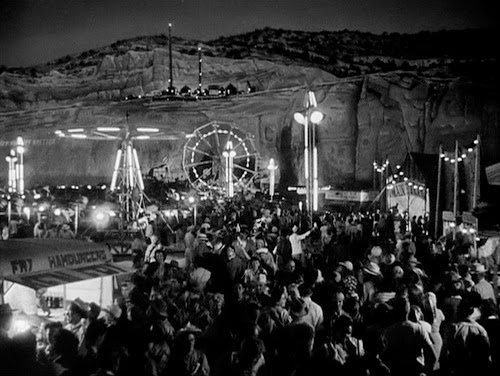
Exiled to New Mexico after no other paper will hire him, reporter Chuck Tatum (Kirk Douglas) has been cooling his heels at the Albuquerque Sun-Bulletin for a year, waiting for the big story that will launch him back to the big city. Then out of nowhere that story drops in his lap, almost too perfect—in tiny desert stopover Escudero local tourist shop proprietor Leo Minosa (Richard Benedict) has become trapped in a cave-in. His wife Lorraine (Jan Sterling) wants to use this as an excuse to finally escape the marriage and that nothing town but Chuck convinces her that she stands to gain from all this as well. As his stories begin to turn up in the paper and the crowds start to appear he also gets the local sheriff (Ray Teal) to go along with his plan to drag out the rescue of Leo and make it the biggest spectacle around. Only Chuck goes a little too far with his plan, putting the perfect grand finale of the big carnival that’s sprouted up in jeopardy.
“I can handle big news and little news. And if there’s no news I’ll go out and bite a dog,” Chuck Tatum tells his new boss Jacob Q. Boot (Porter Hall) to sell himself. Maybe ACE IN THE HOLE isn’t a cynical film as much as it’s about a cynical man and the world he creates out of that cynicism. Somewhat based on the real life case of Floyd Collins, who Tatum even mentions at one point as something long-forgotten, ACE IN THE HOLE is very much the work of Billy Wilder and could have been a dark comedy, a very dark comedy. There are certainly points in the film where it really can’t be considered anything else. Maybe that’s cynicism or maybe it’s just reality. In Cameron Crowe’s “Conversations With Wilder” the director tries to downplay that aspect of his films then allows, “Maybe ACE IN THE HOLE,” which does seem a little like an understatement. He was a newspaperman himself in Vienna long ago, after all, so he must have understood where Chuck Tatum was coming from, desperate to get out of Albuquerque “which is pretty Albuquerque” as he tells it and back to New York where he can finally get his chopped chicken livers. Lorraine admiringly mentions to Chuck who’s been pounding away at his typewriter all night that “he sure can make with the words,” something Wilder always certainly had a knack for.
ACE IN THE HOLE (written by Wilder, Lesser Samuels and Walter Newman) came at a crucial juncture in Wilder’s career—after the all-holy SUNSET BOULEVARD and Wilder’s break with screenwriting partner Charles Brackett who he had worked with since the late 30s. After several films with various writing partners he eventually joined forces with I.A.L. Diamond for 1957’s LOVE IN THE AFTERNOON and the two remained together from then on. But ACE is Wilder’s breaking off with Brackett, breaking off with a half that maybe he felt shackled to at that point—Brackett had apparently wanted nothing to do with DOUBLE INDEMNITY due to its seamy content. With ACE Wilder takes no prisoners, biting into this tale with all the ferociousness imaginable and absolutely unapologetic for the journey it takes, although since the reporter’s byline is actually “Charles Tatum” maybe that first name is some small acknowledgement to his former partner. Either way, the overall effect as more and more people turn up to gawk at what’s happening is unrelenting and Wilder never came anywhere close to it again. The black and white harshness of the New Mexico setting makes it one of the most distinctive looking Billy Wilder films but also one of the most characteristic, a reminder of how anti-color Wilder was for a very long time—New Mexico in its full glory can be a very serene place to visit but that wasn’t how he apparently saw it. There’s no serenity here, no goodness, the Indian spirits people speak of are only meant as warning signs. And if Escudero isn’t swarming over with the masses ready to buy, buy, buy it’s just a barren stretch of emptiness and nothing else.
A flop when it was first released (Paramount also tried it under the title THE BIG CARNIVAL but it didn’t help) ACE IN THE HOLE has never been one of the best known films by Billy Wilder, presumably because it wasn’t an easy film to see for a long time—there’s a readily available DVD and Blu-ray from Criterion now but it never even came out on VHS. It’s an interesting comparison to the acclaimed SUNSET BOULEVARD from the previous year—not only is that film funnier, setting the story in what is essentially a gothic mansion in the middle of Beverly Hills makes it immediately foreign to most people, they can watch it at a remove knowing they’re never going to turn out like William Holden’s Joe Gillis (well, maybe some of us would-be screenwriters do). ACE IN THE HOLE is set out in the middle of the country and dialogue even reels off how many states the multitudes are swarming in from, a reminder that the people watching the film are who Wilder is pointing his finger at, they’re the ones coming whether by car or the ‘Leo Minosa Special’ train that stops nearby to pay to see the spot where the helpless man is trapped. He’s right of course and he still is now—he’s showing us the future of reality TV and cable news networks devoting endless coverage to missing planes. Wilder is toying with the audience as much as Chuck is, he’s the one who moves it all forward. “I’ve met some hard boiled eggs in my time but, you, you’re twenty minutes,” Lorraine tells Tatum (now and forever my favorite line) not with calculation so much as admiration. Her face long since having turned into one giant sneer to go perfectly with her bleached blonde hair, she’s a true noir creation who never seems to have even realized it and she learns fast thanks to his teaching. Chuck is happy to take her along as he pulls the strings on what happens to her husband—I’m your pal, he tells the trapped Leo and the poor guy never even realizes he’s in a Billy Wilder film where those rules don’t apply. “She’s so pretty,” Leo tells Chuck about the wife who has nothing but disdain for him and Wilder immediately dissolves to her proudly watching giant carnival trucks that read “The Great S&M Amusement Corp.” drive on in, a series of two shots which proclaims Wilder’s feelings about relationships between men and women more succinctly than just about anything else in his career.
If there’s a flaw in the film that sometimes nags me in the back recesses of my brain during some viewings it’s that Wilder is almost trying too hard to make this all so venal, bending over backwards just a little too much to display Chuck’s nastiness in risking Leo—but that still doesn’t mean Wilder is wrong in what he’s showing us. After money, after glory, after the Pulitzer, Chuck gets the carnival to seep into everyone, just like that damn novelty song “We’re Coming Leo” that eventually gets heard on an endless loop which is brilliant in its awfulness—after only thirty seconds it’s trapped in our head forever. Lorraine’s earlier joke that they’ll bring a brass band out for Leo essentially comes true in the worst way possible. With the sheriff and his trusty rattlesnake on Chuck’s side no one has a chance. Loyal photographer Herbie (Bob Arthur) is only too happy to go along with Chuck, not thinking of anything beyond that. Radio interviewers covering the scene don’t do much other than say how ‘wonderful’ this rescue operation is while asking witnesses how ‘wonderful’ they think it is too. The visiting press from his beloved New York that Chuck is only too happy to thumb his nose at never get anywhere close to the man in jeopardy they’re on the scene to cover. Leo’s father is mournfully hopeful, but powerless. All his mother, without an audible line in the whole film, can do is pray. The countless masses are represented by the visiting Federber family, led by a goofball father (Frank Cady) who works for Pacific All Risk Insurance--Fred MacMurray’s insurance company in DOUBLE INDEMNITY--and Wilder seems determined to put them into as many shots as possible. They’re the “Mr. & Mrs. America” Chuck speaks of—not unfeeling but gullible, suckers, just looking to go along for the ride at the carnival and not knowing any better.
Closer to Wilder’s own viewpoint is Porter Hall’s newspaper editor/publisher Mr. Boot, who serves as much of a conscience to the main character as Edward G. Robinson does in DOUBLE INDEMNITY--representing all that is noble in the world, maybe overly cautious with his belt & suspenders but a man with decency as well as the ability to express what the other characters can’t. Cunning as Chuck can be, even Boot knows how good a reporter he is, just one that doesn’t think his plan through enough to know that instead of saving Leo they’re doing the exact opposite, winding up killing a man just as much as Fred MacMurray’s Walter Neff did. That drill set up far above Leo making that continuous pounding is like a clock of doom, marking every second closer to his demise and ultimately driving him mad. The talk of the Indian spirits that caused the cave-in in the first place is forgotten about. Clearly, the spirits of capitalism are even worse. “Everybody’s paying for it,” Lorraine says to justify the carnival being built around them and that’s all that matters. Even the more lighthearted moments of Hugo Friedhofer’s score manage to sound like a march towards doom. ACE IN THE HOLE was released in 1951, a timeframe even alluded to when Tatum shouts at Boot that it’s “the second half” of the twentieth century and his loyal assistant Herbie wants to get going, not back to the antiquated world that Boot represents. “Going where?” the editor sadly replies. Going to 2015, I imagine. It’s almost more potent when viewed today because of how long ago Wilder knew the way things were going. Any film that tries to emulate ACE IN THE HOLE, like Costa-Gavras’ now-forgotten 1997 drama MAD CITY, just comes off as old news in comparison, ready to wrap fish in.
But in 1951 ACE IN THE HOLE may have been as far as Wilder or anyone could have gone which may account for Wilder’s retreat to commercial stability. He wanted to keep his career going, after all. STALAG 17 followed a few years later. A big hit based on a hit play. The likes of SABRINA and THE SEVEN YEAR ITCH followed that, big glossy movies meant to be hits and they were and eventually we got THE APARTMENT but that’s another story. Maybe ACE IN THE HOLE just left him with nowhere else to go with those themes so when that happens you kind of need Audrey Hepburn. ACE IN THE HOLE is definitely a look at how Wilder saw America in 1951 and how he saw humanity itself, for that matter. Whether that view was cynical or merely pragmatic could be argued. Either way, it’s clear that the director wishes otherwise so the young photographer Herbie could just stay at his desk in Albuquerque and never be exposed to what Tatum has engineered, so Leo could actually make it out whether Lorraine sticks around or not. “I’m sorry,” Leo says during his final moments when confessing his sins. We know he has nothing to be sorry for so the camera is correctly on Chuck at that point, who of course does. Several years later Wilder adapted his visual style to the arrival of CinemaScope and even continued to work largely in black & white as long as he could, so his harsh visuals were still there. But nothing topped this one. The legendary final shot and line of THE APARTMENT could be said to represent all that is good in the world, the best of what we can ever really hope to achieve in life. The devastatingly unflinching end of ACE IN THE HOLE is maybe how it all inevitably turns out because sooner or later you’re going to go too far in that quest for your own personal glory. That’s the way it is.
You can feel the hunger Kirk Douglas brings to Chuck Tatum, not thinking of the consequences of his actions until it’s too late and he’s every bit as determined in performance as Tatum is to get back to New York. As feverish as he is at times it all seems totally genuine, down to the newspaperman’s bones--he hasn’t quite become Kirk Douglas doing Kirk Douglas yet. It’s one of my favorite performances by him and the grip he maintains on this determination is palpable down to the very last second. Jan Sterling and that sneer trapped on her face matches him totally word for word and the wheels turning in Lorraine’s head as she realizes what she can really gain from all this are just about visible. A brief shot of her near the end of turning away from a window as she learns something says it all. The various character actors throughout all pop in their roles—Gene Evans, star of Sam Fuller’s PARK ROW and THE STEEL HELMET plays the deputy sheriff—but the total decency in Porter Hall’s newspaper editor stands out to me, particularly in contrast to the villains and more comical roles (including in DOUBLE INDEMNITY) the actor played during his career. He has maybe four scenes but throughout them, including his very last moment and final dialogue onscreen, he gives the film its humanity as well as its genuine hope for the future that it wouldn’t have otherwise.
Sometimes I visit Billy Wilder’s grave at the Westwood Village Memorial Park Cemetery and for whatever reason this is the film I think about the most when I do. Of course, no one cares anymore how much ACE IN THE HOLE flopped when it came out and by a certain point maybe he didn’t either. One source has the director, after musing over how the film lost him power at Paramount declared, “Fuck them all--it is the best picture I ever made.” Even Charles Brackett wrote about it with admiration. I’m never sure what my pick for the best Billy Wilder film is and if you ask I’ll probably give you a different answer on a different day but this one is certainly in the running. As much as I cherish THE APARTMENT which I’ll sometimes name as my favorite film, as enjoyable as DOUBLE INDEMNITY always is, I suppose I look at ACE IN THE HOLE with all its bitterness about the world and think about what films really mean to me, why this one affected me so much back then and why it continues to now. It remains in my gut as I wonder if I’m getting more cynical as time goes on or just more aware of how the world really works and how it’s affected by all the Chuck Tatums out there. Maybe more than anything, it’s a reminder of how Billy Wilder’s films matter more as time goes on. That’s the sort of change I can live with.
Wednesday, March 18, 2015
Going On Pure Instinct
You need to find your own way. That just flashed in my head for no particular reason. Well, actually, there probably were a few reasons but sometimes things just don’t work out the way you want them to. Some time ago I had coffee with a person I knew at film school, an institution the name of which shall not be spoken here. It was a horrible time for me, remains a horrible time thinking back on it and this was the first time I’d seen this person in years so when he spoke about how well he regarded me I was honestly kind of baffled. Why am I thinking all this? Damned if I know. Memory is weird.
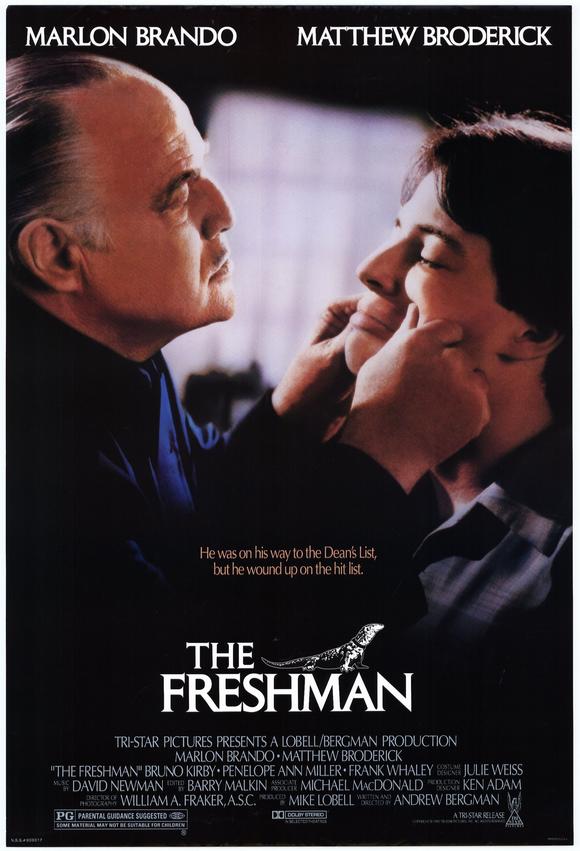
But since all this has come to mind naturally I find myself thinking of Andrew Bergman’s THE FRESHMAN, a film set partly in a film school, taking place around a world of film and a lead character who without even realizing it is forced to consider what kind of man he wants to be. I wish I could have come up with that sort of decision then. This was his first completed directorial effort after 1981’s SO FINE (the production of 1986’s BIG TROUBLE, which he began directing but didn’t finish, is another story entirely) and Bergman’s films—actually, in saying the phrase ‘Bergman’s films’ it’s hard not to think for a brief instant that you’re referring to the other one—often have a tendency to seem too slight, too simple, but then they grow on you, the jokes becoming stronger on repeat viewings, the jokes behind those jokes become more clear. And there’s an affection towards the characters that maybe you didn’t immediately latch on to, making you want to linger with them for just a few minutes longer past the end credits. Plus there’s the wordplay inherent to his screenplays which seems like such a lost art now. Few screenwriters in the modern era have achieved such a Sturges-like way of understanding language the way Bergman has but as a director he sometimes found a way to integrate that language with his own peculiar visual style. THE FRESHMAN, slight as it might seem at first and may really be, is possibly the best example of that. I wish we had more like it.
Leaving his home in Vermont to study film at NYU, freshman Clark Kellogg (Matthew Broderick) arrives at Grand Central and is immediately corralled by overly friendly Vic (Bruno Kirby) who takes off with all of Clark’s belongings as soon as they arrive at his stop. He tracks him down soon enough and in place of giving back his money Vic offers Clark a job with his uncle, Carmine Sabatini (Marlon Brando) a mysterious importer also known as Jimmy the Toucan who has a striking resemblance to the most famous movie mobster of all time. Carmine offers Clark a job running errands, the first being to pick up a Komodo dragon from the airport for mysterious reasons. Soon enough Clark has also met Carmine’s daughter Tina (Penelope Ann Miller) who takes an immediate shine to him. It doesn’t take long for Clark to realize that he’s in over his head, that there’s more going on than anyone will tell him and even his animal rights activist stepfather Dwight (Kenneth Welsh) is immediately suspicious. But it seems there’s no way out for Clark as the reason for the Komodo dragon’s presence becomes clear.
Some of Bergman’s best work has the same conceit—the (relatively) normal lead is thrust into a situation in which the entire world suddenly becomes so insane that he must either become part of that insanity or die. That’s essentially THE IN-LAWS, that’s his 1981 directorial debut SO FINE and even the aborted BIG TROUBLE which he eventually took his name off of (still, it has its fans; as I’ve said before, I’m one of them) has some of that in its mixed up DNA. THE FRESHMAN finds that insanity in the world of film and how people in the real world relate to it, especially when someone who is the spitting image of one of the most iconic film characters of all time is right in front of them. It has no relationship with the Harold Lloyd classic of the same name yet it still feels appropriate as some sort of homage and with both films being about an innocent trying to find his way in the world it wouldn’t be such a bad idea to pair the two on a double bill. Released in July 1990, THE FRESHMAN came over ten years after the Bergman-scripted THE IN-LAWS and with the star power of Brando is very much an attempt to do a similar type of story, one which may not hit the high points of having Alan Arkin stare into space as Peter Falk attempts to explain something totally insane to him but it also feels more elegant, sweeter somehow. It’s a better made film, with Bergman as director paying more attention to the look and feel than IN-LAWS director Arthur Hiller ever did. Shot by William Fraker, the way Brando is photographed at times comes off as a canny spin on the classic Gordon Willis--GODFATHER look, keeping him and his eyes in shadows as Broderick, and maybe the audience as well, is never quite sure just how far this joke is supposed to go which itself almost seems part of the joke.
The elegance makes the wordplay even more effective and that combined with things like the sight of Brando ice-skating gives the film its own sly tone just as much as the name of a character from A NIGHT AT THE OPERA pops up out of nowhere or even the music heard from the band as they play off Maximillian Schell’s Larry London when he welcomes the guests to the Gourmet Club. It’s a ridiculous movie, one where an entire setpiece involves a mall of people screaming when a lizard appears but it’s also one that has Brando involved in one of the most obvious, blithely absurd running gags imaginable. And the movie seems overjoyed that it’s letting this happen. Bergman loves getting actors to dig into his language, the nitpicking of if there is any difference between Leo and Big Leo, the precise syntax used by Penelope Ann Miller as she describes the Mona Lisa’s extended visit to the U.S. or even the very first words uttered by Brando in the film which seem designed to throw us for a loop even more than his very presence has done already.
For all the controversy at the time of Brando giving an interview saying how much he hated working on the film (which he later recanted) there’s not a shred of that in the finished product. He’s kept offscreen for much of the first half, really limited to two lengthy scenes with Broderick and while even now I still don’t know what to make of some of it and there could have been a danger of him nuking one of his most famous roles, along with what are presumably a few ON THE WATERFRONT nods in the dialogue at the very end because, well, why not? But it becomes positively graceful, with even small movements containing laughs. You can feel Sabatini’s mild annoyance at people about to tell him who he looks like and his presence is felt when he isn’t even around as if he would barely be able to disguise his contempt for the insufferable film professor Fleeber, whose teaching style seems to be to insist that his students regurgitate his own pretentious opinions as giant portraits of famous directors stare down at them in presumed agreement. As awful a person as Fleeber is (and, good as Paul Benedict’s performance is, my own personal experience says that they could very well have made him even worse—trust me, I know) he is right about this odd movie Clark finds himself in the middle of, maybe not quite KISS ME DEADLY, but it definitely blends film and real life--“one and the same,” he tells Clark--together and the screwy view of the world that Andrew Bergman takes during the film’s best moments, really the best moments of any of his films, are sublime. He looks at the world with a cockeyed glance, serving as the normal person who wonders what is so wrong with everyone else.
Even the film’s screwy take on animal rights activism which might upset some people today never goes against its essential humanist bent—personality-free stepfather Dwight is so consumed by it that he has no concept of humanity anymore, certainly no idea how to deal with his own stepson. The Sabatini clan may be morally slippery but at least they do what they do out of a passion for the world around them. Maybe one of the things THE FRESHMAN is about is discovering the people in this world who can appreciate simple poetry alongside you, without insisting on the way things should be for their own didactic, selfish purposes. You have to figure some people you meet in life out for yourself just like you have to figure out who you are. Even if you’re never entirely sure whether you’re part of the joke.
THE FRESHMAN may be slight and minor while at the same time made into more than what it would have been with any other actor. Marlon Brando’s performance seems even more special now, more surprising, as the legend of THE GODFATHER has only grown and this film has been slightly forgotten about. He’s willing to mess with his own legend but he never trashes it. It’s a sweet performance, a sly, nimble one in every little gesture he makes and in some ways gives us a happy ending to Vito Corleone that the Don never fully got (Maybe because the release of PART III was imminent at the time, a lengthy disclaimer during the end credits tries to mollify this and in doing so makes more of a direct reference to the film name and character than the actual film ever does). Matthew Broderick may be way too old for the part, although considering who he was co-starring with I doubt he cared, but he’s letter perfect and it ranks with ELECTION as one of his very best performances, just the right amount of befuddlement and intellect. It’s a terrific supporting cast too—possibly the best work Penelope Ann Miller ever did, the unbridled enthusiasm of Bruno Kirby (a GODFATHER PART II alum, don’t forget), Frank Whaley and his hairspray as Clark’s roommate, the detestable snobbery of Paul Benedict’s Fleeber, the glee in Maximilian Schell’s ‘Larry London’ as the repeats the same sentence over and over alongside B.D. Wong as his assistant as well as the sight of Bert Parks performing “Maggie’s Farm”. David Newman’s bouncy score is something that I still can’t quite get out of my head after all these years and sounds more than ever like he was told to emulate the then-hot Danny Elfman but Newman knew that Elfman was really just doing Nino Rota anyway so that’s what he secretly did.
At some point in June 1989 I was downtown one day and when heading back home through Grand Central I saw signs that this was going to be shooting the next day. I asked a friendly crew member if Brando was going to be there, but no dice. It’s a vague memory now. I also saw this film with my dad which now seems somehow fitting. No particular point to be made with that but there you go. Incidentally, Andrew Bergman’s next film was HONEYMOON IN VEGAS starring another GODFATHER alum, James Caan. I’m still waiting for his collaboration with Pacino. Anyway, on another recent morning I woke up and felt a little better. Well, maybe that’s not entirely true. But I know I’m here. I have friends. I’ve done things. “So this is college. I didn’t miss nothin’,” Brando’s Carmine Sabatini muses while looking over Broderick’s threadbare dorm room. Maybe that’s part of my problem. I always feel like I’m missing things. In some ways the message of THE FRESHMAN is that the best way to deal with it all is just to make the best decision in your heart, go with the madness and accept what comes. I’m not sure I can do that yet but I’ll try to keep it in mind as I desperately continue to try to find my own way.
Thursday, March 5, 2015
In Harmony With Our Desires
I’ve had those moments. Maybe you have too but in Los Angeles they seem all the more tactile in their unreality. Those moments, maybe late at night, maybe in the middle of the afternoon, where everything that has ever seemed absolutely correct is there right in front of you in a way that can only be described as purely, unaccountably cinematic. It doesn’t last very long—maybe nothing ever lasts very long—but it happens. For just a few moments, you were alive. But eventually all you have is the memory. Nothing more. Because no matter how much real life gets crossed with movies it’s impossible for real life not to win out. Eventually there’s another person in front of you. Until, of course, there isn’t. “The Cinema substitutes for our gaze a world more in harmony with our desires,” goes the alleged André Bazin quote that opens Jean-Luc Godard’s CONTEMPT, adding that the film is the story of that world. CONTEMPT is film crossed with life and the utter impossibility of the two co-existing.
When I think of Godard I remember a night long ago at the Nuart when I was there to see BAND OF OUTSIDERS. The place was packed for this rare chance to see it in a theater. People were literally sitting in the aisles. The film started and it was immediately apparent this was a scratchy old print, maybe even 16mm, and looked practically unwatchable. Since I’d already sat through the first film on the double bill (Melville’s LE DOULOS) and had seen a scratchy 16mm print of BAND OF OUTSIDERS before, probably at college, I bailed about twenty seconds in. No point in waiting to see if it got better. Walked to my car, then as I drove past the theater I witnessed what appeared to be a mass exodus of people also bailing on that scratchy print. I can’t help but imagine Godard himself amused at the sight of hundreds of people fleeing a screening of one of his films but at the same time viewing them as unworthy just because they didn’t like the way it looked. In other words, there’s no way to win with him. Just thinking that makes me feel like I’m back in film school again and I’d rather not have to relive that nightmare, thank you very much. I’d like to imagine someone in that crowd made it to one of the recent Aero screenings of his newest film GOODBYE TO LANGUAGE which I unfortunately missed. Sorry, it was unavoidable. But for that matter, all these years after that night I now have a pristine quality Criterion Blu of BAND OF OUTSIDERS close by and wonder why I don’t watch it more. Maybe I’m just older now.
Maybe what we really need is a film about Godard in Hollywood. Reportedly Coppola brought him over as he attempted to expand Zoetrope during the making of ONE FROM THE HEART, resulting in Godard shooting footage on the set during production. I like to imagine him stopping off at Pink’s for lunch one day while he was over here. The notion of Coppola’s utopian would be-studio achieving the sort of success that would have allowed Godard to actually make a film in Hollywood is a fascinating one but of course he had already confronted the prospect of such a thing and what that could possibly mean for him. That would of course be CONTEMPT (LE MÉPRIS), based on the novel “Il Disprezzo” by Alberto Moravia, made in 1963 but unreleased in the U.S. until the very end of 1964, the story of writer Paul Javal (Michel Piccoli) hired by American film producer Jeremy Prokosch (Jack Palance) to do a rewrite on his filming of The Odyssey, currently being directed by the legendary Fritz Lang (Fritz Lang). Paul is married to the gorgeous Camille (Brigitte Bardot) who he loves and she loves everything about him completely…until, suddenly, she doesn’t. As Paul attempts to navigate the impossible waters of Prokosch’s personality in making this film he must face up to whatever he may have done that led to Camille feeling such utter contempt for him.
The youthful exuberance of BREATHLESS and BAND OF OUTSIDERS might be the most purely enjoyable of Godard’s films from this era, they’re the ones that people seem to return to the most but CONTEMPT, whatever sort of elaborate prank on the director’s part that it is and almost known more for that famous poster featuring artwork of its iconic star, has always had more pull for me even if it isn’t my ‘favorite’ of his. But it probably is. Described by Godard himself as “an Antonioni film shot by Hawks or Hitchcock” both the story and the filmic language is relatively straightforward—as Godard films go it’s probably his slickest as well as his closest approximation to what we imagine a ‘real’ movie to be, photographed with every ounce of spectacular lusciousness by Raoul Coutard in color and Scope. The tracking shots alone in this film haunt me in how beautiful they are. And yet it’s a film that could only be made by this director, a glorification of the goddess Bardot as well as an examination of how the world, or just Godard himself, looks at her. Plus it’s an extended meta-gag of film vs. reality as well as a brutal examination of what that means. Piccoli’s screenwriter is the obvious surrogate for the director but Godard seems to be fighting against making him anything resembling a hero, not only taking who I imagine would have been the focus in the script and shifting it through the making of the film to female lead Bardot, her love for him, her hatred, her silent pleading to him not to fuck this up.
It isn’t hard for Godard’s camera to keep that harmony with his female star not only because it’s Bardot after all but because the male lead as played by Piccoli is such a schmuck, a screenwriter more interested in looking for ideas in movies he wants to see than in the ‘reality’ in front of him, more interested in discussing the bizarre Marlene Dietrich western RANCHO NOTORIOUS (which is a pretty good movie, but not that good) with the great Fritz Lang than his masterpiece M but more importantly how he fucks up his own marriage for reasons that he can’t even see. He loves everything about Camille’s body, he “loves her totally”. She’s a body to him and she’s happy to be a body for him, she’ll do anything for him, she’ll willingly get down on her knees for him, because she knows deep down that he thinks of her more than that. Until he takes it a step too far and fucks it up, all for Prokosch who doesn’t even bother to keep his interest in Camille a secret. He loses her. He can’t get her back and there’s nothing he can do about it. If he didn’t fuck it up right then he would have eventually. There are parts throughout CONTEMPT that I know deep down I can’t quite grasp due to my eternal singledom and that’s my problem. But more than anything else, the feeling it gives off that I understand down to my bones is that you expect the disaster. Deep down, you know you’re going to fuck things up. Then you do and you’re still clueless about what you may have done. As everything falls apart for Paul, we get quick flashes to moments we’ve seen that illustrate this, as well as a few we haven’t, done in a cutting style that almost makes me queasy in how unnerving it is, in a way only personal flashes in your head of your own fuck-ups do. There’s no way to win but you were going to screw it up anyway. There was no stopping it.
Along with all this are the playful touches that lay bare just the process of the film itself so the artifice is obvious, we know that it’s never anything other than a movie—the opening shot that also displays the filming of a tracking shot as the detailed credits are read aloud. A musical performance in a theater with obvious tracking of the singer, maybe the one sequence closest to early Godard in its playfulness, never even tries to be ‘real’. Cinecitta is portrayed as an empty ghost town of ruins with posters of HATARI! and PSYCHO scattered around. Jack Palance, the ugly American producer, represents the end of cinema while Fritz Lang, a God himself making this film about Gods for a man who is nothing of the sort walks among them. He even recites his famous opinion of what CinemaScope is good for is this film shot in CinemaScope almost better than any other film shot in CinemaScope ever was. Bardot is introduced in a scene supposedly there to appease the producers upset at the lack of Bardot nudity and no matter how blatant it is feels essential. Piccoli’s screenwriter is caught outside of these struggles and a part of it as well, a man who not only lives in movies but can’t see what’s in front of him. He makes the same mistake concerning Camille twice and that second strike is clearly enough.
It’s a portrait of self-loathing for Godard, loathing for making this film, for all I know even loathing for casting Bardot as his wife instead of his own then-wife Anna Karina. He lives through the movies. Even when they’re alone that’s how they live. She puts on a wig and wants to be someone else (Anna Karina, maybe). Never removing his hat even in the bathtub, he wants to be Dean Martin in SOME CAME RUNNING but he can’t and as much as he tries to rationalize it to himself he wants the money this job could give him, communist party card or not, caught between the art of the God Lang and the checkbook/ego of false God Palance, unable to decide for himself which side he should be on or for what reasons. The middle third of the film is basically Bardot and Piccoli alone in their apartment as everything breaks down and the way that half-hour goes, of every excruciating inch of this argument between the two of them scene is shot going through every emotion imaginable, observing them from a distance and when the camera finally moves in to close-ups as their discussion becomes more intimate keeps them deliberately separated. For this half-hour the apartment is the universe, a distance between them vaster than any CinemaScope vista could ever express.
Beyond each of those arguments of film vs life, why Paul & Camille’s marriage collapses vs why Odysseus’ marriage collapses in trying to sort out the story of this film and the playfulness of how CONTEMPT is about watching Bardot, as well as Bardot’s ass, and it knows this. It’s about how she feels about that as well, how she feels about being so dismissed as just a body by her so-called intellectual husband who doesn’t deserve her (it seems like a joke in itself that the film totally ignores whoever the stars of this filming of The Odyssey are—actors can be dismissed as she proves otherwise). Placed up against the jaw-dropping images of Capri filmed in Casa Malaparte to represent Prokosch’s villa, Bardot is just as beautiful and the film seems to understand that she should be worshipped just as we worship the beauty of those majestic cliffs, yet Paul doesn’t. The hauntingly unforgettable Georges Delerue score (prominently featured in Scorsese’s CASINO) deliberately overplayed to heighten the feel watching over it all adds to the majesty just as the statues, the scenery, the gods, watching over it all this madness which in this villa feels like it’s set at the edge of the world, the end of all art, life, film, reality. Paul is a deliberate cipher in the end, as much as we or Camille would wish otherwise, without the backbone to stop what happens—the climactic delirium of the climax of Vincente Minnelli’s TWO WEEKS IN ANOTHER TOWN which seems to anticipate CONTEMPT is numerous ways is here just cut off abruptly.
In the end we’re left with someone who won’t give us any clue to what his feelings really are, beyond presumably checking to see if RIO BRAVO’s still playing when he gets back to Rome. The final line of dialogue we hear in the film, “Silencio”, is of course the exact same last line heard in Lynch’s MULHOLLAND DRIVE (I’m hardly the first to notice parallels between the two) also one of the best films that ever looked at the line between the fantasy of film and the harsh reality surrounding that dream. At the end of the dream that’s all there can be. Before Paul leaves, Fritz Lang tells his that he’s filming Odysseus’ gaze upon seeing his homeland but the best we can tell when the shot plays out is that they’re filming him from behind staring out at the water, no gaze ever visible. Which makes as much sense as any relationship—what we think is safe is really just a void. Or maybe that void is the meaning Godard wants to pretend we’re supposed to get out of it. It’s the meaning we seek in every hoped-for connection that eventually crumbles to pieces.
However much this is Bardot giving a performance or simply going along with what Godard wants she feels totally in synch with her director. Whether she’s a great actress or not, the film is partly about staring at her blank face anyway and her inexpressiveness can be as telling as the monolith in 2001, just as it should be, and there’s forever the hope that she might actually smile again—a joking gesture she makes to Fritz Lang at one point feels out of character but whether it was off the cuff or not doesn’t matter. It reveals more than she’ll allow to Paul at that point. This winds up placing even more distance between us and the actor presumably playing the Godard surrogate and everything is done to make Michel Piccoli not come off as the cool Belmondo-type. He never can be, much as he might want to, but the actor brings a humanity to the character nevertheless as if the character/the actor has discovered he’s not really the ‘lead’ in his own movie and has to do something about it. The intimidation of Jack Palance expressed through his secretary, well played by Georgia Moll, is appropriately confounding so his bullying and false intellectualism towards Piccoli is always nerve-racking. Fritz Lang, who in real life had already directed his final film, seems patiently willing to do whatever Godard wants of him while carrying himself as a man who knows all but the absolute unknowable and he’s content with that. “You must finish what you start,” he declares at the very end and maybe that’s all we can ever try to do.
Now I may think that Godard’s CONTEMPT is one of the best films ever made but, to steal a line from Howard Beale, what has that got to do with the price of rice? To say that I love CONTEMPT is equal to me saying that I have near zero confidence in anything I even try to write, let alone awareness of how to do anything better next time. There are infinite ideas to express about CONTEMPT but in the end there really is just what we see so it’s a film with a fascination that persists. Even if it is a film about bafflement, confusion, obsession, there’s a love in there, a yearning for what is never going to be. But it’s also hard not to look at this film and think of Truffaut’s famous 1973 letter to Godard calling him out on acting like “a shit” in response to Godard’s letter where he writes on his low opinion of DAY FOR NIGHT. Truffaut asks why he’s wasting his time seeing films he hates that will fuel his hatred: “Why? In the hope of finding something that will fuel your contempt for the rest of us, that will reinforce your new prejudices?” I suspect the use of this film’s title in that question was unintentional but it does make a point and Truffaut certainly seems like the one in the right. There’s no use in getting into Godard’s work in recent years since it’s so obscure, there’s so much I haven’t seen yet including GOODBYE TO LANGUAGE (I’ve also never seen all of the English language version of CONTEMPT which removes the element of different languages being spoken from this story of people who aren’t speaking the same language. In clips it seems totally wrong, but perversely amusing). There’s also no point in dwelling on the personalities of either Godard or Bardot in recent years. Maybe it’s best to leave them back in the sixties, still waiting at Casa Malaparte. As for the meaning of CONTEMPT, well, we look for poetry in life, sometimes desperately. It doesn’t mean we find it, even if we’re with the one woman we want to be with, even if she’s the most beautiful woman in the world. You can find several of those in Los Angeles. Sometimes she just happens to be who you’re talking to during one of those moments where everything seems right. It may only be a fantasy and the feeling certainly never lasts but for those few seconds you no longer can tell where the film you’ve been obsessively watching ends and real life begins.
Subscribe to:
Posts (Atom)